MEASUREMENT OF VARIOUS HAND DIMENSIONS, ESTIMATION OF STATURE AMONG THE LIVING AND DEAD POPULATION OF WEST BENGAL.
- Swarup Mondal , Assistant Professor, MD Forensic Medicine, Department of Forensic Medicine & Toxicology, Prafulla Chandra Sen Govt. Medical College & Hospital, Arambagh, Hooghly, West Bengal, PIN-712601, India.
- Rajat Mondal , Demonstrator, MD Pathology, Department of Pathology, Prafulla Chandra Sen Govt. Medical College & Hospital, Arambagh, Hooghly, West Bengal, PIN-712601, India.
- Rajarshee Biswas , Assistant Professor, MD Pathology, Department of Pathology, Prafulla Chandra Sen Govt. Medical College & Hospital, Arambagh, Hooghly, West Bengal, PIN-712601, India.
Article Information:
Abstract:
Introduction: This study focuses on measurement of various hand dimensions in the living and dead population of West Bengal, aiming to establish correlations for stature estimation. Such anthropometric parameters are valuable in forensic identification and medico-legal investigations in regional population studies context. Aims: To determine correlation between stature and hand parameters including hand length, palm length, and hand breadth and develop regression equations to estimate stature from hand length, palm length, and hand breadth in the studied West Bengal population sample. Materials and methods: Anthropometry is vital in forensic anthropology for precise body measurements. The study analyzed hand anatomy and applied statistical methods including descriptive statistics, Pearson correlation for stature relationship, and simple and multiple regression to estimate stature from hand measurements. Result: Hand anthropometric parameters showed significant positive correlation with stature. Right-and left-hand length, palm length, and breadth were all strongly associated, with regression models showing good predictive accuracy. Conclusion: Hand dimensions showed significant correlation with stature in both living and deceased West Bengal populations. Regression models using hand length, palm length, and hand breadth proved useful for reliable stature estimation, supporting their applicability in forensic identification and medico-legal investigations.
Keywords:
Article :
INTRODUCTION:
The accurate measurement of hand dimensions has become increasingly important in forensic anthropology for the identification of individuals, both living and deceased. Hand anthropometry provides valuable information for estimating stature and determining sex, [1] which are essential in forensic investigations involving incomplete, decomposed, or dismembered human remains. Estimating stature from hand measurements is particularly useful in mass disasters, terrorist incidents, and severe accidents where bodies may be fragmented, making traditional identification methods difficult. Numerous studies have demonstrated strong statistical correlations between hand parameters and body height, confirming the reliability of hand-based measurements in forensic reconstruction. [2, 3]
Stature estimation models based on hand and foot measurements have improved significantly through regression analysis and the use of multiple variables. Parameters such as hand length, hand breadth, foot length, and ankle breadth are commonly used, with length-based measurements generally showing stronger correlations with stature than breadth measurements. [4] The combined use of multiple anthropometric variables enhances predictive accuracy and reliability. Population-specific regression equations are particularly important, as biological variation across ethnic groups influences measurement relationships and improves estimation precision when appropriately applied. [5]
MATERIALS AND METHODS:
Study design: Cross-sectional study of hand dimensions.
Place of study: Kolkata Medical College and Hospital and Kolkata Police Morgue.
Period of study: June 2017 to October 2018
Study Population: 196 secondary MBBS student Patients morgue to the Forensic Medicine department for medico-legal examination, or sports death body brought to the Kolkata Police Morgue for post-mortem examination.
Inclusion Criteria:
• Individuals within the age group 18 to 30 years of both sexes.
Exclusion criteria:
• Those having any injury, disease or anomaly that affects hand dimensions.
• Pathology or injury of spine and long bones affecting stature.
• Decomposed charred dead bodies.
• Mutilated dead body.
• Unknown dead bodies.
• Persons residing outside West Bengal.
Study Variable: right- and left-hand length, palm length, and hand breadth (independent variables) .
Statistical Analysis: For statistical analysis, data were initially entered into a Microsoft Excel spreadsheet and then analysed using SPSS (version 27.0; SPSS Inc., Chicago, IL, USA) and GraphPad Prism (version 5). Numerical variables were summarized using means and standard deviations, while Data were entered into Excel and analyzed using SPSS and Graph Pad Prism. Numerical variables were summarized using means and standard deviations, while categorical variables were described with counts and percentages. Two-sample t-tests were used to compare independent groups, while paired t-tests accounted for correlations in paired data. Chi-square tests (including Fisher’s exact test for small sample sizes) were used for categorical data comparisons. P-values ≤ 0.05 were considered statistically significant.
RESULTS:
Table 1: Correlation Between Stature and Right-Hand Measurements
|
Variable |
r value |
R² |
p-value |
|
RHL |
0.475 |
0.225 |
0.000 |
|
RPL |
0.488 |
0.238 |
0.000 |
|
RHB |
0.542 |
0.293 |
0.000 |
Table 2: Correlation between Stature And Left-Hand Measurements
|
Variable |
r value |
R² |
p-value |
|
LHL |
0.504 |
0.254 |
0.000 |
|
LPL |
0.509 |
0.259 |
0.000 |
|
LHB |
0.494 |
0.244 |
0.000 |
Table 3: Pool Population Regression (Stature Estimation)
|
Variable |
r value |
R² |
Regression Equation |
SEE |
|
RHL |
0.773 |
0.597 |
Y = 71.245 + 5.476(RHL) |
6.24 |
|
LHL |
0.772 |
0.596 |
Y = 54.613 + 6.304(LHL) |
6.25 |
|
RPL |
0.765 |
0.585 |
Y = 70.843 + 9.547(RPL) |
6.34 |
|
LPL |
0.730 |
0.533 |
Y = 70.351 + 9.599(LPL) |
6.72 |
|
RHB |
0.710 |
0.504 |
Y = 75.698 + 11.925(RHB) |
6.93 |
|
LHB |
0.753 |
0.567 |
Y = 70.214 + 12.755(LHB) |
6.47 |
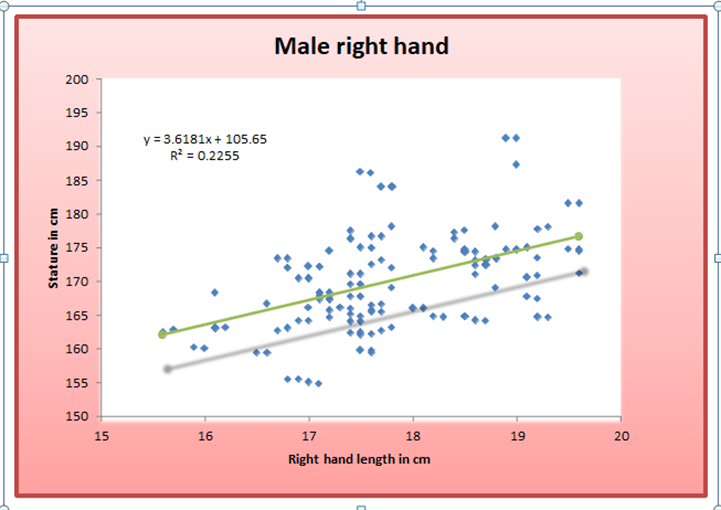
Figure 1: Correlation between Stature and Right-Hand Measurements
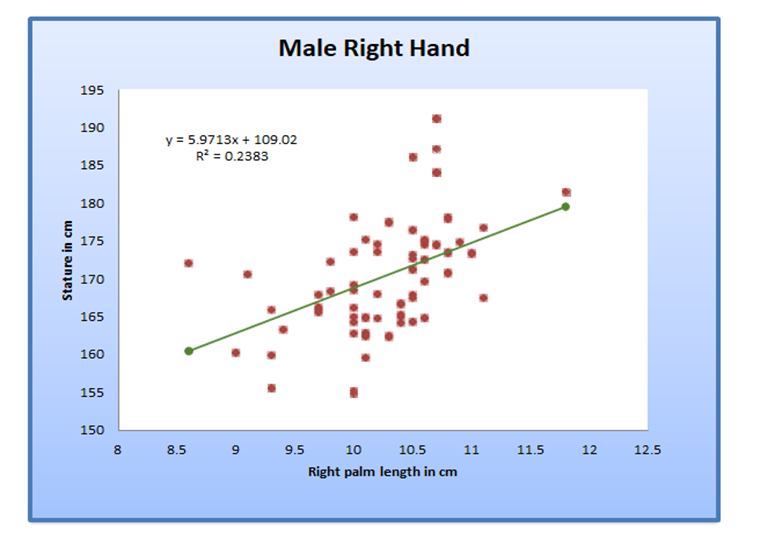
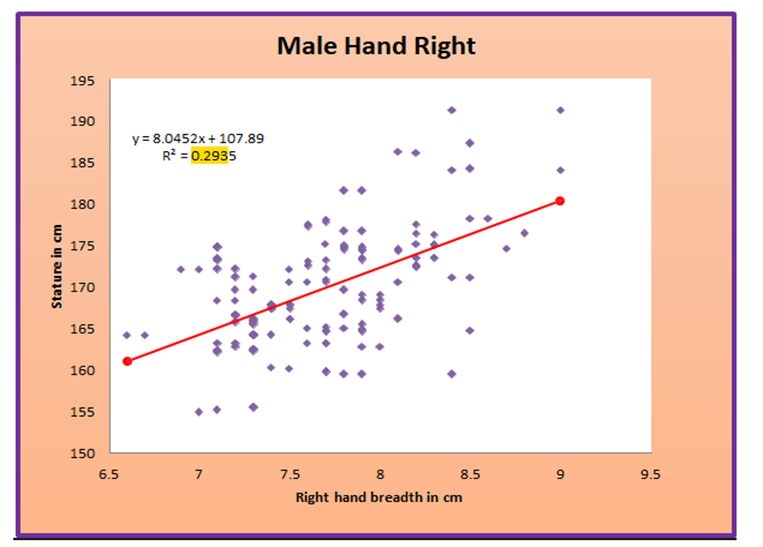
In the present study, right hand measurements showed a statistically significant positive correlation with stature. Right hand length (RHL) demonstrated a correlation coefficient (r) of 0.475 with stature, with a coefficient of determination (R²) of 0.225, and the association was highly significant (p = 0.000). Right palm length (RPL) showed a slightly stronger correlation with stature (r = 0.488), with an R² value of 0.238, which was also statistically significant (p = 0.000). Among the right-hand parameters, right hand breadth (RHB) exhibited the strongest correlation with stature (r = 0.542), with an R² value of 0.293, and this relationship was likewise found to be highly significant (p = 0.000).
In the present study, left hand anthropometric parameters also demonstrated a statistically significant positive correlation with stature. Left hand length (LHL) showed a moderate correlation with stature (r = 0.504), with a coefficient of determination (R²) of 0.254, and the association was highly significant (p = 0.000). Left palm length (LPL) exhibited a slightly stronger correlation (r = 0.509), with an R² value of 0.259, which was also statistically significant (p = 0.000). Left hand breadth (LHB) showed a comparable positive correlation with stature (r = 0.494), with an R² value of 0.244, and this relationship was likewise highly significant (p = 0.000).
In the present study, simple linear regression analysis demonstrated a statistically significant relationship between stature and all hand anthropometric parameters. Among right hand variables, right hand length (RHL) showed a strong correlation with stature (r = 0.773) with an R² value of 0.597 and a standard error of estimate (SEE) of 6.24 cm, producing the regression equation: Y = 71.245 + 5.476(RHL). Right palm length (RPL) also showed a strong association (r = 0.765, R² = 0.585, SEE = 6.34 cm) with the equation Y = 70.843 + 9.547(RPL), while right hand breadth (RHB) demonstrated a slightly lower but still strong correlation (r = 0.710, R² = 0.504, SEE = 6.93 cm) with the equation Y = 75.698 + 11.925(RHB). Similarly, left hand variables also showed strong positive correlations with stature. Left hand length (LHL) demonstrated a strong association (r = 0.772, R² = 0.596, SEE = 6.25 cm) with the regression equation Y = 54.613 + 6.304(LHL). Left palm length (LPL) showed a slightly lower correlation (r = 0.730, R² = 0.533, SEE = 6.72 cm) with the equation Y = 70.351 + 9.599(LPL), while left hand breadth (LHB) exhibited a relatively strong relationship (r = 0.753, R² = 0.567, SEE = 6.47 cm) with the equation Y = 70.214 + 12.755(LHB).
DISCUSSION:
In the present study, all hand anthropometric parameters of both right and left sides showed a statistically significant positive correlation with stature. Right hand parameters demonstrated moderate to strong correlations, with right hand breadth (RHB) showing the highest correlation (r = 0.542), followed by right palm length (RPL) and right-hand length (RHL). Similarly, left hand measurements also showed comparable positive correlations with stature, with left palm length (LPL) and left-hand length (LHL) demonstrating slightly higher associations compared to left hand breadth (LHB). These findings support the overall concept that hand dimensions are reliable predictors of stature in forensic and anthropometric investigations. The present results are consistent with the findings of Sen et al. [6],
who reported significant associations between extremity dimensions in an indigenous Indian population, reinforcing the utility of hand-related anthropometry in forensic identification. Their study highlighted that peripheral skeletal measurements show consistent proportionality with stature, which aligns with the moderate correlations observed in the current study. Similarly, Das et al. [7] in their study hand dimensions in the Bengali population observed strong predictive value for stature estimation. The present study also demonstrated all hand parameters including RHL, LHL, RPL, LPL, RHB, and LHB, supporting their findings.
Ghosh and Maitra [8] further emphasized the role of hand dimensions in stature estimation among the Bengali population, reporting that hand length and palm length were strong predictors of height, particularly in female sub-adult populations. The present study similarly found that both hand length and palm length showed stronger correlations with stature compared to breadth measurements, especially on the left side, which is in agreement with their observations. Pal et al. [9] reported in their study on the Bengali population of West Bengal that hand dimensions, particularly hand length, demonstrated high reliability in stature estimation using regression models. The present study also supports this finding, as regression analysis showed that RHL and LHL produced strong predictive equations with relatively low standard error of estimate (SEE), indicating good predictive accuracy.
Rang et al. [10] in a study conducted among the North Bengal population observed that both hand and foot measurements could reliably estimate stature, with hand dimensions showing slightly higher predictive accuracy. The present study similarly demonstrates that all hand variables have statistically significant regression relationships with stature, with R² values ranging from moderate to high, further reinforcing their utility in population-specific forensic models. Roy et al. [11] studied adult Rajbanshi individuals and found that hand dimensions significant correlations with stature, though the strength of association varied across parameters.
The present study also shows comparable patterns, with breadth measurements such as RHB and LHB exhibiting slightly lower but still significant correlations compared to length-based variables, which aligns with their observations. Finally, Dey et al. [12] highlighted the importance of craniofacial and anthropometric parameters for stature estimation in Bengali-speaking populations, emphasizing population specificity in regression models. The present study similarly reinforces the need for population-specific regression equations, as the derived models for both hand length and breadth variables show strong predictive validity within the studied cohort.
CONCLUSION:
The present study on hand anthropometric measurements in the West Bengal population demonstrates that all hand parameters—right-and left-hand length, palm length, and hand breadth—show a statistically significant positive correlation with stature. Among these variables, hand length and palm length exhibited relatively stronger associations compared to hand breadth, while regression analysis confirmed their strong predictive value for stature estimation.
The derived regression equations showed acceptable accuracy with low standard error of estimate, indicating their usefulness in forensic and anthropometric applications. These findings confirm that hand measurements are reliable indicators for stature prediction and can be effectively utilized in both living and deceased individuals for forensic identification. However, the predictive accuracy is population-specific, highlighting the importance of developing region-specific regression models for improved forensic applicability in the West Bengal population.
REFERENCES:
1. Danborno, B., & Elukpo, A. (2008). Sexual Dimorphism in Hand and Foot Length, Indices, Stature-ratio and Relationship to Height in Nigerians. The Internet Journal of Forensic Science, 3(1).
2. Ghosh, S., & Malik, S. L. (2007). Sex Differences in Body Size and Shape among Santhals of West Bengal. The Anthropologist, 9(2), 143–149.
3. Ibrahim, M., Khalifa, A., Hassan, H., Tamam, H., & Hagras, A. (2018). Estimation of stature from hand dimensions in North Saudi population, medicolegal view. The Saudi Journal of Forensic Medicine and Sciences, 1(1), 19.
4. Mundorff, A. Z., Bartelink, E. J., & Murad, T. A. (2014). Sexual Dimorphism in Finger Ridge Breadth Measurements: A Tool for Sex Estimation from Fingerprints. Journal of Forensic Sciences, 59(4), 891–897.
5. Ozaslan, A., Karadayi, B., Kolusayin, M., Kaya, A., & Afsin, H. (2012). Predictive role of hand and foot dimensions in stature estimation. Romanian Journal of Legal Medicine, 20(1), 41–46.
6. Sen, J., Kanchan, T., & Ghosh, S. (2010). Sex Estimation from Foot Dimensions in an Indigenous Indian Population. Journal of Forensic Sciences, 56(s1), S148–S153.
7. Das N, Chowdhury B, Biswas S, Das A. SEXUAL DIMORPHISM OF VARIOUS HAND DIMENSIONS AND ITS ROLE IN ESTIMATION OF STATURE AMONG BENGALI
8. POPULATION–A PROSPECTIVE STUDY. Journal of Forensic Medicine and Toxicology. 2024;41(2):146-50.
9. Ghosh K, Maitra S. Estimation of Stature from Hand Dimensions: A Study on Sub-Adult Female Bengalee Hindu Caste Population, West Bengal, India. Indian Journal of Physical Anthropology and Human Genetics. 2023 Jan 1.
10. Pal A, De S, Sengupta P, Maity P, Dhara PC. Estimation of stature from hand dimensions in Bengalee population, West Bengal, India. Egyptian Journal of Forensic Sciences. 2016 Jun 1;6(2):90-8.
11. Rang P, Goswami AK, Dey SK, Baske A. Estimation of stature with hand and foot dimensions–A study amongst adult population of North Bengal. Int. J. Acad. Med. Pharm. 2023;5(5).
12. Roy S, Ganguly P, Mondal N, Krishan K, Sen J. Estimation of stature from hand dimensions among adult Rajbanshi individuals of Eastern India. Journal of Indian Academy of Forensic Medicine. 2020 Sep;42(3):181-8.
13. Dey B, Dey P, Choudhury A, Dey A, Chatterjee D, Das P. Stature Estimation From Craniofacial Anthropometry: A Study Among The Bengali Speaking Population Of West Bengal. Journal of Forensic Medicine and Toxicology. 2025 Oct;42(4):45-54.