Prevalence of Insomnia and Its Association With Work-Related Screen Exposure Among Software Employees: A Cross-Sectional Study
- Dileep Kumar Busapogula , Associate Professor, Department of Respiratory Medicine, ESIC Medical College, Sanathnagar, Hyderabad.
- Priscilla Thotla , Fellow in AFIH(Associate Fellow of Industrial Health), ESIC Medical College, Sanathnagar, Hyderabad.
Article Information:
Abstract:
: Insomnia is a common sleep disorder among software professionals and has increasingly been associated with prolonged occupational screen exposure. Extended screen time, particularly during working hours, may adversely affect circadian rhythm, melatonin secretion, and overall sleep quality. With the rapid expansion of the information technology sector, screen-related sleep disturbances have emerged as an important occupational health concern. Objective: To determine the prevalence of insomnia among software employees and to evaluate the association between work-related screen time exposure and insomnia. Methods: A cross-sectional, web-based questionnaire study was conducted among software employees working in Hyderabad. Demographic details and screen exposure characteristics were collected using a structured questionnaire. Insomnia was assessed using the Athens Insomnia Scale (AIS). Statistical analysis was performed to evaluate the association between screen time and insomnia. Results:A total of 62 participants were included in the study, of whom 66.1% were male and 33.9% were female. The prevalence of insomnia among the study participants was 79%. A significant positive association was observed between screen time exposure and insomnia severity, with a beta coefficient of 0.84 (95% Confidence Interval: 0.53–1.16; p < 0.0001). These findings suggest that prolonged occupational screen exposure is strongly associated with increased insomnia symptoms among software employees. Conclusion: The present study demonstrates a high prevalence of insomnia among software professionals and identifies a significant association between work-related screen exposure and insomnia. Early workplace interventions, screen-time regulation, and sleep health awareness programs may help reduce screen-related sleep disturbances and improve employee well-being and productivity.
Keywords:
Article :
INTRODUCTION:
Sleep-related disorders are increasingly recognized as an important occupational health concern among software professionals and information technology (IT) employees. The demanding nature of software-related work, prolonged working hours, irregular schedules, and continuous exposure to electronic screens contribute significantly to disturbances in sleep patterns. Among these sleep-related disorders, insomnia is one of the most common and clinically significant conditions affecting this population. Software employees are particularly vulnerable because of their dependence on computers and digital devices for extended durations during both professional and personal activities. Consequently, sleep disturbances among these individuals warrant greater clinical and public health attention.
Insomnia is a serious sleep disorder characterized by inadequate or poor-quality sleep resulting from difficulty in initiating sleep, maintaining sleep, or early morning awakening. These disturbances often impair daytime functioning and negatively influence physical, psychological, and occupational well-being[1]. According to the second edition of the International Classification of Sleep Disorders (ICSD-2), insomnia is diagnosed when an individual experiences persistent difficulty with sleep initiation, sleep maintenance, early awakening, or chronically non-restorative sleep despite adequate opportunity and appropriate circumstances for sleep. In addition to nocturnal symptoms, the diagnosis also requires associated daytime impairment. Patients may experience one or more consequences such as fatigue or malaise, impaired attention and concentration, memory disturbances, daytime sleepiness, reduced motivation or energy, and excessive concern regarding sleep quality[2].These symptoms substantially impair quality of life and may adversely affect work efficiency, cognitive performance, emotional stability, and social functioning.
Several studies have demonstrated an association between prolonged exposure to visual display terminals (VDTs) and insomnia among employees engaged in computer-based occupations. Research conducted among Japanese government employees reported that extended VDT work was significantly associated with insomnia symptoms. Furthermore, a bidirectional relationship has been observed between psychosomatic conditions and insomnia, with excessive computer use potentially worsening both conditions simultaneously [3,4].The increasing dependence on digital technology in modern workplaces has therefore raised concerns regarding the long-term impact of occupational screen exposure on sleep health.
Computers and screen-based devices are indispensable tools in the daily routine of software professionals. However, prolonged screen exposure has been linked to significant sleep disturbances and poor sleep quality. Studies have shown that individuals exposed to excessive screen time often report reduced sleep duration, delayed sleep onset, and non-restorative sleep characterized by a persistent feeling of unrefreshing sleep upon waking. Poor sleep quality is considered one of the defining clinical features of insomnia and is closely associated with impaired daytime functioning and reduced occupational productivity[5]. Sleep deprivation among IT employees may also contribute to increased stress levels, mood disturbances, impaired decision-making, and reduced cognitive performance, thereby affecting overall professional efficiency.
Occupational workload and prolonged working hours further contribute to sleep disturbances among IT professionals. A study conducted in Finland by Kivistoet al [6] demonstrated that long working hours among IT employees were significantly associated with sleep debt and inadequate recovery.Continuous mental engagement, tight project deadlines, and irregular work schedules often reduce the opportunity for adequate sleep, thereby increasing susceptibility to insomnia and other sleep-related disorders. In recent years, the rapid expansion of the digital economy and remote working culture has further intensified dependence on electronic devices, increasing cumulative daily screen exposure.
The widespread use of digital technology has transformed communication and occupational practices worldwide. Electronic devices such as computers, laptops, smartphones, tablets, and other screen-based gadgets have become essential components of modern life. Their increasing utility in education, professional work, communication, and entertainment has resulted in growing human dependence on digital screens [7]. Although these technologies offer substantial benefits, excessive and prolonged use has raised concerns regarding their adverse effects on physical and mental health, particularly sleep quality.
Evidence suggests that prolonged screen exposure may interfere with normal circadian rhythm through the emission of blue light. Blue light emitted from electronic screens has a shorter wavelength and suppresses melatonin secretion, thereby delaying sleep initiation and altering circadian rhythm. While such light exposure may be beneficial during daytime hours by promoting alertness, nighttime exposure may adversely affect sleep initiation and maintenance. Cho et al. reviewed observational and experimental studies demonstrating the adverse effects of artificial light at night on human sleep and circadian regulation[8]. Consequently, prolonged screen use during evening and nighttime hours has emerged as a major contributor to insomnia among working professionals.
Accurate identification and assessment of insomnia are essential for both clinical management and occupational health research. An ideal screening instrument should be simple, reliable, and easy to administer in large populations. In the present study, the Athens Insomnia Scale (AIS) was used to assess insomnia among software employees. The AIS is an eight-item psychometric instrument designed to quantify insomnia symptoms based on the ICD-10 diagnostic criteria. It is widely used in clinical practice, epidemiological research, and occupational medicine because of its validity and ease of application[9].Beyond its clinical consequences, insomnia also imposes substantial economic and occupational burdens. Indirect costs associated with insomnia, including absenteeism, reduced workplace productivity, impaired concentration, and decreased work performance, are reported to be considerably higher than the direct costs of treatment. Therefore, identifying modifiable occupational risk factors such as excessive screen exposure is essential for developing preventive strategies and promoting sleep health among software professionals.
MATERIALS AND METHODS:
technique. Data were collected through a structured web-based quantitative questionnaire, including demographic details and the Athens Insomnia Scale for the assessment of insomnia.
Study Setting and Population: This study was conducted among software professionals employed in selected information technology companies in Hyderabad, Telangana.
Sample Size:
The sample size was calculated based on the following assumptions:
· Estimated prevalence[10] of insomnia : 14%
· Confidence level: 95%
· Alpha error: 0.05
· Absolute precision (allowable error): 10%
Using the standard formula for sample size calculation for prevalence studies:
n = Z²pq / d²
Where:
· Z = 1.96 at 95% confidence interval
· p = 0.14
· q = 1 − p = 0.86
· d = 0.10
Sample size n = 46.2
The minimum sample size calculated for the study was 46 participants. However, to improve the reliability of the findings and account for possible incomplete responses, a total of 62 participants were included in the study.
Sampling Technique :
A simple random sampling technique was employed for participant selection. A list of software employees was obtained from the employer, and 62 participants were selected randomly from the sampling frame.
Eligibility Criteria:
Inclusion Criteria
· Software professionals employed in selected information technology companies in Hyderabad, Telangana
· Individuals aged between 21 and 45 years
· Participants willing to provide informed consent
Exclusion Criteria
· Individuals with self-reported depression who were previously diagnosed with depression and currently receiving antidepressant therapy
· Employees aged more than 45 years
· Participants who did not provide complete responses to the questionnaire
Study Variables:
The primary study variables included:
· Insomnia
· Work-related screen time exposure
· Additional demographic and occupational variables such as age, sex, and working hours were also collected.
Study Instruments:
A) Structured Questionnaire
Data were collected using a self-developed structured questionnaire designed to obtain information regarding demographic characteristics, occupational profile, working hours, and duration of daily screen exposure.
B) Athens Insomnia Scale (AIS)
Insomnia symptoms were assessed using the Athens Insomnia Scale (AIS), a validated psychometric instrument developed by the Athens research group in 2000. The AIS is an eight-item questionnaire based on the ICD-10 diagnostic criteria for insomnia. It evaluates various domains including sleep induction, awakenings during the night, final awakening, total sleep duration, sleep quality, daytime well-being, functional capacity, and daytime sleepiness. The scale has demonstrated good reliability and validity in both clinical and occupational health settings and is widely used for screening insomnia symptoms.
Study Procedure:
The present cross-sectional study was conducted among software professionals employed in selected corporate offices in Hyderabad, Telangana. A total of 62 participants were included in the study using a simple random sampling technique.
Prior permission to conduct the study was obtained from the respective management authorities. Eligible participants were informed about the objectives and purpose of the study. Informed consent was obtained electronically through Google Forms before participation. Participants were assured that all information collected would remain confidential and anonymous and would be used solely for research purposes.
Data collection was carried out using a web-based questionnaire developed through Google Forms. The questionnaire included details regarding demographic characteristics, occupational profile, duration of working hours, daily screen exposure, and insomnia-related symptoms assessed using the Athens Insomnia Scale.
Statistical Analysis:
Data were entered into Microsoft Excel and analyzed using appropriate statistical software. Nominal variables were expressed as frequencies and percentages. Continuous variables were summarized using mean and standard deviation (SD) or median and interquartile range (IQR), depending on the distribution of data after assessment of normality.
Comparisons between variables were performed using Student’s t-test and Chi-square test wherever appropriate. Logistic regression analysis was conducted to determine the association between screen time exposure and insomnia, with insomnia considered as the dependent variable and screen time exposure as the independent variable. A p-value of less than 0.05 was considered statistically significant.
RESULTS:
A total of 62 software professionals participated in the present study. The socio-demographic characteristics of the study participants included variables such as age, gender, educational status, work experience, and duration of work-related screen exposure.
Table-1: Socio-demographic profile of study participants (N=62)
|
Parameters |
Number of Participants |
Percentage (%) |
|
Gender |
||
|
Male |
41 |
66.1 |
|
Female |
21 |
33.9 |
|
Age Groups |
||
|
20-25 years |
6 |
9.6 |
|
26-30 years |
32 |
51.7 |
|
31-35 years |
15 |
24.2 |
|
36-45 years |
9 |
14.5 |
|
Education status |
||
|
Graduate |
43 |
69.3 |
|
Postgraduate |
19 |
30.7 |
The majority of the participants belonged to the 26–30 years age group (32, 51.7%), followed by 31–35 years (15, 24.2%), 36–45 years (9, 14.5%), and 20–25 years (6, 9.6%). Among the study participants, 41 (66.1%) were males, while 21 (33.9%) were females.
With regard to educational qualification, 43 participants (69.3%) were graduates, while 19 participants (30.7%) were postgraduates.
Distribution of participants based on total years of work experience revealed that the majority, 39 participants (62.9%), had 5–10 years of professional experience. This was followed by 14 participants (22.5%) with less than 5 years of work experience and 9 participants (14.6%) with more than 10 years of experience.
Assessment of work-related screen exposure demonstrated that 32 participants (51.6%) reported spending 8–12 hours per day on screen-based activities, while 16 participants (25.8%) reported screen exposure exceeding 12 hours daily. In addition, 12 participants (19.4%) reported screen exposure of 4–8 hours per day, whereas only 2 participants (3.2%) reported screen exposure of less than 4 hours daily.
The prevalence of insomnia among the study participants was found to be 79%. Based on the Athens Insomnia Scale scores, the severity of insomnia was categorized into no insomnia, mild insomnia, moderate insomnia, and severe insomnia. Moderate insomnia constituted the largest category, observed in 27 participants (43.5%). Mild insomnia was observed in 12 participants (19.4%), while severe insomnia was identified in 10 participants (16.1%). Only 13 participants (21.0%) had no evidence of insomnia.
Table-2 : Grading of Insomnia
|
Grading of insomnia |
Number of subjects |
Percentage |
|
No insomnia (0-5) |
13 |
21.0 |
|
Mild insomnia (6-9) |
12 |
19.4 |
|
Moderate insomnia (10-15) |
27 |
43.5 |
|
Severe insomnia (16-24) |
10 |
16.1 |
|
Total |
62 |
100.0 |
The findings of the present study indicate a high prevalence of insomnia among software professionals, with a substantial proportion of participants reporting prolonged daily screen exposure. Increased duration of occupational screen exposure appeared to be associated with higher insomnia burden among the study population.
Association Between Insomnia and Socio-Demographic Profile of Study Participants
The association between insomnia and socio-demographic characteristics, including age, gender, and educational status, was analyzed among the study participants. Statistical analysis revealed no significant association between age and the presence of insomnia (p = 0.62), indicating that insomnia was distributed similarly across different age groups. A trend toward an association between gender and insomnia was observed (p = 0.086), with insomnia being more prevalent among males (35 participants) compared to females (14 participants), although the association did not reach statistical significance.
Table-3:Association Between Insomnia and Socio-Demographic Profile of Study Participants
|
S.No |
Variable |
Category |
Insomnia |
p value |
|
|
Yes (n=49) |
No (n=13) |
||||
|
1. |
Age (years) |
20-25 years |
5 |
1 |
0.62 |
|
26-30 years |
27 |
5 |
|||
|
31-35 years |
11 |
4 |
|||
|
36-40 years |
6 |
3 |
|||
|
2. |
Gender |
Male |
35 |
6 |
0.086 |
|
Female |
14 |
7 |
|||
Association Between Screen time exposure and Insomnia of Study Participants
The association between screen time exposure and the presence of insomnia among the study participants.
Among the 62 software employees included in the study, 49 participants had insomnia while 13 participants did not have insomnia.
A higher proportion of insomnia was observed among subjects with prolonged screen exposure. The majority of participants with insomnia belonged to the 8–12 hours screen time category (28 participants), followed by the >12 hours category (15 participants). In contrast, very few participants without insomnia were observed in the higher screen time categories.
Among participants with screen exposure of more than 12 hours, almost all subjects reported insomnia (15 out of 16 participants). Conversely, participants with lower screen exposure (<4 hours and 4–8 hours) had comparatively fewer insomnia cases.
The association between screen timing and the presence of insomnia was found to be statistically significant (p = 0.0044), indicating that increased screen time exposure was significantly associated with a higher prevalence of insomnia among software employees.
Table-4: Association Between Screen time exposure and Insomnia of Participants
|
Screen Time Exposure |
Insomnia |
p value |
|
|
Yes (n=49) |
No (n=13) |
||
|
< 4 hours |
1 |
1 |
0.0044 |
|
4- 8 hours |
5 |
7 |
|
|
8- 12 hours |
28 |
4 |
|
|
>12 hours |
15 |
1 |
|
Spearman Correlation Analysis
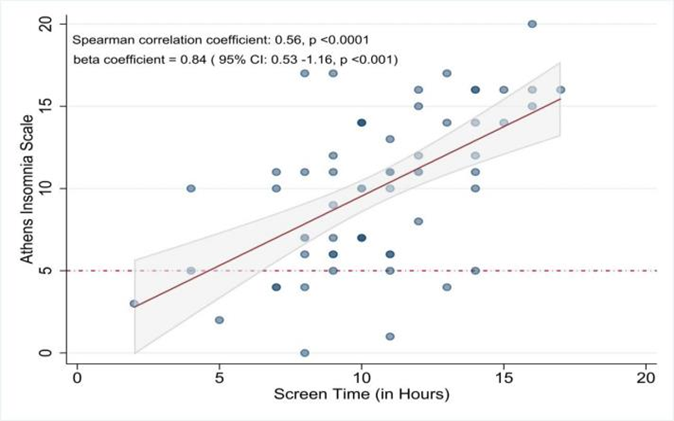
Spearman correlation analysis revealed a moderate positive correlation (r = 0.56, p <0.0001) between screen time duration and Athens Insomnia Scale scores. Regression analysis further showed that increased screen exposure was significantly associated with higher insomnia scores (β = 0.84, 95% CI: 0.53–1.16, p <0.001). These findings suggest that prolonged screen time may contribute to worsening sleep quality and increased insomnia symptoms among software professionals.
DISCUSSION:
The present study was conducted to assess the association between work-related screen exposure and insomnia among software employees in Hyderabad. The findings demonstrated a high prevalence of insomnia among the study participants, with 79% of subjects experiencing varying degrees of insomnia. This highlights insomnia as an important occupational health concern among software professionals who are routinely exposed to prolonged digital screen usage as part of their work environment.
The prevalence observed in the present study was substantially higher compared to findings reported in previous studies conducted among other populations. Yardi et al. [10] reported a prevalence of 13.8% among corporate employees in India, while Panda et al. [11]observed a prevalence of 18% among healthy adults in South India. Jaisoorya et al.[12] reported insomnia among 17.7% of primary healthcare attendees in Kerala, and Xiao-Lan Cao et al. [13] documented a prevalence of 15% in the general population in China. Similarly, Baskar et al.[14] reported a prevalence of 33% among adult patients attending a family medicine outpatient department. The considerably higher prevalence identified in the present study could be attributed to the occupational characteristics of software employees, who are frequently exposed to prolonged screen time, mental workload, irregular work schedules, occupational stress, and sedentary lifestyle patterns, all of which may adversely affect sleep quality.
Differences in prevalence rates between the present study and earlier studies may also be explained by variations in study settings, demographic characteristics, sample size, assessment tools, and diagnostic criteria used for insomnia evaluation. While several previous studies used instruments such as the Pittsburgh Sleep Quality Index (PSQI) and Insomnia Severity Index (ISI), the present study utilized the Athens Insomnia Scale (AIS), which is based on ICD-10 diagnostic criteria and specifically evaluates insomnia-related symptoms. In addition, unlike community-based studies, the present study exclusively focused on software professionals, a group that may be more vulnerable to screen-related sleep disturbances.
In the current study, the majority of participants belonged to the 26–30 years age group, followed by the 31–35 years category. Although no statistically significant association was found between age and insomnia, insomnia was more commonly observed among younger employees. This may reflect the increasing occupational demands, work-related stress, project deadlines, and irregular sleeping habits commonly experienced during the early and middle stages of professional life. Younger employees may also have greater exposure to digital devices outside working hours, which could further contribute to disturbed sleep patterns.
Table-5:Studies on Prevalence of insomnia among different population
|
Author,Year |
Study Area |
Study Population |
Sample size and study design |
Tools used to diagnose insomnia |
Prevalence e of Insomnia |
|
Yardi et al [10] 2016 |
Six Indian corporate offices |
Indian corporate employees (The Spice study) |
cross sectional, observational study to determine the prevalence of insomnia 602 participants |
ISQ - INSOMNIA SYMPTOM QUESTIONNA IRE |
13.8% [33] |
|
Yilmaz et al 2017[15] |
Bursa, Turkeyat Uludag Universit y Faculty of Health Sciences |
population of students studying Department of Nursing |
223 volunteer students.descriptiv e and cross- sectional research |
Pittsburg Sleep Quality Index(PSQI) |
6.52±3.17 . |
|
Panda S et al 2012[11] |
South india |
healthy attendants/relat ives of patients attending a tertiary healthcare institution |
1050 healthy subjects |
Pittsburgh Sleep Quality Index (PSQI) |
18% |
|
Baskar et al. 2016[14] |
family medicine OPD at St. Philomen a's Hospital, Bengaluru |
adult patients attending the OPD |
278 patients cross- sectional study |
Athens Insomnia Scale |
33% |
|
Basu N et al.2027[16] |
tertiary care teaching hospital of Kolkata |
General OPD patients |
390 patients attended general OPD case-control study |
Athens Insomnia Scale |
45% |
|
Xiao- Lan Cao ,et al 2017 [13] |
china |
General population |
115,988 participants,cross- sectional study,Comprehens ive Meta-Analysis program |
Pittsburgh sleep quality index (PSQI) Athens Insomnia Scale |
15% |
|
Jaisoor ya et al., 2018 [12] |
Kerala, India. 71 primary health centers |
General patients at OPD(PHCs) primary care attendees, in the state of Kerala, India. |
Cross sectional study 7017 adult patients |
ISI Insomnia Severity Index |
17.7% |
Male participants constituted a larger proportion of the study population, and insomnia was more frequently observed among males compared to females. Although the association did not reach statistical significance, a trend toward higher insomnia prevalence among males was observed. This finding may be related to the predominance of males in the software workforce and possible differences in workload, stress management, screen exposure duration, and lifestyle factors.
A major finding of the present study was the statistically significant association between prolonged screen exposure and insomnia. Participants who reported more than 8 hours of daily screen exposure had a higher prevalence of insomnia compared to those with lower durations of exposure. This finding is consistent with earlier studies by Vallance et al.,[17] Cellini et al.,[18] and Salfi et al., [19]which demonstrated that excessive screen time is associated with delayed sleep onset, poor sleep quality, shorter sleep duration, and increased sleep disturbances.Similarly, Christensen et al.[20] reported that increased screen time was associated with poorer sleep efficiency and shorter sleep duration.
The biological mechanisms underlying this association may involve suppression of melatonin secretion due to prolonged exposure to blue light emitted from digital devices. Blue light affects circadian rhythm regulation and interferes with normal sleep initiation. In addition, prolonged engagement with computers and mobile devices may lead to increased psychological arousal, mental fatigue, occupational stress, and delayed bedtime habits, all of which may contribute to insomnia symptoms. The moderate positive Spearman correlation coefficient observed in the present study further supports the positive relationship between increasing screen exposure duration and insomnia severity.
The grading of insomnia among study participants revealed that moderate insomnia was the most common category, followed by severe insomnia. This observation indicates that sleep disturbances among software employees are not merely transient or mild complaints but may significantly affect daily functioning, concentration, productivity, emotional well-being, and quality of life. Persistent insomnia may also predispose individuals to long-term health consequences including anxiety, depression, cardiovascular disorders, reduced cognitive performance, and occupational burnout.
The findings of the present study emphasize the need for workplace interventions focusing on sleep health and screen-time management among software employees. Since digital device usage is unavoidable in the software industry, strategies should focus on minimizing harmful exposure rather than complete avoidance. Measures such as promoting regular screen breaks, encouraging physical activity, improving workplace ergonomics, limiting screen exposure before bedtime, and creating awareness regarding sleep hygiene may help reduce the burden of insomnia among software professionals.
However, certain limitations should be considered while interpreting the findings of the present study. The cross-sectional design limits the ability to establish a causal relationship between screen exposure and insomnia. The relatively small sample size and use of self-reported online questionnaires may introduce recall bias and reporting bias. Additionally, factors such as caffeine intake, psychiatric stress, physical activity, shift work, and other medical conditions affecting sleep were not evaluated in detail. Therefore, further longitudinal studies with larger sample sizes are recommended to better understand the long-term impact of occupational screen exposure on sleep health among software employees.
CONCLUSION:
The present study demonstrated a high prevalence of insomnia among software employees, with nearly four-fifths of the participants experiencing varying degrees of insomnia. The findings emphasize that sleep disturbances are an important occupational health concern among software professionals, particularly in the current era of increasing digital dependence and prolonged screen exposure.
A significant association was observed between work-related screen exposure and insomnia. Employees with prolonged daily screen time, especially those exposed to screens for more than eight hours per day, showed a substantially higher prevalence of insomnia. The positive correlation and regression analysis further support the relationship between increased screen exposure and worsening sleep disturbances. These findings are consistent with existing evidence suggesting that excessive screen use adversely affects sleep quality through circadian rhythm disruption, delayed melatonin secretion, and increased mental stimulation.
The study also identified that insomnia was more commonly observed among younger employees, particularly in the 26–30 years age group, as well as among individuals with 5–10 years of work experience. This may reflect the impact of demanding work schedules, occupational stress, performance expectations, and difficulty maintaining work–life balance during the early and middle phases of professional careers. Although no statistically significant association was observed with age or gender, the overall trend indicates that occupational and lifestyle factors play an important role in sleep health among software employees.
The findings of this study highlight the urgent need for workplace-based preventive strategies and employee wellness programs aimed at promoting healthy screen-use habits and adequate sleep hygiene. Organizations should encourage periodic screen breaks, ergonomic workplace practices, stress-management initiatives, physical activity, and awareness regarding the health effects of excessive screen exposure. In addition, fostering a healthy work–life balance and reducing unnecessary after-hours digital engagement may help improve sleep quality and overall employee well-being.
Although digital technology and screen-based work are unavoidable components of the software industry, adopting healthier behavioral practices and organizational policies can considerably reduce the adverse effects associated with prolonged screen exposure. Addressing insomnia among software employees is essential not only for improving individual health and quality of life, but also for enhancing workplace productivity, efficiency, and long-term occupational well-being.
Future research should focus on large multicentric longitudinal studies to establish causal relationships between screen exposure and insomnia and to explore additional occupational, psychological, and lifestyle factors contributing to sleep disturbances among software professionals.
Interventional studies evaluating the effectiveness of screen-time reduction strategies, blue-light filtering measures, workplace wellness programs, and sleep hygiene education may provide valuable evidence for preventive approaches. Further studies incorporating objective sleep assessment tools such as actigraphy, polysomnography, and digital screen-time tracking applications may also help in obtaining more accurate and comprehensive insights into sleep patterns among software professionals.
Conflict of Interest : None
REFERENCES:
1. Roth T. Insomnia: definition, prevalence, etiology, and consequences. J Clin Sleep Med. 2007;3(5 Suppl):S7-S10.
2. American Academy of Sleep Medicine. International classification of sleep disorders: diagnostic and coding manual. 2nd ed. Westchester (IL): American Academy of Sleep Medicine; 2005.
3. Nakazawa T, Okubo Y, Suwazono Y, Kobayashi E, Komine S, Kato N, et al. Association between duration of daily VDT use and subjective symptoms. Am J Ind Med. 2002;42(5):421-426.
4. Sirajudeen MS, Muthusamy H, Alqahtani M, Waly M, Jilani AK. Computer-related health problems among university students in the digital age: a review. Int J Clin Pract.2022;2022:1234567.
5. Sarrafzadeh S, Begum K. Association between insomnia and quality of life: an exploratory study among software engineers. Appl Res Qual Life. 2011;6(2):103-111.doi:10.1007/s11482-010-9131-5.
6. Kivistö M, Härmä M, Sallinen M, Kalimo R. Work-related factors, sleep debt and insomnia in IT professionals. Occup Med (Lond). 2008;58(2):138-140. doi:10.1093/occmed/kqm150.
7. Pandya A, Lodha P. Social connectedness, excessive screen time during COVID-19 and mental health: a review of current evidence. Front Hum Dyn. 2021;3:684137. doi:10.3389/fhumd.2021.684137.
8. Cho Y, Ryu SH, Lee BR, Kim KH, Lee E, Choi J. Effects of artificial light at night on human health: a literature review of observational and experimental studies applied to exposure assessment. Chronobiol Int. 2015;32(9):1294-1310. doi:10.3109/07420528.2015.1073158.
9. Fountoulakis KN, Siamouli M, Kantartzis S, Panagiotidis P, Iacovides A. Psychometric properties of the Athens Insomnia Scale in occupational computer users. Healthcare (Basel). 2020;8(1):20. doi:10.3390/healthcare8010020.
10. Yardi, Nandan & K, Peethambaran. (2016). A Cross Sectional Observational Study to Assess the Sleep Quality and Patterns, Duration of Sleep Related Symptoms, and Action Taken by the Participants in Indian Corporate Offices for Insomnia. Journal of Neurology and Neurorehabilitation Research. 01. 10.35841/Neurology-Neurorehabilitation.1000
11. Panda S, Taly AB, Sinha S, Gururaj G, Girish N, Nagaraja D. Sleep-related disorders among a healthy population in South India. Neurology India. 2012;60(1):68-74. doi:10.4103/0028-3886.93601.
12. Jaisoorya TS, Anjana RM, Priya G, Jeevan CR, Thennarasu K, et al. Insomnia in primary care—a study from India. Sleep Health. 2018;4(1):63-67. doi:10.1016/j.sleh.2017.11.001.
13. Cao XL, Wang SB, Zhong BL, Zhang L, Ungvari GS, Ng CH, et al. The prevalence of insomnia in the general population in China: A meta-analysis. PLoS One. 2017;12(2):e0170772. doi:10.1371/journal.pone.0170772.
14. Bhaskar S, Hemavathy D, Prasad S. Prevalence of chronic insomnia in adult patients and its correlation with medical comorbidities. J Family Med Prim Care. 2016;5(4):780-784. doi:10.4103/2249-4863.201153.
15. Yılmaz D, Tanrikulu F, Dikmen Y. Research on sleep quality and the factors affecting the sleep quality of the nursing students. Curr Health Sci J. 2017;43(1):20-24. doi:10.12865/CHSJ.43.01.03.
16. Basu M, Chatterjee S, De A, Sinha D, Ahamed A, Misra R. A study on prevalence of chronic insomnia and its association with medical co-morbidities among patients attending general outpatient department (OPD) of a tertiary care hospital of Kolkata, India. Int J Contemp Med Res. 2017;4(5):1042-1047.
17. Vallance JK, Buman MP, Stevinson C, Lynch BM. Associations of overall sedentary time and screen time with sleep outcomes. Am J Health Behav. 2015;39(1):62-67. doi:10.5993/AJHB.39.1.7.
18. Cellini N, Canale N, Mioni G, Costa S. Changes in sleep pattern, sense of time and digital media use during COVID-19 lockdown in Italy. J Sleep Res. 2020;29(4):e13074. doi:10.1111/jsr.13074.
19. Salfi F, Amicucci G, Corigliano D, D’Atri A, Viselli L, Tempesta D, et al. Changes of evening exposure to electronic devices during the COVID-19 lockdown affect the time course of sleep disturbances. Sleep. 2021;44(9):zsab080. doi:10.1093/sleep/zsab080.
20. Christensen MA, Bettencourt L, Kaye L, Moturu ST, Nguyen KT, Olgin JE, et al. Direct measurements of smartphone screen-time: Relationships with demographics and sleep. PLoS One. 2016;11(11):e0165331. doi:10.1371/journal.pone.0165331.