A Cross-Sectional Study to Assess the Demographic and Clinical Profile of Vitamin B12 Deficiency in a Tertiary Care Centre.
- Jaswant Yadav , Junior Resident, Department of General Medicine, Mahatma Gandhi Medical College & Hospital, Jaipur, India.
- Raman Sharma , Professor and Unit Head, Department of General Medicine, Mahatma Gandhi Medical College & Hospital, Jaipur, India.
- Manish R. Pahadia , Professor, Department of General Medicine, Mahatma Gandhi Medical College & Hospital, Jaipur, India.
- Ravi Godara , Senior Resident, Department of General Medicine, Mahatma Gandhi Medical College & Hospital, Jaipur, India.
- Manoj Lakhotia , Principal and controller, Mahatma Gandhi Medical College & Hospital, Jaipur, India.
- Anil Mahla , Senior Resident, Department of General Medicine, Dr. SN Medical College, Jodhpur.
Article Information:
Abstract:
Background: Vitamin B12 deficiency is an underdiagnosed yet common nutritional disorder with significant haematological and neurological consequences. Its burden is particularly high in India due to predominantly vegetarian dietary patterns, widespread metformin use, and ageing demographics. Objective: To assess the demographic and clinical profile of patients with vitamin B12 deficiency, evaluate the severity of deficiency in relation to clinical features, and identify associated risk factors at a tertiary care centre. Methods: A hospital-based cross-sectional observational study was conducted in the Department of General Medicine, Mahatma Gandhi Medical College & Hospital, Jaipur, between April 2024 and September 2025. A total of 383 adult patients with biochemically confirmed vitamin B12 deficiency (serum B12 < 200 pg/mL) were enrolled by consecutive sampling. Demographic, dietary, clinical, and laboratory parameters were recorded using a predesigned proforma. Data were analysed using SPSS v29.0; chi-square test, odds ratios, and multivariate logistic regression were applied, with p < 0.05 considered statistically significant. Results: The mean age was 36.08 ± 12.47 years, with male predominance (55.09%). Vegetarian diet was reported by 60.05% of patients. Fatigue/weakness (79.90%) and pallor (84.86%) were the most common symptom and sign, respectively; neuropathy was present in 45.17%. Macrocytic anaemia was observed in 69.97%. Severe deficiency (B12 < 100 pg/mL) was found in 30.03% and was significantly associated with severe anaemia and neuropathy (p < 0.01). On multivariate analysis, severe vitamin B12 deficiency (AOR 4.92; 95% CI 2.76–8.77), symptom duration > 6 months (AOR 2.63; 95% CI 1.51–4.56), strict vegetarian diet (AOR 2.11), metformin use (AOR 1.89), and chronic alcohol intake (AOR 1.74) were independent predictors of neuropathy. Conclusion: Vitamin B12 deficiency in this tertiary care population predominantly affected young to middle-aged adults and was strongly associated with vegetarian diet, metformin therapy, and prolonged symptom duration. Routine screening of high-risk groups and timely supplementation are essential to prevent irreversible haematological and neurological complications.
Keywords:
Article :
INTRODUCTION:
Vitamin B12 (cobalamin) is a water-soluble vitamin essential for DNA synthesis, red blood cell formation, myelin integrity, and normal neurological function. As a cofactor in the conversion of homocysteine to methionine and methylmalonyl-CoA to succinyl-CoA, it is central to cellular metabolism and haematopoiesis; deficiency therefore manifests as a multisystem disorder.¹ Naturally found only in foods of animal origin, vitamin B12 absorption requires intact gastric acid secretion, intrinsic factor, and a healthy terminal ileum—any disruption of which can lead to deficiency.²
The reported prevalence of vitamin B12 deficiency ranges from 5–20% in the general adult population and is markedly higher among the elderly, vegetarians, and patients on long-term metformin or proton pump inhibitor (PPI) therapy. The burden is particularly high in India because of widespread vegetarianism, suboptimal nutrition in low socioeconomic groups, and rising metformin use for diabetes mellitus.³,⁴
Clinical presentations are diverse and frequently nonspecific, including fatigue, pallor, paraesthesia, gait disturbance, glossitis, and cognitive impairment, often resulting in delayed diagnosis and preventable neurological disability.⁵–⁷
Despite its public health relevance, comprehensive Indian hospital-based data correlating demographic, dietary, clinical, and biochemical profiles with severity and risk factors remain limited. The present study was therefore undertaken to assess the demographic and clinical profile of patients with vitamin B12 deficiency, examine the relationship between severity and clinical features, and identify associated risk factors in a tertiary care setting.
MATERIALS AND METHODS:
Study Design and Setting
This was a hospital-based, cross-sectional observational study conducted in the Department of General Medicine, Mahatma Gandhi Medical College & Hospital, Jaipur, a tertiary care teaching hospital, from April 2024 to September 2025. The study was approved by the Institutional Ethics Committee, and written informed consent was obtained from all participants.
Study Population and Sampling
Adult patients (≥ 18 years) of both sexes attending the outpatient department or admitted to the inpatient wards with biochemically confirmed low serum vitamin B12 levels (< 200 pg/mL) were enrolled by consecutive sampling. Patients already receiving vitamin B12 supplementation, those on alternative medicines that could influence B12 levels, pregnant women, and those unwilling to participate were excluded.
Sample Size
The sample size was calculated using the formula n = (Zα/2)² × p × (1 − p) / d², taking the prevalence of vitamin B12 deficiency as 47.19% (Singla et al.) with a 5% allowable error and 95% confidence interval, yielding a final sample of 383 participants.
Data Collection
Each participant was evaluated using a predesigned case record proforma capturing demographic data (age, gender, residence, occupation, socioeconomic status), dietary pattern, clinical symptoms (fatigue, paraesthesia, breathlessness, gait disturbance, glossitis, memory impairment), duration of symptoms, drug history (metformin, PPI), substance use, comorbidities, and detailed general and systemic examination including neurological assessment. Laboratory investigations included complete blood count, haemoglobin, peripheral blood smear, mean corpuscular volume (MCV), and serum vitamin B12 levels.
Diagnostic Criteria
Severity of deficiency was categorised as severe (serum B12 < 100 pg/mL) or moderate (100–200 pg/mL) based on standard laboratory reference values.
Statistical Analysis
Data were entered in Microsoft Excel and analysed using SPSS version 29.0. Continuous variables were expressed as mean ± standard deviation, and categorical variables as frequencies and percentages. Chi-square or Fisher's exact test was used for categorical comparisons. Odds ratios with 95% confidence intervals were calculated for risk factors, and multivariate logistic regression was performed to identify independent predictors of neuropathy. A p-value < 0.05 was considered statistically significant.
RESULTS:
Demographic and Baseline Characteristics
A total of 383 patients with vitamin B12 deficiency were evaluated. The mean age was 36.08 ± 12.47 years; the majority belonged to the 31–40 year (30.03%) and 21–30 year (25.07%) age groups, indicating predominant involvement of young to middle-aged adults.
Males constituted 55.09% (n = 211) and females 44.91% (n = 172). A vegetarian diet was reported by 60.05% (n = 230) of patients, and most belonged to the middle (44.91%) or lower (39.95%) socioeconomic classes (Table 1; Figs. 1–4).
Table 1. Demographic and baseline characteristics of the study population (n = 383)
|
Variable |
Category |
n |
% |
|
Age (years) |
< 20 |
46 |
12.01 |
|
|
21–30 |
96 |
25.07 |
|
|
31–40 |
115 |
30.03 |
|
|
41–50 |
69 |
18.02 |
|
Mean ± SD: 36.08 ± 12.47 |
> 50 |
57 |
14.88 |
|
Gender |
Male |
211 |
55.09 |
|
|
Female |
172 |
44.91 |
|
Diet |
Vegetarian |
230 |
60.05 |
|
|
Mixed |
153 |
39.95 |
|
Socioeconomic status |
Lower |
153 |
39.95 |
|
|
Middle |
172 |
44.91 |
|
|
Upper |
58 |
15.14 |
Clinical Profile
Fatigue/weakness was the most common symptom (79.90%), followed by paraesthesia (50.13%), breathlessness (39.95%), gait disturbance (35.25%), glossitis (25.07%), and memory impairment (20.10%). On examination, pallor (84.86%) was the predominant clinical sign, followed by neuropathy (45.17%), hyperpigmentation (30.03%), reflex changes (25.07%), and ataxia (20.10%). Notably, 79.90% of patients had symptoms for ≥ 1 month at presentation, indicating delayed clinical recognition (Table 2; Figs. 5–7).
Table 2. Clinical profile of the study population
|
Domain |
Feature |
n |
% |
|
Symptoms |
Fatigue/weakness |
306 |
79.90 |
|
|
Paraesthesia |
192 |
50.13 |
|
|
Breathlessness |
153 |
39.95 |
|
|
Gait disturbance |
135 |
35.25 |
|
|
Glossitis |
96 |
25.07 |
|
|
Memory impairment |
77 |
20.10 |
|
Signs |
Pallor |
325 |
84.86 |
|
|
Neuropathy |
173 |
45.17 |
|
|
Hyperpigmentation |
115 |
30.03 |
|
|
Reflex changes |
96 |
25.07 |
|
|
Ataxia |
77 |
20.10 |
|
Symptom duration |
< 1 month |
77 |
20.10 |
|
|
1–3 months |
153 |
39.95 |
|
|
> 3 months |
153 |
39.95 |
Laboratory Profile
Severe deficiency (serum B12 < 100 pg/mL) was observed in 30.03% (n = 115) of patients, while 69.97% (n = 268) had moderate deficiency (100–200 pg/mL). Moderate anaemia (haemoglobin 7–10 g/dL) was the most common haematological pattern (50.13%), with 19.84% having severe anaemia (Hb < 7 g/dL). Macrocytic anaemia on peripheral smear (69.97%) and MCV > 100 fL (69.97%) were the predominant red cell abnormalities, consistent with megaloblastic erythropoiesis (Table 3; Figs. 8–11).
Table 3. Laboratory parameters of the study population
|
Parameter |
Category |
n |
% |
|
Serum vitamin B12 (pg/mL) |
< 100 |
115 |
30.03 |
|
|
100–200 |
268 |
69.97 |
|
Haemoglobin (g/dL) |
< 7 |
76 |
19.84 |
|
|
7–10 |
192 |
50.13 |
|
|
> 10 |
115 |
30.03 |
|
Peripheral smear |
Macrocytic |
268 |
69.97 |
|
|
Dimorphic |
77 |
20.10 |
|
|
Normocytic |
38 |
9.92 |
|
MCV (fL) |
< 80 |
38 |
9.92 |
|
|
80–100 |
77 |
20.10 |
|
|
> 100 |
268 |
69.97 |
Severity of Deficiency and Clinical Correlation
A statistically significant association was observed between serum vitamin B12 levels and severity of anaemia (p < 0.01). Among patients with B12 < 100 pg/mL, 78.41% had severe anaemia, compared with only 21.59% in those with B12 100–200 pg/mL. Similarly, neuropathy was significantly more frequent in patients with severe deficiency: 43.64% of patients with neuropathy had B12 < 100 pg/mL versus 11.66% of those without neuropathy (p < 0.01) (Table 4; Figs. 12–13).
Table 4. Association of serum vitamin B12 levels with severity of anaemia and neuropathy
|
Outcome |
B12 < 100 pg/mL |
B12 100–200 pg/mL |
p value |
|
Severe anaemia, n (%) |
69 (78.41) |
19 (21.59) |
< 0.01 |
|
Moderate anaemia, n (%) |
38 (19.90) |
153 (80.10) |
|
|
Mild anaemia, n (%) |
8 (7.69) |
96 (92.31) |
|
|
Neuropathy present, n (%) |
96 (43.64) |
124 (56.36) |
< 0.01 |
|
Neuropathy absent, n (%) |
19 (11.66) |
144 (88.34) |
|
Risk Factors and Comorbidities
Vegetarian diet was the most prevalent risk factor (60.05%), followed by long-term metformin use (36.30%), PPI use (23.24%), and alcohol intake (17.76%). Diabetes mellitus was the most common comorbidity (38.64%), followed by hypothyroidism (13.58%), chronic kidney disease (7.57%), and chronic liver disease (4.70%) (Table 5; Figs. 14–15).
Table 5. Risk factors and comorbidities among patients with vitamin B12 deficiency
|
Variable |
n |
% |
|
Risk factors |
|
|
|
Vegetarian diet |
230 |
60.05 |
|
Long-term metformin use |
139 |
36.30 |
|
Proton pump inhibitor use |
89 |
23.24 |
|
Chronic alcohol intake |
68 |
17.76 |
|
Comorbidities |
|
|
|
Diabetes mellitus |
148 |
38.64 |
|
Hypothyroidism |
52 |
13.58 |
|
Chronic kidney disease |
29 |
7.57 |
|
Chronic liver disease |
18 |
4.70 |
Predictors of Neuropathy
On univariate analysis, all examined variables—vegetarian diet, metformin use, PPI use, alcohol intake, age > 60 years, and diabetes mellitus—showed significant associations with neuropathy. On multivariate logistic regression, severe vitamin B12 deficiency emerged as the strongest independent predictor (AOR 4.92; 95% CI 2.76–8.77; p < 0.001), followed by symptom duration > 6 months (AOR 2.63; 95% CI 1.51–4.56; p < 0.001), strict vegetarian diet (AOR 2.11; p = 0.006), metformin use (AOR 1.89; p = 0.024), and chronic alcohol intake (AOR 1.74; p = 0.046). PPI use, age > 60 years, male gender, and diabetes mellitus did not retain statistical significance after adjustment (Table 6; Figs. 16–17).
Table 6. Multivariate logistic regression analysis for predictors of neuropathy (n = 383)
|
Variable |
AOR |
95% CI |
p value |
|
S. Vit. B12 deficiency (<100 pg/mL) |
4.92 |
2.76 – 8.77 |
<0.001 |
|
Strict vegetarian diet |
2.11 |
1.24 – 3.58 |
0.006 |
|
Metformin use |
1.89 |
1.08 – 3.29 |
0.024 |
|
PPI use (>6 months) |
1.42 |
0.79 – 2.56 |
0.218 |
|
Chronic alcohol intake |
1.74 |
1.01 – 3.01 |
0.046 |
|
Age >60 years |
1.36 |
0.81 – 2.28 |
0.239 |
|
Male gender |
1.18 |
0.70 – 1.98 |
0.529 |
|
Diabetes mellitus |
1.57 |
0.94 – 2.62 |
0.081 |
|
Duration of symptoms >6 months |
2.63 |
1.51 – 4.56 |
<0.001 |
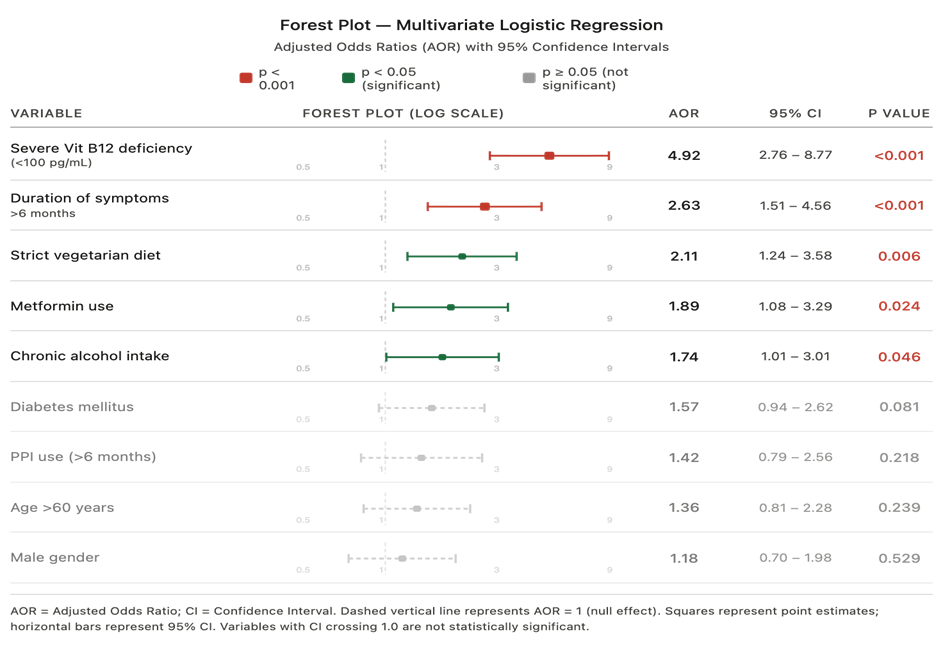
Multivariate logistic regression forest plot for predictors of neuropathy.
DISCUSSION:
This cross-sectional study of 383 patients with biochemically confirmed vitamin B12 deficiency demonstrates that the disorder predominantly affects young to middle-aged adults in the Indian tertiary care setting, with vegetarian diet, metformin therapy, and prolonged symptom duration emerging as the principal independent predictors of neuropathy.
The mean age of 36.08 ± 12.47 years and the predominance of patients in the 21–40 year age band challenge the traditional perception of vitamin B12 deficiency as primarily a disease of the elderly. Although several international studies, including those by Andrès et al.⁸ and Sen et al.,⁹ have reported a higher prevalence among individuals over 60 years owing to gastric mucosal atrophy and food-cobalamin malabsorption, the present findings align with Indian observations by Malik et al. and contrast with Faishal et al., who reported peak prevalence in the 46–60 year group.¹⁰ This shift toward younger patients likely reflects regional dietary patterns, increased metformin exposure for early-onset diabetes, and rising awareness leading to earlier presentation.
The mild male predominance (55.09%) observed here echoes findings by Faishal et al.¹⁰ and probably reflects greater healthcare-seeking behaviour, higher rates of comorbidities, and increased exposure to lifestyle risk factors among men, rather than a true biological susceptibility. Community-based studies indicate comparable risk in both sexes, particularly among vegetarian women and during pregnancy.
Vegetarianism, reported by 60.05% of patients, was a major contributor to deficiency, consistent with reports by Faishal et al. (63.8%)¹⁰ and Singh et al.,¹¹ who highlighted the susceptibility of South Asian vegetarian populations due to the absence of cobalamin in plant-based foods. Middle and lower socioeconomic class predominance further supports the role of dietary diversity and access to animal-source foods in maintaining adequate B12 status.
The clinical profile—fatigue/weakness (79.90%), pallor (84.86%), paraesthesia (50.13%), and neuropathy (45.17%)—closely parallels findings by Faishal et al.¹⁰ and reflects the dual haematological and neurological footprint of cobalamin deficiency. The fact that nearly 80% of patients had symptoms for ≥ 1 month at presentation underscores the well-recognised pattern of delayed diagnosis, with subtle complaints often misattributed to ageing, stress, or coexisting conditions such as diabetes—a delay that risks irreversible neurological injury.⁷
Biochemically, 30.03% of patients had severe deficiency (B12 < 100 pg/mL), and macrocytic anaemia (69.97%) with MCV > 100 fL was the dominant haematological pattern, consistent with megaloblastic erythropoiesis described by Sen et al. (mean MCV 106.15 ± 13.7 fL)⁹ and Ramesh et al.¹² The dimorphic smear seen in 20.10% likely reflects coexisting iron deficiency, a frequent finding in resource-limited settings. The significant association of B12 < 100 pg/mL with both severe anaemia (78.41%) and neuropathy (43.64%) confirms a clear dose-response relationship between biochemical severity and clinical morbidity, in agreement with Faishal et al., who reported neurological manifestations in 79.2% of patients with B12 < 100 pg/mL.¹⁰
On multivariate analysis, severe vitamin B12 deficiency was the strongest independent predictor of neuropathy (AOR 4.92), followed by symptom duration > 6 months (AOR 2.63), reinforcing the importance of early biochemical screening before structural neuronal damage develops. Vegetarian diet (AOR 2.11), metformin use (AOR 1.89), and chronic alcohol intake (AOR 1.74) retained significance, while diabetes mellitus, PPI use, age > 60 years, and male gender did not. The metformin association corroborates Mishra et al.¹³ and Aparicio-Ugarriza et al.,¹⁴ who demonstrated impaired calcium-dependent ileal absorption of the intrinsic factor–B12 complex with prolonged metformin therapy.
Diabetes mellitus, present in 38.64% of patients, was the most common comorbidity. Although it lost independent significance in the adjusted model—likely because its effect is mediated through metformin and dietary factors—it remains clinically important given the diagnostic overlap between diabetic and B12-deficiency neuropathy. The findings collectively support routine vitamin B12 screening in high-risk groups: strict vegetarians, patients on long-term metformin, those with prolonged or unexplained neurological symptoms, and individuals with chronic alcohol use.
Limitations
This was a single-centre, hospital-based, cross-sectional study; consequently, the prevalence estimates and risk-factor associations may not be generalisable to community populations. Confirmatory tests such as serum methylmalonic acid and homocysteine were not routinely performed. Causality cannot be inferred from the cross-sectional design, and recall bias in dietary and drug history is possible.
CONCLUSION:
Vitamin B12 deficiency in this tertiary care population predominantly affected young to middle-aged adults, with a male predominance and a strong association with vegetarian dietary patterns. Fatigue, pallor, and macrocytic anaemia were the most common presenting features, while neuropathy occurred in nearly half of patients. Severe biochemical deficiency, prolonged symptom duration, vegetarian diet, metformin therapy, and chronic alcohol intake were independent predictors of neuropathy. Routine vitamin B12 screening of high-risk individuals—especially strict vegetarians, long-term metformin users, and patients with unexplained neurological symptoms—and prompt supplementation are essential to prevent severe haematological complications and irreversible neurological damage.
REFERENCES:
1. Stabler SP. Vitamin B12 deficiency. N Engl J Med. 2013;368(2):149–160.
2. Green R, Allen LH, Bjørke-Monsen AL, et al. Vitamin B12 deficiency. Nat Rev Dis Primers. 2017;3:17040.
3. Antony AC. Vegetarianism and vitamin B-12 (cobalamin) deficiency. Am J Clin Nutr. 2003;78(1):3–6.
4. Yajnik CS, Deshpande SS, Lubree HG, et al. Vitamin B12 deficiency and hyperhomocysteinemia in rural and urban Indians. J Assoc Physicians India. 2006;54:775–782.
5. Hunt A, Harrington D, Robinson S. Vitamin B12 deficiency. BMJ. 2014;349:g5226.
6. Healton EB, Savage DG, Brust JC, et al. Neurologic aspects of cobalamin deficiency. Medicine (Baltimore). 1991;70(4):229–245.
7. Lindenbaum J, Healton EB, Savage DG, et al. Neuropsychiatric disorders caused by cobalamin deficiency in the absence of anemia or macrocytosis. N Engl J Med. 1988;318(26):1720–1728.
8. Andrès E, Loukili NH, Noel E, et al. Vitamin B12 (cobalamin) deficiency in elderly patients. CMAJ. 2004;171(3):251–259.
9. Sen A, Chandrasekhar K. Clinical and haematological profile of vitamin B12 deficiency. J Clin Diagn Res. 2015;9(5):OC15–OC18.
10. Faishal M, Khan MM, Ahmad S, et al. Clinical and haematological profile of vitamin B12 deficiency in a tertiary care hospital. Int J Adv Med. 2020;7(8):1234–1240.
11. Singh J, Sharma R, Gupta R. Vitamin B12 deficiency in vegetarians: an emerging public health concern. Indian J Med Res. 2018;148(5):495–502.
12. Ramesh L, Sundaresan A, Krishnamurthy V. Haematological manifestations of vitamin B12 deficiency in adults. Int J Res Med Sci. 2019;7(4):1123–1128.
13. Mishra M, Singh A, Tripathi P. Vitamin B12 deficiency in patients on long-term metformin therapy. J Assoc Physicians India. 2021;69(3):42–46.
14. Aparicio-Ugarriza R, Palacios G, Alder M, González-Gross M. A review of the cut-off points for the diagnosis of vitamin B12 deficiency in the general population. Clin Chem Lab Med. 2015;53(8):1149–1159.
15. Singla R, Garg A, Surana V, et al. Vitamin B12 deficiency is endemic in Indian population: a perspective from North India. Indian J Endocrinol Metab. 2019;23(2):211–214.
16. Patel SV, Patel BV, Patel AS. Effect of metformin therapy on serum vitamin B12 levels in type 2 diabetes mellitus. Int J Res Med Sci. 2018;6(6):2008–2012.
17. Hussain M, Ahmad J, Ahmad K. Clinico-haematological profile of vitamin B12 deficiency in adult patients. J Med Sci Clin Res. 2017;5(11):31245–31251.
18. Kumar R, Kumar S, Kumar A. Severity pattern of vitamin B12 deficiency among adult patients attending a tertiary care hospital. Int J Contemp Med Res. 2020;7(4):D5–D9.
19. Agrawal AR, Singh D, Verma A. Neurological manifestations of vitamin B12 deficiency. J Clin Diagn Res. 2016;10(8):OE01–OE03.
20. Malik N, Sharma S, Gupta R. Prevalence of vitamin B12 deficiency among Indian adults: a systematic review. Indian J Community Med. 2022;47(1):8–14.