STUDY OF PULMONARY FUNCTIONS IN PATIENTS WITH CIRRHOSIS OF LIVER AND ITS CORRELATION WITH SEVERITY OF THE DISEASES.
- Deepak Gupta , Professor and Unit Head, Department of General Medicine, Mahatma Gandhi Medical College and Hospital, Jaipur, Rajasthan, India
- Beena Wadhwani , Resident Department of General Medicine, Mahatma Gandhi Medical College and Hospital, Jaipur, Rajasthan, India
- Puneet Rijhwani , Professor and Head of Department, Department of General Medicine, Mahatma Gandhi Medical College and Hospital, Jaipur, Rajasthan, India
- Pradeep Agarwal , Professor and Unit Head, Department of General Medicine, Mahatma Gandhi Medical College and Hospital, Jaipur, Rajasthan, India
- Anchin Kalia , Professor and Unit Head, Department of General Medicine, Mahatma Gandhi Medical College and Hospital, Jaipur, Rajasthan, India
- Shrikant Choudhary , Associate Professor, Department of General Medicine, Mahatma Gandhi Medical College and Hospital, Jaipur, Rajsthan, India
- Ambika Tyagi , Assistant Professor, Department of General Medicine, Mahatma Gandhi Medical College and Hospital, Jaipur, Rajsthan, India.
- Utkarsh Kimmatkar , Assistant Professor, Department of General Medicine, Mahatma Gandhi Medical College and Hospital, Jaipur, Rajsthan, India.
Article Information:
Abstract:
INTRODUCTION: Cirrhosis is defined as fibrosis and alteration in the liver's nodular structure. Chronic liver disease often causes cirrhosis. AIM: To Study Pulmonary Functions In Patients With Cirrhosis Of Liver & Its Correlation With Severity Of The Disease. METHODOLOGY: This is a Hospital-Based Prospective Observational Study with cross - sectional design conducted at Mahatma Gandhi Medical College & Hospital Institute for a duration of 18 months from approval of IEC. RESULT: The present study showed that pulmonary function abnormalities were significantly associated with increasing severity of liver cirrhosis, with restrictive and obstructive PFT patterns Mainly observed in Child-Pugh class C patients. FVC%, FEV1%, and FEV1/FVC showed significant negative correlations with Child-Pugh scores. CONCLUSION: Pulmonary function impairment is common in patients with liver cirrhosis and worsens significantly with increasing Child-Pugh severity. Restrictive and obstructive ventilatory defects were predominantly observed in advanced cirrhosis, highlighting the importance of routine pulmonary function assessment in these patients.
Keywords:
Article :
INTRODUCTION:
Cirrhosis is defined as fibrosis and alteration in the liver's nodular structure. Chronic liver disease often causes cirrhosis. Alcoholic liver disease, NASH, & HCV are common causes of cirrhosis in industrialized countries1. In developing nations, HCV & HBV are the main culprits. Globally, liver cirrhosis is rising. There were 520,000 new cirrhosis & chronic liver disease cases in 2017.
Cirrhosis killed 1.48 million people in 2019, up 8.1% from 2017, & ranked 16th in disability-adjusted life-years in 2019. Cases of cirrhosis due, to alcohol and non alcoholic fatty liver disease are increasing ,but cases due to HBV and HCV are decreasing worldwide.India has one of the highest rates of liver cirrhosis in the world, causing a significant health issue. Alcohol causes 43–63% of growing NAFLD, which affects 9–32% of the population.2 The male-to-female ratio is 5.7:1 & younger people are more likely to have the illness.
Cirrhosis & chronic liver disorders accounted for 0.22 million deaths in India in 2017.3,4 Liver cirrhosis can produce pulmonary dysfunction due to intrinsic cardiopulmonary issues associated with portal hypertension Hepatic hydrothorax, spontaneous pulmonary empyema, HPS, & porto-pulmonary hypertension are the most prevalent & clinically significant pulmonary complications.More precisely, liver cirrhosis induces obstructive pulmonary dysfunction 15–19, restrictive &/or obstructive ventilatory abnormalities by others 20–26, & isolated reduction in FEV1, FVC, PEFR, &/or FEF25–75% by some researchers.
In particular, these dysfunctions have been associated to liver cirrhosis severity as measured by the MELD score, Child Pugh Score, clinical characteristics such ascites, & laboratory values like albumin5.The ChildPugh score is negatively correlated with FEV1 13,29, FVC 19, & FEV1/FVC values , while the FEV1/FVC is negatively correlated to GAHS(Glasgow Alcoholic Hepatitis Scale).6 However, most studies show that liver cirrhosis reduces lung capacity .The CTP score predicts cirrhosis patients' mortality. Child & Turcotte devised it in 1964 to help choose elective portal decompression surgery patients.
Patients were divided into three groups: good liver function (A), moderately impaired (B), & advanced (C). Their initial score system included ascites, neurological illnesses, serum bilirubin, serum albumin, & clinical nutrition status to categorise patients7,8. 5-32 percent of cirrhosis patients suffer hepatopulmonary syndrome (HPS), a hazardous vascular consequence of liver failure. The research shows that liver cirrhosis severity promotes lung dysfunction through several routes, therefore understanding how it affects pulmonary functioning is crucial. This study addresses how pulmonary dysfunction correlates with liver cirrhosis severity. So this study was done with the following aim and objectives.
AIM
To Study Pulmonary Functions In Patients With Cirrhosis Of Liver & Its Correlation With Severity Of The Disease.
METHODOLOGY :
This is a Hospital-Based Prospective Observational Study with cross - sectional design conducted at Mahatma Gandhi Medical College & Hospital Institute for a duration of 18 months from approval of IEC. Patients with a confirmed diagnosis of Cirrhosis of Liver were included in the study with Men & women between 18-65 years of age.
Patients with coexisting disease like chronic obstructive disease, Bronchial Asthma, Interstitial Lung Disease .Patients with heart diseases like Coronary heart disease, Chronic heart Failure c) Patients with a history of smoking excluded from study. Ethics Committee approval was obtained before the start of study.
Written & informed consent of the patients was obtained from all participants before enrolment into the study.
RESULTS:
Table 1: Baseline characteristics of participants
|
|
|
Frequency |
Percentage |
|
Age |
18-30 |
5 |
5.0 |
|
31-40 |
14 |
14.0 |
|
|
41-50 |
29 |
29.0 |
|
|
51-65 |
52 |
52.0 |
|
|
Gender |
Male |
63 |
63 |
|
Female |
37 |
37 |
|
|
Lung function pattern |
Normal |
72 |
72.0 |
|
Restrictive |
26 |
26.0 |
|
|
Obstructive |
2 |
2.0 |
|
|
CTP class |
Child pugh A |
42 |
42.0 |
|
Child pugh B |
34 |
34.0 |
|
|
Child pugh C |
24 |
24.0 |
The mean age of the study subject was 49.39+9.0 Yrs. 63 (63%) males & 37 (37%) females with male to female ratio 1.7:1 depicting cirrhosis occurring more in males in our study. According to spirometry findings, among the 100 study subjects 72 (72%) had normal lung function, 26 (26%) had restrictive lung function & rest 2 (2%) had obstructive lung function. The mean CTP value of the study subject came out to be 7.88 + 2.71 with minimum value of 5 & maximum value of 15. As per categorization most of the study subjects i.e 42 (42%) were in CTP class A, followed by 34(34%) in class B & finally 24(24%) in class C.
Table 2: Distribution of study subject according to Child Pug Turcotte parameters
|
Child Pug Turcotte parameters |
Criteria |
Frequency |
Percentage |
|
Encephalopathy |
None |
80 |
80.0 |
|
Grade 1-2 |
12 |
12.0 |
|
|
Grade 3-4 |
8 |
8.0 |
|
|
Ascites |
None |
10 |
10.0 |
|
Mild/Moderate |
74 |
74.0 |
|
|
Severe |
16 |
16.0 |
|
|
Serum bilirubin |
<2 mg/dl |
41 |
41.0 |
|
2-3 mg/dl |
44 |
44.0 |
|
|
> 3mg/dl |
15 |
15.0 |
|
|
Serum albumin |
>3.5 gm/dl |
63 |
63.0 |
|
2.8-3.5 gm/dl |
28 |
28.0 |
|
|
<2.8 gm/dl |
9 |
9.0 |
|
|
Prothrombin time |
<4 Sec |
79 |
79.0 |
|
4-6 Sec |
9 |
9.0 |
|
|
>6 Sec |
12 |
12.0 |
Grade 1-2 encephalopathy was present in 12 (12%) , grade 3-4 was present in 8 (8%) study subjects & rest 80 (80%) did not suffer from encephalopathy. However most of the study subject i.e 74 (74%) had mild to moderate ascites, severe ascites was present in 16 (16%) study subjects & rest 10 (10%) did not have any ascites. 44 (44%) had serum bilirubin 2-3mg/dl, followed by 41 (41%) had serum bilirubin of <2 mg/dl & rest 15(15%) had serum bilirubin of >3mg/dl. 63(63%) had serum albumin of >3.5gm/dl, followed by 28 (28%) study subject having serum albumin of 2.8 to 3.5gm/dl & rest 9(9%) had serum albumin of <2.8gm/dl. 79 (79%) had prothrombin time (PT) of <4 seconds, followed by 12 (12%) had PT of >6 seconds & rest 9(9%) had PT of 4 to 6 seconds.
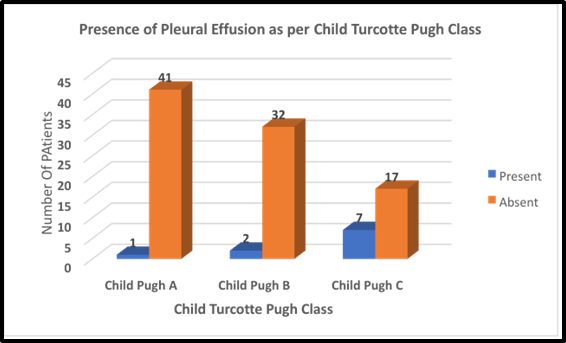
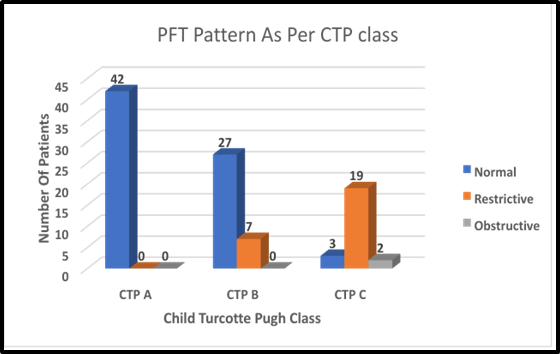
Figure 1,2,:Comparison of Pleural Effusion,PFT pattern with Child Turcotte Pugh Category
On comparing the PFT pattern with CTP category it was found that among study subjects with normal PFT 42(58.3%), 27(37.5%) & 3(4.2%) were in CTP category A,B & C respectively showing most of the study subjects in CTP A category. Among study subjects with restrictive PFT pattern 7(26.9%) & 19(73.1%) were in CTP B & C category respectively showing most in CTP C category. Finally only 2(100%) study subjects had obstructive study patterns & both were in CTP C category.(p<0.001) 7(70%) were in CTP C class followed by 2(20%) & 1 (10%) in CTP B & A respectively. However, subjects with no pleural effusion most i.e 41 (45.6%) were in CTP A followed by 32 (35.6%) in CTP B & rest 17(18.9%) in CTP C class. (p=0.002).
Table 3: Correlation between Child Pugh Value & PFT parameters
|
|
PFT parameters |
||
|
|
FVC % |
FEV1 % |
FEV1/FVC |
|
Pearson Correlation Coefficient |
-0.738 |
-0.612 |
-0.347 |
|
p |
<0.001 |
<0.001 |
<0.001 |
On doing correlation between CTP value & PFT parameters it was found that FVC% was significantly (p<0.001) negatively correlated with CTP with correlation coefficient – 0.738. FEV1% was also significantly negatively correlated with CTP (p<0.001) with correlation coefficient -0.612. Similarly, FEV1/FVC was significantly (p<0.001) negatively correlated with CTP with correlation coefficient -0.347.
Table 4. Comparison of Mean Spirometry finding with Child Turcotte Pugh Class
|
PFT |
CTP Class |
Mean |
Sad |
F |
P |
|
FVC% |
A |
99.85 |
17.64 |
61.96 |
<0.001 |
|
B |
77.83 |
5.58 |
|||
|
C |
65.18 |
9.63 |
|||
|
FEV1% |
A |
96.02 |
15.80 |
39.96 |
<0.001 |
|
B |
77.22 |
8.13 |
|||
|
C |
69.30 |
11.53 |
As shown in the above table in this study the mean FVC% decreased significantly 99.85 + 17.64 to 77.83 + 5.58 & then to 65.18 + 9.63 in CTP class A, B & C respectively & this decrease was statistically significant. (p<0.001). Similarly, the mean FEV1% decreased significantly from 96.02 + 15.80 to 77.22 + 8.13 & then to 69.30 + 11.53 in CTP class A, B & C respectively & this decrease was statistically significant. (p<0.001). Again the mean FEV1/FVC decreased significantly 0.88 + 0.13 to 0.77 + 0.05 & then to 0.77 + 0.08 in CTP class A, B & C respectively & this decrease was statistically significant. (p<0.001). Thus PFT parameters decrease significantly as the CTP class changes from A to B & then to C.
DISCUSSION:
In this study the mean age of the study subject was 49.39+9.0 Yrs with most of the study subjects (52) belonging to the age group 51 to 65 yrs indicating cirrhosis occurring at a higher age. Cirrhosis prevalence was more in males (63%) compared to females (37%) with male to female ratio of 1.7:1 indicating cirrhosis being more common in males compared to females. In the study by Vignesh V et al.9 (2023) a total of 50 subjects with cirrhosis were enrolled in which 39 were male & 11 were female again showing the prevalence more in male.
After classifying the study population using Child Pug Turcotte parameters, it was discovered that 12% of the participants had Grade 1-2 encephalopathy, 8 (8%) had Grade 3-4 encephalopathy, 74% had mild to moderate ascites, 16% had severe ascites, & the remaining participants had neither encephalopathy nor ascites. Once more, 44% had serum bilirubin levels between 2 & 3 mg/dl, 41% had levels below 2 mg/dl, & the remaining 15 (15%) had levels above 3 mg/dl; 63% had serum albumin levels above 3.5 g/dl, 28% had levels between 2.8 & 3.5 g/dl, & the remaining 9% had levels below 2.8 g/dl. Once more, 12% had a prothrombin time (PT) of more than six seconds, 9% had a PT between four & six seconds, & the remainder had a PT of less than four seconds. In a study of pulmonary manifestations in cirrhotic patients in Odisha, Samal et al.10 (2024) found that varices were seen in 69% of patients & that splenomegaly (98%), ascites (95%), & abdominal distension (75%) were prevalent complaints. Similar to our study, the study group was divided into CTP classes based on the severity of the condition. They discovered that 27% of patients were classified as class A, 32% as class C, & 41% as Child-Pugh class B.
When we compared the PFT pattern with CTP class, we found that 42 (58.3%), 27 (37.5%), & 3 (4.2%) of the study participants with normal PFT were in CTP class A, B, & C, respectively, indicating that the majority of the study subjects were in the less severe CTP class, or CTP A class. Our study showed that as the severity of cirrhosis increases, we found a restrictive & obstructive PFT pattern mostly in CTP class C, & this difference was statistically significant. Of those with restrictive PFT patterns, 7 (26.9%) & 19 (73.1%) were in CTP B & C class, respectively, with the majority in CTP C class. Only 2 (100%) had an obstructive study pattern, & that too in CTP C class.
FVC% (r = –0.738), FEV1% (-0.612), & FEV1/FVC (-0.347) were all significantly (p<0.001) negatively linked with CTP, according to an even correlation study between CTP value & PFT measures. According to this data, the PFT values dramatically dropped as the severity of cirrhosis increased as indicated by the CTP score, highlighting the metabolic impact of declining liver function on pulmonary function.
Even in CTP classes A, B, & C, the mean FVC% dropped dramatically from 99.85 ± 17.64 to 77.83 ±5.58 & finally to 65.18 + 9.63 (<0.001). Similarly, in CTP classes A, B, & C, the mean FEV1% dropped dramatically from 96.02 ± 15.80 to 77.22 ± 8.13 & finally to 69.30 ± 11.53 (<0.001). Once more, in CTP classes A, B, & C, the mean FEV1/FVC dropped considerably from 0.88 ±0.13 to 0.77 ± 0.05 & then to 0.77 ± 0.08 (<0.001). Additionally, this analysis provides compelling evidence of a connection between declining lung & liver function.
The association between the severity of liver cirrhosis & PFT was also examined by According to Niveditha R et al.11, there was no significant change in FEV1/FVC (P>0.05), while the mean FVC% & FEV1% decreased from CTP group A to B & C (p<0.05). Even the CTP score was strongly negatively linked with FVC & FEV1 (p<0.001), but there was no correlation with FEV1/FVC. From CTP class A to B & C, the mean FVC% & FEV1% in our study also dramatically reduced, & we discovered that the FEV1/FVC also significantly fell (p<0.001). In line with that study, we also found a substantial negative association between the CTP score & FVC & FEV1, as well as a significant negative correlation between FEV1 & FVC. (p<0.001)
Out of 100 participants in our study, 28 exhibited aberrant PFT patterns, 26 had restrictive PFT patterns, & 2 had obstructive PFT patterns. While 19 & 2 in CTP class C showed restrictive & obstructive PFT patterns with a significant difference of p <0.001, all 42 in CTP class A had normal PFT patterns.
In a related study, Awad et al.12 (2019) discovered a statistically significant (p-value < 0.05) negative connection (r = -0.51) between group I (CT class A) FEV1/FVC & the severity of liver cirrhosis (CHILD score). However, in group II (CTP class B), they discovered a statistically significant (p-value < 0.05) but favourable connection (r = 0.6) between FVC & the severity of liver cirrhosis (CHILD score).
When the Child Pugh Score was used to evaluate FEV1, it was discovered that the severity of cirrhosis was associated with a decrease in FEV1, which was statistically significant (p0.003) both between & within groups. The Child Pugh Score was used to analyse FVC, & the results showed a statistically significant (p-0.027) decrease in FVC with varices severity both within & between groups. These results are similar to our research as well.
Therefore, all of the research, including ours, found that pulmonary function declines in the form of decreased FVC%, decreased FEV1, or decreased FEV1/FVC, & that the presence of restrictive or obstructive lung disorders is associated with an increase in the severity of liver cirrhosis, as indicated by an elevated CTP score.
CONCLUSION:
This study emphasized the importance of evaluation of pulmonary function in patients with cirrhosis of the liver. The increased severity of cirrhosis of liver as shown by CTP score affected the pulmonary function as depicted by significant decrease in mean FVC %, FEV1% & FEV1/FVC ratio. Even the deranged PFT ultimately affects the ABG parameters & we found the same as with increased severity of cirrhosis the mean pO2 & SaO2 decreased significantly. Though we did not find any difference in age in relation to CTP score, we found male gender to be more vulnerable to the severity of cirrhosis of liver compared to females. Rather other studies depicted higher age to be more affected with severe cirrhosis of liver. This study strengthens the facts presented by other studies about the adverse effect of cirrhosis of liver on pulmonary function.
REFERENCES:
1. Sharma B, John S. Hepatic Cirrhosis. In: StatPearls [Internet]. Treasure Island (FL): StatPearls Publishing; 2025 [cited 2026 Jan 24]. Available from: http://www.ncbi.nlm.nih.gov/books/NBK482419/ PubMed PMID: 29494026.
2. Naveau S, Perlemuter G, Balian A. [Epidemiology and natural history of cirrhosis]. Rev Prat. 2005 Sep 30;55(14):1527–32. PubMed PMID: 16255293.
3. Kaur D, Chhina R, Goyal O, Goyal P. Etiological Profile of Cirrhosis in a Tertiary Care Institute in Northern India. Journal of Gastrointestinal Infections. 2018 Dec 1;8:28–31. doi:10.5005/jpjournals-10068-0017
4. Mishra D, Dash KR, Khatua C, Panigrahi S, Parida PK, Behera SK, et al. A Study on the Temporal Trends in the Etiology of Cirrhosis of Liver in Coastal Eastern Odisha. Euroasian J Hepatogastroenterol. 2020;10(1):1–6. doi:10.5005/jp-journals-10018-1312 PubMed PMID: 32742964; PubMed Central PMCID: PMC7376596.
5. Liver Disease In Adults. The Liver Foundation India [Internet]. [cited 2026 Jan 25]. Available from: https://theliverfoundationindia.org/liver-disease-in-adults/
6. Iwakiri Y. Pathophysiology of portal hypertension. Clin Liver Dis. 2014 May;18(2):281–91.
7. doi:10.1016/j.cld.2013.12.001 PubMed PMID: 24679494; PubMed Central PMCID: PMC3971388.
8. MB F, GA A. Pulmonary dysfunction in chronic liver disease. Hepatology. 2000;32:859-865,.
9. Benz F, Mohr R, F T, Roderburg C. Pulmonary complications in patients with liver cirrhosis. J Transl Int Med. 2020;8:150-158,.
10. Vignesh V, BM Singh L, Kumari V, Gupta N, Agarwal A. A Study of Pulmonary Functions in Patients with Cirrhosis of Liver and its Correlation with the Severity of the Disease. Vol. 24, Pt. 118-23. 2023;24(2).
11. Samal S, Jena S, Dhar S, Sahu S, Vihari J, Ghosh S. Assessment of Pulmonary Manifestations in Cirrhotic Patients at a Tertiary Care Hospital in Odisha: A Correlation Study with Liver Disease Severity. Biomedicine. 2024 Sep 30;44:222–7. doi:10.51248/v44i2.56
12. Niveditha R, Honnutagi RM. A Study on Relationship Between Severity of Liver Cirrhosis and Pulmonary Function Tests. Journal of Contemporary Clinical Practice. 2025 May 24;11:556–63. doi:10.61336/jccp/25-05-78
13. Awad NF, Elbalsha AAM, Amer MZA, Ibrahim MHE. Study of The Relationship between Severity of Liver Cirrhosis and Pulmonary Function Tests. Vol. 76. 2019;76(7):4570–6.