A 3 YEARS RETROSPECTIVE STUDY OF FATAL AGRICULTURAL POISONING WITH RESPECT TO SURVIVAL PERIOD AND THE TYPE OF POISON IN CASES AUTOPSIED AT A TERTIARY CARE CENTRE.
- Pramod SB , Post Graduate / Tutor, Department of Forensic Medicine & Toxicology, Belagavi Institute of Medical Sciences, Belagavi, Karnataka, India.
- Pushpa MG , Associate Professor& I/C HOD,Department of Forensic Medicine & Toxicology, Belagavi Institute of Medical Sciences, Belagavi, Karnataka, India.
- Keshava H B , Assistant Professor, Department of Forensic Medicine & Toxicology, Belagavi Institute of Medical Sciences, Belagavi, Karnataka, India.
- Somashekhar s Pujar , Professor and Head, SG Patil Medical College, Department of Forensic Medicine & Toxicology, Belagavi Institute of Medical Sciences, Belagavi, Karnataka, India.
Article Information:
Abstract:
Background: Agricultural poisoning continues to be a major public health and medico-legal problem in India, particularly in rural communities where pesticides and other agrochemicals are easily accessible. Fatal poisoning due to agricultural chemicals constitutes a significant proportion of medicolegal autopsies. Objectives: 1. To study the demographic profile of fatal agricultural poisoning cases. 2. To identify thetype of agricultural poisons involved. 3. To analyze the manner of poisoning and survival period among victims. Materials and Methods: A retrospective descriptive study was conducted in the Department of Forensic Medicine, Belagavi Institute of Medical Sciences, Belagavi. All fatal agricultural poisoning cases subjected to medicolegal autopsy between January 2021 and December 2023 were included. Data regarding age, sex, type of poison, route of exposure, manner of poisoning, and survival period were collected from autopsy records, hospital records, police documents, and chemical analysis reports. Data were analyzed using descriptive statistics. Results: A total of 189 cases of fatal agricultural poisoning were studied. The mean age of the victims was 41.15 years, with ages ranging from 4 to 90 years. Males constituted 84.1% (159 cases), while females accounted for 15.9% (30 cases), giving a male-to-female ratio of approximately 5.3:1. The majority of victims belonged to the 19–40 year age group (51.9%). Suicidal poisoning was the predominant manner of death, accounting for 97.4% of cases. Organophosphorus compounds were the most commonly implicated poisons, followed by paraquat and other agricultural chemicals. Oral ingestion was the route of exposure in all cases. Conclusion: Agricultural poisoning remains an important cause of preventable mortality among the economically productive population. Organophosphorus compounds continue to be the leading toxic agents, with suicidal ingestion being the predominant manner of poisoning. Strengthening pesticide regulation, improving mental health services, and promoting safe storage practices are essential to reduce poisoning-related deaths.
Keywords:
Article :
INTRODUCTION:
Agricultural poisoning remains a significant public health problem worldwide, particularly in developing countries where pesticides are readily available and widely used in farming practices. Poison is defined as any substance that, when introduced into the living body or brought into contact with any part thereof, produces ill-health or death by its local or systemic effects. Toxicology is the branch of science that deals with the study, diagnosis, treatment, and prevention of poisoning.¹
According to the World Health Organization (WHO), poisoning accounts for hundreds of thousands of deaths annually, with pesticide self-poisoning being one of the most common methods of suicide globally.² It is estimated that more than three million cases of acute poisoning and approximately 250,000 deaths occur worldwide every year, with the majority of fatal cases occurring in developing countries.³
India is predominantly an agricultural country, and pesticides are extensively used for crop protection. Easy accessibility and storage of these toxic compounds in households and farms have contributed to their widespread use in deliberate self-harm.⁴ Organophosphorus compounds continue to be the most common agents involved in poisoning deaths in southern India, whereas aluminum phosphide poisoning is more frequently reported from northern regions.⁵˒⁶ The present study was undertaken to evaluate the epidemiological profile, toxicological pattern, and survival characteristics of fatal agricultural poisoning cases subjected to medicolegal autopsy at a tertiary care centre.
MATERIALS AND METHODS:
Study Design:
Retrospective descriptive study.
Study Period:
January 2021 to December 2023.
Study Setting:
Department of Forensic Medicine, Belagavi Institute of Medical Sciences, Belagavi.
Inclusion Criteria:
All fatal agricultural poisoning cases subjected to medicolegal autopsy during the study period.
Exclusion Criteria:
Cases with incomplete records and toxicological findings.
Data Collection:
Data regarding age, sex, type of poison, route of exposure, manner of poisoning, and survival period were collected from autopsy records, hospital records, police documents, and chemical analysis reports.
Statistical Analysis:
Data were entered into Microsoft Excel and analyzed using descriptive statistical methods. Results were expressed as frequencies, percentages, mean, median, and range.
RESULTS:
A total of 189 fatal agricultural poisoning cases subjected to medicolegal autopsy during the period January 2021 to December 2023 were analyzed.
Table 1: Sex Distribution of Cases
|
Sex |
Number of Cases |
Percentage (%) |
|
Male |
159 |
84.13 |
|
Female |
30 |
15.87 |
|
Total |
189 |
100.00 |
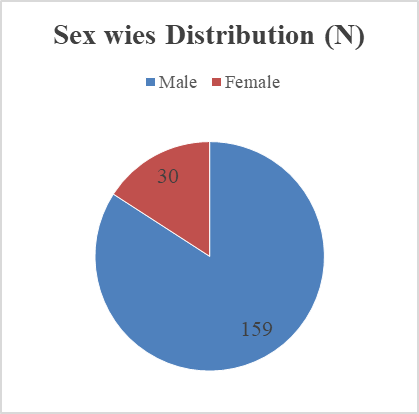
Figure 1: Sex wies Distribution
Male victims predominated, accounting for more than four-fifths of all cases.
Table 2: Age Distribution
|
Age Group (Years) |
Number of Cases |
Percentage (%) |
|
0–10 |
2 |
1.06 |
|
11–20 |
11 |
5.82 |
|
21–30 |
54 |
28.57 |
|
31–40 |
43 |
22.75 |
|
41–50 |
27 |
14.29 |
|
51–60 |
22 |
11.64 |
|
61–70 |
14 |
7.41 |
|
71–80 |
14 |
7.41 |
|
>80 |
2 |
1.06 |
|
Total |
189 |
100.00 |
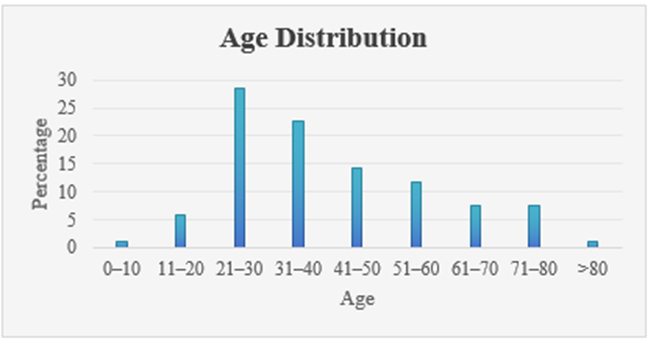
Figure 2: Age distribution
The age of victims ranged from 4 to 90 years, with a mean age of 41.15 years and a median age of 37 years. The majority of victims belonged to the 21–30 years age group (28.57%), followed by the 31–40 years age group (22.75%). Thus, more than half of the victims belonged to the economically productive age group of 21–40 years.
Poison Involved
Table 3: Distribution of Agricultural Poisons Among Fatal Cases (N = 189)
|
Poison Type |
Number of Cases |
Percentage (%) |
|
Organophosphorus compounds |
99 |
52.38 |
|
Paraquat herbicide |
28 |
14.81 |
|
Phosphide rodenticides |
9 |
4.76 |
|
Amitraz |
7 |
3.70 |
|
Pyrethroid insecticides |
7 |
3.70 |
|
Carbamate compounds |
6 |
3.17 |
|
Imidacloprid |
5 |
2.65 |
|
Phenol |
4 |
2.12 |
|
Glyphosate |
3 |
1.59 |
|
Cyanide |
2 |
1.06 |
|
Poison not detected / inconclusive |
19 |
10.05 |
|
Total |
189 |
100.00 |
Organophosphorus compounds were the most commonly implicated agricultural poisons, accounting for 52.38% of all fatal poisoning cases, followed by paraquat herbicide (14.81%). Phosphide rodenticides constituted 4.76% of cases. Other toxic agents identified included amitraz (3.70%), pyrethroid insecticides (3.70%), carbamate compounds (3.17%), imidacloprid (2.65%), phenol (2.12%), glyphosate (1.59%), and cyanide (1.06%). Toxicological analysis was inconclusive or failed to detect poison in 10.05% of cases.
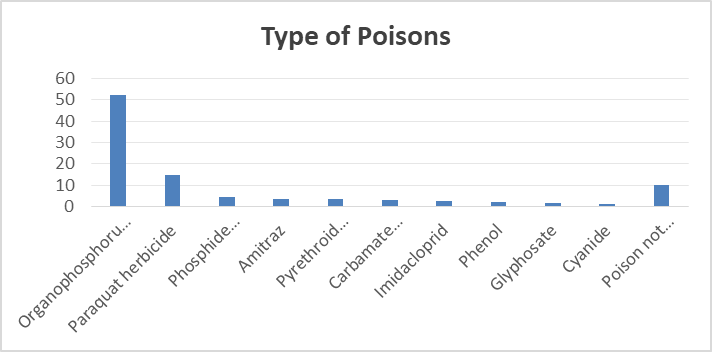
Figure 3: Distribution of Agricultural Poisons Among Fatal Cases.
Organophosphorus compounds constituted the largest proportion of poisoning cases. Paraquat herbicide was the second most common poison identified. Other agents included carbamates, phosphides, amitraz, phenol, glyphosate, pyrethroids, imidacloprid, cyanide, and miscellaneous agricultural chemicals.
Manner of Poisoning
Table 4: Manner of poisoning
|
Manner |
Number of Cases |
Percentage (%) |
|
Suicidal |
184 |
97.35 |
|
Homicidal |
3 |
1.59 |
|
Accidental |
1 |
0.53 |
|
Undetermined |
1 |
0.53 |
|
Total |
189 |
100.00 |
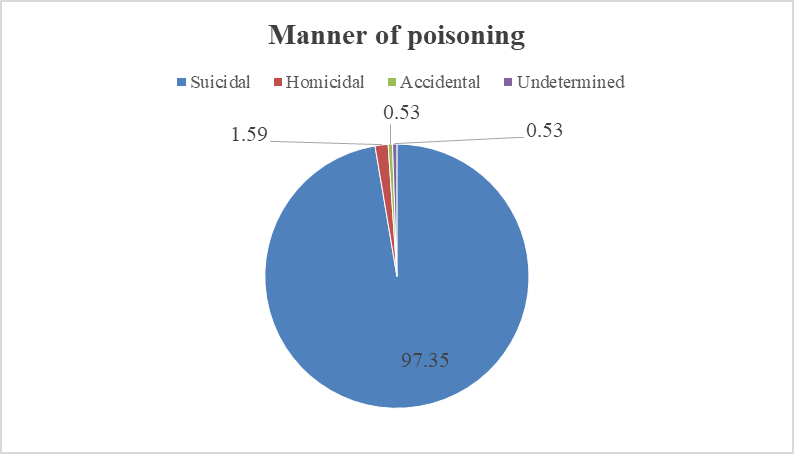
Figure 4: Manner of poisoning.
Suicidal poisoning accounted for 184 cases (97.4%). Homicidal poisoning was observed in 3 cases (1.6%), while accidental poisoning was documented in 1 case (0.5%). One case had an undetermined manner.
Route of Exposure
All victims consumed poison through oral ingestion.
Survival Period
Table 5: Survival Pattern in Common Poisoning Cases
|
Poison Type |
Number of Cases |
Median Survival Period |
Longest Survival |
|
Organophosphorus compounds |
99 |
1 day |
33 days |
|
Paraquat herbicide |
28 |
5 days |
33 days |
|
Phosphide rodenticides |
9 |
<24 hours |
3 days |
|
Amitraz |
7 |
2 days |
7 days |
|
Pyrethroid insecticides |
7 |
2 days |
10 days |
|
Carbamate compounds |
6 |
1 day |
5 days |
|
Imidacloprid |
5 |
2 days |
6 days |
|
Phenol |
4 |
<24 hours |
2 days |
|
Glyphosate |
3 |
3 days |
8 days |
|
Cyanide |
2 |
Immediate |
Immediate |
The interval between poison consumption and death ranged from a few hours to several days. A large proportion of victims succumbed within the first 24 hours following ingestion. Prolonged survival was observed mainly among paraquat poisoning cases.
DISCUSSION:
The present study demonstrated a marked male predominance (84.1%), which is comparable to the findings of Aaron et al. and Singh et al., who reported a higher incidence of poisoning among males due to greater occupational exposure and psychosocial stressors.⁷˒⁸
The majority of victims belonged to the third and fourth decades of life, similar to observations made by Das et al. and Zine et al., where young adults constituted the most vulnerable group.⁹˒¹⁰ This age group represents the economically productive population and is more susceptible to occupational, financial, and social stress.
Organophosphorus compounds were the most frequently encountered poisons in the present study. Similar findings have been reported from several studies conducted in southern India.⁵˒¹¹ The continued predominance of these compounds may be attributed to their widespread agricultural use, easy accessibility, and relatively low cost. Confirmation of poison was based on forensic toxicological examination performed at the Regional Forensic Science Laboratory using chromatographic and spectrometric techniques, which enhanced the reliability of poison identification in the present study13.
Most victims in the present study died within the first 24 hours of poison consumption, indicating the high toxicity of agricultural chemicals and the critical importance of early medical management. Organophosphorus compounds were associated with rapid deterioration and death, whereas paraquat poisoning exhibited a comparatively prolonged survival period due to progressive pulmonary fibrosis and delayed multiorgan failure. Similar observations have been reported by Gawarammana and Buckley¹² and Eddleston et al.¹¹.
Suicidal poisoning accounted for more than 97% of cases in the present study. This finding is consistent with previous Indian studies that have identified deliberate self-poisoning as the predominant manner of pesticide poisoning deaths.⁷˒⁹.
CONCLUSION:
The present retrospective study highlights that agricultural poisoning remains a significant public health and medicolegal challenge in rural and semi-rural populations. The majority of victims were males in the third and fourth decades of life, representing the economically productive segment of society. This finding underscores the substantial social and economic impact of poisoning-related mortality on families and communities.
Organophosphorus compounds emerged as the most commonly implicated agricultural poisons, reflecting their widespread availability and extensive use in agricultural practices. Paraquat herbicide was identified as the second most common toxic agent and was associated with a comparatively prolonged survival period, whereas organophosphorus compounds were associated with rapid clinical deterioration and early mortality. The overwhelming predominance of suicidal poisoning indicates that deliberate self-harm remains the principal reason for agricultural poison consumption.
The study further emphasizes the critical importance of early recognition, prompt transportation, and timely medical intervention in improving survival outcomes following poisoning. Strengthening poison management facilities at peripheral healthcare centers, ensuring the availability of antidotes and trained healthcare personnel, and establishing efficient referral systems may substantially reduce mortality.
In addition, stricter regulation of highly hazardous pesticides, promotion of safe storage and handling practices, increased public awareness regarding pesticide toxicity, and the implementation of comprehensive mental health and suicide prevention programs are essential measures for reducing the burden of agricultural poisoning. A multidisciplinary approach involving healthcare providers, policymakers, agricultural authorities, forensic experts, and community stakeholders is necessary to effectively address this preventable cause of death.
REFERENCES:
1. Reddy KSN, Murthy OP. The Essentials of Forensic Medicine and Toxicology. 35th ed. New Delhi: Jaypee Brothers Medical Publishers; 2022.
2. World Health Organization. Preventing Suicide: A Global Imperative. Geneva: WHO; 2014.
3. World Health Organization. Guidelines for Poison Control. Geneva: WHO; 1999.
4. Eddleston M. Patterns and problems of deliberate self-poisoning in the developing world. QJM. 2000;93(11):715-731.
5. Singh G, Khurana D. Neurology of acute organophosphate poisoning. Neurol India. 2009;57(2):119-125.
6. Singh D, Tyagi S. Changing trends in acute poisoning in Chandigarh zone. Am J Forensic Med Pathol. 1999;20:203-210.
7. Aaron R, Joseph A, Abraham S, Muliyil J, George K, Prasad J, et al. Suicides in young people in rural southern India. Lancet. 2004;363(9415):1117-1118.
8. Guntheti BK, Singh UP. The pattern of poisoning in East Delhi. J Forensic Med Toxicol. 2011;28(2):28-31.
9. Das RK. Epidemiology of insecticide poisoning at AIIMS Emergency Services. Medico-Legal Update. 2007;7(2):43-46.
10. Zine KU, Mohanty AC. Pattern of acute poisoning at Indira Gandhi Medical College and Hospital, Nagpur. J Indian Acad Forensic Med. 1998;20:37-39.
11. Eddleston M, Buckley NA, Eyer P, Dawson AH. Management of acute organophosphorus pesticide poisoning. Lancet. 2008;371:597-607.
12. Gawarammana IB, Buckley NA. Medical management of paraquat ingestion. Br J Clin Pharmacol. 2011;72(5):745–757.
13. Regional Forensic Science Laboratory, Belagavi. Working Procedure Manual for Toxicology Division. Karnataka State Forensic Science Laboratory; 2024.