Assessment of Infrastructure and Services at Anganwadi Centres under the Integrated Child Development Services (ICDS) scheme in rural areas of district Etawah: A Cross-Sectional Study.
- Udayakumar Rangasamy , Junior Resident, Department of Community Medicine, Uttar Pradesh University of Medical Sciences, Saifai, Etawah-206130, Uttar Pradesh, India.
- Naresh Pal Singh , Professor, Department of Community Medicine, Uttar Pradesh University of Medical Sciences, Saifai, Etawah-206130, Uttar Pradesh, India.
- Pankaj Kumar Jain , Professor & Head, Department of Community Medicine, Uttar Pradesh University of Medical Sciences, Saifai, Etawah-206130, Uttar Pradesh, India.
- Sandip Kumar , Professor, Department of Community Medicine, Uttar Pradesh University of Medical Sciences, Saifai, Etawah-206130, Uttar Pradesh, India.
- Supriya , Junior Resident. Department of Community Medicine, Uttar Pradesh University of Medical Sciences, Saifai, Etawah-206130, Uttar Pradesh, India.
- Parul , Junior Resident, Department of Community Medicine, Uttar Pradesh University of Medical Sciences, Saifai, Etawah-206130, Uttar Pradesh, India.
- Balram Prajapati , Junior Resident, Department of Community Medicine, Uttar Pradesh University of Medical Sciences, Saifai, Etawah-206130, Uttar Pradesh, India.
Article Information:
Abstract:
Background: Context: Anganwadi Centres (AWCs) are the main platform for delivering Integrated Child Development Services (ICDS) in India. Infrastructure and service quality at AWCs strongly influence programme effectiveness, and recent studies from different parts of India continue to report gaps in water, sanitation, infrastructure, equipment, and service readiness. Aim: To assess the infrastructure and services at AWCs in rural areas of District Etawah. Settings and Design: Facility-based cross-sectional study conducted in rural Etawah from January 2024 to November 2025. Methods and Material: A total of 120 AWCs from Four rural blocks were selected by systematic random sampling. Data were collected using a pretested structured tool through observation andreview of records maintained by Anganwadi workers. Statistical analysis used: Descriptive statistics such as frequencies, percentages, meanand standard deviations were used. Results: All AWCs were located within villages and 95% had pucca structures, but only 24.2% functioned from dedicated buildings. Child-friendly toilets, safe drinking water through RO purification, and Nutri-gardens were absent in all centres. Electric fans and separate kitchens were available in 34.2% and 18.3% centres, respectively. Supplementary nutrition was provided in all centres, but many essential tools were non-functional, including Infantometer (64.8%) and infant weighing scales (51.7%). Growth monitoring and immunization coverage were good, though health check-up regularity varied. Conclusion: Rural AWCs in Etawah had major infrastructure and equipment gaps despite reasonable structural coverage. Functional strengthening, maintenance, and better monitoring are needed to improve ICDS service quality.
Keywords:
Article :
INTRODUCTION:
Anganwadi Centres (AWCs) serve as the cornerstone for delivering the Integrated Child Development Services (ICDS) scheme in India, targeting early childhood development through six essential services. Despite nearly five decades of implementation and modernization efforts under Mission Saksham Anganwadi and Poshan 2.0, persistent gaps in infrastructure, water, sanitation, hygiene (WASH) facilities, and equipment functionality have been documented across multiple states. Recent studies in Delhi, West Bengal, and Odisha highlight substantial infrastructural deficits, including inadequate child-friendly toilets, safe drinking water, and dedicated buildings.[1,2,3] Furthermore, equipment for growth monitoring often remains non-functional, while service coverage does not always translate into quality due to digital reporting burdens and worker motivation issues. [4,8,9]
In Uttar Pradesh, nutritional indicators remain concerning, with District Etawah showing 38.8% stunting among under-five children (NFHS-5).[4]Evidence from rural Etawah on AWC infrastructure and service delivery remains limited. Therefore, the present study was conducted to assess the infrastructure and services at AWCs in rural areas of District Etawah.
SUBJECTS AND METHODS:
This facility-based cross-sectional study was conducted in rural areas of District Etawah from January 2024 to February 2026. All eight rural blocks of the district were included. The study population comprised Anganwadi Centres operational during the study period and Anganwadi workers willing to participate.
The sample size was 120 Anganwadi Centres. Centres were selected by two-stage systematic random sampling with representation from all eight rural blocks, as depicted in the participant selection flow diagram (Figure 1). A pretested structured questionnaire and observation checklist were used to collect information on infrastructure, basic amenities, equipment, logistics, and service delivery. Data were collected by direct observationand review of records maintained by Anganwadi workers.
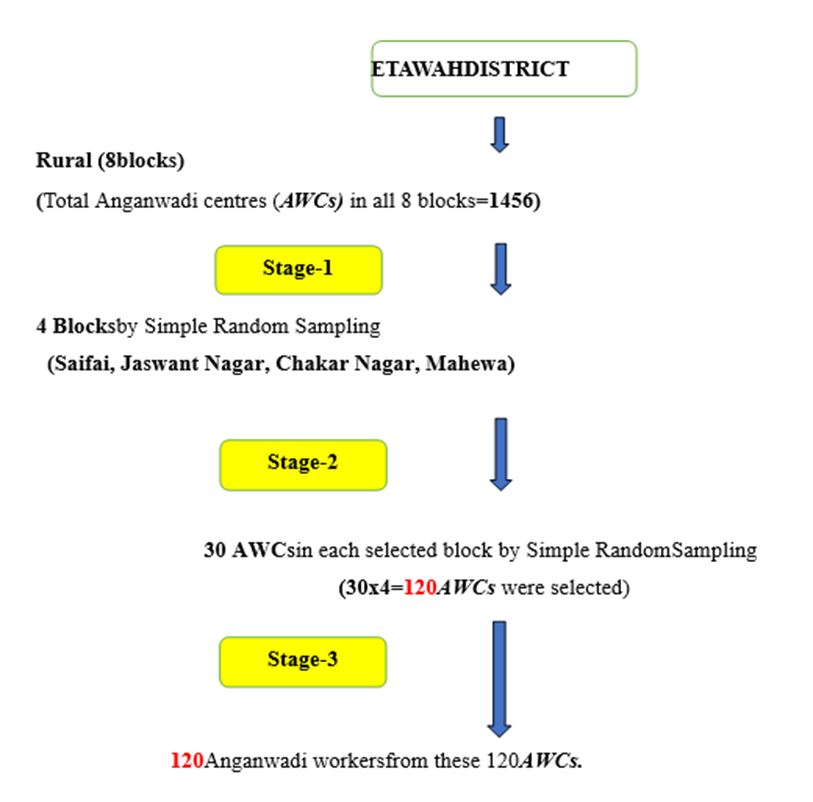 Figure no :1 Flow chart for selection of Participants
RESULTS:
Table 1: Socio-demographic profile of Anganwadi workers (n=120)
|
S.no |
Socio-demographic profile |
Anganwadi workers (n=120) |
|
|
n |
% |
||
|
1. |
Age (Years) |
|
|
|
Mean ± SD |
44 ± 5 |
||
|
34-44 |
62 |
51.7 |
|
|
45-54 |
50 |
41.7 |
|
|
55-58 |
8 |
6.7 |
|
|
2. |
Religion |
|
|
|
Hindu |
116 |
96.7 |
|
|
Muslim |
4 |
3.3 |
|
|
3. |
Category |
|
|
|
General |
18 |
15.0 |
|
|
Other Backward caste |
69 |
57.5 |
|
|
Scheduled Caste |
33 |
27.5 |
|
|
4. |
Educational Qualification |
|
|
|
Secondary school |
24 |
20.0 |
|
|
Higher Secondary school |
60 |
50.0 |
|
|
Graduate |
34 |
28.3 |
|
|
Post-graduate |
2 |
1.7 |
|
|
5. |
Marital status |
|
|
|
Married |
117 |
97.5 |
|
|
Widow/ Separated |
3 |
2.5 |
|
|
6. |
Monthly salary (Rupees) |
|
|
|
4500-5500 |
72 |
60.0 |
|
|
6000-7500 |
48 |
40.0 |
|
|
7. |
Residence of AWW |
|
|
|
Within village |
120 |
100 |
|
|
8. |
Anganwadi Helper |
|
|
|
Yes |
108 |
90.0 |
|
|
No |
12 |
10.0 |
|
Table 1 shows the socio-demographic characteristics of the Anganwadi workers (n=120) with the majority aged 34–44 years (51.7%) and identifying as Hindu (96.7%). Over half belonged to the OBC category (57.5%), and 50.0% had completed higher secondary education. Most were married (97.5%), earned between ₹4,500 and ₹5,500 monthly (60.0%), and all resided within their respective villages (100%).
Table 2: Distribution of Anganwadi centres as per Infrastructure and Condition status
|
S. No. |
Infrastructure |
Category |
Anganwadi Centres (n = 120), n |
% |
|
1 |
Location |
Within village |
120 |
100.0 |
|
2 |
Building Ownership |
Own building |
29 |
24.2 |
|
Government school |
91 |
75.8 |
||
|
3 |
Building Type |
Pucca |
114 |
95.0 |
|
Semi-pucca |
6 |
5.0 |
||
|
4 |
Building Condition |
Well-maintained |
24 |
20.0 |
|
Minor repair needed |
78 |
65.0 |
||
|
Poor condition |
18 |
15.0 |
Table no: 2 describe the Anganwadi centres which all were located within villages, with the majority (75.8%) operating from government schools and only 24.2% having dedicated buildings. While most featured pucca structures (95.0%), maintenance was largely suboptimal, with 65.0% requiring minor repairs and 15.0% found in poor condition.
Table 3: Distribution of Anganwadi centres as per availability and functionality status of basic Amenities
|
S.no |
Basic Amenity |
Anganwadi centres (n=120) |
Functionality Status |
n |
% |
|
1. |
Electric fan |
41 |
Functional |
35 |
85.3 |
|
Non-functional |
6 |
14.7 |
|||
|
2. |
Lighting |
86 |
Functional |
70 |
81.3 |
|
Non-functional |
16 |
18.6 |
|||
|
3. |
Separate kitchen |
22 |
Hygienic |
19 |
86.3 |
|
Unhygienic |
3 |
13.6 |
|||
|
4. |
Store room (food) |
13 |
Pest-free |
9 |
69.2 |
|
Infested |
4 |
30.7 |
|||
|
5. |
Store room (equipment) |
29 |
Functional |
23 |
79.3 |
|
Non-functional |
6 |
20.6 |
|||
|
6. |
Indoor activity space |
105 |
Adequate |
42 |
40.0 |
|
Inadequate |
63 |
60.0 |
|||
|
7. |
Outdoor activity space |
101 |
Adequate |
89 |
88.1 |
|
Inadequate |
12 |
11.8 |
Table 3 describes the basic amenities were limited, with electric fans present in 41 centres (85.3% functional) and lighting in 86 (81.3% functional). Separate kitchens were available in 22 centres (86.3% hygienic), while food and equipment storage facilities showed functional and hygiene gaps. Although indoor activity space was common, it was adequate in only 40.0% of cases, whereas outdoor space was adequate in 88.1% of centres.
Table 4: Distribution of Anganwadi centres as per availability and functionality status of anthropometric equipment and preschool education kits
|
S.no |
Equipment |
Anganwadi centres (n=120) |
Functionality Status |
n |
% |
|
1. |
Infantometer |
37 |
Functional |
13 |
35.1 |
|
Non-functional |
24 |
64.8 |
|||
|
2. |
Stadiometer |
65 |
Functional |
36 |
55.3 |
|
Non-functional |
29 |
46.0 |
|||
|
3. |
Infant weighing scale |
56 |
Functional |
27 |
48.2 |
|
Non-functional |
29 |
51.7 |
|||
|
4. |
Mother & child scale |
113 |
Functional |
99 |
87.6 |
|
Non-functional |
14 |
12.3 |
|||
|
5. |
Growth charts |
115 |
Preserved/readable |
32 |
27.8 |
|
Faded/illegible |
83 |
72.1 |
|||
|
6. |
NFPSE kits* |
116 |
Well-maintained |
45 |
38.7 |
|
Worn-out/incomplete |
71 |
61.2 |
*Non-Formal Pre-school Education
Table 4 presents the functionality status of anthropometric equipment was notably low, with only 35.1% of Infantometer, 55.3% of Stadiometers, and 48.2% of infant weighing scales being functional. Mother and child scales performed better at 87.6% functionality, but 72.1% of growth charts were faded or illegible. Additionally, while NFPSE kits were widely available, 61.2% were worn-out or incomplete.
Table 5: Distribution of Anganwadi centres as per Service delivery status of ICDS components
|
S.no |
Service Components |
Anganwadi centres (n=120) |
% |
|
1. |
Supplementary Nutrition |
||
|
THR* provided |
120 |
100.0 |
|
|
HCM* provided |
118 |
98.3 |
|
|
Regular supply (≥25 days/month) |
87 |
72.5 |
|
|
Meal plan displayed |
95 |
79.2 |
|
|
2. |
Growth Monitoring |
||
|
Regular weighing conducted |
120 |
100.0 |
|
|
Monthly frequency |
76 |
63.3 |
|
|
3. |
Health Check-ups |
||
|
For children |
102 |
85.0 |
|
|
ANC* for pregnant women |
94 |
78.3 |
|
|
PNC* for lactating mothers |
89 |
74.2 |
|
|
4. |
Immunization Facilitation |
||
|
Immunization services |
120 |
100.0 |
|
|
Regular VHND (monthly) |
108 |
90.0 |
|
|
5. |
Preschool Education (PSE) |
||
|
PSE activities conducted |
114 |
95.0 |
|
|
Daily sessions (of 114) |
68 |
59.6 |
|
|
Play-way methods used (of 114) |
82 |
71.9 |
|
|
6. |
Health & Nutrition Education |
||
|
Regular sessions conducted |
106 |
88.3 |
|
*THR-Take Home Ration, HCM-Hot Cooked Meals, ANC-Antenatal care, PNC-Postnatal care
Table 5 summarises ICDS service coverage was broadly high, with 100% coverage for supplementary nutrition (THR), regular weighing, and immunization support. However, gaps in regularity were evident: only 72.5% of centres maintained a consistent 25-day food supply, and monthly weighing was achieved in just 63.3% of cases. While preschool education and health education reached over 88% of centres, daily preschool sessions occurred in only 59.6% of those facilities.
DISCUSSION:
The present study reveals a significant gap between the broad geographic reach of the ICDS scheme and the functional quality of infrastructure in rural Etawah. While 95% of AWCs operated from pucca structures, only 24.2% had dedicated buildings. These findings correlate with Pradhan et al. (2025) [2], who reported similar infrastructural deficits in West Bengal, noting a heavy reliance on government school premises rather than independent facilities. The absolute absence of child-friendly toilets and safe RO drinking water in the 120 studied centres is a critical deficiency. This aligns with Behera et al. (2025) [3] and Tabassum et al. (2025) [1] who both documented significant gaps in WASH practices and physical infrastructure in Odisha and Delhi respectively.
Growth monitoring services showed a disconnect between universal coverage and tool functionality. Although weighing was conducted in all centres, 64.8% of Infantometer and 51.7% of infant scales were non-functional. This lack of equipment readiness is consistent with findings by Vishwa Prasad et al. (2024)[6]in Karnataka. Furthermore, the high prevalence of illegible growth charts(72.1%) reflects the documentation challenges and digital transition issues highlighted by Kurian et al.(2023)[10] and Verma and Mishra (2025)[4].
While supplementary nutrition showed near-universal coverage (100% for THR), regular supply for at least 25 days a month was achieved in only 72.5% of centres. The 59.6% rate of daily preschool education (PSE) sessions suggests better performance than some older multi-state evaluations like Panda et al. (2021)[14], yet it indicates that worker motivation and reporting burdens, as discussed by Pandey et al. (2024)[9], continue to impact service intensity.
CONCLUSION:
Rural Anganwadi Centres in District Etawah showed major infrastructure and functional gaps despite broad geographic coverage and predominantly pucca buildings. Critical deficiencies included absence of child-friendly toilets and safe drinking water, limited kitchen and storage facilities, and poor functionality of essential growth-monitoring equipment. Strengthening dedicated infrastructure, maintenance protocols, supportive digital systems, and routine monitoring is necessary to improve the quality and effectiveness of ICDS services in rural Etawah.
Acknowledgements
The authors express sincere gratitude to the District Programme Officer, ICDS, Etawah, for granting permission and facilitating field visits.
Financial Support and Sponsorship
Nil.
Conflicts of Interest
There are no conflicts of interest.
Authors’ Contribution
All authors contributed to the conception, design, data collection, analysis, interpretation, drafting, and revision of the manuscript, and approved the final version.
Ethical Policy and Institutional Review Board Statement
Ethical clearance was obtained from the Institutional Ethics Committeebefore initiation of the study.
Patient Declaration of Consent Statement
Written informed consent was obtained from all participating Anganwadi workers. No patient-identifiable information is included in this manuscript.
REFERENCES:
1. Tabassum Z, Dwivedi D, Mishra CP, Ranjan A. Quality of physical infrastructure, WASH practices, preschool education and safety in Anganwadi centres, government preschools and private preschools in Delhi. Indian J Community Med. 2025;50(1):78-84.
2. Pradhan PP, Chakraborty S, Mandal S. Infrastructural and functional characteristics of urban and rural Anganwadi centres in Purba Medinipur, West Bengal: A comparative analysis. Indian J Public Health. 2025;69(1):45-51.
3. Behera BK, Swain S, Pati S. WASH status of Anganwadi centres in Jajpur district, Odisha. J Family Med Prim Care. 2025;14(2):156-162.
4. Verma S, Mishra P. Digital divide and frontline workers: The POSHAN Tracker experience. Econ Polit Weekly. 2025;60(3):34-41.
5. Rajith MR, Kumar A, Thankappan KR. Assessing impact of ICDS services on beneficiaries in Wayanad district, Kerala. Indian J Community Med. 2025;50(1):67-73.
6. Vishwa Prasad CK, Ravi Kumar MN, Praveen Kumar S. Assessment of facilities and services at Anganwadi centres under ICDS scheme in Hanur, Karnataka. Int J Community Med Public Health. 2024;11(8):2945-2951.
7. Dave P, Solanki D, Yadav S. Assessment of infrastructural and utility facilities of Anganwadi centres in Gujarat. Natl J Community Med. 2024;15(6):456-462.
8. Lall M, Reddy V, Sharma K. Early years foundation: Perspectives and challenges of Anganwadi workers in supporting early child development. Child Care Health Dev. 2024;50(3):e13245.
9. Pandey S, Gaikwad N, Kulkarni P. Factors affecting Anganwadi workers’ performance and motivation in Nagpur, Maharashtra. Indian J Community Med. 2024;49(2):234-240.
10. Kurian S, Shah N, Patel D. Response and adaptations to digitalization of ICDS record keeping systems in urban Gujarat. BMC Health Serv Res. 2023;23(1):456.
11. Touthang J, Singh R, Devi L. Evaluation of ICDS scheme in a hilly tribal district of Manipur. Indian J Community Med. 2022;47(3):345-350.
12. Baseer M, Mahadevappa K, Nanjappa S. Infrastructure evaluation of Anganwadi centres in Kalaburagi city, Karnataka, India. Int J Community Med Public Health. 2022;9(5):2156-2161.
13. Wilson P, Patil S, Jadhav N. Assessment of ICDS at grassroot level in urban Raigad district, Maharashtra. Int J Med Sci Public Health. 2021;10(6):234-239.
14. Panda P, Benjamin AI, Zachariah A. Evaluation of Anganwadi centres under ICDS in India: A multi-state study. Indian Pediatr. 2021;58(8):723-728.
15. Sabat S, Panigrahi AK. A study on facilities available in Anganwadi centres of Odisha. Indian J Prev Soc Med. 2020;51(2):78-84.