C PEPTIDE TO TRIGLYCERIDE RATIO AS A MARKER OF PANCREATIC BETA CELL FUNCTION IN PATIENT WITH TYPE 2 DIABETES MELLITUS.
- Dhruvin Tamboli , Assistant Professor, Department of Biochemistry, Sal Institute of Medical Sciences, Opp. Science City, Sola Bhadaj Road, Ahmedabad, Gujarat – 380060, India.
- Jadav Helly Pareshbhai , 2nd Year of MBBS Student, Sal Institute of Medical Sciences, Opp. Science City, Sola Bhadaj Road, Ahmedabad, Gujrat – 380060, India.
- Patel Shailaja Bharatbhai , 3rd Year of MBBS Student, Sal Institute of Medical Sciences- Sal Institute of Medical Sciences, Opp. Science City, Sola Bhadaj Road, Ahmedabad, Gujrat – 380060, India.
- Meman Ujmabanu Arifbhai , 3rd Year of MBBS Student, Sal Institute of Medical Sciences - Sal Institute of Medical Sciences, Opp.Science City, Sola Bhadaj Road, Ahmedabad, Gujrat – 380060, India.
- Renil N. Shah , 3rd Year of MBBS Student, Sal Institute of Medical Sciences - Sal Institute of Medical Sciences, Opp.Science City, Sola Bhadaj Road, Ahmedabad, Gujrat – 380060, India.
- Patel Shailja Rajanikumar , 3st year of MBBS Student, Kemerovo state university,650043, Kemerovo Oblast, Russia.
Article Information:
Abstract:
Background: Type 2 diabetes mellitus (T2DM) is characterized by insulin resistance and progressive pancreatic β-cell dysfunction. C-peptide, secreted in equimolar amounts with insulin, serves as a reliable marker of endogenous insulin secretion and β-cell function. Dyslipidemia, particularly hypertriglyceridemia, is commonly associated with T2DM and contributes to insulin resistance and β-cell impairment. The present study was conducted to evaluate the relationship between C-peptide and triglyceride levels and to assess the utility of the C-peptide to triglyceride (C-peptide/TG) ratio as a marker of pancreatic β-cell function in patients with T2DM.
Keywords:
Article :
INTRODUCTION:
Diabetes mellitus (DM) is a condition marked by high blood sugar levels resulting from inadequate insulin production or ineffective insulin action. In type 2 diabetes, the cells in the body become resistant to insulin, leading to insulin resistance. Beta cells in the pancreas create insulin by generating proinsulin, which then undergoes a series of steps to become insulin. Proinsulin consists of three peptide chains; when the C peptide is removed, it transforms into insulin. Insulin has a brief half-life and varies quickly, while C peptide has a longer half-life and indirectly reflects the activity of pancreatic beta cells. Insulin and C peptide are released in equal quantities from the pancreatic beta cells. A high level of C peptide indicates enhanced beta cell activity due to insulin resistance. As a result, we can assess the quantity of insulin secreted by beta cells by evaluating the level of C peptide.
Metabolism of glucose and lipid are linked. The majority of patients with type 2 diabetes exhibit a dyslipidemia which is characterized by elevated triglycerides, low HDL-C and the predominance of small-dense LDL particle.(1) Although not all diabetic patients show all manifestations, 60% to 70% of patients show at least some lipid abnormality. This dyslipidemia presents a major (probably the most important) link between diabetes and cardiovascular disease. The characteristic lipid changes are not only seen in patients with overt diabetes but also in patients with metabolic syndrome and are therefore believed to reflect insulin resistance rather than hyperglycemia.(2) Hypertriglyceridemia can worsen glucose metabolism is clinically important as it explains why it is more difficult to control hyperglycemia in patients with hypertriglyceridemia compared to those with normal triglyceride values. It also explains why patients usually require less intensive antidiabetic treatment once hypertriglyceridemia has resolved.
More recently it was shown that also HDL may directly affect glucose metabolism (6). Hypertriglyceridemia increases the accumulation of free fatty acids in the skeletal muscles, resulting in IR (8). Additionally, at higher TG levels the breakdown of fat is reduced, leading to a significant increase in the accumulation of circulating chylomicron and very-low-density lipoprotein (LDL) remnants. This increase promotes endothelial dysfunction and inflammation, increased β-cell dysfunction, and cell apoptosis. For decades, increased levels of TG and TG-rich lipoproteins have been widely recognized as risk factors for atherosclerotic cardiovascular disease (9,10). The triglyceride-glucose (TyG) index, a combination of TG and fasting blood glucose (FBG), has been identified as a more reproducible biomarker of IR than the homeostatic model assessment for IR (HOMA-IR) (11,12). The atherogenic index of plasma (AIP), which is the ratio of TGs to high-density lipoprotein (HDL), is a biomarker for plasma atherosclerosis used to predict the development of cardiovascular events and their associated mortality rates (13).
AIMS AND OBJECTIVES
Objectives: To determine the correlation between serum C-peptide and triglyceride levels and to establish the C-peptide/TG ratio as a marker of pancreatic β-cell function in patients with Type 2 diabetes mellitus.
MATERIALS AND METHODS:
Type of study: A hospital based study
Study design: Case control study
Sample size: Study population compromised of 60 subjects with age 25-65 years of age who sought health care at Medicine department in GCS Medical Collage, Ahmedabad.
Approval & Consent: This study was conducted after the approval from the institutional Ethics Committee and with written informed consent from each patient after explaining the study procedure to them in their own language.
Sample collection procedure: 30 patients of type 2 DM were randomly selected for the study who had fulfilled the inclusion criteria and 30 age and sex matched healthy individuals as control group.
Inclusion Criteria:
1. Patients attending the outpatient department and inpatient department of Medicine department GCS Medical College, Hospital and Research Centre. Clinically and laboratory diagnosed cases of Type 2 DM [Age between 25 to 65 years] were included in this study.
2. Age and sex matched healthy subjects without any disease were used as control group.
Exclusion Criteria:
1. Clinically and laboratory diagnosed cases of Type 2 DM whose age is less than 25 and more than 65 years were excluded in this study.
2. Clinically and laboratory diagnosed cases of Type 1 DM.
Methods of evaluation: Estimation of Lipid Profile – Total cholesterol
ESTIMATION OF THE BIOCHEMICAL PARAMETER:
Estimation of Triglyceride:
Principle of Procedure:
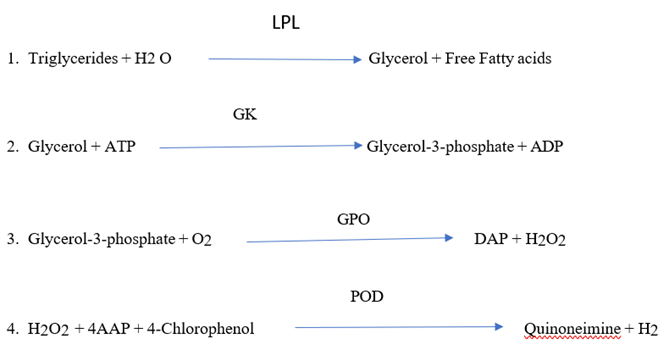
Triglycerides are enzymatically hydrolyzed by lipase to free acids and glycerol. The glycerol is phosphorylated by adenosine triphosphate (ATP) with glycerol kinase (GK) to produce glycerol-3-phosphate and adenosine diphosphate (ADP). Glycerol-3-phosphate is oxidized to dihydroxy-acetone phosphate (ADP) by glycerol phosphate oxidase producing hydrogen peroxide (H2 O2). In a Trinder type colour reaction catalyzed by peroxidase, the H2 O2 reacts with 4-aminoantipyrine (4AAP) and 4-chlorophenol to produce a red coloured dye. The absorbance of this dye is proportional to the concentration present in the sample.
REAGENT COMPOSITION:
R1
Good’s buffer (pH 7.2) 50 mmol/l
4-Chlorophenol 4 mmol/l
Mg 2+ 15 mmol/l
ATP 2 mmol/l Glycerolkinase ≥ 0.4 KU/l Peroxidase ≥ 2.0 KU/l Lipoproteinlipase ≥ 2.0 KU/l
Glycerol-3-phosphate-Oxidase ≥ 0.5 KU/l 4-Aminoantipyrine 0.5 mmol/l
REAGENT PREPARATIONS
Reagent is liquid and ready to use.
Reagent Storage:-
The unopened reagents are stable till the expiry date stated on the bottle and kit label when stored at 2–8°C.
On board stability: min. 30 days if refrigerated (2–10°C) and not contaminated.
CALIBRATION
Calibration with calibrator XL MULTICAL, Cat. No. XSYS0034 is recommended.
Calibration frequency: it is recommended to do a calibration.
after reagent lot change
as required by internal quality control procedures
Measuring range:- 9.74 – 1062 mg/dI
Specimen Required:- No Anticoagulant Human Serum.
RESULTS:
Serum Triglyceride Level
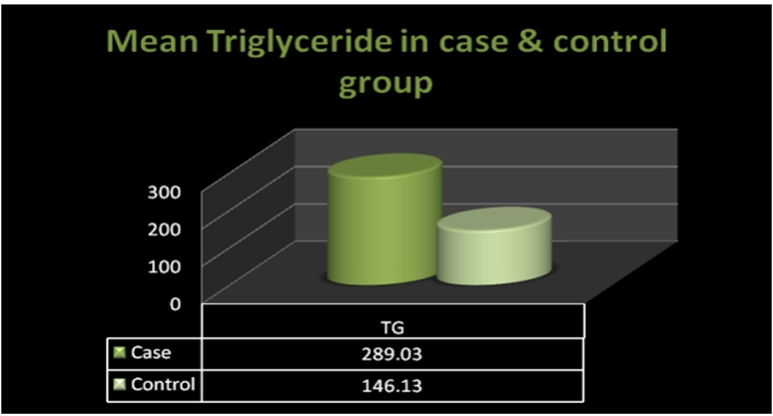
Figure 1: Serum Triglyceride Level:
Table 2: Serum Triglyceride Level
|
|
Case |
Control |
P Value |
|
TG |
289.03 ± 87.75 |
146.13 ± 59.71 |
0.042 |
From the above diagram, it was seen that mean TG level in the cases have higher than in the controls & it is also statistically significant (p<0.05).
C-Peptide to TG Correlation between Cases & Controls:
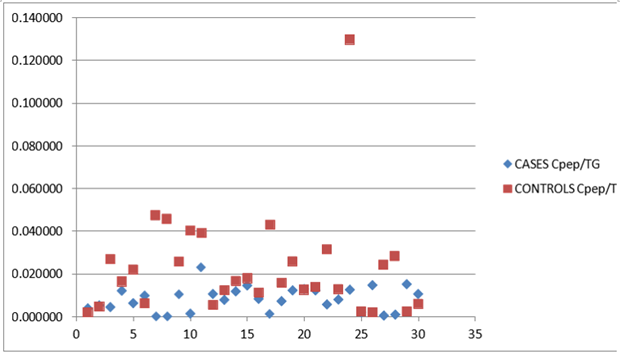
Figure 2: C-Peptide to TG Correlation between Cases & Controls:
Table 2: C-Peptide to TG Correlation between Cases & Controls:
|
|
Case |
Control |
P Value |
|
C-peptide/TG |
0.00804±0.005587 |
0.02287±0.0244 |
0.0020 |
From the above graph ,it was seen that mean C-peptide/TG level in the controls have higher than in the cases & it is also statistically significant ( p<0.05).
The mean serum triglyceride level was significantly higher in patients with T2DM compared to healthy controls (289.03 ± 87.75 mg/dL vs. 146.13 ± 59.71 mg/dL; p = 0.042). The mean C-peptide/TG ratio was significantly lower in T2DM patients than in controls (0.00804 ± 0.005587 vs. 0.02287 ± 0.0244; p = 0.002), indicating impaired pancreatic β-cell function in diabetic patients. These findings demonstrate a significant association between altered lipid metabolism and β-cell dysfunction in T2DM.
DISCUSSION:
Although the origin of T2DM is IR, it is only when β-cell failure leads to impaired insulin and secretion of C-peptide that fasting and postprandial hyperglycemia occur. Therefore, assessing the insulin secretory capacity of a patient is crucial for optimizing the treatment of diabetes. Actively functioning C-peptide serves as an indicator for evaluating insulin secretory capacity (14). In recent years it was recognized that lipid changes may not only be a consequence of impaired glucose metabolism but also cause them. Hypertriglyceridemia and low HDL-C are important in that context. Elevated levels of triglycerides lead to elevated levels of free fatty acids which may induce insulin resistance and β-cell dysfunction. (3,4).
A Korean study reported significant differences in fasting serum C-peptide levels for obesity and correlation of C-peptide with TG.(5) Individuals with high C-peptide levels in the present study had higher serum cholesterol and triglyceride levels. In a similar study by Gilsa E S et al,(7) Banu et al., in their study on patients with metabolic syndrome, demonstrated a significant correlation of TG with C peptide levels and a progressive increase in insulin resistance with an increase in C-peptide levels, supporting the usefulness of C-peptide in monitoring insulin resistance.(15) We explored the correlation of age with insulin, C peptide, and lipid levels in individuals with T2DM.
Understanding these associations is crucial for tailoring diabetes management strategies, especially in older individuals, and addressing the heightened cardiovascular risk associated with aging in the context of T2DM. Insulin um/ml, Insulin Resistance (IR), C peptide Ng/ml, Hb-A1C%, Triglycerides (TG) Mg/dl, and Total Cholesterol (T-CH) Mg/dl all exhibit a positive correlation with age. These correlations are statistically significant(16). Patients were assigned to four groups (FCP 0, 1, 2, and 3) based on FCP level quartiles, from lowest to highest. The differences in TG levels, TyG indices, and AIPs among the four groups were statistically significant (all P<0.01).(17).
CONCLUSION:
The current hospital-based case-control study was carried out to determine the usefulness of C-peptide as a measure of pancreatic β-cell activity and to examine the connection between blood C-peptide levels and total cholesterol levels in patients with Type 2 Diabetes Mellitus (T2DM). Thirty clinically and biochemically diagnosed Type 2 DM cases were compared to thirty healthy controls who were matched for age and sex.
The results of this study showed that patients with Type 2 Diabetes Mellitus had significantly higher serum total cholesterol levels than healthy controls (220.5 ± 32.6 mg/dL vs. 183.7 ± 20.41 mg/dL, p = 0.00014). This suggests that T2DM patients have dyslipidemia, which is linked to insulin resistance and altered metabolic status.
The results of this study showed that patients with Type 2 Diabetes Mellitus had significantly higher serum total cholesterol levels than healthy controls (220.5 ± 32.6 mg/dL vs. 183.7 ± 20.41 mg/dL, p = 0.00014). This suggests that T2DM patients have dyslipidemia, which is linked to insulin resistance and altered metabolic status. Additionally, the C-peptide to total cholesterol (C-peptide/TC) ratio between patients and controls showed a statistically significant difference (0.0100 ± 0.007318 vs. 0.01571 ± 0.01102, p = 0.0219). This finding implies a close relationship between changes in lipid metabolism and pancreatic β-cell activity in individuals with Type 2 Diabetes Mellitus.
Patients with Type 2 diabetes have elevated C-peptide levels, which are indicative of compensatory hyperinsulinemia brought on by peripheral insulin resistance. The coexistence of diabetic dyslipidemia is shown by the corresponding rise in total cholesterol levels. These results lend credence to the idea that patients with Type 2 Diabetes Mellitus develop insulin resistance, β-cell dysfunction, and cardiovascular risk as a result of simultaneous disruptions in glucose and lipid metabolism.
As a result, serum C-peptide can be a helpful indirect indicator of pancreatic β-cell reserve and endogenous insulin secretion. Evaluation of lipid profile characteristics and C-peptide levels may aid in the early detection of metabolic abnormalities, assessment of the course of the disease, and risk assessment of individuals with Type 2 Diabetes Mellitus. The current study did have several drawbacks, though, such as a limited sample size and the assessment of just total cholesterol among lipid markers. To further establish the clinical significance of C-peptide as a marker of pancreatic β-cell function and its relationship with diabetic dyslipidemia, future studies with larger sample sizes and comprehensive lipid profiling, including triglycerides, HDL cholesterol, LDL cholesterol, and various insulin resistance indices, are advised.
In summary, this study shows that people with Type 2 Diabetes Mellitus have significantly different serum total cholesterol levels and the C-peptide to total cholesterol ratio when compared to healthy persons. These results imply that serum C-peptide could be a useful indicator of pancreatic β-cell function and could play a significant part in comprehending the metabolic and cardiovascular issues related to Type 2 Diabetes Mellitus.
REFERENCES:
1. Wu L, Parhofer KG. Diabetic dyslipidemia. Metabolism 2014; 63:1469-79
2. Avramoglu RK, Basciano H, Adeli K. Lipid and lipoprotein dysregulation in insulin resistant states. Clin Chim Acta 2006;368: 1-19.
3. Briaud I, Harmon JS, Kelpe CL, Segu VB, Poitout V. Lipotoxicity of the pancreatic beta-cell is associated with glucose-dependent esterification of fatty acids into neutral lipids. Diabetes 2001;50:315-21.
4. Lee Y, Hirose H, Ohneda M, Johnson JH, McGarry JD, Unger RH. Beta-cell lipotoxicity in the pathogenesis of non-insulin dependent diabetes mellitus of obese rats: impairment in adipocyte-beta-cell relationships. Proc Natl Acad Sci U S A 1994; 91:10878-82.
5. Cho M, Park JS, Nam J, Kim CS, Nam JH, Kim HJ, et al. Association of abdominal obesity with atherosclerosis in type 2 diabetes mellitus (T2DM) in Korea. J Korean Med Sci 2008;23:781-8.
6. Drew BG, Rye KA, Duffy SJ, Barter P, Kingwell BA. The emerging role of HDL in glucose metabolism. Nat Rev Endocrinol 2012;8:237-45.
7. . Gilsa ES, Lonappan L, Madhavan L. C-peptide levels: anthropometric correlation with measurements of obesity and components of metabolic syndrome. Int J Acad Med Pharm 2024;6(1):1783-7
8. Borén J, Taskinen MR, Olofsson SO, Levin M (2013) Ectopic lipid storage and insulin resistance: a harmful relationship. J Intern Med 274(1):25–40
9. Ginsberg HN, Packard CJ, Chapman MJ, Borén J, Aguilar-Salinas CA, Averna M et al (2021) Triglyceride-rich lipoproteins and their remnants: metabolic insights, role in atherosclerotic cardiovascular disease, and emerging therapeutic strategies-a consensus statement from the European Atherosclerosis Society. Eur. Heart J. 42:4791–4806.
10. Chait A, Ginsberg HN, Vaisar T, Heinecke JW, Goldberg IJ, Bornfeldt KE (2020) Remnants of the triglyceride-rich lipoproteins, diabetes, and cardiovascular disease. Diabetes 69:508–516.
11. Simental-Mendía LE, Rodríguez-Morán M, Guerrero-Romero F (2008) The product of fasting glucose and triglycerides as surrogate for identifying insulin resistance in apparently healthy subjects. Metab Syndr Relat Disord 6:299–304.
12. Tahapary DL, Pratisthita LB, Fitri NA, Marcella C, Wafa S, Kurniawan F et al (2022) Challenges in the diagnosis ofinsulin resistance: focusing on the role of HOMA-IR and tryglyceride/glucose index. Diabetes Metab Syndr 16:102581.
13. Wu X, Qiu W, Yang H, Chen YJ, Liu J, Zhao G (2024) Associations of the triglyceride-glucose index and atherogenic index of plasma with the severity of new-onset coronary artery disease in different glucose metabolic states. Cardiovasc Diabeto.l 23:76
14. Araki E, Goto A, Kondo T, Noda M, Noto H, Origasa H et al (2020) Japanese clinical practice guideline for diabetes 2019. J Diabetes Investig 11:1020–1076. Araki E, Goto A, Kondo T, Noda M, Noto H, Origasa H et al (2020)
15. Banu S, Jabir NR, Manjunath CN, et al. C peptide and its correlation to parameters of insulin resistance in the metabolic syndrome. CNS Neurol Disord Drug Targets 2011;10(8):921-7.
16. Namah, S., Esmael, W., & Abdul-Hussein , A. (2024). Insulin Resistance, Lipid Profile, C-Peptide, and Their Interplay in Type 2 Diabetes: A Basrah Population Study. Al-Kufa University Journal for Biology, 16(3), 27-34.
17. Li H, Zhu Z. Involvement of C-peptide in the progression of type 2 diabetes mellitus through triglyceride-centered lipid metabolism. Hormones (Athens). 2026 Mar;25(1):129-137. doi: 10.1007/s42000-025-00737-0. Epub 2025 Nov 25. PMID: 41288953; PMCID: PMC13013344.