To Compare Hemodynamic Stability And Any Side Effects With Intrathecal 0.5% Hyperbaric Bupivacaine, Intrathecal Buprenorphine And Dexmedetomidine As Additives To 0.5 % Hyperbaric Bupivacaine For Spinal Anaesthesia.
- Shilpa wali , Senior resident, Dept of Anaesthesiology, ESIC Gulbarga.
- Nusrat Anjum , Assistant Professor, Department of anaesthesia, Gulbarga Institute of Medical Sciences
- Harshita Muralidhar , Senior Resident, Dept of Anesthesiology, Gulbarga Institute of Medical Sciences.
Article Information:
Abstract:
Background: Objective: To study the hemodynamic stability and any side effects of the drugs under study Methods: This prospective, interventional randomised study was conducted at Department of Anesthesiology, Basaveshwar teaching and general hospital, Mahadevappa Rampure Medical College, Kalaburagi. Result: Demographic datas were not statistically significant. Hemodynamic parameters were comparable between the groups. Conclusion: All three groups had stable and comparable hemodynamics during the study. Compared to buprenorphine, intrathecal administration of dexmedetomidine as additive to hyperbaric bupivacaine was associated with fewer side effects.
Keywords:
Article :
INTRODUCTION:
Spinal anesthesia have been shown to inhibit many endocrine metabolic changes associated with stress response, the effect is greatest with lower abdomen and lower extremity procedures than upper abdominal and thoracic procedures. This effect is due to decrease in afferent sensory information that helps to initiate stress response.
Subarachnoid block is a safe and effective form of anesthesia in surgeries involving the lower extremities and surgeries below the umbilicus.
Using High doses of Bupivacaine to prolong the duration of anaesthesia could be detrimental as it could lead to complication like hypotension, myocardial depression, dysrhythmias due to its cardiotoxicity. By prolonging the duration of sensory - motor block and limiting the cumulative dose requirement of local anaesthetics, co-administration of adjuvants has the potential to improve efficacy of perineural blocks and decrease local anaesthetic toxicity. They contribute in their own special manner to potentiate the analgesic effect of the local anaesthetics. [1]
Buprenorphine is a centrally acting partial opioid agonist with both spinal and supraspinal component of analgesia. [2]
Recently it has been found that buprenorphine has a local anaesthetic action, this mechanism may be responsible for prolonging the anaesthesia associated with buprenorphine. [3] It is highly lipid soluble and diffuses quickly into neural tissue, decreasing the chances of rostral spread leading to lesser side effects in the post-operative period. [4]
Dexmedetomidine is a highly specific α-2 adrenergic agonist.[5] It prolongs sensory block by acting on presynaptic C fibres and decreasing the neurotransmitter release. It acts on postsynaptic dorsal neurons causing their hyperpolarisation. It prolongs motor block by binding to motor neurons in the spinal cord [6,7].
MATERIALS AND METHODS:
This Prospective Interventional study was conducted on the patients in Department of Anesthesiology, Basaveshwar teaching and general hospital, Mahadevappa Rampure Medical College, Kalaburagi. Period of study was 01-08-2022 to 31-01-2024 (18 months.
Data will be collected in prescribed proforma meeting the objectives of the study. Patients are grouped randomly by simple Random technique into 3 groups (n=30): Group A: will receive 3ml (15mg) of 0.5% hyperbaric bupivacaine.
Group B: will receive 3ml (15mg) of 0.5% hyperbaric bupivacaine+5mcg Dexmedetomidine
Group C: will receive 3ml (15mg) of 0.5% hyperbaric bupivacaine +60mcg of buprenorphine.
Sampling procedure: Study subjects will be selected after applying inclusion and exclusion criteria. Information will be collected through prepared proforma from each case.
SELECTION CRITERIA FOR PATIENTS
Inclusion criteria
1. Patients belonging to ASA category 1 and 2
2. Male and Female gender
3. Age 18- 60 years
4. Posted for Elective spinal anaesthetic surgeries
Exclusion criteria
1. Patients with known contraindication for spinal anaesthesia.
2. Patients with coagulation disorders or on anticoagulation therapy.
3. Patients with cardiac disease, heart blocks and dysarrythmias
4. Patients with betablockers & alpha antagonists.
Sample size: 90
90 patients (30 patients in each group).
All subjects will be monitored during the surgery and perioperative period employing multi parameter monitors which displays heart rate, systolic blood pressure (SBP) diastolic blood pressure(DBP), mean arterial pressure(MAP), ECG and SPO2.
Side effects: Subjects will be monitored for occurrence of adverse events after spinal injection like, nausea, vomiting, shivering, bradycardia, hypotension, respiratory discomfort.
Statistical data analysis
All cases will be completed within the stipulated time. Data will be collected, compiled and tabulated. The statistical analysis will be done by using parametric test and final interpretation by using Software SPSS 20.0. Quantitative data will be analysed by paired and unpaired, ANOVA test and qualitative data by Chi square test or T test.
RESULTS:
The age distribution was in the range of 19-60 in Group A, 1 8 - 6 0 i n Group B and 18-60 in Group C. The ‘p’ value for mean age was not statistically significant (p value = 0.953).
The Gender distribution between the three groups, A had 11 males, 19 females. B had 18 males 12 females, C had 25 males and shows no significant difference, as indicated by a p-value of 0.773.
In this study, heart rate less than 50 beats was considered as bradycardia while collecting the data. Heart rate was recorded in 13 intervals, out of which only 2 intervals (0 and 3rd minute) were statistically significant.
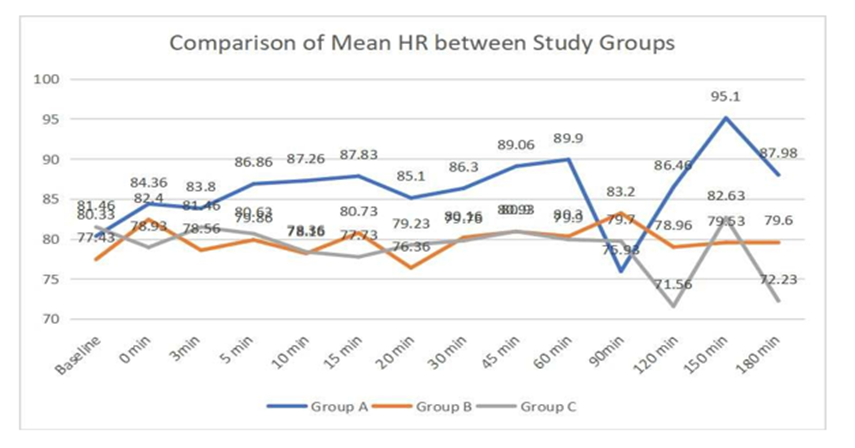
Graph 1 - Comparison of Mean HR between Study Groups
Table 1– Comparison of Mean SPO2 between Study Groups
|
Time |
Group A (n=30) Mean ± SD |
Group B (n=30) Mean ± SD |
Group C (n=30) Mean ± SD |
P-value |
|
Baseline |
99.06 ± 0.94 |
74.2 ± 9.13 |
99.06 ± 1.01 |
<0.001 |
|
0 min |
98.93 ± 1.08 |
98.9 ± 0.08 |
98.83 ± 1.11 |
0.917 |
|
3 min |
99.5 ± — |
98.2 ± 1.1 |
99 ± 0.98 |
<0.001 |
|
5 min |
99.1 ± 0.9 |
98.46 ± 1.22 |
99 ± 1.01 |
0.048 |
|
10 min |
99.63±0.66 |
98.5 ± 1.07 |
98.43 ± 1.27 |
<0.001 |
|
15 min |
99.63 ± 0.66 |
98.66 ± 1.23 |
98.43 ± 1.27 |
<0.001 |
|
20 min |
99.63 ± 0.66 |
98.66 ± 1.23 |
98.56 ± 1.04 |
<0.001 |
|
30 min |
99.5 ± 0.73 |
98.83 ± 1.08 |
98.53 ± 0.97 |
0.002 |
|
45 min |
99.33 ± 0.75 |
98.16 ± 1.01 |
98.73 ± 0.91 |
0.04 |
|
60 min |
99.56 ± 0.37 |
98.23 ± 1.08 |
98.56 ± 1.71 |
<0.001 |
|
90 min |
99.83 ± 1.3 |
98.07 ± 1.12 |
98.05 ± 1.08 |
0.002 |
|
120 min |
99.5 ± 0.73 |
98.2 ± 1.1 |
99 ± 0.98 |
0.04 |
|
150 min |
99.85 ± 0.96 |
98.28 ± 1.98 |
98.26 ± 1.82 |
0.002 |
|
180 min |
99.1 ± 0.9 |
98.46 ± 1.22 |
99 ± 1.01 |
0.048 |
Oxygen saturation was in the range of 96 – 100 %. It was not statistically significant (p value 0.07 > 0.05).
Table 2 - Comparison of Mean SBP between Study Groups
|
Parameters |
Group A (Mean ± SD) |
Group B (Mean ± SD) |
Group C (Mean ± SD) |
P-value |
|
Baseline |
126.7 ± 8.3 |
121.86 ± 8.81 |
81.06 ± 11.54 |
<0.001 |
|
0 min |
127.5 ± 10.7 |
123.3 ± 9.77 |
119.9 ± 9.76 |
0.018 |
|
3 min |
116.5 ± 10.8 |
119.93 ± 9.98 |
114 ± 8.91 |
0.668 |
|
5 min |
113.7 ± 13.12 |
124.23 ± 9.2 |
113.2 ± 8.38 |
<0.001 |
|
10 min |
120.23 ± 11.13 |
116.6 ± 11.22 |
110.86 ± 9.59 |
0.006 |
|
15 min |
128.03 ± 8.15 |
114.13 ± 9.61 |
112.26 ± 11.64 |
<0.001 |
|
20 min |
118.96 ± 1.15* |
121.66 ± 8.35 |
110.26 ± 10.18 |
<0.001 |
|
30 min |
125.36 ± 11.37 |
113.46 ± 14.14 |
108.46 ± 8.27 |
<0.001 |
|
45 min |
119.84 ± 1.42* |
116.13 ± 13.53 |
116.13 ± 13.53 |
0.006 |
|
60 min |
122.23 ± 1.12 |
116.7 ± 11.13 |
13.38± 110.91 |
0.045 |
|
90 min |
123.46 ± 4.14 |
113.13 ± 13.53 |
112.12 ± 11.15 |
0.021 |
|
120 min |
120.45 ± 0.72 |
123.31 ± 9.83 |
110.32 ± 9.59 |
0.031 |
|
150 min |
111.46 ± 9.38 |
119.7 ± 13.7 |
115.66 ± 17.5 |
0.015 |
|
180 min |
118.56 ± 9.61 |
114.61 ± 6.35 |
110.18 ± 10.26 |
<0.001 |
Table 3- Comparison of Mean DBP between Study Groups
|
Parameters |
Group A (n=30) Mean ± SD |
Group B (n=30) Mean ± SD |
Group C (n=30) Mean ± SD |
P-value |
|
Baseline |
75.83 ± 6.71 |
80.33 ± 11.8 |
74.33 ± 4.61 |
0.018 |
|
0 min |
58.7 ± 4.9 |
9.41± 63.3 |
6.91 ±66.5 |
0.018 |
|
3 min |
59.83 ± 8.69 |
61.9 ± 7.95 |
65.6 ± 6.11 |
0.031 |
|
5 min |
66.63 ± 7.65 |
62.96 ± 9.21 |
65.6 ± 6.11 |
0.170 |
|
10 min |
67.03 ± 5.09 |
58.9 ± 6.6 |
64.73 ± 7.33 |
<0.001 |
|
15 min |
68.66 ± 10.83 |
68.03 ± 8.73 |
62.26 ± 7.13 |
0.013 |
|
20 min |
59.69 ± 6.32 |
58.21 ± 8.6 |
62.5 ± 6.11 |
0.032 |
|
30 min |
66.22 ± 7.31 |
69.33 ± 11.88 |
65.91 ± 6.5 |
0.051 |
|
45 min |
66.63 ± 7.65 |
62.96 ± 9.21 |
65.6 ± 6.11 |
0.170 |
|
60 min |
65.83 ± 5.65 |
61.41 ± 7.61 |
63.95 ± 7.58 |
0.023 |
|
90 min |
68.63 ± 6.22 |
68.53 ± 8.69 |
63.41 ± 4.09 |
0.005 |
|
120 min |
74.63 ± 6.31 |
66.73 ± 9.34 |
67.53 ± 8.69 |
0.021 |
|
150 min |
66.5 ± 7.22 |
61.9 ± 9.44 |
64.4 ± 7.59 |
0.032 |
|
180 min |
69.76 ± 1.09 |
68.56 ± 7.61 |
68.7 ± 5.07 |
0.891 |
Table -4 Comparison of Mean MBP between Study Groups
|
Parameters |
GROUP A (n =30) Mean ± SD |
GROUP B (n= 30) Mean ± SD |
Group C (n=30) Mean ± SD |
P – value |
|
Baseline |
73.2±4.85 |
77.8±12.18 |
79.56±7.30 |
0.02 |
|
0 min |
77.7 ± 8.3 |
68.5 ± 10.39 |
79.53 ± 9.92 |
0.003 |
|
3min |
76.16 ± 7.5 |
63.3 ± 8.14 |
79.6 ± 7.31 |
<0.001 |
|
5 min |
78.2 ±9.5 |
68.6 ±6.41 |
79.8 ±8.82 |
<0.001 |
|
10 min |
77.43 ± 7.6 |
73.43 ± 9.12 |
81.8 ±5.51 |
0.001 |
|
15 min |
72.6 ± 7.5 |
74.3 ±8.6 |
86.1 ±5.9 |
<0.001 |
|
20 min |
80.3 ±5.6 |
69.63 ±8.4 |
83.46 ±7.57 |
<0.001 |
|
30 min |
77.2 ±5.09 |
74.6 ±5.56 |
90.6 ±10.73 |
<0.001 |
|
45 min |
76.2 ±10.21 |
70.6 ±5.7 |
87.6 ±6.93 |
<0.001 |
|
60 min |
80.83 ±10.37 |
89.56 ± 9.5 |
78.5 ±8.9 |
<0.001 |
|
90min |
82.2 ±8.2 |
81.6 ±9.2 |
83.2 ±8.95 |
0.418 |
|
120 min |
77.16 ± 8.03 |
79.86 ± 9.58 |
93.9 ±8.11 |
0.003 |
|
150 min |
82.3 ±8.68 |
79.5 ±8.56 |
89.86 ±8.7 |
<0.001 |
|
180 min |
78.33 ±9.24 |
77.16 ±9.74 |
84.2 ± 7.48 |
<0.001 |
Table 5 – Association of Side-effects between the groups
|
Side- effects |
GROUP A |
GROUP B |
GROUP C |
Total |
p- value |
|
Bradycardia |
2 (16.7%) |
3 (27.2%) |
3 (30%) |
8 (24.2%) |
0.969 |
|
Hypotension |
3 (25%) |
2 (18.1%) |
2 (20%) |
7 (21.2%) |
|
|
Shivering |
1 (8.3%) |
2 (18.1%) |
1 (10%) |
4 (12.1%) |
|
|
Vomiting |
6 (50%) |
4 (63.4%) |
4 (40%) |
14 (42.5%) |
|
|
Total |
12 (100%) |
11 (100%) |
10 (100%) |
33 (100%) |
More than one adverse effect was present in one case in each group.
In Group A, 2 (16.7%), Group B, 3 patients (27%), and in Group C, 3 patients (30%) had Bradycardia. Group A, 3 patients (25%) had hypotension and received ephedrine. In Group B, 2 patients had hypotension (18%), Group C, 2 patients (20%) had hypotension. But these episodes were not statistically significant (P value 0.969). Other adverse effects between the two groups were comparable.
1 patient (8%) in Group A, 2 patients (18%) in Group B, 1 patient in Group C (10%) had shivering. 6 patients (50%) in Group A, 4 patients(63%) in Group B, 4 patients in Group C (40%) had vomiting.
DISCUSSION:
This prospective, interventional randomised study was conducted at Department of Anesthesiology, Basaveshwar teaching and general hospital, Mahadevappa Rampure Medical College, Kalaburagi, with an aim to compare the effects of Plain Intrathecal 0.5% bupivacaine along with Dexmedetomidine and Buprenorphine as an adjuvant to 0.5% hyperbaric bupivacaine. The study included 90 patients belonging to the age group of 18-60 years of both sex of ASA grade 1 and 2 scheduled to undergo elective infraumblical surgeries.
HAEMODYNAMIC STABILTY
Al-Ghanem et al [8] in their study noted that the use of intrathecal dexmedetomidine to be associated with decrease in blood pressure and heart rate. In the present study, it was noted 3 cases of bradycardia and 2 cases of hypotension in dexmedetomidine group whereas 3 cases of bradycardia and 2 cases of hypotension in buprenorphine group. They were managed successfully with the use of atropine 0.6 mg I.V and ephedrine in incremental doses of 6 mg. Mahima gupta et al [1] in their studies also incidence of bradycardia was more in dexmedetomidine group. Dexmedetomidine causes bradycardia but the effect is more prominent when administered intravenously and with a higher dose [38].
ADVERSE EVENTS
Capogna et al[28] also observed more number of nausea and vomiting in buprenorphine group. Similar observations were seen by sapkal et al[9]. Talke et al[10] in their study observed that α2 adrenergic agents have anti shivering property. In the present study we have encountered case of shivering more in dexmedetomidine group compared to other two groups. This is similar to Mahima gupta et al [1] study where the incidence of shivering was more in dexmedetomidine group when compared to buprenorphine group. In the present study the SPO2 was in the range of 97 – 100 % without oxygen supplementation. No incidence of respiratory depression, pruritus and ECG changes were found in both the groups.
CONCLUSION:
The present study concludes that All three groups had stable and comparable hemodynamics during the study. Compared to buprenorphine, intrathecal administration of dexmedetomidine as additive to hyperbaric bupivacaine was associated with fewer side effects.
REFERENCES:
1. Mahima gupta, S. Shailaja, K.Sudhir Hegde. Journal of clinical and diagnostic research 2014. Vol-8(2):114-117.
2. Ding Z, Raffa RB. Identification of an additional supraspinal component to the analgesic mechanism of action of buprenorphine. Br J Pharmacol. 2009;157:831-43.
3. Leffler A, Frank G, Kishner K, Niedermirtl F, Koppert W, Reeh PW, Nau C. Local anesthetic-like inhibition of voltage-gated Na(+) channels by the partial µ-opioid receptor agonist buprenorphine. Anesthesiology. 2012;116:1335-46.
4. Capogna G, Celleno D, Tagariello V, Loffreda-Mancinelli C. Intrathecal buprenorphine for postoperative analgesia in the elderly patient. Anaesthesia. 1988; 43: 128-30.
5. Gupta R, Verma R, Bogra J, Kohli M, Raman R, Kushwaha JK. A comparative study of intrathecal dexmedetomidine and fentanyl as adjuvants to bupivacaine. J Anaesthesiol Clin Pharmacol. 2011;27:339-43.
6. Shah A, Patel I, Gandhi R. Haemodynamic effects of intrathecal dexmedetomidine added to ropivacaine intraoperatively and for postoperative analgesia. Int J Basic Clin Pharmacol. 2013;2:26-29.
7. Eisenach JC, De Kock M, Klimscha W. Alpha(2)-adrenergic agonists for regional anesthesia. A clinical review of clonidine (1984-1995). Anesthesiology. 1996; 85: 655-74
8. Al- Ghanem SM, Massad IM, Al-Mustafa MM, Al- Zaben KR, Qudaisat IY, Qatawneh AM and Abu-Ali HM. Effect of Adding Dexmedetomidine versus Fentanyl to Intrathecal Bupivacaine on Spinal Block Characteristics in Gynaecological procedures: A double blind controlled study. American Journal of applied science 2009; volume- 6(5):882-887.
9. Sapkal PS, Kulkarni KD, Rajurkar SS, Nandedkar pd. Comparative study of intrathecal clonidine and intrathecal Buprenorphine for postoperative analgesia after lower limb orthopaedic surgery.International journal current Res Rev. 2013;5:87-91.
10. Talke P, Tayefeh F, Sessler DI, Jeffrey R, Noursalehi M, Richardson C. Dexmedetomidine does not alter the sweating threshold, but comparably and linearly reduces the vasoconstriction and shivering thresholds. Amesthesiology. 1997;87:835-41.