A Study On Outcome Of Surgical Management Of Unstable Intertrochanteric Fractures In Geriatric Population By Various Modalities”.
- Dumala Shambu , Assistant Professor, Department Of Orthopedics and Traumatology GMC, NIZAMABAD.
- Banoth Gavaskar , Associate Professor, Department of Orthopedics and Traumatology RIIMS, ADILABAD.
- G. Naveen , Assistant Professor, Department Of Orthopedics and Traumatology GMC JAGITYAL.
- Bandela Snigdha , Assistant Professor, Department Of Orthopedics and Traumatology GMC JAGITYAL.
- N.Ravi Kiran , Professor, Department Of Orthopedics and Traumatology GMC NIZAMABAD.
Article Information:
Abstract:
Background: Intertrochanteric fractures are a major cause of morbidity and mortality among the elderly, accounting for approximately 45% of all hip fractures. These fractures are commonly associated with osteoporosis and low-energy falls, particularly in older women. Although internal fixation remains the standard treatment, unstable fractures in osteoporotic bone are associated with complications such as implant failure, loss of fixation, and delayed rehabilitation. Cemented bipolar hemiarthroplasty has emerged as an alternative treatment option to facilitate early mobilization and reduce fixation-related complications. Materials and Methods: This study included 50 patients with unstable intertrochanteric fractures. Patients were managed using different treatment modalities, including Dynamic Hip Screw (DHS), Proximal Femoral Nail (PFN), Ender’s nail, and cemented bipolar hemiarthroplasty. Osteoporosis was assessed using Singh’s index based on radiographic evaluation of the proximal femur. Clinical outcomes, postoperative rehabilitation, and complications associated with each treatment modality were evaluated. Results: Intertrochanteric fractures were predominantly observed in elderly patients with osteoporotic bone, with a higher incidence in females. Internal fixation provided satisfactory fracture stabilization but was associated with complications such as implant loosening, cut-out, penetration, and loss of fixation in osteoporotic patients. Cemented bipolar hemiarthroplasty allowed earlier weight bearing, improved mobilization, and reduced fixation-related complications, making it a favorable option for selected elderly patients with unstable fractures. Conclusion: Unstable intertrochanteric fractures in elderly patients remain a challenging clinical problem due to poor bone quality and fracture instability. While internal fixation remains an effective treatment, cemented bipolar hemiarthroplasty offers significant advantages in carefully selected patients by enabling early rehabilitation and minimizing implant-related complications. Treatment should be individualized based on fracture pattern, bone quality, and patient characteristics.
Keywords:
Article :
INTRODUCTION:
One of the main causes of morbidity and death in the senior population is intertrochanteric fractures. Approximately 80 hip fractures occur for every 100,000 people. Forty-five percent of hip fractures are intertrochanteric fractures1. Even though internal fixation has improved outcomes, unstable intertrochanteric fractures in older individuals are linked to significant rates of morbidity and mortality2. However, osteoporosis and instability frequently make it impossible for these individuals to resume full weight bearing at an early stage3.
Falls combining both direct and indirect pressures nearly always result in trochanteric fractures. According to Koval4 and Zuckerman, intertrochanteric fractures account for about half of all proximal femur fractures. Intertrochanteric fractures are caused by direct forces acting either directly across the greater trochanter or along the femur's axis. The draw of the abductor muscle on the greater trochanteric region and the pull of the iliopsoas muscle on the smaller trochanteric are examples of indirect forces.
Orthopaedic surgeons frequently treat intertrochanteric fractures, such as femoral neck fractures. Because women are typically less active and develop postmenopausal osteoporosis, intertrochanteric fractures are three times more common in women than in males over the age of sixty. Trochanteric fractures with mild to moderate trauma are common in this age range due to severe osteoporosis. Patients with intracapsular femoral neck fractures had an average age of 60 to 75 years, whereas patients with intertrochanteric fractures are 10 to 12 years older, according to Norton and Ruska5.
Osteoporosis-affected bone is often the cause of intertrochanteric fractures. Singh's index, which categorises the severity of osteoporosis based on radiographic assessment of the proximal femur's trabecular pattern6, can be used to assess the degree of osteoporosis. In older patients with trochanteric fractures, surgery is crucial for early rehabilitation and mobilisation as well as preventing complications from conservative care, such as pressure sores, lung infections, atelectasis, hyperpigmentation, etc. Although internal fixation offers immediate fracture fixation, complications such as loosening, implant penetration, loss of fixation, and cut through of the implant are common in elderly patients with osteoporotic bones. This is why cemented bipolar is becoming more and more important in the treatment of intertrochanteric fractures. Fifty cases of unstable intertrochanteric fractures treated with various modalities, including dynamic hip screws, proximal femoral nails, enders nails, and cemented bipolar, are included in this study.
MATERIALS AND METHODS:
The present study consists of 50 elderly patients with unstable intertrochanteric fractures of femur who are treated with DHS and PFN, Ender’s nails and Cemented bipolar prosthesis at department of Orthopaedics, Prathima Institute of Medical Sciences, Karimnagar. All the patients with unstable intertrochanteric fractures were selected among the admissions in the department of Orthopaedics, Prathima Institute of Medical Sciences, Karimnagar from Oct 2015 to Oct 2018, So that minimum follow-up for six months was available.
This study was carried out to study the results of unstable intertrochanteric fractures treated with DHS, PFN, Ender’s Nails and cemented bipolar prosthesis. All the 50 patients were followed up at regular intervals. After the patient with unstable intertrochanteric fracture was admitted to hospital all the necessary clinical details were recorded in proforma prepared for this study. After the completion of the hospital treatment, patients were discharged and called for follow-up at outpatient level, at regular intervals for serial clinical and radiological evaluation.
Inclusion Criteria
All patients with unstable intertrochanteric fractures with age > 65 years
Exclusion Criteria
Intertrochanteric fractures in young patients age < 65.
Stable intertrochanteric fractures.
Methodology
As soon as the patient with suspected unstable trochanteric fractures was seen, necessary clinical and radiological evaluation was done and admitted to ward after necessary resuscitation and splintage with skeletal traction. The following Investigations were done routinely on all these patients preoperatively. Blood Hb%, Bleeding time, Clotting time, Blood grouping and cross-matching, Fasting and postprandial blood sugar, Blood urea and Serum Creatinine, Urine Albumin, Sugar, Microscopic examination.
X-ray Pelvis with both hips (AP view), Chest X ray PA view in necessary patients All the patients were evaluated for associated medical problems and were referred to respective department and treated accordingly. Associated injuries were evaluated and treated simultaneously. The patients were operated on elective basis after overcoming the avoidable anaesthetic risks.
RESULTS:
It is a non-randomized prospective study conducted at Prathima Institute of Medical Sciences, Karimnagar where 50 cases of unstable intertrochanteric fractures were studied.
Age incidence.
The average age of patients in our series was above 65 years
|
Age group |
No.of patients |
Percentage |
|
65-75 |
25 |
50% |
|
75-85 |
18 |
36% |
|
85-95 |
7 |
14% |
SEX INCIDENCE
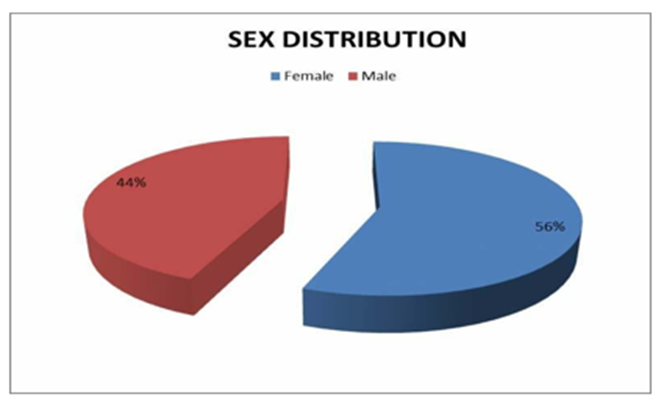
Out of 50 patients 28 (56%) female and 22(44%) male. Female predominance due to post menopausal osteoporosis and decrease activity than Males in elderly age group.
|
Sex |
No of patients |
Percentage |
|
Female |
28 |
56% |
|
Male |
22 |
44 % |
SIDE INVOLVED
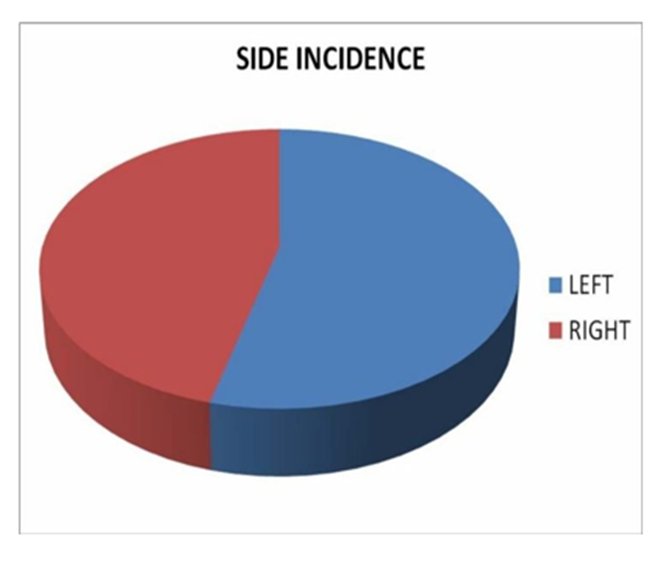
Left side is more commonly involved in our study with 27 patients (54%) than right side 23 (46%).
|
Side involved |
No. of patients |
Percentage |
|
Left |
27 |
54% |
|
Right |
23 |
46 % |
MECHANISM OF INJURY
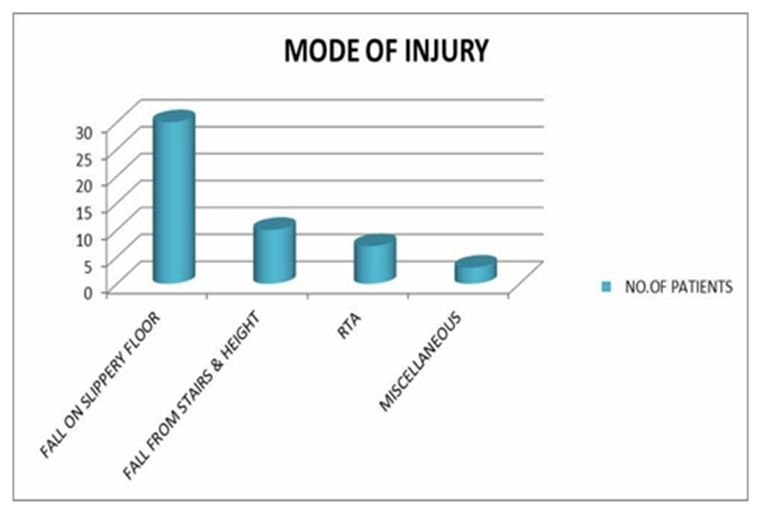
In our study commonest mode of unstable intertrochanteric injury was due to trivial fall, while walking inside and outside the house .This is probably due to severe osteoporosis in elderly, decreased vision in elderly and lack of co-ordination and reaction time.
In our study, unstable intertrochanteric fracture was common due to fall on a slippery surface.
|
MODE OF INJURY |
NO. OF PATIENTS |
PERCENTAGE |
|
FALL ON SLIPPERY FLOOR |
30 |
60% |
|
FALL FROM STAIRS & HEIIGHT |
10 |
20% |
|
RTA |
7 |
14% |
|
MISCELLANEOUS |
3 |
6% |
SINGH’S INDEX
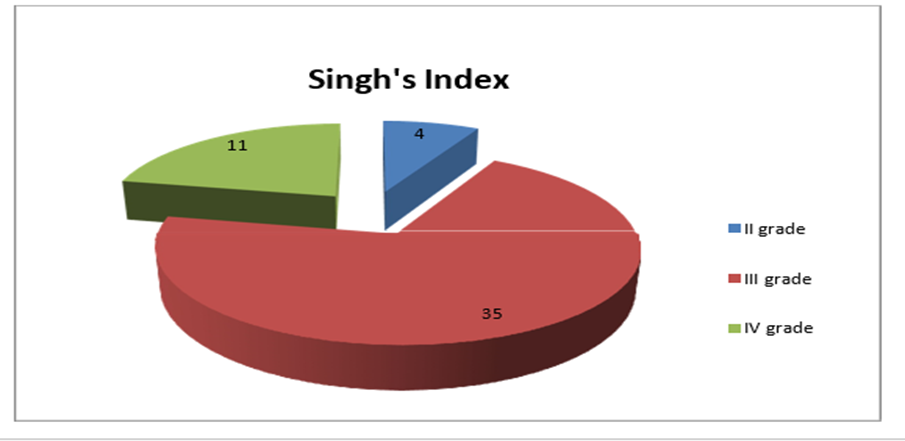
In our study there were 4 patients are of grade II , 35 patients were grade III and 11 patients were grade IV according to singh’s index.
|
Grade |
Number of patients |
|
I |
0 |
|
II |
4 |
|
III |
35 |
|
IV |
11 |
|
V |
0 |
|
VI |
0 |
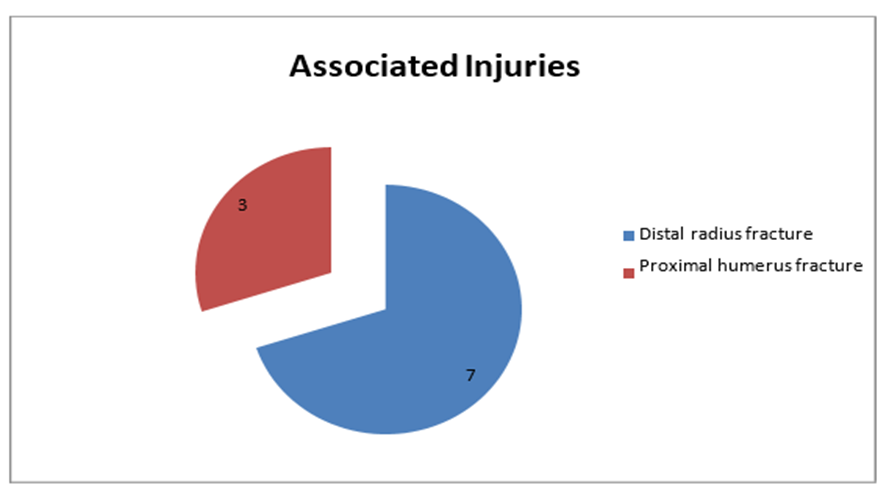
ASSOCIATED INJURIES
|
Associated Injuries |
No. of Cases |
Percentage |
|
Distal Radius Fracture |
7 |
14% |
|
Proximal Humerus Fracture |
3 |
6% |
10 (20%) patients had associated injuries.
SURGICAL PROCEDURE EMPLOYED
|
SURGICAL PROCEDURE |
NO. OF PATIENTS |
PERCENTAGE |
|
DYNAMIC HIP SCREW |
25 |
50% |
|
PROXIMAL FEMORAL NAIL |
9 |
18% |
|
CEMENTED BIPOLAR |
9 |
18% |
|
ENDERS NAIL |
7 |
14% |
DURATION OF HOSPITAL STAY
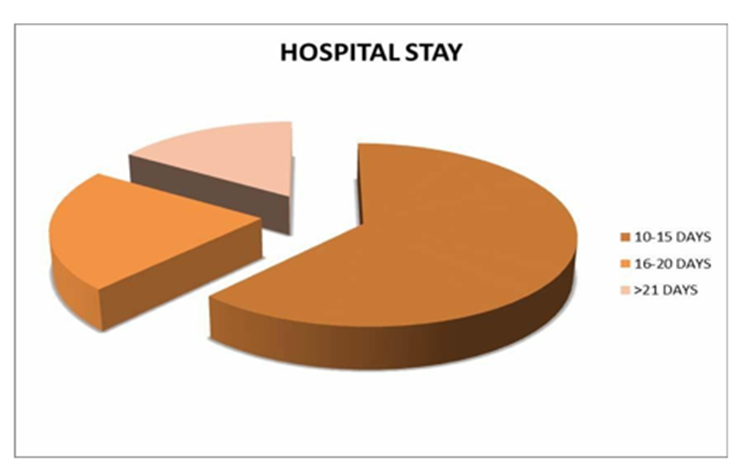
The average duration of hospital stay was 14 days, with a range of 10-25 days.
|
DURATION IN DAYS |
NO.OF PATIENTS |
PERCENTAGE |
|
10-15 DAYS |
31 |
62% |
|
16-20 DAYS |
11 |
22% |
|
>21 DAYS |
8 |
16% |
DISCUSSION:
In the present study of 50 patients of intertrochanteric fractures, 9 cases were treated with PFN, 25 cases with DHS, 9 cases with bipolar Hemiarthroplasty and 7 with Ender nails. The data was assessed; analyzed, evaluated.
OUR STUDY AND OTHER STUDIES: in our study 88% good and excellent results were noted with bipolar hemiarthroplasty comparable to other studies conducted by Rosenfeld et al.52 (1973) used arthroplasty and reported 86% satisfactory results in the early period. Sternand Angerman(1977) reported 94% good and excellent results after a mean follow-up period of 8 months.
|
NAME OF AUTHOR |
YEAR |
RESULTS % |
|
Rosenfeld et al |
1973 |
86% |
|
Sternand Angerman et al |
1977 |
94% |
|
Rodop et al |
2002 |
82% |
|
Haentjens et al |
1989 |
75% |
|
K H Sancheti et al |
2010 |
91% |
|
Present Study |
2015-18 |
88% |
Rodop et al. (2002) in a study of primary bipolar hemiprosthesis for unstable intertrochanteric fractures in 37 elderly patients obtained 82% of excellent to good results after 12 months according to the Harris hip-scoring system. Haentjens et al.53 (1989) compared the clinical results of internal fixation and bipolar arthroplasty for unstable trochanteric fractures and reported 75% satisfactory results and less postoperative complications in the
latter group.
In 2004, Barathi and Arshad studied twenty patients with unstable intertrochanteric fractures treated with PFN and DHS. They discovered that hospital stays for PFN and DHS were 14 and 22 days, respectively, and that blood loss was 275 and 475 millilitres. This was consistent with our study, which found that hospital stays for bipolar hemiarthroplasty were 10 days on average, with an average blood loss of 250 millilitres.
Pankovich and Pankovich & Tarabishy reported a blood loss of 120cc, while Passoff & Schein reported an average blood loss of 100cc. It was only 50 millilitres in our Ender's nails investigation, which is extremely small when compared to other techniques. In a study of 108 patients with pertrochanteric fractures treated with DHS and PFN, Pajarein and Lindal discovered that PFN allowed for a quicker restoration of post-operative walking capacity than DHS. This was consistent with our research showing that, in comparison to DHS and ENDER'S NAILS, PFN and BIPOLAR HEMIARTHROPLASTY patients recovered their ability to walk after surgery more quickly.
In our series, the average age was over 65. The reported series' average age is as follows: Heidelberg 2002 was 75.6 years, and Casey MD series 2000 was 84.2 years. The lower age incidence in our series is likely caused by early development of senile osteoporosis and malnutrition in our nation.
In our investigation, we found one (4%) superficial infection. Antibiotics and routine aseptic dressings helped the infection go away without any problems. Bipolar prosthesis dislocation is an uncommon occurrence. According to literature, it was 2.63% (Maricevic), however in our series, it was zero. In 1998, Mericevic A et al. reported that 2.6% of patients had dislocation, 1.3% had loosening, and 2.3% had intra-hospital mortality following bipolar hemiarthroplasty.
One patient in our study had a shortening of less than 2 cm, which was caused by the fracture's severe comminution. Osteoporosis may be the cause of the screw backout we saw in two patients in our study—one in DHS and one in PFN. One patient experienced varus malunion, and another experienced implant failure, both of which were related to DHS. This could be the result of poor fixation and improper patient selection.Osteoporotic, for example.
CONCLUSION:
Early surgical intervention for trochanteric fractures lowers morbidity and mortality, increasing the likelihood of early independence and lowering the need for extended bed rest. There are still some failures in the management of intertrochanteric fractures. The surgeon is forced to reconsider choosing the right implant due to the high stress concentration that is susceptible to various deforming pressures and the high rate of problems observed following surgical therapy. The sliding screw system is the most widely utilised fixation technique. With documented complication rates of 3–15%, the sliding nail plate technique provides favourable outcomes for unstable intertrochanteric fractures.
Their strength is sufficient to support the physiological demands of a typical gait. Complications include superior cutting out, which is connected to the lag screw's position, and lag screw penetration, which results from the screw's inability to glide. In order to treat trochanteric fractures, Ender and Simon Weidner recommended using prebent 4.5 mm numerous flexible intramedullary nails implanted into the distal femoral metaphysic in 1970. Ender nails have several benefits for stable intertrochanteric fractures, including shorter operating times, less blood loss, a lower risk of infection, less trauma, and a straightforward closed reduction technique. individuals with congenital deformities, Paget's illnesses with bowed, slanted femurs, fractures in flourosis with osteoporosis, and individuals with high anaesthesia risk from cardiac, renal, or hepatic disorders can benefit from these nails.
REFERENCES:
1. JD Zuckerman: Hip fracture. N Engl J Med 1996; 334:1519-1523.
2. Jensen, J. S.: Trochanteric Fractures. An Epidemiological, Clinical and Biomechanical Study. Acta Orthop. Scandinavica, Supplementum 188, 1981.
3. Bergman, G. D.; Winquist, R. A.; Mayo, K. A.; and Hansen, S. 1. , JR. : Subtrochanteric Fracture of the Femur. Fixation Using the Zickel Nail. J. Bone and Joint Surg., 69-A: 1032-1040, Sept. 1987.
4. Asencio, G.: La grande prothse epiphyso-metaphyso-diaphysaire de l’extremitymit suprieure du femur de Vidal-Goalard. Etude clinique a proposde 265 CAS, pp. 23-29, 77-83. Montpellier, Dehan, 1978
5. Bendo JA, Weiner LS, Strauss E, and Yang E: Collapse of intertrochanteric hip fractures fixed with sliding screws. Orthop Rev Suppl: 30-37, 1994.
6. Koval KJ, Sala DA, Knmmer FJ, Zuckerman JD: Postoperative weight-bearing after a fracture of the Femoral neckor an intertrochanteric fracture.J Bone Joint Surg 80A:352-356, 1998
7. Kyle Richard F.: Factures and Dislocations, Chapter 23, Gustilo Ramon B., Kyle Richard F. and Templeman David (eds), Mosby, 1993, Vol. 2, 783-854.
8. Jesse C Delee. Rockwood and Green’s Fractures in Adults. Chapter 18, 3rd edition 1991, Charles A. Rockwood, David P. Green and Robert W. Bucholz JB (eds), Lippincott Company, Vol. 2, 1481-1651.
9. Jewett EL. One-Piece Angle Nail for Trochanteric Fractures. Journal of Bone and Joint Surgery 1941; 23: 803-810.
10. Watson-Jones. Fractures and Joint Injuries, edited by JN Wilson; 6th edition 1992, B.I. Churchill Livingstone, Vol. 2, Chapter 29: 878-973.
11. Murray RC. and Frew JFM. Trochanteric Fractures of the Femur. Journal of Bone and Joint Surgery 1949; 31B: 204-219.
12. Evans EM. The Treatment of Trochanteric Fractures of the Femur. Journal of Bone and Joint Surgery 1949; 31B: 190-203.
13. Srivastva KP. Textbook of Orthopaedics and Trauma. Kulakarni GS (eds), Jaypee Brothers Medical Publishers (P) Ltd., 1999, Vol.3, 2052-2072.
14. Pugh WL. A Self-Adjusting Nail-Plate for Fractures about the Hip Joint. Journal of Bone and Joint Surgery 1955; 37A: 1085-1093.
15. Massie WK. Functional Fixation of Femoral Neck Fractures. Telescoping Nail Technique. Clinical Orthopaedics and Related Research 1958, 12: 230-255.
16. Dimon JH and Hughston JC. Unstable Intertrochanteric Fractures of the Hip.Journal of Bone and Joint Surgery 1967; 49A: 440-450
17. Kuntscher G. A New Method of Treatment of Pertrochanteric Fractures. Proceedings of the Royal Society of Medicine 1970; 63: 1120.
18. Heinman M.L;Leinbach prosthesis in unstable intertrochanteric fractures.Contemp.Orthop 5: 37: 1982
19. Gilberty RP : Bipolar endoprothesis minimizes protrusion acetabuli,loose stems. Ortho review 14:27,1985.
20. Ecker ML. The Treatment of Trochanteric Hip Fractures using a Compression Screw. Journal of Bone and Joint Surgery 1975; 57A: 23-27.
21. Rao JP. Treatment of Unstable Intertrochanteric Fractures with Anatomic Reduction and Compression Hip Screw Fixation. Clinical Orthopaedics and Related Research 1983; 175: 65-71.
22. Rao JP. A Comparative Analysis of Ender’s Rod and Compression Screw with Side Plate Fixation of Intertrochanteric Fractures of the Hip. Clinical Orthopaedics and Related Research, 1988; 256: 127.
23. Bridle SH, Patel AD, Bircher M. Fixation of Intertrochanteric Fractures of the Femur: A Randomized Prospective Comparison of the Gamma Nail and the Dynamic Hip Screw. Journal of Bone and Joint Surgery 1991; 73B: 330.
24. Baumgaertner MR Curtin SL, Lindskog DM.. Intramedullary Versus Extramedullary Fixation for the Treatment of Intertrochanteric Hip Fractures. Clinical Orthopaedics and Related Research 1998; 348: 87-94.
25. Olsson O. Femoral Shortening in Intertrochanteric Fractures. J Bone and Joint Surgery, 2001, 83B: 572-578.