EFFECT OF OBESITY ON PULMONARY FUNCTIONS IN SCHOOL CHILDREN.
- Madhuri Sharma , Assistant Professor, Department of Physiology, RUHS College of Medical Sciences, Jaipur.
- Rajnee , Associate Professor, Department of Physiology, S.N. Medical College, Jodhpur.
- Manoj K Bundela , Professor, Department of Physiology, S.N. Medical College, Jodhpur.
Article Information:
Abstract:
Background: Childhood obesity is a significant public health concern globally. Excess adiposity negatively impacts multiple organ systems, including the respiratory system. Obesity reduces chest wall compliance, limits diaphragmatic movement, and increases airway resistance, which alters pulmonary mechanics. While respiratory impairment is well documented in obese adults, evidence among children remains inconsistent. Objective: To assess pulmonary function in obese school children, compare pulmonary function parameters between obese and non-obese groups, and determine the prevalence of obesity within the study population. Methods: This cross-sectional comparative study included 200 schoolchildren aged 9–16 years from multiple schools in Bikaner. Of the 250 children initially screened, 50 underweight participants were excluded. The remaining children were classified according to International Obesity Task Force (IOTF) BMI criteria into obese (n=44) and non-obese (n=156) groups. Pulmonary function tests were conducted using a computerized RMS Helios-401 spirometer. Student's t-test was applied, with p<0.05 considered statistically significant. Results: Of the 200 children, 44 (22%) were classified as obese and 156 (78%) as non-obese. Pulmonary function parameters were generally lower in obese children; however, these differences did not reach statistical significance. Conclusion: Mild obesity in childhood was not associated with statistically significant impairment of pulmonary function. Further longitudinal studies are recommended.
Keywords:
Article :
INTRODUCTION:
Obesity develops when caloric intake surpasses energy expenditure, leading to the storage of excess calories as adipose tissue. The primary cause of obesity is an imbalance between energy intake and expenditure, arising from complex interactions among genetic, physiological, behavioral, and environmental factors.[1]
The global increase in adult obesity has been accompanied by a considerable rise in the prevalence of overweight and obesity among children and adolescents. Childhood obesity is particularly concerning because it often persists into adulthood and significantly elevates the risk of cardiovascular, metabolic, and respiratory disorders.
Multiple studies have demonstrated that obesity alters autonomic nervous system activity. The sympathetic nervous system is integral to the regulation of energy expenditure. Individuals with reduced sympathetic activity exhibit a lower metabolic rate, which predisposes them to weight gain. Experimental evidence indicates that obesity is associated with decreased sympathetic and increased parasympathetic activity.[2-5]
Obesity induces significant mechanical changes in the respiratory system. Excess adipose tissue over the thoracic cage reduces chest wall compliance and respiratory muscle endurance, increasing the work of breathing and airway resistance.[6-8] Additionally, accumulation of abdominal and visceral fat restricts diaphragmatic movement, decreases basal lung expansion, and promotes ventilation-perfusion mismatch, resulting in impaired respiratory mechanics.[9-10]
Although pulmonary abnormalities related to obesity have been extensively studied in adults, research involving children has produced inconsistent findings. Therefore, this study aimed to evaluate pulmonary function in obese school children and compare these results with age-matched non-obese peers using standardized spirometric assessment.
MATERIALS AND METHODS:
Study Design and Setting
A cross-sectional comparative study was conducted in the Department of Physiology at Sardar Patel Medical College, Bikaner, Rajasthan, India, after obtaining approval from the Institutional Ethics Committee and the Departmental Research Committee. The objective was to evaluate pulmonary function in obese and non-obese school children using standardized spirometric techniques. The following methodology is adapted from the original thesis, with scientific content and reference numbering maintained.
Study Population
A total of 250 schoolchildren aged 9 to 16 years, representing diverse socioeconomic backgrounds, were randomly selected from multiple schools in Bikaner. All participants initially underwent anthropometric screening using Body Mass Index (BMI). Fifty children classified as underweight using lower BMI cutoffs were excluded, resulting in a final study population of 200 children. Participants were categorized into two study groups according to the International Obesity Task Force (IOTF) age- and sex-specific BMI criteria:
• Non-obese group (n=156)
• Obese group (n=44)
The IOTF classification links childhood BMI percentiles to adult BMI thresholds of 25 kg/m² and 30 kg/m² at 18 years of age and is widely accepted for defining childhood overweight and obesity.[11]
Inclusion Criteria
1) Boys and girls aged between 9 and 16 years.
2) Physically and mentally healthy children.
3) Children who were cooperative and capable of understanding the study procedure.
Exclusion Criteria
1) Acute or chronic medical illness.
2) Any disease likely to affect pulmonary function.
3) Major psychiatric illness.
4) Anxiety, apprehension, or inability to cooperate during pulmonary function testing.
Ethical Considerations
The study protocol was approved by the Institutional Ethics Committee and the Departmental Research Committee of Sardar Patel Medical College, Bikaner. Written informed consent was obtained from school authorities and from the parents or guardians of all participating children prior to study initiation. The objectives and procedures were explained in detail before enrolment.
Data Collection
A pre-tested proforma was distributed two days before data collection to obtain demographic and family-related information, including type of residence, family structure, parental educational status, parental occupation, and family income. The exact age of each participant was verified using school records and recorded in completed years.
Anthropometric Measurements
Anthropometric measurements were obtained using standardised procedures. Body weight was measured with a calibrated spring scale and recorded to the nearest kilogram. Standing height was measured using a wall-mounted stadiometer and recorded to the nearest centimetre. All measurements were taken after removal of footwear and heavy clothing. BMI was calculated as weight in kilograms divided by height in meters squared (kg/m²). Children were classified according to the International Obesity Task Force (IOTF) BMI criteria for age and sex.[11]
Pulmonary Function Testing
Pulmonary function tests were conducted using a computerized spirometer (RMS Helios-401, Transducer No. 400–666). This electronic instrument records respiratory flow and volume through a calibrated transducer connected to a computerized recording system.
Spirometry Procedure
1) Tight clothing was loosened before testing.
2) Age, sex, height, and body weight were recorded.
3) A nasal clip was applied to prevent air leakage.
4) Participants performed several tidal breaths before testing.
5) Subjects were instructed to inhale maximally, and then perform a rapid and forceful expiration through the mouthpiece while maintaining a sitting posture.
6) Each manoeuvre was repeated three times.
7) The best technically acceptable recording was selected for analysis.
Pulmonary Function Parameters
· Forced Vital Capacity (FVC)
· Forced Expiratory Volume in one second (FEV₁)
· FEV₁/FVC ratio
· Forced Expiratory Flow (FEF25–75%)
· Peak Expiratory Flow Rate (PEFR)
Definitions and clinical interpretation of these parameters were identical to those described in the original study protocol.
Quality Control
· Flow-volume curves were examined for technical adequacy.
· Peak expiratory flow was required to be sharp and well-defined.
· Expiratory effort was maintained for more than four seconds.
· Inadequate manoeuvres were repeated.
· The best acceptable tracing from three attempts was used for statistical analysis.
Outcome Measures
The primary outcome of the study was the comparison of pulmonary function parameters between obese and non-obese school children.
· Determination of obesity prevalence among screened schoolchildren.
· Evaluation of the association between obesity and pulmonary function indices.
Statistical Analysis
Data were compiled and analysed using standard statistical methods. Continuous variables were expressed as mean ± standard deviation (SD). Comparisons between obese and non-obese groups were performed using Student's unpaired t-test. All statistical tests were two-tailed, with a p-value less than 0.05 considered statistically significant.
RESULTS:
Study Population
A total of 250 school children aged 9–16 years were initially screened. After excluding 50 underweight children, 200 children fulfilled the eligibility criteria and were enrolled in the study. Based on the International Obesity Task Force (IOTF) BMI criteria, 44 (22%) children were classified as obese and 156 (78%) as non-obese.
The study population comprised 121 boys (60.5%) and 79 girls (39.5%). Among boys, 95 were non-obese, and 26 were obese, whereas among girls, 61 were non-obese and 18 were obese.
Table 1: Demographic characteristics of study participants
|
Variable |
Non-obese |
Obese |
Total |
|
Boys |
95 |
26 |
121 |
|
Girls |
61 |
18 |
79 |
|
Total |
156 |
44 |
200 |
Anthropometric Characteristics
The mean BMI was substantially higher in obese children compared to non-obese children across both sexes.
TABLE 2: MEAN BMI OF STUDY PARTICIPANTS
|
Group |
Mean BMI (kg/m²) |
SD |
|
Non-obese boys |
18.25 |
1.915 |
|
Obese boys |
25.94 |
4.208 |
|
Non-obese girls |
17.70 |
1.891 |
|
Obese girls |
24.07 |
4.932 |
These results demonstrate a clear anthropometric distinction between obese and non-obese groups.
Pulmonary Function in Boys
Pulmonary function parameters in boys exhibited marginally lower mean values in obese participants; however, these differences were not statistically significant.
TABLE 3: PULMONARY FUNCTION PARAMETERS AMONG BOYS
|
Parameter |
Non-obese (Mean±SD) |
Obese (Mean±SD) |
p-value |
|
FVC |
84.67±14.80 |
77.52±16.97 |
0.0834 |
|
FEV₁ |
97.12±16.22 |
89.02±17.39 |
0.2711 |
|
FEV₁/FVC (%) |
116.67±7.18 |
115.19±9.59 |
0.3889 |
|
FEF25–75% |
101.68±26.21 |
93.97±27.94 |
0.1921 |
|
PEFR |
132.09±32.71 |
120.66±24.28 |
0.0996 |
Obese boys had lower mean FVC, FEV₁, FEF25–75%, and PEFR values compared to non-obese boys; however, these differences were not statistically significant (p>0.05).
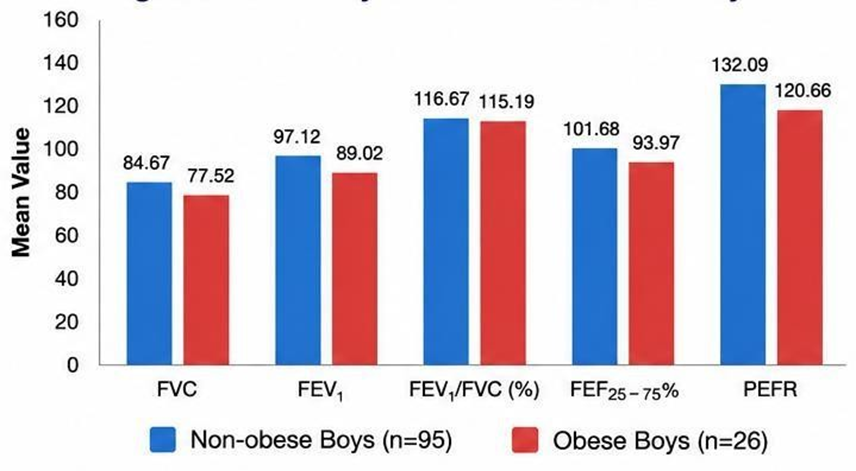
Graph 1: Comparison of pulmonary function parameters between non-obese (n=95) and obese boys (n=26). Mean values of FVC, FEV₁, FEV₁/FVC, FEF25–75% and PEFR are presented.
Pulmonary Function in Girls
In girls, pulmonary function parameters were similar between obese and non-obese participants.
TABLE 4: PULMONARY FUNCTION PARAMETERS AMONG GIRLS
|
Parameter |
Non-obese (Mean±SD) |
Obese (Mean±SD) |
p-value |
|
FVC |
82.82±15.06 |
88.78±17.02 |
0.1559 |
|
FEV₁ |
92.10±15.55 |
100.28±17.21 |
0.0592 |
|
FEV₁/FVC (%) |
111.64 |
113.44 |
>0.05 |
|
FEF25–75% |
117.66 |
129.14 |
>0.05 |
|
PEFR |
138.56 |
152.56 |
>0.05 |
No significant differences in pulmonary function parameters were observed between obese and non-obese girls (p>0.05).
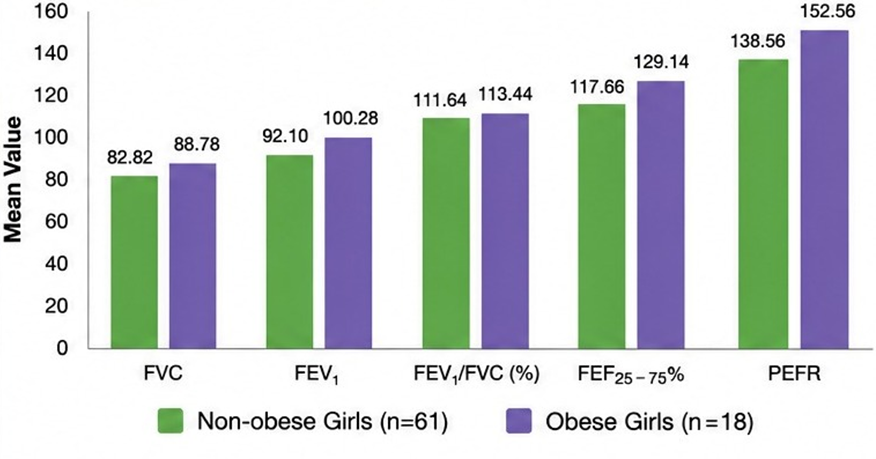
Graph 2: Comparison of pulmonary function parameters between non-obese (n=61) and obese girls (n=18). Mean values of FVC, FEV₁, FEV₁/FVC, FEF25–75% and PEFR are presented.
Overall Findings
· Obese children demonstrated marginally lower pulmonary function values than non-obese children across several spirometric indices.
· Differences in FVC, FEV₁, FEV₁/FVC ratio, FEF25–75%, and PEFR were not statistically significant.
· Anthropometric differences were apparent between study groups, while pulmonary function remained largely similar.
· The prevalence of overweight and obesity among the screened school children was 17.6%, underscoring the growing burden of childhood obesity.
DISCUSSION:
This study assessed pulmonary function in obese and non-obese schoolchildren aged 9–16 years using standardised spirometric methods. Of the 200 participants, 44 were classified as obese and 156 as non-obese based on International Obesity Task Force (IOTF) BMI criteria. While obese children exhibited lower mean values for several pulmonary function parameters, none of these differences was statistically significant. These results indicate that mild childhood obesity, as observed in this cohort, may not lead to clinically meaningful impairment of pulmonary function.
Obesity is a well-established risk factor for respiratory dysfunction due to both mechanical and metabolic effects. Increased adipose tissue around the thoracic cage reduces chest wall compliance, and abdominal fat limits diaphragmatic movement, leading to greater work of breathing and decreased lung expansion.[6-10] However, in this study, pulmonary function parameters such as FVC, FEV₁, FEV₁/FVC ratio, FEF25–75%, and PEFR were similar between obese and non-obese children. This finding suggests that the level of obesity present in this cohort may not have been sufficient to cause detectable changes in lung function.
Previous studies have reported results consistent with those of the present investigation. Boran et al.[12] found that pulmonary function parameters in mildly obese children were comparable to those in normal-weight peers, concluding that anthropometric measurements did not significantly influence spirometric variables during childhood. Similarly, Tang et al.[13] observed no statistically significant differences in pulmonary function between obese and non-obese children.
Conversely, Biring et al.[14], Ulger et al.[15], Eisenmann et al.[16], and Rio-Navarro et al.[17] reported varying degrees of pulmonary function impairment in obese children. Such discrepancies may be attributable to differences in study populations, obesity severity, ethnicity, age distribution, and methodological approaches.
Other researchers, such as Lazarus et al.[18] and He et al., identified positive associations between obesity and specific pulmonary function parameters, highlighting the complex relationship between childhood obesity and respiratory function.
Multiple mechanisms have been proposed to account for obesity-related changes in pulmonary function. Mechanical restriction from increased thoracic and abdominal adiposity limits chest expansion and diaphragmatic movement, while inflammatory mediators released by adipose tissue may further compromise respiratory function.[19-23]
A key finding of this study is that anthropometric measurements did not have a statistically significant impact on pulmonary function in mildly obese children. In childhood, adiposity is primarily subcutaneous, while visceral fat accumulation becomes more prominent with increasing age.[24-25]
This study was limited by its single-centre design, a relatively small sample of obese participants, reliance on conventional spirometry, and a cross-sectional design. Overall, mild childhood obesity was not associated with statistically significant impairment of pulmonary function; however, larger longitudinal studies are needed to confirm these findings.
CONCLUSION:
This cross-sectional study assessed pulmonary function in 200 schoolchildren aged 9–16 years, comprising 44 obese and 156 non-obese participants. The prevalence of childhood obesity in this cohort was 17.6%.
Pulmonary function parameters, including FVC, FEV₁, FEV₁/FVC ratio, FEF25–75%, and PEFR, did not differ significantly between obese and non-obese children. Therefore, mild obesity was not associated with measurable impairment of pulmonary function in this population.
Although significant respiratory dysfunction was not observed, the rising prevalence of childhood obesity remains a critical public health issue. Early lifestyle modification, dietary counseling, regular physical activity, and school-based health education are recommended. Future multicenter longitudinal studies with larger sample sizes and varying degrees of obesity are warranted.
REFERENCES:
1. David OE. Obesity Part 1: Epidemiology, Etiology, Pathophysiology and Non pharmacotherapeutic Treatments. Internet J Acad Physician Assist. 1997;2:1-27.
2. Bray GA. Autonomic and endocrine factors in the regulation of energy balance. In: Federation proceedings.Vol 45.; 1986:1404-1410.
3. Quadri R, Maule S, Flecchia D, et al. Autonomic nervous activity in obese subjects before and after caloric restriction. Funct Neurol. 1989;5(3):273-276.
4. Valensi P, Thi BN, Lormeau B, Paries J, Attali JR. Cardiac autonomic function in obese patients. Int J Obes Relat Metab Disord J Int Assoc Study Obes. 1995;19(2):113-118.
5. Bray GA. Nutrient balance: new insights into obesity. Int J Obes. 1986;11:83-95.
6. McClean KM, Kee F, Young IS, Elborn JS. Obesity and the lung: 1. Epidemiology. Thorax. 2008;63(7):649-54. doi:10.1136/thx.2007.086801.
7. Ochs-Balcom HM, Grant BJB, Muti P, et al. Pulmonary function and abdominal adiposity in the general population. Chest J. 2006;129(4):853-862.
8. Wannamethee SG, Shaper AG, Whincup PH. Body fat distribution, body composition, and respiratory function in elderly men. Am J Clin Nutr. 2005;82(5):996-1003.
9. Babb TG, Ranasinghe KG, Comeau LA, Semon TL, Schwartz B. Dyspnea on exertion in obese women: association with an increased oxygen cost of breathing. Am J Respir Crit Care Med. 2008;178(2):116-123.
10. Malhotra A, Hillman D. Obesity and the lung: 3. Obesity, respiration and intensive care. Thorax. 2008;63(10):925-931.
11. Cole TJ, Bellizzi MC, Flegal KM, Dietz WH. Establishing a standard definition for child overweight and obesity worldwide: international survey. Bmj. 2000;320(7244):1240.
12. Boran P, Tokuc G, Pisgin B, Oktem S, Yegin Z, Bostan O. Impact of obesity on ventilatory function. J Pediatr (Rio J). 2007;83(2):171-176.
13. Tang R-B, Chao T, Chen S-J, Lai C-C. Pulmonary function during exercise in obese children. CHINESE Med JOURNAL-TAIPEI-. 2001;64(7):403-407.
14. Biring MS, Lewis MI, Liu JT, Mohsenifar Z. Pulmonary physiologic changes of morbid obesity. Am J Med Sci. 1999;318(5):293.
15. Ulger Z, Demir E, Tanaç R, et al. The effect of childhood obesity on respiratory function tests and airway hyperresponsiveness. Turk J Pediatr. 2006;48(1):43.
16. Eisenmann JC, Arnall DA, Kanuho V, Interpretter C, Coast JR. Obesity and pulmonary function in Navajo and Hopi children. Ethn Dis. 2007;17(1):14.
17. Del Rio-Navarro B, Cisneros-Rivero M, Berber-Eslava A, Espinola-Reyna G, Sienra-Monge J. Exercise induced bronchospasm in asthmatic and non-asthmatic obese children. Allergol Immunopathol (Madr). 1999;28(1):5-11.
18. Lazarus R, Colditz G, Berkey CS, Speizer FE. Effects of body fat on ventilatory function in children and adolescents: Cross-sectional findings from a random population sample of school children. Pediatr Pulmonol. 1997;24(3):187-194.
19. He Q, Wong T, Du L, et al. Respiratory health in overweight and obese Chinese children. Pediatr Pulmonol. 2009;44(10):997-1002.
20. Sin DD, Man SFP. Impaired lung function and serum leptin in men and women with normal body weight: a population based study. Thorax. 2003;58(8):695-698.
21. El-Gamal H, Khayat A, Shikora S, Unterborn JN. Relationship of dyspnea to respiratory drive and pulmonary function tests in obese patients before and after weight loss. CHEST J. 2005;128(6):3870-3874.
22. Crummy F, Piper AJ, Naughton MT. Obesity and the lung: 2. Obesity and sleep-disordered breathing. Thorax. 2008;63(8):738-746.
23. O’DONNELL CP, Schaub CD, Haines AS, et al. Leptin prevents respiratory depression in obesity. Am J Respir Crit Care Med. 1999;159(5):1477-1484.
24. Brambilla P, Manzoni P, Sironi S, et al. Peripheral and abdominal adiposity in childhood obesity. Int J Obes Relat Metab Disord J Int Assoc Study Obes. 1994;18(12):795-800.
25. Seidell JC, Oosterlee A, Deurenberg P, Hautvast JG, Ruijs JH. Abdominal fat depots measured with computed tomography: effects of degree of obesity, sex, and age. Eur J Clin Nutr. 1988;42(9):805-815.