COMPARISON OF REMIFENTANIL VERSUS DEXMEDETOMIDINE AS ADJUNCTS TO TARGET-CONTROLLED PROPOFOL INFUSION FOR CONTROLLED HYPOTENSION DURING FUNCTIONAL ENDOSCOPIC SINUS SURGERY: A RANDOMIZED COMPARATIVE STUDY.
- Manasa G. , Assistant Professor, Department of Anaesthesiology, Chamarajnagar Institute of Medical Sciences, Karnataka. India.
- Santhosh Kumar Bennur , Associate Professor, Department of Anaesthesiology, Chamarajnagar Institute of Medical Sciences, Karnataka, India.
- Darshan M S , Associate Professor, Department of Anaesthesiology, Chamarajnagar Institute of Medical sciences, Karnataka, India.
Article Information:
Abstract:
Background: Functional Endoscopic Sinus Surgery (FESS) requires a clear and bloodless operative field to facilitate surgical precision and minimize complications. Controlled hypotension is routinely employed to reduce intraoperative bleeding. Remifentanil and dexmedetomidine are commonly used adjuncts during total intravenous anesthesia; however, their comparative efficacy when combined with target-controlled infusion (TCI) of propofol remains inadequately explored. Aim: To compare remifentanil and dexmedetomidine as adjuvants to propofol TCI with respect to intraoperative hemodynamic control and postoperative recovery in patients undergoing FESS. Materials and Methods: This prospective randomized comparative study included 50 patients (ASA physical status I–II) scheduled for elective FESS. Patients were randomly allocated into two equal groups: Group D received dexmedetomidine infusion and Group R received remifentanil infusion along with propofol TCI anesthesia. Systolic arterial pressure (SAP), diastolic arterial pressure (DAP), and heart rate (HR) were recorded at predefined intervals. Recovery characteristics including time to spontaneous respiration, extubation time, response to verbal commands, and attainment of Aldrete score ≥9 were evaluated. Statistical analysis was performed using SPSS version 25.0. A p-value <0.05 was considered statistically significant. Results: Demographic characteristics and baseline hemodynamic variables were comparable between groups (p>0.05). Remifentanil produced significantly lower intraoperative SAP, DAP, and HR values compared with dexmedetomidine from 5–10 minutes onward (p<0.001). Time to spontaneous respiration and extubation were comparable between groups (p>0.05). However, response to verbal commands (12.96±1.49 vs 14.36±1.63 min; p=0.003) and attainment of Aldrete score ≥9 (16.84±1.46 vs 19.20±1.12 min; p<0.001) were significantly faster in the remifentanil group. Conclusion: Both remifentanil and dexmedetomidine effectively facilitated controlled hypotension during FESS. Remifentanil provided superior suppression of sympathetic responses, more profound hypotension, and faster postoperative recovery compared with dexmedetomidine.
Keywords:
Article :
INTRODUCTION:
Functional Endoscopic Sinus Surgery (FESS) has become the gold standard surgical procedure for chronic rhinosinusitis and various sinonasal pathologies owing to its minimally invasive nature and favorable outcomes. Despite technological advances, intraoperative bleeding remains a major challenge because the nasal cavity is highly vascular and even small amounts of blood can significantly impair endoscopic visualization.¹ Controlled hypotension is a widely accepted anesthetic technique employed to reduce surgical bleeding and improve visibility during FESS. Controlled hypotension is defined as a deliberate reduction in systolic blood pressure to approximately 80–90 mmHg or a reduction in mean arterial pressure by 30% from baseline while maintaining adequate organ perfusion.²
Various pharmacological agents have been investigated for controlled hypotension, including vasodilators, beta-blockers, inhalational anesthetics, opioids, and α₂-adrenergic agonists. Remifentanil is an ultra-short-acting μ-opioid receptor agonist characterized by rapid onset, easy titratability, and rapid recovery due to metabolism by nonspecific plasma esterases.³,⁴ Dexmedetomidine is a highly selective α₂-adrenoceptor agonist producing sedation, analgesia, and sympatholysis without significant respiratory depression.⁵
Target-controlled infusion (TCI) of propofol provides predictable plasma and effect-site concentrations and has gained popularity in FESS because of improved hemodynamic control and rapid recovery.⁶ Combining propofol TCI with either remifentanil or dexmedetomidine may optimize surgical conditions while ensuring cardiovascular stability. Previous studies have demonstrated the effectiveness of both remifentanil and dexmedetomidine in controlled hypotension; however, comparative data regarding their performance during propofol TCI anesthesia remain limited. Therefore, the present study was undertaken to compare remifentanil and dexmedetomidine as adjuncts to propofol TCI in patients undergoing FESS.
MATERIALS AND METHODS:
This is a Prospective randomized comparative study. After obtaining approval from the ethical committee and written informed consents from the patients, 50 American Society of Anesthesiologists (ASA) risk classification I-II patients, aged between 18-60 years and scheduled to undergo elective FESS, were included in our controlled, randomized clinical study. Exclusion criteria were significant cardiovascular disease, Uncontrolled hypertension, Hepatic or renal dysfunction, Pregnancy, Bradyarrhythmias, Drug allergy to study medications, BMI >35 kg/m², long-term drug treatment (beta blockers, analgesics, sedatives or tricyclic antidepresants), psychiatric disease and alcohol addiction, being a heavy smoker.
Patients were randomly allocated using computer-generated random numbers into:
Group D (n=25): Dexmedetomidine infusion + Propofol TCI
Group R (n=25): Remifentanil infusion + Propofol TCI
Standard ASA monitoring included ECG, non-invasive blood pressure, pulse oximetry, and capnography. The Sensor electrodes were placed on the patient’s forehead, and entropy values were displayed using an electroencephalogram monitor. Muscle relaxation was monitored with a train-of-four nerve stimulator (TOF). Then normal saline solution was started IV. Propofol was administered by TCI with an effect site concentration (Ce) of 3 mcg/ml, using Schnider’s pharmacokinetic model. In Group D (dexmedetomidine group), endotracheal intubation was performed after inducing anesthesia with 2 mg/kg propofol, 0.1mg/kg vecuronium , 1μg/ kg fentanyl . During maintenance, propofol infusion and 0.5 µg/kg/h dexmedetomidine infusions were pumped using two different pumps at each cannulation sites. In Group R (remifentanil group) patients, endotracheal intubation was performed after inducing anesthesia using 2 mg/kg propofol, 0.1 mg/kg vecuronium, 1μg/kg fentanyl. During maintenance, propofol infusion and 0.5 µg/kg/ min remifentanil infusions were pumped using two different pumps at two different venous cannulation site. In both groups, 0.02 mg/kg vecuronium was administered when deemed necessary.
After intubation all patients were given 100% O2 and EtCO2 values were maintained between 25-35 mmHg. SAP, DAP, HR, SpO2 and EtCO2 were recorded before intubation, after intubation and on the 5th, 10th, 20th, 30th, 40th, 50th and 60th min of the surgical incision. Medications administered to the patients when deemed necessary were recorded too.
A decrease in SAP, more than 20% of the values before infusion, was regarded as hypotension and 6 mg ephedrine IV was given in case of no response to initial fluid replacement. A heart rate of less than 45 beat/min was regarded as bradycardia which was treated by 0.5 mg atropine IV. Time to sufficient spontaneous respiration, time to extubation time, time to verbal commands and time to reach an Aldrete score ≥ 9 after the operation were recorded.
Statistical Analysis
Data were analyzed using SPSS version 25.0. Continuous variables were expressed as mean ± standard deviation. Statistical significance was considered at p<0.05.
RESULTS:
A total of 50 patients undergoing FESS were included, with 25 patients in each group.
Table 1: Demographic Data
|
Variable
|
Group D (Dexmedetomidine) (n=25) |
Group R (Remifentanil) (n=25) |
p value
|
|
Age (years) |
37.64 ± 8.32 |
35.28 ± 9.82 |
0.36 |
|
BMI (kg/m²) |
24.20 ± 2.24 |
24.60 ± 2.58 |
0.56 |
|
Male/Female |
12/13 |
12/13 |
1.00 |
No statistically significant differences were observed between groups, confirming baseline comparability.
Table 2: Comparison of Systolic Arterial Pressure (SAP)
|
Time Point |
Group D Dexmedetomidine Mean ± SD |
Group R Remifentanil Mean ± SD |
p value |
|
Baseline |
125.00 ± 11.46 |
128.88 ± 8.61 |
0.183 |
|
Intubation |
151.24 ± 5.13 |
152.04 ± 8.92 |
0.698 |
|
5 min |
128.48 ± 5.42 |
108.24 ± 8.11 |
<0.001* |
|
10 min |
114.16 ± 4.67 |
96.44 ± 5.88 |
<0.001* |
|
20 min |
105.40 ± 4.58 |
95.76 ± 4.85 |
<0.001* |
|
30 min |
103.44 ± 4.40 |
94.80 ± 4.44 |
<0.001* |
|
40 min |
106.96 ± 4.12 |
93.36 ± 4.87 |
<0.001* |
|
50 min |
104.96 ± 3.93 |
91.92 ± 4.56 |
<0.001* |
|
60 min |
104.32 ± 4.18 |
92.00 ± 4.90 |
<0.001* |
Following induction and intubation, SAP increased similarly in both groups (p=0.698). Thereafter, patients receiving remifentanil demonstrated significantly lower SAP values throughout the intraoperative period compared with dexmedetomidine (p<0.001 at all measured intervals from 5 to 60 min), indicating more effective controlled hypotension.
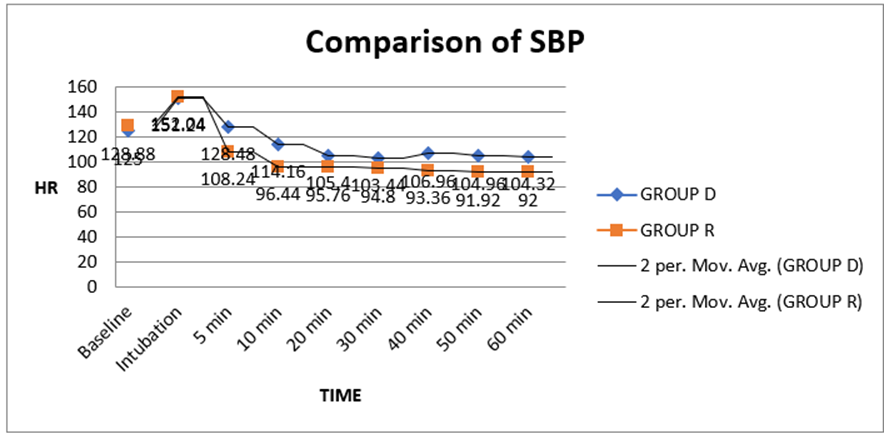
Figure
Table 3: Comparison of Diastolic Arterial Pressure (DAP)
|
Time Point |
Dexmedetomidine Mean ± SD |
Remifentanil Mean ± SD |
p value |
|
Baseline |
78.24 ± 5.25 |
80.28 ± 6.00 |
0.207 |
|
Intubation |
102.32 ± 4.84 |
103.72 ± 5.89 |
0.362 |
|
5 min |
77.32 ± 4.31 |
78.40 ± 5.10 |
0.425 |
|
10 min |
74.64 ± 3.86 |
67.24 ± 4.12 |
<0.001* |
|
20 min |
75.84 ± 4.28 |
64.88 ± 3.89 |
<0.001* |
|
30 min |
73.60 ± 4.18 |
64.72 ± 3.62 |
<0.001* |
|
40 min |
73.28 ± 3.72 |
64.60 ± 3.71 |
<0.001* |
|
50 min |
71.64 ± 3.48 |
64.24 ± 3.55 |
<0.001* |
|
60 min |
71.60 ± 3.69 |
64.92 ± 3.44 |
<0.001* |
DAP remained significantly lower in the remifentanil group from 10 minutes onwards (p<0.001 at all measured intervals).
Table 4: Comparison of Heart Rate (HR)
|
Time Point
|
Dexmedetomidine Mean ± SD |
Remifentanil Mean ± SD |
p value
|
|
Baseline |
85.24 ± 7.86 |
84.32 ± 8.45 |
0.692 |
|
Intubation |
135.20 ± 7.02 |
125.80 ± 8.76 |
<0.001* |
|
5 min |
104.92 ± 6.58 |
91.92 ± 8.28 |
<0.001* |
|
10 min |
92.20 ± 5.36 |
77.84 ± 5.89 |
<0.001* |
|
20 min |
85.72 ± 4.86 |
66.68 ± 4.18 |
<0.001* |
|
30 min |
92.68 ± 5.17 |
65.44 ± 4.22 |
<0.001* |
|
40 min |
90.76 ± 5.09 |
66.24 ± 4.07 |
<0.001* |
|
50 min |
90.72 ± 5.15 |
66.60 ± 4.25 |
<0.001* |
|
60 min |
88.80 ± 4.78 |
65.76 ± 4.10 |
<0.001* |
Heart rate was significantly reduced in the remifentanil group from the intubation period through the remainder of surgery (p<0.001), indicating superior control of sympathetic responses and facilitation of controlled hypotension during FESS.
Table 5: Recovery Characteristics
|
Variable
|
Dexmedetomidine (Mean ± SD) |
Remifentanil (Mean ± SD) |
p value
|
|
Time to adequate spontaneous respiration (min) |
6.88 ± 0.93
|
6.60 ± 0.71
|
0.236
|
|
Extubation time (min) |
8.64 ± 0.64 |
8.52 ± 0.77 |
0.551 |
|
Response to verbal commands (min) |
14.36 ± 1.63
|
12.96 ± 1.49
|
0.003*
|
|
Aldrete score ≥9 (min) |
19.20 ± 1.12 |
16.84 ± 1.46 |
<0.001* |
The time to spontaneous respiration and extubation were comparable between groups (p>0.05). However, patients receiving remifentanil recovered significantly faster, demonstrating earlier response to verbal commands (12.96±1.49 vs 14.36±1.63 min; p=0.003) and earlier attainment of Aldrete score ≥9 (16.84±1.46 vs 19.20±1.12 min; p<0.001).
DISCUSSION:
The present study evaluated the comparative efficacy of remifentanil and dexmedetomidine as adjuncts to propofol target-controlled infusion for controlled hypotension during FESS. The principal findings indicate that remifentanil produced significantly lower intraoperative blood pressure and heart rate values and facilitated faster recovery than dexmedetomidine.
Baseline demographic characteristics and hemodynamic parameters were comparable between groups, suggesting successful randomization and minimizing confounding variables. Both study drugs effectively attenuated the hemodynamic responses associated with laryngoscopy and surgical stimulation; however, remifentanil provided more pronounced reductions in SAP and DAP throughout the maintenance period.
These findings are consistent with the work of Degoute et al., who demonstrated that remifentanil-based anesthesia significantly improved surgical field conditions and reduced intraoperative bleeding during FESS.² The potent analgesic action of remifentanil suppresses sympathetic activation and facilitates controlled hypotension while allowing rapid titration according to surgical requirements.
The present study also demonstrated significantly lower heart rate values in the remifentanil group. Similar observations were reported by Eberhart et al., who found that total intravenous anesthesia using propofol-remifentanil combinations resulted in excellent hemodynamic control and superior surgical conditions during endoscopic sinus surgery.⁷
Dexmedetomidine produced satisfactory hemodynamic stability but did not achieve the same degree of hypotension as remifentanil. This observation may be explained by its mechanism of action, which involves central sympatholysis through activation of α₂-adrenoceptors in the locus coeruleus.⁵ Previous investigators including Ayoglu et al. and Guven et al. reported that dexmedetomidine improved surgical visibility and reduced anesthetic requirements during FESS.⁸,⁹ Our findings support these observations while suggesting that remifentanil may provide a more profound hypotensive effect.
Postoperative recovery characteristics are particularly important in ambulatory and short-duration surgical procedures. In the present study, remifentanil was associated with significantly earlier response to verbal commands and attainment of Aldrete score ≥9. The rapid metabolism of remifentanil by nonspecific esterases explains its favorable recovery profile.³,⁴ Similar results have been reported by Scott and Perry, who highlighted the rapid offset of remifentanil and its utility in fast-track anesthesia protocols.⁴ Although recovery was slower in the dexmedetomidine group, the sedative and analgesic properties of dexmedetomidine may provide advantages such as smoother emergence, reduced perioperative stress responses, and decreased postoperative analgesic requirements.⁵ Therefore, the choice between the two agents should be individualized based on surgical requirements and recovery goals.
Limitations
Single-center study.
Small sample size.
Surgical field grading and blood loss measurements were not analyzed.
Postoperative analgesic consumption was not assessed.
Long-term outcomes were not evaluated.
CONCLUSION:
Remifentanil provides superior controlled hypotension, greater suppression of sympathetic responses, and faster postoperative recovery. Dexmedetomidine offers effective hemodynamic stability and remains a valuable alternative, particularly when sedation and sympatholysis are desired.
REFERENCES:
1. Wormald PJ. Endoscopic Sinus Surgery. 4th ed. New York: Thieme; 2018.
2. Degoute CS. Controlled hypotension: a guide to drug choice. Drugs. 2007;67(7):1053-76.
3. Glass PSA, Hardman D, Kamiyama Y, Quill TJ, Marton G, Donn KH, et al. Preliminary pharmacokinetics and pharmacodynamics of an ultra-short-acting opioid: remifentanil. Anesth Analg. 1993;77(5):1031-40.
4. Scott LJ, Perry CM. Remifentanil: a review of its use during general anaesthesia and conscious sedation. Drugs. 2005;65(13):1793-823.
5. Gerlach AT, Dasta JF. Dexmedetomidine: an updated review. Ann Pharmacother. 2007;41(2):245-52.
6. Absalom AR, Struys MMRF. An Overview of TCI and TIVA. Anaesthesia. 2019;74(Suppl 1):38-45.
7. Eberhart LHJ, Folz BJ, Wulf H, Geldner G. Intravenous anesthesia provides optimal surgical conditions during FESS. Laryngoscope. 2003;113(8):1369-73.
8. Ayoglu H, Yapakci O, Ugur MB, Uzun L, Altunkaya H, Ozer Y, et al. Effectiveness of dexmedetomidine in reducing bleeding during FESS. Eur Arch Otorhinolaryngol. 2008;265(7):753-8.
9. Guven DG, Demiraran Y, Sezen G, Kepek O, Iskender A. Evaluation of outcomes with dexmedetomidine in FESS. Eur J Anaesthesiol. 2011;28(2):136-40.
10. Miller RD, Cohen NH, Eriksson LI, Fleisher LA, Wiener-Kronish JP, Young WL. Miller's Anesthesia. 9th ed. Philadelphia: Elsevier; 2020.
11. Barash PG, Cullen BF, Stoelting RK, Cahalan MK, Stock MC. Clinical Anesthesia. 9th ed. Philadelphia: Wolters Kluwer; 2023.
12. Song J, Zhang X, Wang Y. Controlled hypotension during FESS: systematic review and meta-analysis. Int Forum Allergy Rhinol. 2018;8(9):1048-56
13. Subasi H, Ozdemir Kol I, Duger C, Kaygusuz K, Isbir AC, Gursoy S, Mimaroglu C. Dexmedetomidine and remifentanil as adjuncts to total intravenous anesthesia with propofol. Anaesth Pain & Intensive Care 2017;21(3):328-334
14. Guarracino F, Lapolla F, Cariello C, Danella A, Doroni L, Baldassarri R, Boldrini A, Volpe ML. Target controlled infusion: TCI. Minerva Anestesiol. 2005;71:335–7.