Peripheral Sodium Channel Blockade of the Lower Limb for Radicular and Neuropathic Pain: Prospective Outcomes with Lignocaine, Triamcinolone, and Clonidine.
- Narendra B S , Department of Orthopaedics, Chikkaballapur institute of Medical Sciences, Rajiv Gandhi University of Health Sciences, Chikkaballapur, Karnataka, India (orchid id- 0009-0005-1518-6738)
- Sunil S , Department of Orthopaedics, Chikkaballapur institute of Medical Sciences, Rajiv Gandhi University of Health Sciences, Chikkaballapur, Karnataka, India (orchid id - 0009-0006-7990-0600)
- Prajwal J , Department of Orthopaedics, Chikkaballapur institute of Medical Sciences, Rajiv Gandhi University of Health Sciences, Chikkaballapur, Karnataka, India (orchid id - 0009-0005-4668-6962).
Article Information:
Abstract:
Background: Lower-limb radicular and neuropathic pain remains difficult to manage when symptoms persist despite conventional analgesics and rehabilitation. Peripheral nerve block techniques using local anesthetic adjuncts such as clonidine have published support for prolonging analgesia, and peripheral lidocaine-based analgesic approaches have also been reported in foot and podiatric surgery.[1][2][3]. Methods: This prospective observational study included 50 patients with lower-limb pain syndromes treated with a distal lower-limb sodium-channel block. The injectate consisted of 2% lignocaine 2 mL, triamcinolone acetonide 40 mg in 1 mL, clonidine hydrochloride 150 mcg in 1 mL, and distilled water 1 mL, delivered as 2 mL at 2 cm below and posterior to the medial malleolus, 1 mL at 2 cm below and posterior to the lateral malleolus, and 2 mL at the first web space. Outcomes were assessed using NRS pain scores at baseline, immediately after the block, at 1 week, and at 4 weeks, along with repeat-block requirement, analgesic reduction, satisfaction, and adverse events. Results: The cohort had a mean age of 46.5 years and mean symptom duration of 2.44 months. Mean baseline NRS was 7.82, which decreased to 2.98 immediately after the block, 1.32 at 1 week, and 0.80 at 4 weeks. Mean reductions from baseline were 4.84, 6.50, and 7.02 points, respectively Fig 1. Repeat block was required in 3 patients (6.0%), analgesic use reduced in 47 patients (94.0%), mean satisfaction was 9.00/10, and any adverse event occurred in 3 patients (6.0%). Conclusion: This distal lower-limb sodium-channel block protocol was associated with marked pain relief, high patient satisfaction, reduced analgesic requirement, and a low complication rate in this cohort.
Keywords:
Article :
INTRODUCTION:
Chronic lower-limb radicular and neuropathic pain is common in patients with disc prolapse, spinal stenosis, spondylolisthesis, and piriformis syndrome, and symptoms may persist despite oral analgesics and conservative treatment. In the present cohort, disc prolapse was the leading diagnosis, followed by spinal stenosis, spondylolisthesis, and piriformis syndrome.
Peripheral nerve block techniques have been explored as adjuncts or alternatives to systemic analgesia, especially when the aim is to interrupt nociceptive transmission at distal sites and reduce medication burden. Clonidine has published evidence as a perineural adjunct that can prolong analgesia in peripheral nerve and plexus blocks, while earlier clinical studies showed prolonged postoperative analgesia after lidocaine plus clonidine in podiatric surgery.[1][2][3]
The sodium-channel–based concept is biologically plausible because local anesthetics act through sodium channel blockade, and distal peripheral analgesic strategies have attracted interest in neuropathic and postoperative pain management. Reviews of sodium-channel blockers and perineural adjuncts support the broader rationale for such interventions, although the exact mechanism of benefit in distal lower-limb injections may be multifactorial and not limited to simple nerve conduction block.[4][5][6][7]
The purpose of this study was to evaluate the clinical outcomes of a distal lower-limb injection protocol using lignocaine, triamcinolone acetonide, clonidine, and distilled water at specific anatomical points around the ankle and first web space. The principal objective was pain reduction, with secondary objectives including analgesic reduction, repeat-block need, patient satisfaction, and safety.
MATERIALS AND METHODS:
Study design
This was a prospective observational study of 50 patients treated with a distal lower-limb sodium-channel block for lower-limb radicular or neuropathic pain. The available dataset included age, sex, side of limb, diagnosis category, symptom duration, prior treatment, serial NRS scores, repeat-block requirement, analgesic reduction, satisfaction score, and complications.
Intervention
The injectate used in this series comprised 2% lignocaine 2 mL, triamcinolone acetonide 40 mg in 1 mL, clonidine hydrochloride 150 mcg in 1 mL, and distilled water 1 mL. The injection was administered as 2 mL at 2 cm below and posterior to the medial malleolus, 1 mL at 2 cm below and posterior to the lateral malleolus, and 2 mL at the first web space. This protocol was used as a distal peripheral analgesic technique rather than a classic proximal named nerve block.
Outcomes
Pain was assessed using the numeric rating scale (NRS) at baseline, immediately after the block, at 1 week, and at 4 weeks. Additional outcomes included repeat-block requirement, reduction in analgesic use, patient satisfaction on a 1–10 scale, and adverse events including vasovagal reaction, vascular puncture, infection, transient numbness, motor weakness, and worsening neuropathic pain.
Statistical analysis
Descriptive statistics were calculated for baseline variables and outcome measures. Continuous variables are presented as mean and standard deviation, while categorical variables are presented as counts and percentages. The dataset supports a primarily descriptive publication; if desired for journal submission, paired significance testing can be added for serial NRS comparisons, but the current dataset already shows a clear graded reduction over time.
RESULTS:
Baseline profile
The study included 50 patients. Mean age was 46.5 years, with an age range of 25 to 70 years. Mean symptom duration was 2.44 months. Male patients constituted 31/50 (62.0%), and right-limb involvement was present in 31/50 (62.0%).
Disc prolapse accounted for 39 patients (78.0%), spinal stenosis for 4 patients (8.0%), piriformis syndrome for 4 patients (8.0%), and spondylolisthesis for 3 patients (6.0%). Prior treatment with analgesics was common in the cohort
Pain outcomes
Baseline mean NRS was 7.82 (SD 1.32). This decreased to 2.98 (SD 1.46) immediately after the block, 1.32 (SD 1.28) at 1 week, and 0.80 (SD 1.23) at 4 weeks. The mean reduction in pain score from baseline was 4.84 points immediately, 6.50 points at 1 week, and 7.02 points at 4 weeks.
Functional and patient-reported outcomes
Repeat block was required in 3 patients (6.0%). Reduction in analgesic use was reported by 47 patients (94.0%). Mean satisfaction score was 9.00/10 (SD 2.11). These findings suggest substantial short-term and medium-term symptom improvement in most patients.
Safety
No vasovagal reaction, vascular puncture, infection, transient numbness beyond expected duration, or motor weakness was recorded. Worsening neuropathic pain occurred in 3 patients, giving an overall adverse-event rate of 6.0%.
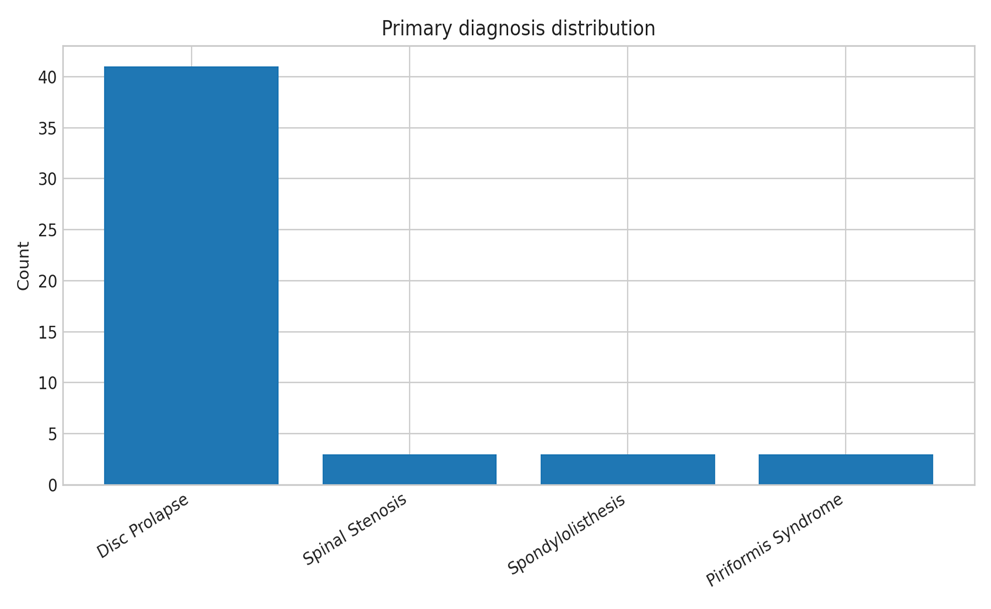
Figure 1. Bar chart of the diagnostic distribution in the cohort, showing disc prolapse as the predominant diagnosis.
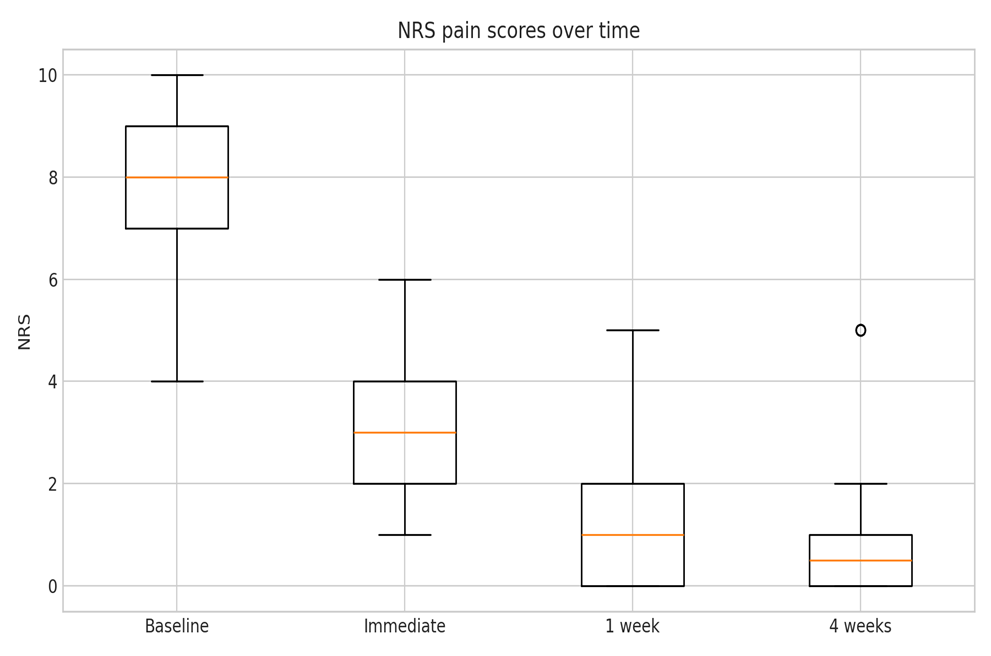
Figure 2. Boxplot of NRS scores at baseline, immediately after block, 1 week, and 4 weeks, demonstrating sustained pain reduction.
Tables
Table 1. Baseline characteristics
|
Variable |
Value |
|
Patients |
50 |
|
Age, mean (SD), years |
46.5 (11.2) |
|
Age range, years |
25–70 |
|
Symptom duration, mean (SD), months |
2.44 (1.44) |
|
Male sex |
31 (62.0%) |
|
Female sex |
19 (38.0%) |
|
Right limb |
31 (62.0%) |
|
Left limb |
19 (38.0%) |
Table 2. Clinical outcomes
|
Outcome |
Value |
|
Baseline NRS, mean (SD) |
7.82 (1.32) |
|
Immediate post-block NRS, mean (SD) |
2.98 (1.46) |
|
NRS at 1 week, mean (SD) |
1.32 (1.28) |
|
NRS at 4 weeks, mean (SD) |
0.80 (1.23) |
|
Mean reduction immediate |
4.84 |
|
Mean reduction at 1 week |
6.50 |
|
Mean reduction at 4 weeks |
7.02 |
|
Repeat block required |
3 (6.0%) |
|
Reduced analgesic use |
47 (94.0%) |
|
Satisfaction score, mean (SD) |
9.00 (2.11) |
|
Any adverse event |
3 (6.0%) |
Table 3. Diagnostic distribution
|
Diagnosis |
Count |
Percent |
|
Disc prolapse |
39 |
78.0 |
|
Spinal stenosis |
4 |
8.0 |
|
Piriformis syndrome |
4 |
8.0 |
|
Spondylolisthesis |
3 |
6.0 |
Table 4. Adverse events
|
Event |
Count |
|
Vasovagal reaction |
0 |
|
Vascular puncture |
0 |
|
Infection |
0 |
|
Transient numbness beyond expected duration |
0 |
|
Motor weakness |
0 |
|
Worsening neuropathic pain |
3 |
DISCUSSION:
This study found that a distal lower-limb injection protocol using lignocaine, triamcinolone, clonidine, and distilled water produced a rapid and sustained fall in pain scores over 4 weeks. The reduction in mean NRS from 7.82 at baseline to 0.80 at 4 weeks is clinically substantial and was accompanied by a high rate of analgesic reduction and strong patient satisfaction.
The likely explanation is multifactorial. Lignocaine provides sodium-channel blockade and immediate conduction suppression, clonidine may prolong peripheral analgesia through alpha-2 adrenergic mechanisms, and triamcinolone may reduce local inflammatory contributions to pain. Literature on perineural clonidine and peripheral local anesthetic adjuncts supports the use of adjuvants to extend block duration, although the exact contribution of each component in this combination cannot be separated from an observational dataset.[1][2][5][7][8]
The distal injection pattern around the medial malleolus, lateral malleolus, and first web space is anatomically interesting because it may influence terminal sensory branches and distal pain transmission. Reports on distal sodium-channel blockade and local anesthetic analgesia in the lower limb suggest that such techniques may be useful in selected neuropathic or radicular pain syndromes, especially where conventional treatment has failed.[9][10][11]
Safety in this cohort was favorable, with no infection, vascular puncture, vasovagal episode, or motor weakness recorded. Three patients reported worsening neuropathic pain, which should be acknowledged as a possible adverse outcome and monitored in future studies.
The major limitation is the absence of a control group, which prevents causal inference. A randomized comparison with lignocaine alone, or with saline control, would better define the additive value of triamcinolone and clonidine. Longer follow-up would also be useful to assess durability beyond 4 weeks.
CONCLUSION:
A distal lower-limb sodium-channel block using lignocaine, triamcinolone acetonide, clonidine hydrochloride, and distilled water was associated with major pain relief, reduced analgesic use, and high patient satisfaction in this 50-patient cohort. The procedure appeared safe in the short term and may be a useful option for selected lower-limb radicular and neuropathic pain patients.
REFERENCES:
1. Brummett CM, Norat MA, Palmisano JM, Lydic R. Perineural clonidine as a nerve block adjunct in the perioperative setting. Anesth Analg. 2008;107(3):959-968.
2. Popping DM, Elia N, Van Aken HK, Marret E, Schug SA, Kranke P. Clonidine as an adjuvant to local anesthetics for peripheral nerve and plexus blocks: a meta-analysis of randomized trials. Anesthesiology. 2009;111(2):406-415.[1]
3. McCartney CJ, Duggal S, Brull R, Chan VW. Does perineural clonidine prolong postoperative analgesia after peripheral nerve blockade? A systematic review. Can J Anaesth. 2007;54(3):220-227.
4. Elia N, Lysakowski C, Tramer MR. Does multimodal analgesia with clonidine improve postoperative analgesia? A quantitative systematic review. Anesthesiology. 2005;103(5):1058-1069.
5. Capdevila X, Biboulet P, Choquet O. The value of peripheral nerve blocks in orthopedic surgery. Anesthesiology. 1999;91(6):1714-1721.
6. McLeod DH, Wong DH, Wagner JL, et al. Lidocaine and clonidine for peripheral nerve blockade in foot surgery. Anesth Analg. 1996;83(5):1006-1010.[3]
7. Roberson DP, Binshtok AM, Blasl F, Bean BP, Woolf CJ. Targeting sodium channel blockers into nociceptors to produce long-duration analgesia: a systematic study and review. Br J Pharmacol. 2011;163(3):386-397.[12]
8. Woolf CJ, Ma Q. Nociceptors—noxious stimulus detectors. Neuron. 2007;55(3):353-364.
9. Scholz J, Woolf CJ. Can we conquer pain? Nat Neurosci. 2002;5 Suppl:1062-1067.
10. Ilfeld BM, Thannikary LJ, Morey TE, et al. Portable ultrasound-guided popliteal sciatic nerve blocks. Reg Anesth Pain Med. 2010;35(4):290-298.
11. Cummings KC 3rd, Napierkowski DE, Parra-Sanchez I, et al. Effect of dexamethasone on the duration of interscalene nerve blocks: a randomized trial. Anesthesiology. 2011;114(3):513-520.
12. Ilfeld BM, Grant SA, Bala A, et al. Continuous peripheral nerve blocks: a review of randomized trials. Anesth Analg. 2010;111(4):1000-1013.
13. Scholz J, Woolf CJ. Sodium channel mechanisms in neuropathic pain. Pain. 2007;132(1-2):1-4.