Impact Of Iron Deficiency Anemia On Cognitive Performance:A Comparative Analysis Of Cognition In Anemic Iron Deficient,Non Anemic Iron Deficient &Non Anemic Non Iron Deficient Young Women Using Weschlers Memory Scale.
- S. Selvapriya. , Associate Professor, Swamy Vivekananda medical college Hospital and Research Institute, Elayampalayam Tamilnadu, India
Article Information:
Abstract:
Background: Iron Deficiency starts inutero mainly due to maternal iron deficiency later on brings tremendous effect to fetal brain. Alteration in the brain iron content in early life can persist entirely throughout the adulthood. Insufficient iron stores, in the young brain has a profound irreversible damage on the developing brain. Objective: To evaluate and compare the Memory Quotient of Multicomponent weschler’s test of Anemic Iron deficient and non-anemic iron deficient study group with the Non anemic non-iron deficient control group in order to rule out the impact of Iron deficiency on cognition in the present study. Methods: To analyse the effects of Iron deficiency on cognitive functions in young women this case control study is been done. For this study 81 female subjects in the age group of 18-35 years were chosen divided in to three groups. Result: On using a weschler’s memory scale all the domains of the test showed a statistical significance between the Non anemic Non-iron deficient control (Group 1) & Anemic Iron deficient(Group 2) except for the domain orientation(W2).whereas,NonanemicNonirondeficientcontrol(Group1)Non anemic iron deficient (Group 3) also showed a high statistical significance except for the domain orientation(W2),visual reproduction(W6).MQ scores a showed a high statistical significance between (Group 1) & (Group 2) and as well as between ( Group 1 )& (Group3). Conclusion: ID with anemia affects “how fast we can complete a cognitive task” whereas Iron deficiency without anemia affects “how well we can perform a simple and complex cognitive task.
Keywords:
Article :
INTRODUCTION:
Since the era of its evolution, Iron is the most essential element, preferably channelled for Hemoglobin formation, oxygen transport and storage, cell growth and differentiation, Cognitive function, Immune functions,ATPproduction,DNA synthesis, effective protection of cells from serious oxidative damage, and Mitochondrial function. The overall concentration of iron in brain is found to be far greater. It is interesting to note that Iron accretion in human fetus begins in early pregnancy and rises significantly in third trimester and continues gradually after birth until 30-50 years of age. (1,2) ID and IDA is a well-known public health problem in developing countries. In Indian young females, there is multitude of causative factors contributing to iron deficiency anemia to start with it includes inadequate iron intake,poor absorption(diets low in ascorbic acid, and high in iron chelators like phytates)iron demand(growth spurt),menstruation, reproductive tract infection, women of child bearing age(pregnancy),chronic inflammatory states mediated by hepcidin expression, parasitic infestation, micronutrient deficiencies, Hemoglobinopathies, Malnutrition, Poverty, Intrafamilial food distribution affecting females rather than males reflecting the gender discrimination since birth apart from overall lower literacy rate. Various Non hematologic manifestations seen are reduced work capacity, depressed immunefucnction, decreased athletic performance, decreased scholastic performance, growth and development retardation, Impaired cognitive function (3,4)
MATERIALS AND METHODS:
This study was conducted at college Hospital,. Informed written consent was taken from the participants.
To analyse the effects of Iron deficiency on cognitive functions in young women this case control study is been done. For this study 81 female subjects in the age group of 18-35 years were chosen divided in to three groups
• Group I-27 subjects in (Non anemic Non Iron deficient controlgroup)
• Group II-27 subjects in ( Anemic Iron deficient studygroup)
• Group III-27 subjects in (Non anemic Iron deficient studygroup)
Inclusion Criteria:
Young women with iron deficiency anaemia
ExclusionCriteria:
• Cardiovasculardisease
• Chronicillness
• DiabetesMellitus
• Hypertension
• ChronicInfection
• Chronicinflammation
• PostmenopausalWomen
• Recent Blooddonation
• Pregnancy Related Condition (Abortion, PostpartumPeriod)
• Neurologicaldisorder/Seizures
• Mentalretardation
• PsychiatricIllness
Method Of Estimation Of Parameters
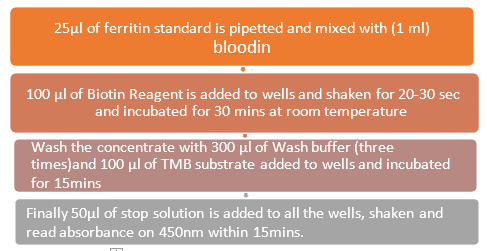
Blood samples (2ml) were taken from the study participants and evaluation of the hemoglobin concentration was done by Automated analyzer –Beckman coulter counter.
Estimation of serum Ferritin concentration to rule out iron deficiency was done by ELISA method.
Reagent Used
- Ferritinstandard-0.5ml
- Anti-ferritin BiotinReagent-12ml.
- Anti-ferritin EnzymeReagent-12ml
- Washconcentrate-25ml
- TMBSubstrate-12ml
- Stop solution-12ml.
ASSAY PROTOCOL
|
Parameter |
Unit |
Normal Range |
|
Hemoglobin |
gm% |
12.0 to 17 |
|
Serum Ferritin |
ng/ml |
Women-10-200 |
METHOD OF ASSESSING COGNITIVE FUNCTION
MULTICOMPETENT TEST- by Weschler’s Memory scale(DavidWeschler)
Participants in both the study and control group were asked various questions to assess the multiple domains of cognition such as the personal & current information, Orientation, Memory control-Immediate Recall, Digits Backward, Digits Forward and Associative Learning following which scoring is done under Indian norms, by addition of partial subtest scores and age assigned constant is again added to those scores,to obtain raw scores and from which finally the Memory Quotient(MQ) of an individual isobtained.
Statistical Analysis
• Data analysis in this Case-Control Study was done by using IBM SPSS (Statistical Package for Social Sciences) software version 16.0 for windows10.0.
• Statistical analysis done using Independent t-test was done to find out the significance of difference between Groups I and II and between Groups II andIII.
• One way Analysis of Variance (ANOVA) was applied to compare means within and between the threegroups.
• The confidence interval was set at 95% and p-value< 0.05 was considered significant.
RESULTS:
On using the Weschler’s Memory Scale, all the domains of the test showed a statistical significance between the Non anemic Non iron deficient control (Group 1) and Anemic Iron deficient (Group 2), except for the domain Orientation (W2). Similarly, between the Non anemic Non iron deficient control (Group 1) and Non anemic iron deficient (Group 3) there was also a high statistical significance, except for the domains Orientation (W2) and Visual Reproduction (W6). MQ scores showed a high statistical significance between Group 1 and Group 2, as well as between Group 1 and Group 3.
TABLE 1: DESCRIPTIVE STATISTICS & COMPARISON OF COGNITIVE SUBTEST SCORES OF WESCHLER’S MEMORY SCALE BETWEEN NON ANEMIC NON IRON DEFICIENT CONTROL (GROUP 1), ANEMIC IRON DEFICIENT (GROUP 2) AND NON ANEMIC IRON DEFICIENT (GROUP 3) (ONE WAY ANOVA)
|
WESCHLER’S MEMORY SCALE |
GROUP 1 Mean ± SD (n = 27) |
GROUP 2 Mean ± SD (n = 27) |
GROUP 3 Mean ± SD (n = 27) |
F value |
p value |
|
PERSONAL & CURRENT INFORMATION (W1) |
5.74 ± .447 |
5.04 ± .192 |
6.00 ± .000 |
85.048 |
.000 < 0.05 Significant |
|
ORIENTATION (W2) |
5.04 ± .192 |
5.00 ± .000 |
5.00 ± .000 |
1.000 |
.373 > 0.05 Not Significant |
|
MENTAL CONTROL (W3) |
8.96 ± .192 |
8.56 ± .506 |
8.41 ± .501 |
12.319 |
.000 < 0.05 Significant |
|
LOGICAL MEMORY – IMMEDIATE RECALL (W4) |
13.22 ± 4.228 |
3.56 ± .847 |
11.33 ± 1.441 |
102.887 |
.000 < 0.05 Significant |
|
DIGITS FORWARD (W5A) |
6.37 ± 1.006 |
4.63 ± .565 |
5.19 ± .736 |
34.212 |
.000 < 0.05 Significant |
|
DIGITS BACKWARD (W5B) |
5.19 ± 1.039 |
3.78 ± .698 |
4.26 ± .764 |
19.268 |
.000 < 0.05 Significant |
|
VISUAL REPRODUCTION (W6) |
11.44 ± .641 |
9.33 ± 1.000 |
11.00 ± .877 |
46.035 |
.000 < 0.05 Significant |
|
ASSOCIATE LEARNING (W7) |
17.81 ± 3.235 |
9.00 ± 1.038 |
9.70 ± 1.958 |
126.442 |
.000 < 0.05 Significant |
|
RAW SCORE |
106.74 ± 4.776 |
81.96 ± 2.579 |
93.89 ± 1.987 |
372.219 |
.000 < 0.05 Significant |
From this table we can infer that the scores of the domains of Weschler’s test – Personal and Current Information (W1), Mental Control (W3), Logical Memory – Immediate Recall (W4), Digits Forward (W5A), Digits Backward (W5B), Visual Reproduction (W6) and Associate Learning (W7) – between and within the groups were highly significant (p<0.000), whereas Orientation (W2) scores showed a p value of p<0.3. Raw scores and Memory Quotient of the Weschler’s Test in the groups showed a significant difference (p<0.000).
COMPARISON OF WESCHLER’S MEMORY SCALE COGNITIVE SCORES AMONG GROUPS
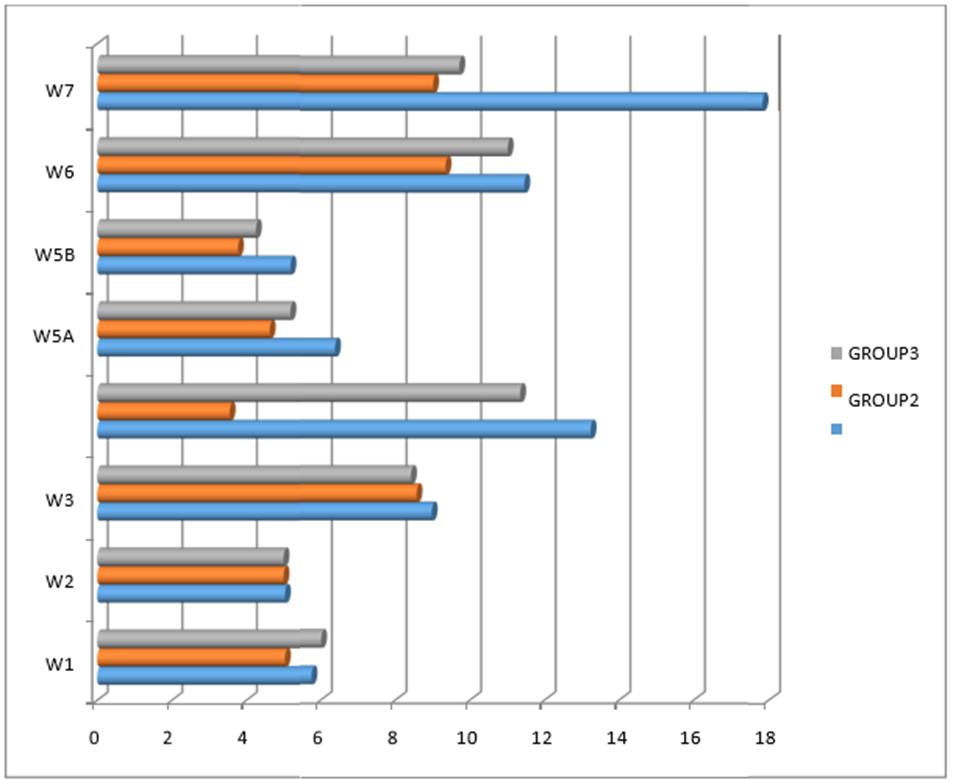
FIG 1: This bar diagram shows the comparison of Weschler’s Memory Scale subtest scores between the Non Anemic Non Iron Deficient Control (Group 1), Anemic Iron Deficient (Group 2) and Non Anemic Iron Deficient (Group 3), showing that the anemic iron deficient group has very low scores compared to the control and the Non anemic iron deficient group (Group 3).
TABLE 2: COMPARISON OF WESCHLER’S MEMORY SCALE COGNITIVE SUBTEST SCORES IN NON ANEMIC NON IRON DEFICIENT CONTROL GROUP (1) AND ANEMIC IRON DEFICIENT GROUP (2) (INDEPENDENT T TEST)
|
WESCHLER’S MEMORY SCALE |
n |
GROUP 1 Mean ± SD |
GROUP 2 Mean ± SD |
p value |
|
PERSONAL & CURRENT INFORMATION (W1) |
27 |
5.74 ± .447 |
5.04 ± .192 |
.000 < 0.05 Significant |
|
ORIENTATION (W2) |
27 |
5.04 ± .192 |
5.00 ± .000 |
.322 < 0.05 Not Significant |
|
MENTAL CONTROL (W3) |
27 |
8.96 ± .192 |
8.56 ± .506 |
.000 < 0.05 Significant |
|
LOGICAL MEMORY – IMMEDIATE RECALL (W4) |
27 |
13.22 ± 4.228 |
3.56 ± .847 |
.000 < 0.05 Significant |
|
DIGITS FORWARD (W5A) |
27 |
6.37 ± 1.006 |
4.63 ± .565 |
.000 < 0.05 Significant |
|
DIGITS BACKWARD (W5B) |
27 |
5.19 ± 1.039 |
3.78 ± .698 |
.000 < 0.05 Significant |
|
VISUAL REPRODUCTION (W6) |
27 |
11.44 ± .641 |
9.33 ± 1.000 |
.000 < 0.05 Significant |
|
ASSOCIATE LEARNING (W7) |
27 |
17.81 ± 3.235 |
9.00 ± 1.038 |
.000 < 0.05 Significant |
|
RAW SCORE |
27 |
106.74 ± 4.776 |
81.96 ± 2.579 |
.000 < 0.05 Significant |
|
MQ |
27 |
116.00 ± 10.134 |
77.15 ± 3.549 |
.000 < 0.05 Significant |
This table shows that the difference in scores of Personal and Current Information (W1), Mental Control (W3), Logical Memory – Immediate Recall (W4), Digits Forward (W5A), Digits Backward (W5B), Visual Reproduction (W6) and Associate Learning (W7) between the Non anemic Non iron deficient group (Group 1) and the Anemic iron deficient group (Group 2) were highly significant (p<0.000). Orientation (W2) scores in Group 1 and Group 2 showed a p value of 0.322, which is not significant. Memory Quotient on comparison between Group 1 and Group 2 showed a statistical significance, indicating that differences exist between the groups.
TABLE 3: COMPARISON OF WESCHLER’S MEMORY SCALE COGNITIVE SUBTEST SCORES IN NON ANEMIC NON IRON DEFICIENT CONTROL GROUP (1) AND NON ANEMIC IRON DEFICIENT GROUP (3) (INDEPENDENT T TEST)
|
WESCHLER’S MEMORY SCALE |
n |
GROUP 1 Mean ± SD |
GROUP 3 Mean ± SD |
p value |
|
PERSONAL & CURRENT INFORMATION (W1) |
27 |
5.74 ± .447 |
6.00 ± .000 |
.000 < 0.05 Significant |
|
ORIENTATION (W2) |
27 |
5.04 ± .192 |
5.00 ± .000 |
.322 < 0.05 Not Significant |
|
MENTAL CONTROL (W3) |
27 |
8.96 ± .192 |
8.41 ± .501 |
.000 < 0.05 Significant |
|
LOGICAL MEMORY – IMMEDIATE RECALL (W4) |
27 |
13.22 ± 4.23 |
11.33 ± 1.441 |
.000 < 0.05 Significant |
|
DIGITS FORWARD (W5A) |
27 |
6.37 ± 1.006 |
5.19 ± .736 |
.000 < 0.05 Significant |
|
DIGITS BACKWARD (W5B) |
27 |
5.19 ± 1.039 |
4.26 ± .764 |
.000 < 0.05 Significant |
|
VISUAL REPRODUCTION (W6) |
27 |
11.44 ± .640 |
11.00 ± .877 |
.000 < 0.05 Significant |
|
ASSOCIATE LEARNING (W7) |
27 |
17.81 ± 3.234 |
9.70 ± 1.958 |
.000 < 0.05 Significant |
|
RAW SCORE |
27 |
106.74 ± 4.776 |
93.89 ± 1.987 |
.000 < 0.05 Significant |
|
MQ |
27 |
116.00 ± 10.134 |
93.89 ± 1.987 |
.000 < 0.05 Significant |
This table shows that the differences in test scores of Personal and Current Information (W1), Mental Control (W3), Logical Memory – Immediate Recall (W4), Digits Forward (W5A), Digits Backward (W5B) and Associate Learning (W7) between the Non anemic Non iron deficient group (Group 1) and the Non anemic iron deficient group (Group 3) were highly significant (p<0.000). Orientation scores (W2) are statistically not significant between Group 1 and Group 3, showing that no differences exist in these scores between the groups. Memory Quotient (MQ) was statistically significant (p<0.000) between Group 1 and Group 3.
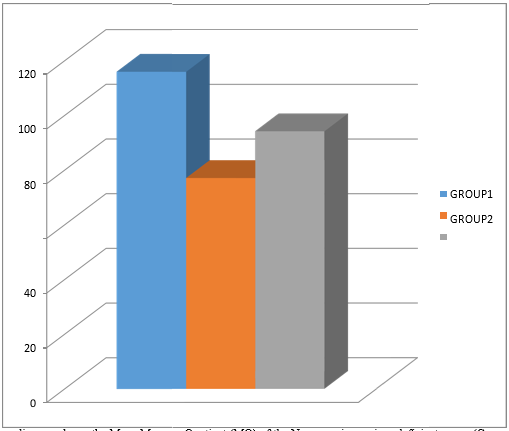
FIG 2: This bar diagram shows the Mean Memory Quotient (MQ) of the Non anemic non iron deficient group (Group 1) compared with the Anemic iron deficient group (Group 2) and Non anemic iron deficient group (Group 3).
DISCUSSION:
In accordance with the prospective study by Eman Khedr et al (5), patients with iron deficiency anemia showed highly significantly lower scores on cognitive tests such as the Mini Mental State Examination and in most domains of Weschler’s Memory Scale. IDA proved to have a deleterious effect on verbal as well as performance IQ, besides memory. These findings suggest that IDA has a negative impact on intelligence. Our study also agrees with the results of this study, showing significantly lower scores on the Mini Mental State Examination in the Anemic iron deficient group (16.444 ± 0.84132) and the Non anemic iron deficient group (21.9259 ± 0.91676) compared to the Non anemic non iron deficient control group (27.2963 ± 0.95333). In addition, there was a significant reduction in scores of the Weschler’s Memory Scale (WMS) cognitive domains, such as Personal and Current Information, Mental Control, Logical Memory, Digits Forward, Digits Backward, Visual Reproduction and Associative Learning, in the Anemic iron deficient group and the Non anemic iron deficient group compared with the Non Anemic Non Iron deficient control group, indicating that iron deficiency has a significant deleterious impact on cognition in the present study.
Jennifer A. Deal et al (6), in their prospective cohort study, concluded that the association between anemia and cognitive decline often differs according to domain. Anemia was associated with a faster rate of decline in the domains of memory, immediate and delayed recall than in executive function, which is consistent with our study, showing that on using the Weschler’s Memory Scale the Anemic iron deficient (Group 2) participants showed a decline in logical memory to a maximum proportion.
Limitation
Weschler’s Memory Scale (WMS) has a satisfactory standardization. We employed three neuropsychological tests in the cognitive assessment of iron deficient individuals; many more neuropsychological tests covering multiple cognitive domains could be performed on participants to arrive at a conclusive diagnosis from a clinical perspective.
CONCLUSION:
Although it is highly difficult to identify the cause-effect relationship between the various factors and the development of iron deficiency and neurocognitive impairment, iron deficiency (ID) and iron deficiency without anemia (ID-A) are more often associated with poor behavioural and cognitive outcomes.
The findings of our study support the fact that neurocognitive insufficiency of iron in young women influences the cognitive functions of the study participants, in terms of reduction in mathematical score and reduction in test scores on various domains of cognition such as Logical Memory, Immediate Recall, Digits Forward, Digits Backward and Associative Learning, which in the long term disrupts the level of IQ. This impairment in young women can have a negative influence on the multistage approach in which women are expected to multitask – being a mother, being at work, or being in a family environment.
ID with anemia affects “how fast we can complete a cognitive task”, whereas iron deficiency without anemia affects “how well we can perform simple and complex cognitive tasks”.
Thus, eliminating the etiological factors of iron deficiency, initiating a cost-effective food fortification program, and taking further measures to increase the amount of absorbable iron intake in the targeted population with iron deficiency with and without anemia, by fortification of food with EDTA, hemoglobin and vitamin C in developing countries like India, would be beneficial.
An educational approach, in which the importance of programmes like the National Nutritional Anemia Control Programme (NNACP) is brought to the attention of young women and children in rural areas, by teaching the importance of consuming iron and folic acid for the prevention of non-hematological consequences of iron deficiency, is also needed
REFERENCES:
1. Rekha Kumari, Raushan Kumar Bharati, Kalpana Singh, Archana Sinha, Sudhir Kumar, Anand Saran, Uday Kumar. Prevalence of Iron Deficiency and Iron Deficiency Anemia in Adolescent Girls in a Tertiary Care Hospital. Journal of Clinical and Diagnostic Research, 2017, Vol 11, pg 4-6.
2. Joyce C McCann and Bruce N Ames. An overview of evidence for a causal relation between iron deficiency during development and deficits in cognitive or behavioral function. American Journal of Clinical Nutrition, 2007, Vol 85, pg 931-945.
3. Martin Falkingham, Asmaa Abdelhamid, Peter Curtis, Susan Fairweather-Tait, Louise Dye, Lee Hooper. The effect of iron supplementation on cognition in older children and adults: a systematic review and meta-analysis. Nutrition Journal, 2010, 9:4, pg 1-16.
4. Sarika More, V.B. Shivkumar, Nitin Gangane, and Sumeet Shende. Effects of Iron Deficiency on Cognitive Function in School Going Adolescent Females in Rural Area of Central India. Hindawi Anemia – Research Article, 2013, pg 1-5.
5. Eman Khedr, Sherifa A. Hamed, Esam Elbeih, Hala El-Shereef, Yousreyia Ahmad, Safa Ahmed. Iron states and Cognitive abilities in young adults: Neuropsychological and Neurophysiological assessment. European Archives of Clinical Neuroscience, 2008, Vol 258, pg 489-496.
6. Jennifer A Deal, Michelle C. Carlson, Qian-Li Xue, Linda P. Fried and Paulo H.M. Chaves. Anemia and 9 year Domain specific cognitive Decline in Community-Dwelling Older women: The Women's Health and Aging Study II. Journal of the American Geriatrics Society, 2009, Vol 57, pg 1604-1611.