ECOTOXICOLOGICAL EVALUATION OF DICLOFENAC, FLUCONAZOLE AND CARBAMAZEPINE ON EARLY GROWTH INDICES OF COTTON.
- Kevin Roshan Rozario , Senior Resident, Department of Pharmacology, Dhanalakshmi Srinivasan medical college and Hospital, Siruvachur, Perambalur, Tamil Nadu.
- Bhuvaneswari S , Associate Professor, Department of Pharmacology, Dhanalakshmi Srinivasan medical college and Hospital, Siruvachur, Perambalur, Tamil Nadu.
- Jisha Justin J , Postgraduate, Department of Pharmacology, Dhanalakshmi Srinivasan medical college and Hospital, Siruvachur, Perambalur, Tamil Nadu.
- Nilofa M , Postgraduate, Department of Pharmacology, Dhanalakshmi Srinivasan medical college and Hospital, Siruvachur, Perambalur, Tamil Nadu.
Article Information:
Abstract:
Background: Drugs are essential for safeguarding human and animal health but have become emerging environmental pollutants. Even trace levels can interfere with biological functions in non-targeted organisms, such as plants and biota that form the foundation of terrestrial ecosystems. Hence, this study seeks to evaluate the impact of selected pharmaceuticals on early plant growth and development. MATERIALS AND METHODS: The toxic effects of diclofenac, fluconazole, and carbamazepine on early cotton seedling growth were evaluated. Stock solutions of each drug were freshly prepared at concentrations of 25, 50, 100, 200, and 600 ppb and germinated seedlings were exposed to the respective concentrations in six pots per treatment group for 14 days. On day 15, shoot length, root length, and total germination length were measured and subjected to statistical analysis to assess drug induced phytotoxicity. RESULTS: Cotton growth decreased in a concentration-dependent manner (25–600 ppb). Fluconazole showed the greatest inhibition, while carbamazepine significantly reduced root elongation (p < 0.00001). Diclofenac significantly decreased root length (p = 0.0001) and germination length (p = 0.00001) at ≥ 200 ppb. Root length was the most sensitive indicator of phytotoxicity. CONCLUSION: Drug residues at trace levels can impair early plant growth, suggesting their potential role as emerging environmental toxic compound and strict monitoring of drug disposal and its impact on environment needed to mitigate the eco hazard.
Keywords:
Article :
INTRODUCTION:
Medicinal products have improved global health by reducing mortality, increasing life expectancy, and enhancing the acute and chronic disease management. But unsafe healthcare remains a major public health concern, experiencing preventable harm during healthcare delivery.(1)
The release of these medicinal products into the environment through wastewater effluents, agricultural runoff, and improper disposal has emerged as a significant public health concern that frequently escapes removal in conventional wastewater treatment systems.(2) Even at lower concentrations, these compounds can disrupt ecosystem causing unintended effect on plant and non target organisms.(3,4)
The continuous release of antibiotic residues into ecosystems may compromise the effectiveness of existing antimicrobial therapies and increase the worldwide emergence of resistant infections substantially contributing to global morbidity and mortality.(5,6)
Although human exposure through contaminated water and food chains is generally low, their long term impact on human remains an area of active investigation.(2,3) Hence a balanced approach is needed to maximize therapeutic benefits while minimizing health and environmental risks.
In response to these emerging challenges, ecopharmacovigilance has evolved as an extension of conventional pharmacovigilance that shifts the focus from human health alone to encompass the environmental impact of medicinal products. Unlike drug safety monitoring, which focuses only adverse reactions in humans, ecopharmacovigilance assesses how the active pharmaceutical ingredients enter and persist in our ecosystem affecting non target organisms because of overlapping drug target mechanisms across different species. As consumers continue to grow globally, concerns have expanded beyond human health to include the unintended ecological consequences of drug residues released into the environment.(7)
Cotton is a high value commercial crop with considerable economic importance in India.(8) It has reliable seed germination and rapid seedling growth.(9) Seed germination and early seedling growth are recommended endpoints for assessing phytotoxic effects in terrestrial plants.(10)
Diclofenac, Fluconazole and Carbamazepine are widely prescribed medicines with distinct mechanisms of action. These drugs were detected frequently in aquatic environments and recognized as an environmental trace contaminant.(11-13)
Since these drugs differ in their physicochemical properties and distinct mechanism, evaluating their effects on cotton seed early seedling growth provides valuable insight into the phytotoxic potential of environmentally relevant medicinal products contaminants and their possible ecological risks to terrestrial plants.
MATERIALS AND METHODS:
STUDY DESIGN
The study was carried out for 14 days to assess the phytotoxic effect of the drugs on plant growth. Drugs included in this study were Diclofenac, Fluconazole and Carbamazepine. These drugs were tested on growth parameters of cotton . At the end of the study period Root length, shoot length and total gemination length were assessed.
STUDY SETTING
The study was carried out in experimental laboratory, Dhanalakshmi Srinivasan medical college and Hospital, Siruvachur, Perambalur for 14 days and growth indices were assessed on day 15. Before initiating the study, cotton seed were authenticated by the botanist from Thiru Vi Ka government arts college, Thiruvarur, Tamil Nadu.
GROUPS
Three groups consisting of Group I – Diclofenac, Group II – Fluconazole and Group III – Carbamazepine which include six treatment solutions (0, 25, 50, 100, 200 and 600 ppb) per group tested on cotton.
SEED GERMINATION METHOD
On Day 0, cotton seeds were rinsed thoroughly and soaked in fresh water for 6 hours. To induce germination the soaked seeds were kept in the dark. Subsequently, the germinated seeds were sown in sterilized plastic pots filled with soil and maintained under ambient conditions (29 ± 2°C) with a 12-hour light and dark photoperiod throughout the experiment.
DRUG DOSE AND ADMINISTRATION
Fresh aqueous stock solutions of Diclofenac, Fluconazole, and Carbamazepine prepared on Day 0. The test drugs were diluted with water to prepare concentrations of 25, 50, 100, 200, and 600 parts per billion (ppb). The test solutions were applied directly to soil surface for uniform exposure.
STUDY PROCEDURE
Six identical sterilized pots filled with equal quantity of soil were labelled separately as 0 , 25, 50, 100, 200 and 600 parts per billion (ppb) to which corresponding stock solutions were administered during the study. Three seeds were sown per pot in uniform spacing. They were allowed to germinate under ambient conditions and each pot received corresponding drug solution daily from Day 1 onward to maintain consistent exposure. On the 15th day root length, shoot length and total germination length were measured and taken for statistical analysis.
STATISTICAL ANALYSIS
The shoot length, root length and total germination length of cotton exposed to Diclofenac (Group-I), Fluconazole (Group – II) and Carbamazepine (Group-III) for different concentrations (0–600 ppb) were expressed as mean ± SD (n = 3). Data was analyzed using ANOVA to compare the mean of the study variables using SPSS software version 24.0. The p-value < 0.05 was considered as statistically significant.
RESULTS:
A concentration dependent reduction in cotton growth parameters was observed following exposure to diclofenac, fluconazole, and carbamazepine. Fluconazole produced a significant decrease in shoot length (p = 0.0001), whereas diclofenac (p = 0.13) and carbamazepine (p = 0.07) did not show statistically significant effects on shoot growth (Table 01) . Root length was significantly reduced by all three drugs, with diclofenac (p = 0.0001), fluconazole (p = 0.00001), and carbamazepine (p = 0.00001) producing marked inhibition (Table 02) . Total germination length also showed a significant reduction in all treatment groups (p = 0.00001) as mentioned in (Table 03). Fluconazole exhibited the greatest inhibitory effect on shoot growth, while carbamazepine produced marked suppression of root elongation. Root length emerged as the most sensitive indicator of pharmaceutical-induced phytotoxicity in cotton seedlings.
Table 01 : Shoot Length of cotton expressed in centimeter
|
Growth Parameter |
Dose (PPB) |
Group I – Diclofenac |
Group II – Fluconazole |
Group III – Carbamazepine |
|
Total Germination Length |
0 PPB |
17 ± 1.93 |
17.5 ± 1.97 |
16.5 ± 1.86 |
|
25 PPB |
17 ± 1.92 |
17 ± 1.95 |
16 ± 1.89 |
|
|
50 PPB |
16 ± 1.83 |
15.5 ± 1.79 |
16 ± 1.87 |
|
|
100 PPB |
15 ± 1.75 |
13.5 ± 1.58 |
16 ± 1.80 |
|
|
200 PPB |
15 ± 1.79 |
10.8 ± 1.28 |
15.5 ± 1.76 |
|
|
600 PPB |
13 ± 1.53 |
11 ± 1.35 |
12 ± 1.42 |
|
|
P value |
— |
0.00001* |
0.00001* |
0.00001* |
* p value of < 0.05 considered to be statistically significant
Table 02 : Root Length of cotton expressed in centimeter
|
Growth Parameter |
Dose (PPB) |
Group I – Diclofenac |
Group II – Fluconazole |
Group III – Carbamazepine |
|
Root Length |
0 PPB |
16 ± 1.86 |
15.5 ± 1.73 |
15 ± 1.71 |
|
25 PPB |
8 ± 1.03 |
7.5 ± 0.98 |
6 ± 0.83 |
|
|
50 PPB |
7 ± 0.98 |
6.2 ± 0.88 |
5 ± 0.76 |
|
|
100 PPB |
7 ± 0.91 |
6 ± 0.87 |
4 ± 0.65 |
|
|
200 PPB |
5 ± 0.72 |
4.5 ± 0.62 |
3.5 ± 0.56 |
|
|
600 PPB |
3 ± 0.56 |
3.5 ± 0.51 |
2.5 ± 0.41 |
|
|
P value |
— |
0.0001* |
0.00001* |
0.00001* |
* p value of < 0.05 considered to be statistically significant
Table 03 : Total germination length of cotton expressed in centimeter
|
Growth Parameter |
Dose (PPB) |
Group I (Diclofenac) |
Group II (Fluconazole) |
Group III (Carbamazepine) |
|
Total Germination Length |
0PPB |
32 ± 3.46 |
33 ± 3.56 |
31 ± 3.34 |
|
0 PPB |
32 ± 3.46 |
33 ± 3.56 |
31 ± 3.34 |
|
|
25 PPB |
25 ± 2.75 |
23 ± 2.57 |
21.5 ± 2.35 |
|
|
50 PPB |
24 ± 2.64 |
23 ± 2.53 |
21.5 ± 2.39 |
|
|
100 PPB |
22 ± 2.45 |
18 ± 2.07 |
20 ± 2.25 |
|
|
200 PPB |
20 ± 2.23 |
17 ± 1.91 |
19.5 ± 2.13 |
|
|
P value |
— |
0.00001* |
0.00001* |
0.00001* |
* p value of < 0.05 considered to be statistically significant.
A concentration dependent reduction in cotton growth parameters was observed following exposure to diclofenac, fluconazole, and carbamazepine. Fluconazole produced a significant decrease in shoot length (p = 0.0001), whereas diclofenac (p = 0.13) and carbamazepine (p = 0.07) did not show statistically significant effects on shoot growth (Table 01) . Root length was significantly reduced by all three drugs, with diclofenac (p = 0.0001), fluconazole (p = 0.00001), and carbamazepine (p = 0.00001) producing marked inhibition (Table 02) . Total germination length also showed a significant reduction in all treatment groups (p = 0.00001) as mentioned in (Table 03). Fluconazole exhibited the greatest inhibitory effect on shoot growth, while carbamazepine produced marked suppression of root elongation. Root length emerged as the most sensitive indicator of pharmaceutical-induced phytotoxicity in cotton seedlings.
Table 01 : Shoot Length of cotton expressed in centimeter
|
Growth Parameter |
Dose (PPB) |
Group I – Diclofenac |
Group II – Fluconazole |
Group III – Carbamazepine |
|
Total Germination Length |
0 PPB |
17 ± 1.93 |
17.5 ± 1.97 |
16.5 ± 1.86 |
|
25 PPB |
17 ± 1.92 |
17 ± 1.95 |
16 ± 1.89 |
|
|
50 PPB |
16 ± 1.83 |
15.5 ± 1.79 |
16 ± 1.87 |
|
|
100 PPB |
15 ± 1.75 |
13.5 ± 1.58 |
16 ± 1.80 |
|
|
200 PPB |
15 ± 1.79 |
10.8 ± 1.28 |
15.5 ± 1.76 |
|
|
600 PPB |
13 ± 1.53 |
11 ± 1.35 |
12 ± 1.42 |
|
|
P value |
— |
0.00001* |
0.00001* |
0.00001* |
* p value of < 0.05 considered to be statistically significant
Table 02 : Root Length of cotton expressed in centimeter
|
Growth Parameter |
Dose (PPB) |
Group I – Diclofenac |
Group II – Fluconazole |
Group III – Carbamazepine |
|
Root Length |
0 PPB |
16 ± 1.86 |
15.5 ± 1.73 |
15 ± 1.71 |
|
25 PPB |
8 ± 1.03 |
7.5 ± 0.98 |
6 ± 0.83 |
|
|
50 PPB |
7 ± 0.98 |
6.2 ± 0.88 |
5 ± 0.76 |
|
|
100 PPB |
7 ± 0.91 |
6 ± 0.87 |
4 ± 0.65 |
|
|
200 PPB |
5 ± 0.72 |
4.5 ± 0.62 |
3.5 ± 0.56 |
|
|
600 PPB |
3 ± 0.56 |
3.5 ± 0.51 |
2.5 ± 0.41 |
|
|
P value |
— |
0.0001* |
0.00001* |
0.00001* |
* p value of < 0.05 considered to be statistically significant
Table 03 : Total germination length of cotton expressed in centimeter
|
Growth Parameter |
Dose (PPB) |
Group I (Diclofenac) |
Group II (Fluconazole) |
Group III (Carbamazepine) |
|
Total Germination Length |
0PPB |
32 ± 3.46 |
33 ± 3.56 |
31 ± 3.34 |
|
0 PPB |
32 ± 3.46 |
33 ± 3.56 |
31 ± 3.34 |
|
|
25 PPB |
25 ± 2.75 |
23 ± 2.57 |
21.5 ± 2.35 |
|
|
50 PPB |
24 ± 2.64 |
23 ± 2.53 |
21.5 ± 2.39 |
|
|
100 PPB |
22 ± 2.45 |
18 ± 2.07 |
20 ± 2.25 |
|
|
200 PPB |
20 ± 2.23 |
17 ± 1.91 |
19.5 ± 2.13 |
|
|
P value |
— |
0.00001* |
0.00001* |
0.00001* |
* p value of < 0.05 considered to be statistically significant
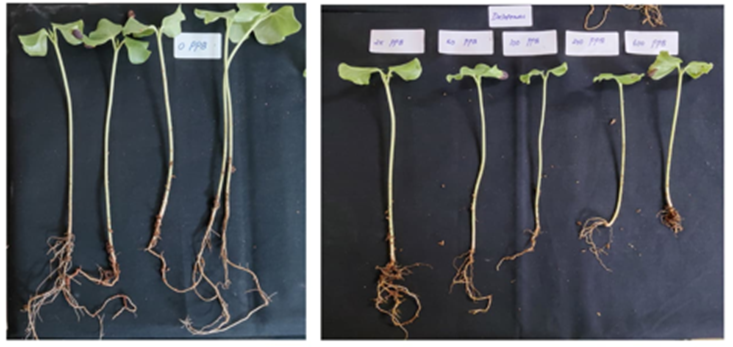
Image 01 : Group I – Diclofenac
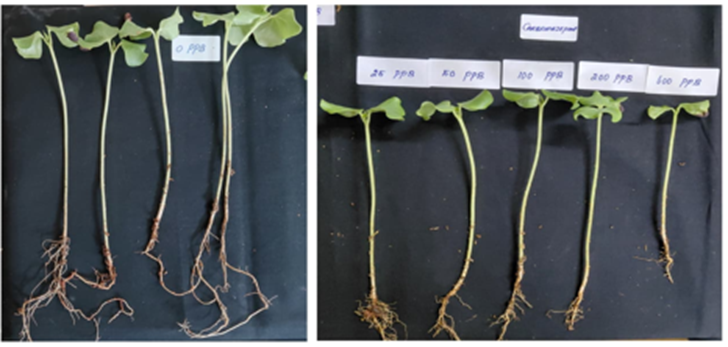
Image 02 : Group II – Fluconazole
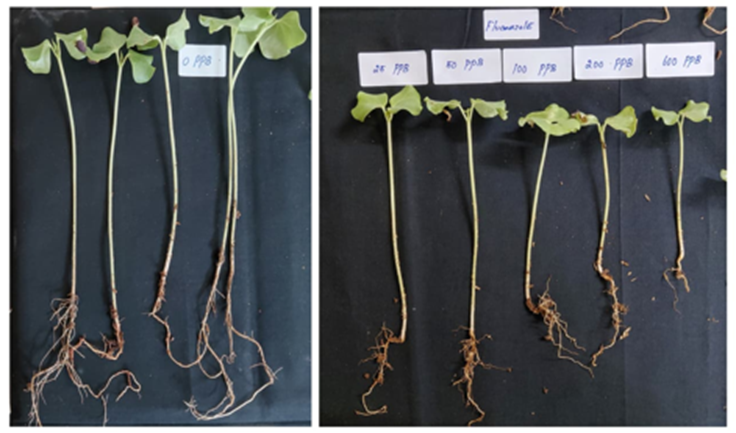
Image 03 : Group III - Carbamazepine
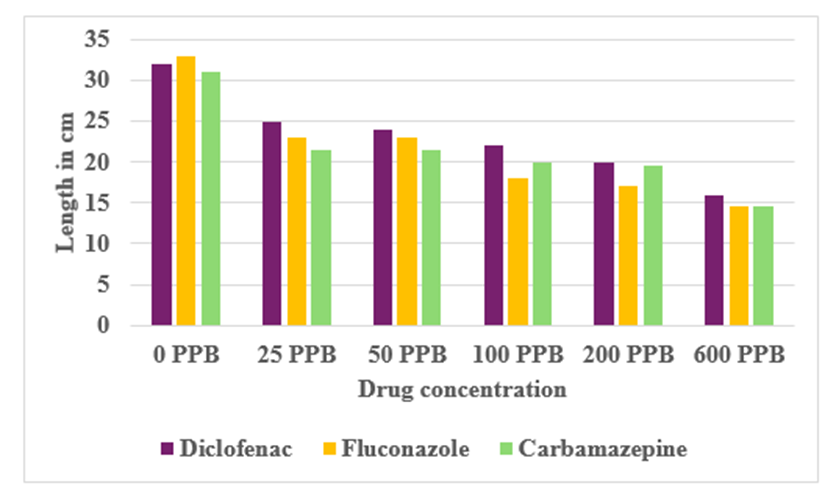
Figure 01 : Total Germination length of cotton (in centimeter) compared between Group I (Diclofenac) , Group II (Fluconazole) and Group III (Carbamazepine)
DISCUSSION:
The present study demonstrates an observable dose dependent inhibitory effect of Diclofenac, Fluconazole, and Carbamazepine on the early growth parameters such as shoot length, root length and total germination length of the cotton plant. Negative correlation was observed between drug concentration and plant growth suggesting phytotoxic impact on physiological and biochemical processes that are essential for seed germination and development. Among the compounds tested, Fluconazole demonstrated the most significant reduction in both root and shoot length. Root elongation was more sensitive, showing greater decline at 600 ppb compared to the control. This strong inhibition effect may linked to azole mediated interference of sterol synthesis of cell and disrupting the integrity of membrane, that impairs cellular division and elongation in root tissues. Carbamazepine showed marked growth suppression, with root length declining significantly than shoot elongation.
The observed toxic effect could be related to its interference with ion channel regulation, cell wall development or oxidative imbalance in plants. Even at lower concentrations there were significant reduction in root length thus emphasizing its potential environmental accumulation effects in the soil. Even though Diclofenac has less negative impact compared to Fluconazole and Carbamazepine, still demonstrated a significant decline in root length and total germination length, particularly at higher concentration of ≥200 ppb. Phytotoxic effect of Diclofenac is likely due to oxidative stress induction and enzymatic inhibition, showing its negative influence on plant growth and seed development.
The systematic review by Carballo M, et al. emphasized that exposure to pharmaceutical contaminants specifically antibiotics, can adversely affects normal plant growth.(14) These observations support the present findings, in which exposure to pharmaceutical compounds resulted in concentration dependent inhibition of cotton seedling growth.
De Mastro F et al. investigated the effects of twelve pharmaceutical compounds on germination and early growth of Ocimum basilicum. The authors observed that higher concentrations produced significant reductions in shoot growth, root growth, and photosynthetic pigment content. Low concentrations exhibited minimal phytotoxicity, whereas higher doses caused marked inhibition of seedling development. The study further demonstrated that early growth parameters were more sensitive indicators of pharmaceutical toxicity than germination percentage.(15) Similarly, the present study showed concentration dependent reductions in growth parameters.
Eggen et al.(2011) reported that pharmaceutical residues accumulated predominantly in root tissues and adversely affected plant growth.(16)This supports the present finding that root length is a sensitive biomarker of pharmaceutical induced phytotoxicity.
In our study, even at low concentrations of 25–50 ppb there was a significant reduction in root length, shoot length and total germination length indicating that these residues in the environment pose a potential impact on ecosystem. The pronounced effect noted in root growth suggests that it is a reliable and sensitive indicator for early detection of drugs induced harm to the plants. These findings illustrate the necessity for continuous monitoring and regulation of drug contaminants in both soil and water ecosystems to prevent negative effect on plant development and health.
CONCLUSION:
Further investigations on whether the phytotoxicological effect of these drug compounds in plant and their recognized mechanism of action seen in humans i.e.; cyclooxygenase inhibition by Diclofenac, sterol synthesis inhibition by Fluconazole, modulation of ion channel by Carbamazepine parallel the biochemical alterations in physiological mechanism in plants. Such insights can reveal cross-kingdom pharmacodynamics and identify molecular pathways shared between plant and mammalian systems.
Moreover, long-term studies are needed to assess the chronic phytotoxic effect and the combined exposure of numerous drug residues which will enlighten us with a more realistic and practical visualization of drug induced environmental imbalance. Integrated approach such as designing biodegradable ecofriendly drugs and phytoremediation methods into environmental risk management framework will be crucial for creating a sustainable environmental management strategy and minimizing the ecosystem impact of drug contamination. Drug induced environmental toxicity testing should be included as a routine aspect during drug discovery and post-marketing surveillance process which will ensure that future therapeutics are efficacious to consumers and safer to environment.
REFERENCES:
1. World Health Organization. Global patient safety report 2024. Geneva: WHO; 2024.
2. Adeleye AS, Xue J, Zhao Y, Taylor AA, Zenobio JE, Sun Y, Han Z, Salawu OA, Zhu Y. Abundance, fate, and effects of pharmaceuticals and personal care products in aquatic environments. Journal of Hazardous Materials. 2022 Feb 15;424:127284.
3. Osuoha JO, Anyanwu BO, Ejileugha C. Pharmaceuticals and personal care products as emerging contaminants: Need for combined treatment strategy. Journal of hazardous materials advances. 2023 Feb 1;9:100206.
4. Khan HK, Rehman MY, Malik RN. Fate and toxicity of pharmaceuticals in water environment: An insight on their occurrence in South Asia. Journal of environmental management. 2020 Oct 1;271:111030.
5. Polianciuc SI, Gurzău AE, Kiss B, Ştefan MG, Loghin F. Antibiotics in the environment: causes and consequences. Medicine and pharmacy reports. 2020 Jul 22;93(3):231.
6. Anwar M, Iqbal Q, Saleem F. Improper disposal of unused antibiotics: an often overlooked driver of antimicrobial resistance. Expert review of anti-infective therapy. 2020 Aug 2;18(8):697-9.
7. Uppsala Monitoring Centre. Ecopharmacovigilance: ensuring environmental safety from pharmaceuticals. Uppsala Reports. 2024 Oct 15. https://uppsalareports.org/articles/ecopharmacovigilance-ensuring-environmental-safety-from-pharmaceuticals
8. Radhika E, Kumari RV. An economic analysis of processing of cotton crop produce. International Journal of Economic Plants. 2015;2(4):162-7.
9. Maeda AB, Wells LW, Sheehan MA, Dever JK. Stories from the greenhouse—A brief on cotton seed germination. Plants. 2021 Dec 18;10(12):2807.
10. OECD. Test No. 208: Terrestrial Plant Test: Seedling Emergence and Seedling Growth Test. Paris: OECD Publishing; 2006
11. Lonappan L, Brar SK, Das RK, Verma M, Surampalli RY. Diclofenac and its transformation products: environmental occurrence and toxicity-a review. Environment international. 2016 Nov 1;96:127-38.
12. Hai FI, Yang S, Asif MB, Sencadas V, Shawkat S, Sanderson-Smith M, Gorman J, Xu ZQ, Yamamoto K. Carbamazepine as a possible anthropogenic marker in water: occurrences, toxicological effects, regulations and removal by wastewater treatment technologies. Water. 2018 Jan 26;10(2):107.
13. Assress HA, Nyoni H, Mamba BB, Msagati TA. Occurrence and risk assessment of azole antifungal drugs in water and wastewater. Ecotoxicology and Environmental Safety. 2020 Jan 15;187:109868.
14. Carballo M, Rodríguez A, de La Torre A. Phytotoxic effects of antibiotics on terrestrial crop plants and wild plants: a systematic review. Archives of environmental contamination and toxicology. 2022 Jan;82(1):48-61.
15. De Mastro F, Brunetti G, Traversa A, Cacace C, Cocozza C. Investigation of the effect of twelve pharmaceuticals on germination and growth parameters of basil (Ocimum basilicum L.). Applied Sciences.2023 Jun 1;13(11):6759.
16. Eggen T, Asp TN, Grave K, Hormazabal V. Uptake and translocation of metformin, ciprofloxacin and narasin in forage- and crop plants. Chemosphere. 2011;85(1):26-33.