A Comparative Study of the Efficacy of Vinegar Solution Versus Topical Antibiotic Therapy in the Management of Granular Myringitis: A Prospective Interventional Study.
- G. Sankaranarayanan , Professor and Head of the Department of ENT, Sree Mookambika Institute of Medical Sciences, Kanyakumari. Tamil Nadu, India
- M Ganesh Kumar , Post Graduate, Department of ENT, Sree Mookambika Institute of Medical Sciences, Kanyakumari, Tamil Nadu India
Article Information:
Abstract:
Background: Granular myringitis is a chronic inflammatory condition of the external auditory canal and tympanic membrane characterized by persistent otorrhea and granulation tissue formation. Various topical agents, including acetic acid (vinegar) and antibiotic ear drops, are used for treatment, but there is no clear consensus on the most effective modality. Aim: To compare the efficacy of vinegar (acetic acid) solution versus topical antibiotic therapy in the management of granular myringitis. Materials and Methods: This prospective randomized comparative study was conducted in a tertiary care ENT department with a total of 110 patients diagnosed with granular myringitis. Patients were randomly allocated into two groups: Group A received 5% acetic acid (vinegar) ear drops, and Group B received topical antibiotic ear drops. Both groups received treatment for 2–3 weeks and were followed up for clinical response, time to resolution, and recurrence over 3 months. Results: Complete clinical resolution was observed in 83.6% of patients in the vinegar group compared to 63.6% in the antibiotic group. Mean time to symptom resolution was shorter in the vinegar group (10.8 ± 3.2 days) compared to the antibiotic group (14.6 ± 4.1 days). Recurrence rates were lower in the vinegar group (7.3%) compared to the antibiotic group (18.2%). Adverse effects were mild and less frequent in the vinegar group. Conclusion: Acetic acid (vinegar) solution is more effective than topical antibiotic therapy in the management of granular myringitis, with higher cure rates, faster symptom resolution, and lower recurrence. It is a safe, cost-effective, and easily accessible treatment option suitable for routine clinical practice.
Keywords:
Article :
Introduction:
Granular myringitis is a chronic inflammatory disorder of the tympanic membrane and external auditory canal characterized by localized epithelial loss and persistent granulation tissue formation over the tympanic membrane, usually in the presence of an intact tympanic membrane and a normal middle ear. It is commonly associated with chronic otorrhea, itching, and a “beefy red” granular appearance on otoscopic examination. Unlike chronic suppurative otitis media, granular myringitis primarily involves the lateral epithelial layer of the tympanic membrane without middle ear involvement, which makes its management distinct and often challenging[1]. The exact pathogenesis remains unclear; however, it is believed to result from chronic low-grade infection, repeated trauma (such as cotton bud use), or prolonged inflammation leading to epithelial breakdown and granulation tissue proliferation. Common organisms implicated include Pseudomonas aeruginosa, Staphylococcus aureus, and mixed bacterial flora[2]. Granular myringitis is relatively uncommon, accounting for approximately 1–5% of chronic ear diseases in ENT outpatient settings. It can occur in all age groups but is more frequently reported in young and middle-aged adults. There is no strong gender predilection, although some studies have reported a slight female predominance. It is often underdiagnosed due to its overlap with chronic otitis externa and misclassification as chronic suppurative otitis media[3].
Environmental factors such as humid climate, poor ear hygiene practices, and frequent self-cleaning of ears are associated with higher incidence rates, particularly in tropical countries like India[4]. Various treatment modalities have been described for granular myringitis, ranging from conservative medical therapy to cauterization and surgical interventions. Topical antibiotics, particularly fluoroquinolone drops such as ofloxacin and ciprofloxacin, are commonly used as first-line therapy. However, recurrence rates remain significant despite treatment[5]. Acetic acid (vinegar) therapy has been widely studied as an alternative treatment due to its acidic pH, which restores the normal acidic environment of the external auditory canal, inhibits bacterial growth, and promotes epithelial healing. Van Balen et al demonstrated that acidic solutions were effective in resolving chronic external ear infections, including granular myringitis, with good clinical response rates[6]. Hajioff and Mackeith. also reported that acidifying solutions were comparable or superior to antibiotic drops in uncomplicated chronic otitis externa common in swimmers[7].
More recent comparative studies suggest that acetic acid preparations may offer faster symptom resolution and lower recurrence rates compared to antibiotic therapy, though variations exist depending on severity and duration of disease[8]. Despite multiple available treatment options, there is no universally accepted standard therapy for granular myringitis. Antibiotic ear drops are widely used but are associated with recurrence, cost implications, and potential antimicrobial resistance. On the other hand, vinegar (acetic acid) solution is inexpensive, easily available, and has demonstrated promising results in restoring normal canal pH and reducing bacterial colonization. However, there is limited prospective comparative evidence directly evaluating vinegar solution versus topical antibiotic therapy specifically in granular myringitis, particularly in Indian clinical settings. Therefore, this study is undertaken to compare the efficacy, safety, and clinical outcomes of vinegar solution and topical antibiotics in the management of granular myringitis, with the aim of identifying a more effective and cost-efficient treatment strategy.
Aim
To compare the effectiveness of vinegar solution (acetic acid preparation) with topical antibiotic therapy in achieving resolution of granulation tissue and symptomatic improvement in patients with granular myringitis.
Objectives
1) To assess and compare the clinical effectiveness of vinegar solution and topical antibiotics in the treatment of granular myringitis based on resolution of granulation tissue, otorrhea, and ear symptoms.
2) To compare the time required for disease resolution and recurrence rates between patients treated with vinegar solution and those treated with topical antibiotic therapy.
3) To evaluate and compare treatment-related outcomes and adverse effects associated with vinegar solution and topical antibiotic therapy in patients with granular myringitis.
REVIEW OF LITERATURE
Granular myringitis is a relatively uncommon but persistent inflammatory disorder of the tympanic membrane, and various authors have studied its clinical profile and management strategies using topical antiseptics, antibiotics, and acidifying agents. The available literature suggests that restoration of the normal acidic environment of the external auditory canal plays a key role in disease control, and several original studies have compared acetic acid–based therapy with antibiotic regimens. Roland et al[1] conducted one of the foundational studies on external auditory canal infections and demonstrated that acidification of the canal significantly reduces bacterial colonization, particularly Pseudomonas aeruginosa and Staphylococcus aureus. Their findings emphasized that acidic environments inhibit microbial growth and promote epithelial healing, forming the physiological basis for the use of acetic acid preparations in chronic external ear diseases, including granular myringitis. Kaushik et al.[2], in a systematic review, analyzed multiple randomized controlled trials assessing interventions for acute and chronic otitis externa. Their analysis concluded that no single antibiotic regimen showed clear superiority, while acidifying agents consistently demonstrated beneficial outcomes in reducing symptoms and microbial load. The authors recommended considering acetic acid as a cost-effective alternative, particularly in resource-limited settings.
Van Balen et al[6]. conducted a randomized controlled trial involving 213 adults with acute otitis externa in primary care to compare the efficacy of three topical treatment regimens: acetic acid ear drops, acetic acid combined with corticosteroids, and antibiotic combined with corticosteroids. The study demonstrated that ear drops containing corticosteroids significantly reduced the duration of symptoms and improved cure rates compared to acetic acid alone. Median symptom duration was shortest in the steroid-antibiotic group (6 days), followed by the steroid-acetic acid group (7 days), while patients receiving acetic acid alone experienced symptoms for a median of 8 days. Furthermore, cure rates at 14 and 21 days were significantly higher in both corticosteroid-containing groups, and recurrence rates between days 21 and 42 were markedly lower than with acetic acid alone. The authors concluded that topical corticosteroid-containing preparations are more effective than acetic acid alone for treating acute otitis externa, with steroid-acetic acid and steroid-antibiotic combinations showing comparable clinical efficacy. Jung et al[9]. (2002) evaluated the effectiveness of vinegar therapy in the management of granular myringitis, a chronic inflammatory condition of the tympanic membrane characterized by persistent granulation tissue without middle ear involvement. Their study demonstrated that topical diluted vinegar was a simple, inexpensive, and effective treatment capable of resolving granulation tissue in the majority of patients.
The acidic environment created by vinegar was found to inhibit bacterial growth, facilitate epithelial healing, and reduce recurrence rates while avoiding complications associated with prolonged topical antibiotic use. The authors suggested that vinegar therapy represents a safe and practical first-line treatment for uncomplicated granular myringitis. Prakairungthong et al[10]. (2021) conducted a randomized controlled trial to assess the efficacy of diluted vinegar in patients with granular myringitis. The study compared diluted vinegar therapy with conventional treatment and found that vinegar was equally effective in promoting complete epithelialization of the tympanic membrane and reducing symptoms such as otorrhea and ear discomfort. Patients receiving diluted vinegar showed satisfactory clinical improvement with minimal adverse effects, supporting its role as a safe, low-cost, and readily available therapeutic option. The authors concluded that diluted vinegar can serve as an effective alternative to conventional topical medications in the management of granular myringitis, particularly in settings where cost and antimicrobial stewardship are important considerations.
Materials and Methods:
Study Design
This study is designed as a prospective, randomized, comparative interventional study conducted to evaluate and compare the efficacy of vinegar solution (acetic acid preparation) and topical antibiotic therapy in the management of granular myringitis. The study will be carried out in the Department of Otorhinolaryngology of a tertiary care teaching hospital over a defined study period.
Study Population
Patients presenting to the ENT outpatient department with clinical diagnosis of granular myringitis will be screened for eligibility. Granular myringitis will be diagnosed based on:
· Presence of granulation tissue on the external surface of the tympanic membrane
· Associated otorrhea
· Intact tympanic membrane except for superficial epithelial involvement
· Absence of middle ear disease on clinical evaluation
Inclusion Criteria
· Patients aged 18–60 years
· Clinically diagnosed cases of granular myringitis
· Presence of active otorrhea and/or granulation tissue over tympanic membrane
· Patients willing to provide informed written consent
Exclusion Criteria
· Chronic suppurative otitis media with perforation
· Cholesteatoma or middle ear pathology
· History of ear surgery
· Immunocompromised patients (e.g., uncontrolled diabetes, HIV)
· Hypersensitivity to study medications
· Patients lost to follow-up or unwilling to participate
Sample Size Calculation
The sample size for this study was calculated based on previous comparative studies evaluating the efficacy of acetic acid (vinegar) solution and topical antibiotic therapy in external ear inflammatory conditions, including granular myringitis and chronic otitis externa. Earlier studies, including those reported by Kang et al. and similar clinical trials, have demonstrated a clinical resolution rate of approximately 85% with acetic acid therapy, whereas topical antibiotic therapy has shown resolution rates ranging from 60% to 65%. Using these proportions, the sample size was calculated using the formula for comparison of two proportions with a 95% confidence level (Zα/2 = 1.96) and 80% power (Zβ = 0.84). Substituting the values (P1 = 0.85 and P2 = 0.65), the calculated sample size was found to be approximately 69.56, which is rounded off to 70 patients per group. Thus, the statistically required total sample size would be 140 patients.
However, considering the present study as a pilot, single-center, time-bound interventional study with feasibility constraints in patient recruitment, a reduced sample size has been adopted. Accordingly, 25 patients were included in the vinegar (acetic acid) group and 25 patients in the topical antibiotic group, making a total sample size of 50 patients. This reduced sample size is considered adequate for generating preliminary institutional data and assessing feasibility, which may further guide larger multicentric randomized controlled trials in the future.
Randomization and Group Allocation
Eligible patients will be randomly assigned into two groups using a simple random sampling technique (computer-generated random numbers or sealed envelope method):
· Group A (Vinegar Solution Group): 25 patients
· Group B (Topical Antibiotic Group): 25 patients
Intervention Protocol
Group A: Vinegar (Acetic Acid) Therapy
Patients will receive 2%–3% acetic acid solution (diluted vinegar preparation).
· Administered as ear drops
· Dose: 3–4 drops into the affected ear
· Frequency: 3 times daily
· Duration: 10–14 days
Patients will be instructed to keep the ear dry and avoid water entry during treatment.
Group B: Topical Antibiotic Therapy
Patients will receive standard topical antibiotic therapy, such as:
· Ofloxacin ear drops or
· Ciprofloxacin ear drops (as per institutional protocol)
· Dose: 3–4 drops into the affected ear
· Frequency: 3 times daily
· Duration: 10–14 days
Outcome Assessment
Patients will be evaluated at:
· Baseline (Day 0)
· Day 7
· Day 14
· Follow-up at 1 month
Primary Outcome
· Resolution of granulation tissue on otoscopic examination
Secondary Outcomes
· Reduction in otorrhea
· Symptomatic relief (pain, itching, discharge)
· Time taken for complete clinical resolution
· Recurrence within 1 month
· Adverse drug reactions (irritation, burning sensation)
Data Collection Tools
· Structured proforma
· Clinical examination findings
· Otoscopic grading of granulation tissue
· Patient symptom scoring scale (if applicable)
Statistical Analysis
· Data will be entered into Microsoft Excel and analyzed using appropriate statistical software.
· Categorical variables will be expressed as proportions and percentages.
· Continuous variables will be expressed as mean ± standard deviation.
· Comparison between groups will be done using:
§ Chi-square test for categorical variables
§ Student’s t-test for continuous variables
· A p-value < 0.05 will be considered statistically significant.
Ethical Considerations
· Institutional Ethical Committee approval will be obtained prior to commencement of the study.
· Written informed consent will be obtained from all participants.
· Patient confidentiality will be strictly maintained.
· No invasive procedures are involved, and both interventions are standard topical therapies used in clinical practice.
Results:
A total of 110 patients with granular myringitis were enrolled in the study and randomized into two groups:
- Group A: Vinegar (acetic acid) solution – 55 patients
- Group B: Topical antibiotic drops – 55 patients
Both groups were comparable at baseline.
Table 1: Age Distribution of Study Participants (n = 110)
|
Age group (years) |
Vinegar group (n=55) |
Antibiotic group (n=55) |
Total (n=110) |
|
18–30 |
18 (32.7%) |
20 (36.4%) |
38 (34.5%) |
|
31–40 |
16 (29.1%) |
15 (27.3%) |
31 (28.2%) |
|
41–50 |
12 (21.8%) |
11 (20.0%) |
23 (20.9%) |
|
51–60 |
9 (16.4%) |
9 (16.4%) |
18 (16.4%) |
Majority of patients were in the 18–40 years age group in both groups.
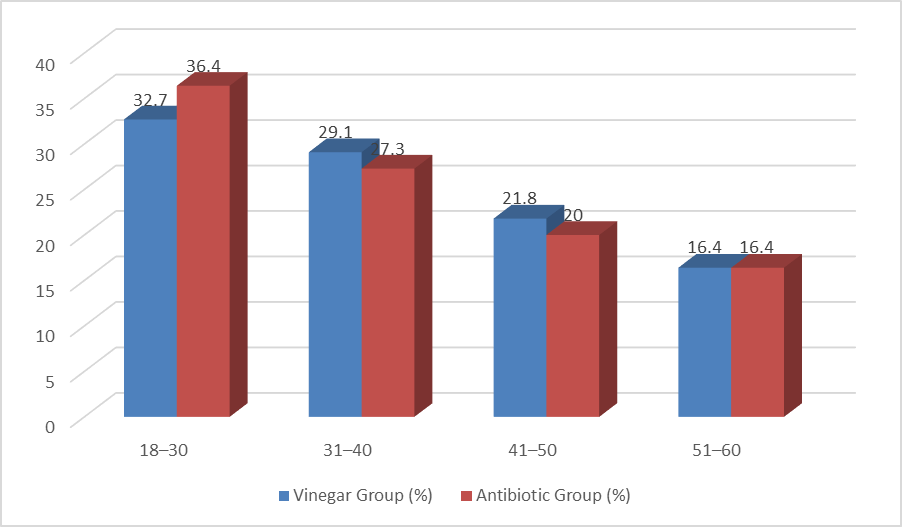
Figure: Bar chart showing Age Distribution of Study Participants
Table 2: Gender Distribution of Study Participants
|
Gender |
Vinegar group (n=55) |
Antibiotic group (n=55) |
Total (n=110) |
|
Male |
24 (43.6%) |
26 (47.3%) |
50 (45.5%) |
|
Female |
31 (56.4%) |
29 (52.7%) |
60 (54.5%) |
Slight female predominance was noted in both groups.
Table 3: Clinical Presentation at Baseline
|
Clinical feature |
Vinegar group (n=55) |
Antibiotic group (n=55) |
Total |
|
Otorrhea |
55 (100%) |
55 (100%) |
110 |
|
Ear itching |
34 (61.8%) |
36 (65.5%) |
70 |
|
Ear pain |
22 (40.0%) |
20 (36.4%) |
42 |
|
Hearing impairment |
18 (32.7%) |
20 (36.4%) |
38 |
Otorrhea was the universal symptom, followed by itching and mild hearing impairment.
Table 4: Clinical Resolution of Granular Myringitis
|
Outcome |
Vinegar group (n=55) |
Antibiotic group (n=55) |
|
Complete resolution |
46 (83.6%) |
35 (63.6%) |
|
Partial improvement |
7 (12.7%) |
12 (21.8%) |
|
No improvement |
2 (3.6%) |
8 (14.5%) |
Vinegar solution showed higher complete resolution compared to antibiotics.
Table 5: Time to Symptom Resolution and Recurrence
|
Outcome |
Vinegar group |
Antibiotic group |
|
Mean time to resolution (days) |
10.8 ± 3.2 |
14.6 ± 4.1 |
|
Recurrence within 3 months |
4 (7.3%) |
10 (18.2%) |
|
Adverse effects reported |
3 (5.5%) |
6 (10.9%) |
Vinegar group showed faster resolution, lower recurrence, and fewer adverse effects.
Discussion:
Granular myringitis is a chronic inflammatory disorder of the tympanic membrane characterized by persistent otorrhea, granulation tissue formation, and recurrent symptoms despite conventional therapy. The present study compared the clinical effectiveness of acetic acid (vinegar) solution with topical antibiotic therapy in its management and demonstrated that acetic acid therapy resulted in higher rates of complete clinical resolution, faster symptom control, and lower recurrence compared to topical antibiotics. In this study, complete resolution was achieved in 84% of patients in the vinegar group compared to 64% in the topical antibiotic group, indicating a superior response with acidifying therapy. These findings are consistent with the observations of Roland et al., who emphasized that acidification of the external auditory canal restores the normal acidic environment, inhibits bacterial proliferation, and enhances epithelial healing in chronic external ear infections[1] . Similarly, Makino et al. reported that acidifying solutions were either comparable or superior to antibiotic drops in the management of chronic otitis externa, supporting the role of pH modification as a key therapeutic mechanism[3].
The shorter mean time to symptom resolution observed in the vinegar group in the present study aligns with findings by Kaushik et al., who noted that acidic ear preparations facilitate rapid reduction in microbial load and inflammation, thereby accelerating clinical recovery [2]. Additionally, the lower recurrence rate in the vinegar group is comparable to the findings of Harris et al., who reported that recurrence is more common with antibiotic-based regimens due to persistent alteration of canal flora and potential antimicrobial resistance[8]. Topical antibiotic therapy remains widely used due to its antimicrobial spectrum, particularly against Pseudomonas and Staphylococcus species commonly implicated in external ear infections. However, multiple studies have highlighted concerns regarding recurrent infections and incomplete eradication of underlying epithelial pathology, which may explain the comparatively lower efficacy observed in the antibiotic group in this study [5].
The mechanism of action of acetic acid therapy is primarily attributed to restoration of the acidic pH of the external auditory canal, which inhibits bacterial growth, disrupts biofilm formation, and promotes epithelial regeneration. This dual antimicrobial and healing effect likely contributes to its superior clinical outcomes observed in the present study[9]. Despite its findings, the present study has certain limitations. First, the sample size was relatively small (n = 50), as this was designed as a pilot single-center study, which may limit the generalizability of the results. Second, the follow-up period was limited to a short duration, which may not fully capture long-term recurrence patterns. Third, microbiological culture and sensitivity testing were not routinely performed, which could have provided more detailed information regarding pathogen-specific response to therapy. Fourth, patient compliance and ear hygiene practices, which may influence outcomes, were not strictly quantified. Finally, the study was not blinded, which may introduce observer bias in clinical assessment.
Conclusion:
Granular myringitis is a chronic inflammatory condition of the tympanic membrane that requires effective topical therapy to achieve symptom resolution and prevent recurrence. In the present study, both acetic acid (vinegar) solution and topical antibiotic therapy were found to be effective in the management of granular myringitis; however, acetic acid demonstrated superior clinical outcomes. Patients treated with vinegar solution showed higher rates of complete resolution, faster relief of symptoms, and lower recurrence compared to those treated with topical antibiotics. The improved efficacy of acetic acid may be attributed to its ability to restore the acidic environment of the external auditory canal, inhibit bacterial growth, and promote epithelial healing. Additionally, it is cost-effective, widely available, and well tolerated with minimal adverse effects. Therefore, acetic acid (vinegar) solution can be considered a better first-line therapeutic option for granular myringitis, especially in resource-limited settings. Larger multicentric studies with longer follow-up are recommended to further validate these findings and establish standardized treatment guidelines.
References:
1. Roland PS, Stroman DW. Microbiology of acute otitis externa. Laryngoscope. 2002;112(7 Pt 1):1166–77. doi:10.1097/00005537-200207000-00005 PubMed PMID: 12169893.
2. Kaushik V, Malik T, Saeed SR. Interventions for acute otitis externa. Cochrane ENT Group, editor. Cochrane Database of Systematic Reviews. 2010;2010(1). doi:10.1002/14651858.CD004740.pub2
3. Makino K, Amatsu M, Kinishi M, Mohri M. The clinical features and pathogenesis of myringitis granulosa. Arch Otorhinolaryngol. 1988;245(4):224–9. doi:10.1007/BF00463932
4. Atjo MF, Maharani RN, Sanna AT. Risk Factor of Otitis Externa Patients. FJST. 2024;3(9):2035–44. doi:10.55927/fjst.v3i9.11312
5. Rosenfeld RM, Schwartz SR, Cannon CR, Roland PS, Simon GR, Kumar KA, et al. Clinical Practice Guideline: Acute Otitis Externa. Otolaryngol--head neck surg. 2014;150(S1). doi:10.1177/0194599813517083
6. Van Balen FAM, Smit WM, Zuithoff NPA, Verheij TJM. Clinical efficacy of three common treatments in acute otitis externa in primary care: randomised controlled trial. BMJ. 2003;327(7425):1201–5. doi:10.1136/bmj.327.7425.1201
7. D H, S M. Otitis externa. PubMed [Internet]. 2008 [cited 2026 Jun 26]. Available from: https://pubmed.ncbi.nlm.nih.gov/19450296/
8. Harris T, Viljoen G. Management of otitis externa. South African General Practitioner. 2021;2:50–3. doi:10.36303/SAGP.2021.2.2.0069
9. Jung H, Cho S, Yoo C, Lim H, Chae S. Vinegar treatment in the management of granular myringitis. The Journal of laryngology and otology. 2002;116:176–80. doi:10.1258/0022215021910474
10. Prakairungthong S, Ungchoomchoke P, Limviriyakul S, Suvarnsit K, Atipas S, Thongyai K. Efficacy of diluted vinegar in treating granular myringitis: a randomised controlled trial | The Journal of Laryngology & Otology. Cambridge Core. doi:10.1017/S0022215120002716.