Perceptions and Preferences of Undergraduate Medical Students Regarding Teaching Methodologies in Biochemistry: A Cross-Sectional Study.
- Manchala Swathi , Associate Professor, Department of Biochemistry, Government Medical College, Nizamabad, Telangana, India.
- Veeramalla Vydehi , Assistant Professor, Department of Biochemistry, Government Medical College, Kamareddy, Telangana, India.
- G. R. Raveena Paul , Associate Professor, Department of Anatomy, Government Medical College, Nizamabad, Telangana, India.
Article Information:
Abstract:
Background: Biochemistry is conceptually dense, and no single teaching aid adequately represents its sequential, spatial, and clinically integrated content. This study assessed first-year medical students’ perceptions of chalkboard teaching, digital slides, animations, clinical integration, and a hybrid teaching approach. Methods: This descriptive cross-sectional survey was conducted among first-year MBBS students at Government Medical College, Nizamabad, over a two-month period. All 120 students in the batch were invited. A structured 14-item questionnaire used a five-point Likert scale. Frequencies, percentages, item means with standard deviations, and pooled domain summaries were calculated. Agreement and strong agreement were combined as a positive response. Results: Of 120 eligible students, 107 submitted complete questionnaires (response rate, 89.2%). Positive responses across item observations were 72.2% for chalkboard teaching, 80.4% for digital slides, 89.4% for animations and short videos, and 88.8% for clinical and examination integration. The strongest item-level endorsement concerned three-dimensional animations for spatial and complex processes (103/107, 96.3%; mean 4.37 ± 0.71). A hybrid approach combining chalkboard logic with digital visuals was supported by 96/107 students (89.7%; mean 4.41 ± 0.75). Chalkboard-based attention received the lowest, though still favourable, endorsement (71/107, 66.4%). Conclusion: Students favoured complementary use of teaching methods rather than replacement of one modality by another. A deliberate sequence comprising stepwise chalkboard explanation, focused digital visualization, brief animations, case linkage, and accessible revision material may better match the varied cognitive demands of undergraduate biochemistry. These perception-based findings should be tested against objective learning outcomes in multicentre studies.
Keywords:
Article :
INTRODUCTION:
Biochemistry provides the molecular framework needed to interpret normal physiology, disease mechanisms, laboratory investigations, and rational therapeutics. For new medical students, however, the subject can appear fragmented and abstract. Metabolic pathways require learners to follow sequential reactions, molecular structures demand spatial visualization, and regulatory networks must be connected to clinical phenotypes. When instruction emphasizes factual recall without showing these relationships, students may adopt surface learning strategies and have difficulty transferring knowledge to patient care.1
Teaching aids differ in the cognitive work they support. Chalk-and-board instruction permits progressive construction of a pathway, allows the teacher to adjust pace, and may help students organize notes. Digital slides can display molecular structures, laboratory patterns, and dense tables efficiently, while animations can represent movement, temporal change, and three-dimensional relationships that static media cannot readily convey. Multimedia learning theory nevertheless cautions that adding visual material is not automatically beneficial; coherence, signalling, segmenting, pacing, and avoidance of redundant information are central to limiting extraneous cognitive load.2,3
Digital resources also extend learning beyond the classroom. Recorded lectures, downloadable slides, and short videos allow self-paced review and repeated exposure. Evidence from health-professions education suggests that well-designed internet-based and online learning can improve knowledge outcomes, although intervention design and study quality vary substantially.4,5 Digital delivery is therefore best viewed as an instructional component whose value depends on alignment with learning objectives, not as an end in itself.
Students’ preferences for lecture media have been inconsistent across settings. Indian studies have reported support for PowerPoint, chalkboard teaching, practical demonstration, active learning, or combinations of these methods.6–10 The variability is plausible because preference is influenced by discipline, year of training, teacher skill, pace, availability of learning resources, and the purpose of the session. Experiences during the COVID-19 period further demonstrated that students may value the convenience of digital instruction while still preferring face-to-face interaction or hybrid delivery.11
Broad surveys of medical education are useful but may conceal discipline-specific needs. Biochemistry requires the simultaneous teaching of stepwise logic, molecular visualization, clinical application, and examination-oriented organization. Evidence focused on first-year MBBS students in an Indian government medical college remains limited, particularly evidence that examines these functions within a single instrument.
The present study therefore aimed to assess undergraduate medical students’ perceptions and preferences regarding traditional chalk-and-board teaching, PowerPoint and digital slides, animations and short videos, clinical and examination integration, and an overall hybrid approach in biochemistry. The primary outcome was endorsement of hybrid teaching; secondary outcomes were the distributions and mean scores for individual items and their prespecified instructional domains.
MATERIALS AND METHODS:
Study design, setting, and period
A descriptive cross-sectional survey was conducted in the Department of Biochemistry, Government Medical College and Government General Hospital, Nizamabad, Telangana, India. Data collection occurred over the two-month period January to March 2026.The report was prepared with reference to STROBE guidance for cross-sectional studies.12
Participants and eligibility criteria
The source population comprised the complete first-year MBBS batch. Students were eligible if they were enrolled in first year, had attended at least 75% of scheduled biochemistry theory classes, and provided informed consent. Students who declined participation were not enrolled. Questionnaires with incomplete study items were to be excluded; however, every submitted questionnaire contained responses to all 14 items.
Sample size and sampling
The minimum sample size was estimated using the single-population proportion formula n = Z²p(1−p)/d². With Z = 1.96 for 95% confidence, p = 0.50 to provide the most conservative estimate, and absolute precision d = 0.10, the calculated minimum was 96. Because the first-year batch contained 120 students, universal sampling was adopted and all eligible students were invited. The final sample of 107 exceeded the calculated minimum.
Questionnaire and variables
Data were collected using an anonymous, structured 14-item electronic questionnaire. Items were organized a priori into traditional chalk-and-board teaching (Q1–Q4), PowerPoint and digital slides (Q5–Q8), animations and short videos (Q9–Q11), clinical and examination integration (Q12–Q13), and overall hybrid utility (Q14). Each item was scored on a five-point Likert scale: 1, strongly disagree; 2, disagree; 3, neutral; 4, agree; and 5, strongly agree. The complete item wording is provided in Supplementary Appendix 1.
The primary variable was a positive response to Q14, defined as agree or strongly agree. Secondary variables included the five-category response distribution, item mean score, item-level positive response, and pooled positive-response proportion for each instructional domain. No demographic variables or academic examination scores were included in the available study instrument; subgroup and outcome-correlation analyses were therefore not undertaken.
Data collection and bias reduction
The questionnaire was distributed through an anonymous Google Form after students received a brief explanation of the study purpose and voluntariness of participation. No names, roll numbers, or direct identifiers were collected. Universal invitation minimized sampling selection within the batch, and identical wording and response options were used for all students. Responses were reviewed for completeness before analysis. Participation had no effect on attendance, internal assessment, or academic standing.
Statistical analysis
Responses were exported to a spreadsheet and checked against the final Google Forms frequency charts. Categorical responses are presented as number and percentage. Because Likert responses are ordinal, the full distributions were retained; means and sample standard deviations are also provided as compact descriptive summaries. Positive response was calculated as the combined proportion selecting agree or strongly agree. Domain summaries were obtained by pooling item responses within each prespecified domain and calculating the corresponding mean score and positive-response proportion. The analysis was descriptive; no hypothesis tests or causal comparisons between teaching methods were performed. Percentages were calculated using 107 as the denominator for every item and rounded to one decimal place.
Ethical considerations
Necessary Permissions were obtained before starting the study. Electronic informed consent was obtained before participation. Responses were anonymous, participation was voluntary, and aggregate reporting was used to protect confidentiality.
RESULTS:
Participant flow
All 120 first-year MBBS students in the batch were invited. A total of 107 students completed the survey, while 13 did not submit a response. No submitted questionnaire was excluded for missing item data. The final response rate was 89.2%, and each item therefore had a denominator of 107.
Item-level perceptions
The complete Likert distribution is shown in Table 1. Within the traditional domain, 80 students (74.8%) agreed or strongly agreed that stepwise chalkboard drawing improved understanding of metabolic cycles, and 81 (75.7%) supported its value for lecture pace and organized note-taking. The corresponding proportion for attention during chalkboard-based sessions was 71 (66.4%), the lowest positive response in the questionnaire.
Digital slides were viewed most favourably as tools for rapid examination revision (91/107, 85.0%) and as post-lecture resources for self-study (90/107, 84.1%). Their positive-response proportions were slightly lower for visualizing complex structures and dense data (79/107, 73.8%) and for learning clinical correlations (84/107, 78.5%).
Animations received the strongest item-level support. Three-dimensional animation of spatial and complex processes was endorsed by 103 students (96.3%; mean 4.37 ± 0.71). Animated explanations of metabolic regulation and short video clips for retention were supported by 94 (87.9%) and 90 (84.1%) students, respectively. Clinical case integration and examination-oriented explanation each received positive responses from 95 students (88.8%).
Table 1. Distribution of responses and descriptive scores for the 14 questionnaire items (N = 107)
|
Item |
Strongly |
Disagree |
Neutral |
Agree |
Strongly |
Mean ± SD |
|
Q1. Stepwise chalkboard pathways |
3 |
6 |
18 |
56 |
24 |
3.86 ± 0.93 |
|
Q2. Progressive enzyme explanations |
2 |
6 |
22 |
55 |
22 |
3.83 ± 0.88 |
|
Q3. Lecture pace and note-taking |
2 |
7 |
17 |
48 |
33 |
3.96 ± 0.95 |
|
Q4. Attention during chalkboard sessions |
7 |
7 |
22 |
37 |
34 |
3.79 ± 1.16 |
|
Q5. Slides for structures and data |
0 |
7 |
21 |
53 |
26 |
3.92 ± 0.84 |
|
Q6. Slides for clinical correlations |
1 |
7 |
15 |
60 |
24 |
3.93 ± 0.84 |
|
Q7. Slide decks for rapid revision |
1 |
4 |
11 |
57 |
34 |
4.11 ± 0.80 |
|
Q8. Post-lecture PDF access |
0 |
3 |
14 |
59 |
31 |
4.10 ± 0.73 |
|
Q9. 3D animation of complex processes |
2 |
0 |
2 |
55 |
48 |
4.37 ± 0.71 |
|
Q10. Animation of metabolic regulation |
2 |
2 |
9 |
52 |
42 |
4.21 ± 0.82 |
|
Q11. Short videos for retention |
1 |
3 |
13 |
53 |
37 |
4.14 ± 0.81 |
|
Q12. Case studies and clinical reasoning |
1 |
0 |
11 |
55 |
40 |
4.24 ± 0.71 |
|
Q13. Exam-oriented explanations |
1 |
0 |
11 |
67 |
28 |
4.13 ± 0.66 |
|
Q14. Hybrid teaching effectiveness |
0 |
3 |
8 |
38 |
58 |
4.41 ± 0.75 |
Values are n (%) unless otherwise indicated. Likert coding: 1 = strongly disagree to 5 = strongly agree. SD, standard deviation.
Domain-level pattern and hybrid preference
Across pooled item observations, the positive-response proportion increased from 72.2% for traditional chalk-and-board teaching to 80.4% for PowerPoint and digital slides, 89.4% for animations and short videos, and 88.8% for clinical and examination integration (Table 2). These are descriptive domain summaries and do not represent independent participant groups.
For the primary outcome, 96 of 107 students (89.7%) agreed or strongly agreed that a strategically blended approach combining chalkboard logic with digital visuals was the most effective method for learning medical biochemistry. The mean score for this item was 4.41 ± 0.75. Eight students (7.5%) were neutral and three (2.8%) disagreed; no participant strongly disagreed.
Table 2. Pooled descriptive summaries by instructional domain
|
Domain |
Items |
Item observations |
Pooled mean score |
Agree/strongly agree, n (%) |
|
Traditional chalk-and-board |
Q1–Q4 |
428 |
3.86 |
309 (72.2) |
|
PowerPoint and digital slides |
Q5–Q8 |
428 |
4.01 |
344 (80.4) |
|
Animations and short videos |
Q9–Q11 |
321 |
4.24 |
287 (89.4) |
|
Clinical and examination integration |
Q12–Q13 |
214 |
4.19 |
190 (88.8) |
|
Overall hybrid utility |
Q14 |
107 |
4.41 |
96 (89.7) |
Domain summaries pool all item responses within that domain. For example, the traditional domain contains 107 × 4 = 428 item observations. They are descriptive and should not be interpreted as repeated independent samples.
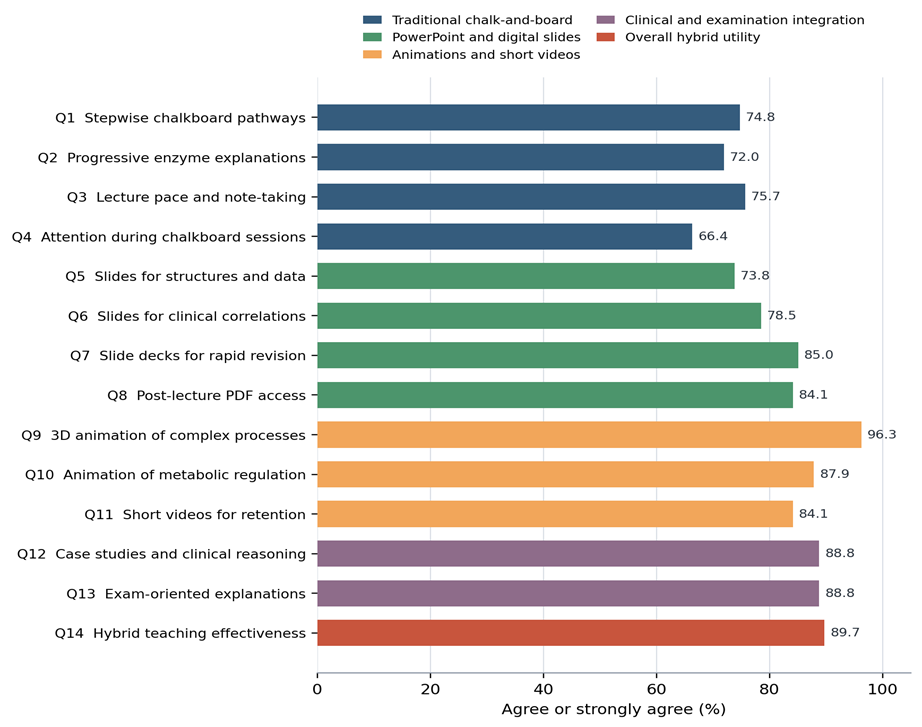
Figure 1. Positive responses to individual teaching-methodology items. Positive response was defined as agree or strongly agree; N = 107 for every item.
DISCUSSION:
Principal findings
This single-centre survey identified a clear preference for multimodal biochemistry instruction. Students valued the explanatory pace and organizational advantages of chalkboard teaching, but their strongest endorsements were directed toward animations, clinical linkage, accessible revision resources, and a hybrid approach. The pattern does not suggest that conventional teaching has become irrelevant. Rather, it indicates that different media are perceived to solve different learning problems.
The primary finding was the 89.7% endorsement of hybrid instruction. This result aligns with evidence that blended learning can produce better knowledge outcomes than traditional instruction alone, although published studies are heterogeneous in their design and effect size.13 It also agrees with Indian and post-pandemic surveys in which students favoured combined or hybrid delivery over exclusive reliance on one medium.9,11 The present study extends those observations by showing how the preference is distributed across specific functions within biochemistry.
Traditional teaching remains functionally important
Approximately three-quarters of students supported stepwise chalkboard explanation for metabolic pathways, enzyme mechanisms, lecture pacing, and note-taking. These functions are closely linked to temporal sequencing: the pathway becomes visible at the same pace at which its logic is explained. Earlier Indian surveys reported divergent overall preferences for PowerPoint and chalkboard instruction, illustrating that the effectiveness of a teaching aid depends partly on the discipline, learner cohort, and teacher’s presentation skill.6,7 More recent commentary has likewise argued that the chalk talk remains useful when it is interactive, paced, and conceptually organized.14
The lower endorsement of chalkboard teaching for attention (66.4%) is informative. Chalkboard use alone may become slow, visually monotonous, or unsuitable for complex structures. Thus, preserving its strengths does not require using it for every component of a session. It may be most effective for skeleton pathways, causal sequences, and problem solving, with digital media introduced when they add information that cannot be conveyed efficiently by progressive drawing.
Digital slides, animations, and cognitive design
Digital slides were rated more positively for revision and post-lecture access than for the initial visualization of structures. This distinction suggests that students value slides not merely as a projection medium but as a durable learning resource. Scoping and meta-analytic evidence indicates that online and internet-based learning can support knowledge acquisition and learner satisfaction, particularly when resources are well designed and integrated with in-person learning.4,5
Three-dimensional animations achieved the highest item-level positive response (96.3%). Biochemical processes such as electron transport, membrane transport, enzyme conformational change, and DNA replication have spatial and dynamic features that are difficult to infer from a static diagram. Cognitive theory provides a plausible explanation: coordinated verbal and visual representations can support mental-model construction when relevant information is selected and organized.2 Yet animation can also increase extraneous load if it is rapid, decorative, or poorly signalled. Effective resources should be brief, segmented, narrated with restraint, and paused at decision points so that students can explain the mechanism rather than passively watch it.3
The high endorsement of clinical cases and examination-oriented explanation reflects two immediate learner needs: understanding why biochemical mechanisms matter and organizing knowledge for assessment. Case-based biochemistry can promote deeper processing by connecting molecular mechanisms with symptoms, laboratory patterns, and therapeutic decisions.1 These sessions should not become answer templates alone; examination guidance is most educationally useful when it reinforces causal reasoning and clinically relevant application.
Educational implications
A practical interpretation is to design each lecture as a sequence of complementary media. The teacher may begin by eliciting prior knowledge, construct the core pathway progressively on the board, use a focused slide for complex structures or comparative data, insert a short animation for dynamic processes, and close with a clinical vignette and a concise summary slide. Active prompts, retrieval questions, and brief peer discussion can be embedded throughout. Active learning generally improves performance in science education, but it is most effective when aligned with clear outcomes rather than added as an isolated activity.15,16
The strong demand for downloadable revision material also has practical implications. Providing a concise, accessible post-lecture resource may reduce pressure to copy dense slides and allow classroom time to be used for explanation and application. Current evidence on digital clinical-skills education similarly suggests that technology is most useful when integrated with, rather than detached from, direct instruction and guided practice.17 Faculty development should therefore focus on instructional design, visual signalling, pacing, and purposeful transitions between media.
Strengths and limitations
The study has several strengths. It addressed a discipline-specific question, invited the complete first-year batch, achieved an 89.2% response rate, obtained complete item data, and reported the full Likert distributions rather than only overall means. Anonymous data collection may also have reduced reluctance to express critical views about routine teaching.
The findings should nevertheless be interpreted cautiously. First, this was a single-centre study of one cohort, so generalizability to other institutions, curricula, or years of training is uncertain. Second, responses measured perceived usefulness and preference, not knowledge gain, retention, examination performance, or clinical application. Third, the cross-sectional design cannot establish that any teaching method caused better learning. Fourth, demographic and academic variables were not collected, precluding subgroup analysis. Fifth, formal psychometric indices for the locally administered 14-item questionnaire were not available in the analysed records. Finally, nonrespondents may have held different views, and social-desirability or novelty effects may have influenced the responses.
Future research should use a multicentre design, establish content validity and internal consistency of the instrument, and link preferences with objective outcomes. Controlled comparisons of deliberately designed hybrid sessions against conventional lectures, with immediate and delayed assessments, would clarify whether the highly endorsed features translate into durable learning.
CONCLUSION:
First-year medical students supported a hybrid model of biochemistry teaching that retains the sequential clarity of chalkboard explanation while adding digital visualization, short animations, clinical cases, examination structure, and accessible revision material. Animations were particularly valued for spatial and dynamic concepts, whereas chalkboard teaching remained useful for pathways and note organization. These findings justify iterative redesign of lecture sessions, but they should not be interpreted as proof of educational superiority. Objective, multicentre evaluations are needed before effectiveness claims are made.
REFERENCES:
1. Kulak V, Newton G. A guide to using case-based learning in biochemistry education. Biochem Mol Biol Educ. 2014;42(6):457–473. doi:10.1002/bmb.20823.
2. Mayer RE. Applying the science of learning to medical education. Med Educ. 2010;44(6):543–549. doi:10.1111/j.1365-2923.2010.03624.x.
3. Grunwald T, Corsbie-Massay C. Guidelines for cognitively efficient multimedia learning tools: educational strategies, cognitive load, and interface design. Acad Med. 2006;81(3):213–223. doi:10.1097/00001888-200603000-00003.
4. Cook DA, Levinson AJ, Garside S, Dupras DM, Erwin PJ, Montori VM. Internet-based learning in the health professions: a meta-analysis. JAMA. 2008;300(10):1181–1196. doi:10.1001/jama.300.10.1181.
5. Tang B, Coret A, Qureshi A, Barron H, Ayala AP, Law M. Online lectures in undergraduate medical education: scoping review. JMIR Med Educ. 2018;4(1):e11. doi:10.2196/mededu.9091.
6. Seth V, Upadhyaya P, Ahmad M, Moghe V. PowerPoint or chalk and talk: perceptions of medical students versus dental students in a medical college in India. Adv Med Educ Pract. 2010;1:11–16. doi:10.2147/AMEP.S12154.
7. Papanna KM, Kulkarni V, Tanvi D, Lakshmi V, Kriti L, Unnikrishnan B, et al. Perceptions and preferences of medical students regarding teaching methods in a medical college, Mangalore, India. Afr Health Sci. 2013;13(3):808–813. doi:10.4314/ahs.v13i3.41.
8. Jana PK, Sarkar TK, Adhikari M, Chellaiyan VG, Ali FL, Chowdhuri S. A study on the preference of teaching methods among medical undergraduate students in a tertiary care teaching hospital, India. J Educ Health Promot. 2020;9:275. doi:10.4103/jehp.jehp_232_20.
9. Mahanta P, Kalita D, Phukon C, et al. Indian medical undergraduates’ perceptions of effective teaching methods: a cross-sectional study. Adv Med Educ Pract. 2021;12:473–479. doi:10.2147/AMEP.S306598.
10. Muniyapillai T, Kulothungan K, Abdul Malik SR, et al. Learning styles and their relationship with preferred teaching methodologies and academic achievement among medical students in teaching medical college, Tamil Nadu. J Educ Health Promot. 2023;12:256. doi:10.4103/jehp.jehp_185_23.
11. Kumari A, Rani S, Bara MP. A study on the perception of medical students using online teaching during the COVID-19 pandemic. J Family Med Prim Care. 2022;11(6):2552–2556. doi:10.4103/jfmpc.jfmpc_2074_21.
12. von Elm E, Altman DG, Egger M, Pocock SJ, Gøtzsche PC, Vandenbroucke JP; STROBE Initiative. The Strengthening the Reporting of Observational Studies in Epidemiology (STROBE) statement: guidelines for reporting observational studies. PLoS Med. 2007;4(10):e296. doi:10.1371/journal.pmed.0040296.
13. Vallée A, Blacher J, Cariou A, Sorbets E. Blended learning compared to traditional learning in medical education: systematic review and meta-analysis. J Med Internet Res. 2020;22(8):e16504. doi:10.2196/16504.
14. Singh N, Phoon CK. Not yet a dinosaur: the chalk talk. Adv Physiol Educ. 2021;45(1):61–66. doi:10.1152/advan.00126.2020.
15. Freeman S, Eddy SL, McDonough M, Smith MK, Okoroafor N, Jordt H, et al. Active learning increases student performance in science, engineering, and mathematics. Proc Natl Acad Sci U S A. 2014;111(23):8410–8415. doi:10.1073/pnas.1319030111.
16. Michael J. Where’s the evidence that active learning works? Adv Physiol Educ. 2006;30(4):159–167. doi:10.1152/advan.00053.2006.
17. McGee RG, Wark S, Mwangi F, Drovandi A, Alele F, Malau-Aduli BS, et al. Digital learning of clinical skills and its impact on medical students’ academic performance: a systematic review. BMC Med Educ. 2024;24(1):1477. doi:10.1186/s12909-024-06471-2.