COMPARATIVE STUDY OF HEMODYNAMIC RESPONSES TO ETOMIDATE VERSUS KETOFOL ANAESTHETIC INDUCTION IN PATIENTS UNDERGOING CABG SURGERY.
- Manjunath KR , Associate Professor, Department of Cardiac Anesthesia, Sri Jayadeva Institute of Cardiovascular Sciences and Research, Mysore, Karnataka.
- Muralidhara Danappa Patel , Associate Professor, Department of Cardiac Anesthesia, Sri Jayadeva Institute of Cardiovascular Sciences and Research, Mysore, Karnataka.
- Nanjappa SN , Associate Professor, Department of Cardiac Anesthesia, Sri Jayadeva Institute of Cardiovascular Sciences and Research, Mysore, Karnataka.
Article Information:
Abstract:
Background: Anaesthetic agents produces variable degree of hemodynamic changes. These changes are depend’s on type of anaesthesia drug, dose and duration of exposure. Coronary artery bypass grafting surgery (CABG) is the commonest surgery performed cardiovascular surgery. The present study aimed to compare hemodynamic responses to etomidate versus ketofol anesthetic induction in patients undergoing CABG surgery. Materials and Methods: The present study conducted in the department of anaesthesia, during the period of April 2025 to May 2026. A total of 70 patients undergoing CABG surgery divided into two groups each of 35. Group-I given Etomidate and group-II Ketofol. All the patient’s demographic, clinical and hemodynamic data were collected and analyzed. Statistical Package for Social Sciences (SPSS 20.0) version used for analysis. Results: The maximum number of patients had age between 51-60 years in both groups. Comparison of mean age between the groups not showed any significant difference. In both groups males are more than female. Comparison of mean weight between the groups not showed any significant difference. Systolic blood pressure (SBP) was decreased in both groups compared baseline with 2 min. Comparison of systolic blood pressure at 1 min, before laryngoscope (BL), immediately after laryngoscope (AL) and 2 min following laryngoscope between the groups showed significant difference. Diastolic blood pressure (DBP) at all times showed significant difference compared between the groups. Mean arterial pressure (MAP) was showed significant difference compared between the group-I and group-II. Conclusion: This study results concluded that patients received etomidate showed better cardiovascular effects compared to Ketofol.
Keywords:
Article :
INTRODUCTION:
Anaesthesia induction is often associated with a period of hemodynamic instability which could be a major problem in patients undergoing cardiovascular surgeries. Induction of anesthesia is one of the most critical step in cardiac anesthesia, especially in high risk individuals undergoing coronary artery bypass graft (CABG) surgery with left ventricular dysfunction. All the anesthetic agents often cause changes in cardiovascular disturbance directly or indirectly.
Anesthetic agents majorly act through sodium channels [1,2] which can depress or activate the cardiovascular system. Induction of anesthesia is associated with hypotension which could be a significant problem in patients undergoing CABG surgery because these patients cannot tolerate such depression. [3,4]
In addition, laryngoscopy and followed by intubation also stimulates the catecholamine surge which causes hypertension and tachycardia which can be detrimental to patients associated with cardiovascular diseases. Due to these type of variations in hemodynamic status may create an imbalance of oxygen supply and demand thus increasing the chances of myocardial ischemia in these patients. [5,6]
Thus the preservation hemodynamic stability during anaesthesia is very important to prevent the morbidity and mortality. [7] According review of literature it was evaluated the effects of a wide variety of induction agents and their combinations used to attain cardiovascular stability during anesthesia induction. At present there is no single anaesthetic drug suitable for all patients. Etomidate is commonly used anesthetic agent with minimal cardiovascular and respiratory depressant effect. Studies showed that etomidate has better stability on cardiovascular parameters. [8,9]
Ketofol is a mixture of ketamine and propofol well known anesthetic agent used in various surgeries. Ketamine is a dissociative anesthetic agent which stimulate the cardiovascular parameters and propofol is a sedative agent which depresses the cardiovascular functions. Due to divergent effects of these two drugs which can minimize the cardiovascular patients undergoing CABG surgery. With this background the present study aimed to evaluate the hemodynamic responses to etomidate versus ketofol anaesthetic induction in patients undergoing CABG surgery.
MATERIALS AND METHODS:
Study type: Comparative study
Study settings: The study was conducted in the Sri Jayadeva Institute of Cardiovascular Sciences and Research, Mysore, Karnataka.
Study period: April 2025 to May 2026
Inclusion criteria
• Patients undergoing CABG surgery
Exclusion criteria
• Pregnant women
• Drug allergy
• Asthma
• Patients on sedative and hypnotic drugs
Groups
Group-I: Etomidate (n=35)
Group-II: Ketofol (n=35)
Procedure
The study included 70 subjects undergoing CABG surgery divided into two groups. Both groups explained about study procedure and informed consent was obtained. All the patient’s demographic and clinical observations were collected and recorded. Cardiovascular parameters Heart rate (HR) systolic blood pressure(SBP), diastolic blood pressure(DBP), mean arterial pressure (MAP) were recorded at baseline ,1 min after induction , before laryngoscope (BL), after laryngoscope (AL) and 2 min after airway manipulation . The collected data was recorded in excel sheet and used for analysis.
Statistical analysis
The study was expressed in number, percentage, mean and standard deviation. Statistical Package for Social Sciences (SPSS 20.0) Version used for analysis. Unpaired t test applied to find the statistical significant between the groups. p value less than 0.05 consider statistically significant at 95% confidence interval.
RESULTS:
The maximum number of patients had age between 51-60 years in the both groups. 2 in group-II and 3 in group-I had age between 71-80 years. 14 in group-I and 15 in group-II had age between 51-60 years. Comparison of mean age between the groups not showed significant difference. Males are more number compared to females in both groups.
Comparison of mean weight between the groups not showed significant difference. (Table-1 and Graph-1) Systolic blood pressure compared between the groups at different time periods. At baseline both group patients had similar levels. Comparison of systolic blood pressure at 1 min, BL, AL and after 2 min showed significant difference.
In both groups SBP was lesser than baseline value. Group-I showed less increase in the SBP than group-II at different times. (Table-2) Comparison of DBP between the groups at baseline, 1 min, BL and after 2 min did not show any significant difference except at after laryngoscope (AL) group-II showed significant (p < 0.05) increase of DBP (86.17) compared to group I (77.86) (Table-3).
Comparison of mean arterial pressure at baseline between the groups not showed any significant difference. 1 min, BL, AL and at 2min MAP showed significant difference between the groups. At all the time periods group-I showed better MAP than group-II. (Table-4) Mean heart rate was compared between the groups at baseline, 1 min, BL, AL and at 2 min not showed any significant difference. At different study time intervals the change in heart rate between the groups were statistically insignificant). Group-I showed better pattern of heart rate compared to group-II. (Graph-2)
Table-1: Comparison of demographic data between the groups
|
Groups |
Group-I (MEAN±SD) |
Group-II (MEAN±SD) |
|
Age (Years) |
|
|
|
40-50 |
6 |
5 |
|
51-60 |
14 |
15 |
|
61-70 |
12 |
13 |
|
71-80 |
3 |
2 |
|
Gender |
|
|
|
Male |
23 |
25 |
|
Female |
12 |
10 |
|
Weight (kg) |
65.43±10.82 |
63.03±8.79 |
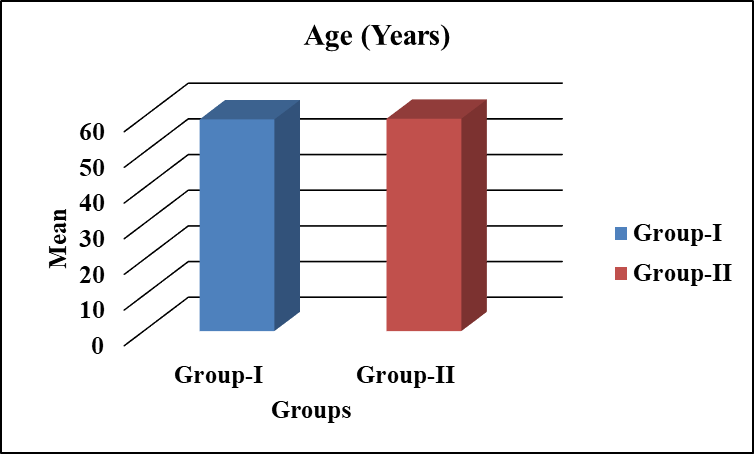
Graph-1: Comparison of mean age between the groups
Table-2: Comparison of systolic blood pressure between the groups at different time periods
|
Systolic blood pressure |
Group-I (MEAN±SD) |
Group-II (MEAN±SD) |
|
Baseline |
174.09±22.00 |
172.60±30.40 |
|
1 min |
138.69±27.32 |
150.54±30.12* |
|
BL |
130.43±24.75 |
147.54±21.04* |
|
AL |
139.94±26.50 |
158.89±27.41* |
|
2 min |
130.03±28.75 |
139.69±22.03* |
(*p<0.05 significant)
Table-3: Comparison of diastolic blood pressure between the groups at different time periods
|
Diastolic blood pressure |
Group-I (MEAN±SD) |
Group-II (MEAN±SD) |
|
Baseline |
86.37±10.04 |
85.00±14.92 |
|
1 min |
76.29±12.60 |
80.46±12.49 |
|
BL |
74.71±12.69 |
77.54±14.95 |
|
AL |
77.86±15.60 |
86.17±18.49* |
|
2 min |
72.77±13.51 |
75.57±13.73 |
(*p<0.05 significant)
Table-4: Comparison of mean arterial pressure between the groups at different time periods
|
Mean arterial pressure |
Group-I (MEAN±SD) |
Group-II (MEAN±SD) |
|
Baseline |
120.57±13.89 |
119.49±16.00 |
|
1 min |
98.89±16.93 |
107.77±17.24* |
|
BL |
94.94±16.10 |
102.43±15.14* |
|
AL |
101.80±20.30 |
114.26±21.77* |
|
2 min |
93.26±19.55 |
100.11±15.61* |
(*p<0.05 significant)
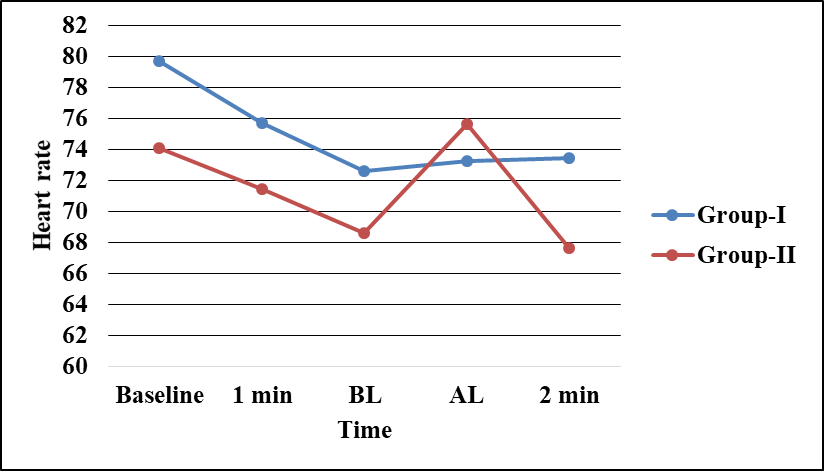
Graph 2: Comparison of mean heart rate between the groups at different time periods.
DISCUSSION:
The prevalence of patients with compromised left ventricular function undergoing CABG is significantly increasing. [10] According to studies CABG is a safe and effective treatment for patients with severely compromised left ventricular function with coronary artery disease.[11] Cardiovascular stability is the most important for any anesthetic agent used for anesthesia induction in patients undergoing CABG surgery majorly patients with a poor cardiovascular issues.
Various studies have investigated the effects of different anesthetic agents used for induction. In the present study we compared the hemodynamic effects of etomidate and ketofol in patients undergoing CABG surgery. The study results showed that etomidate showed better hemodynamic changes compared to ketofol. Aghdaii et.al evaluated the effects of etomidate-midazolam versus propofol ketamine combination during anesthesia in patients undergoing CABG surgery. The results of the study concluded that hemodynamic response at different time intervals in the two groups showed significant higher CI with patients undergoing on pump CABG surgery.[12]
Pandey et.al study found that etomidate provide more stable hemodynamic values when compared to propofol in patients compared ventricular function, undergoing CABG surgery.[13] Masoudifar et.al and Aggarwal et.al studies have confirmed that using etomidate during anesthesia induction in elective procedures results in greater hemodynamic stability compared to propofol.[14, 15] Shah SB et.al study demonstrated that etomidate gives stability without requiring any rescue drug as compared to the need for a stability drug with propofol before and during surgical procedure. [16] However, in the present study we found that etomidate provide better cardiovascular and hemodynamic stability compare to ketofol patients undergoing CABG surgery.
CONCLUSION:
The study results concluded that patients received etomidate showed better cardiovascular stability than ketofol. Patients with any preexisting cardiovascular diseases can use etomidate than ketofol to avoid cardiovascular complications during surgery.
REFERENCES:
1. Hamzeh H, Mahmood E, Samad EJG, Mahmood V. Hemodynamic stability during induction anesthesia in elderly patients: Propofol+Ketamine versus propofol and etomidate. J cardiovasc Thorac Res 2013;5(2):51-4.
2. Dhungana Y,Bhattaraji BK,Bhadani UK,Biswas BK,Tripad M. Prevention hypotension during propofol induction: A comparison of preloading with 3.5% polymers of degraded gelatin and intravenous ephedrine. Nepal Med Coll J 2008;10:16-9.
3. Reich Dl, Hossain S, Krol M, Baex B, Patel P, Bernstein A. Predictors of hypotension after induction of general anesthesia. Anesth Analg 2005;101:622-8.
4. Mankikian B, Cantineau JP, Sartene R,Clergue F,Viars P. Ventilatory pattern and chest wall mechanics during ketamine anesthesia in humans. Anesthesiology 1986;65:492-9.
5. Liou CM, Hung WT,Chen CC, Hsu SC, Lau HK. Improving the success rate of laryngeal mask airway insertion during etomidate induction by using fentanyl or succinylcholine. Acta Anaesthesiol Taiwan 2004;42:209-13.
6. Lui Pw. Is etomidate fentanyl or etomidate succinylcholine combination suitable for the insertion of laryngeal mask airway. Acta Anaesthesiol Taiwan 2004;42:183-4.
7. Micheal JS. Perioperative patients with hemodynamic instability: Consensus recommendations of the anesthesia patients safety foundation. Anesth Analg 2023;138(4):713-24.
8. Gregory A, Stapelfeldt WH, Khanna AK. Intraoperative hypotension is associated with adverse clinical outcomes after noncardiiac surgery. Anesth Analg 2021;132:1654.
9. Sessler DI, Khanna AK. Perioperative myocardial injury and the contribution of hypotension, Intensive Care Med 2018;44:811-22.
10. Mehrdad S, Alireza B, Mehrzad R, Kianoosh S, Mahdi K, Kevian S. Coronary artery bypass grafting in patients with advanced left ventricular dysfunction: Excellent early outcome with improved ejection fraction. J Tehran Heart Cen 2026;13(11):6-10.
11. Alderman EL, Fisher LD, Litwin P, Kaiser GC, Myers WO, Maynard C. Results of coronary artery surgery in patients with poor left ventricular (CASS) circulation. 1983:68:785-95.
12. Nahid Aghdaii, Mohsen Z, Seyedeh ZF, Rasoul A. Hemodynamic responses to two different anesthesia regimens in compromised left ventricular function patients undergoing coronary artery bypass graft surgery: Etomidate Midazolam versus propofol ketamine. Anesthesiology and Pain Medicine 2015;5(3):7996-9.
13. Pandey AK, Makhija N, Chauhan S, Das S, Kiran U, Bisoi AK. The effects of etomidate and propofol induction on hemodynamic and endocrine responses in patients undergoing coronary artery by pass graft surgery on cardiopulmonary bypass. World Journal of Cardiovascular Surgery 2012;2:48-53.
14. Mehrdad M, Elham B. Comparison of cardiovascular responses to laryngoscopy and tracheal intubation after induction of anesthesia by propofol and etomidate. J Res Med Sci 2013;18(10):870-4.
15. Supriya Aggarwal, Vipin KG, Shashi KC,Vijay M, Birbal B,Alok Kumar. A comperative study between propofol and etomidate in patients under general anesthesia. Braz J Anesthesiol 2016;66(3):237-41.
16. Shagun BS, Itee C,Ajay KB,Bhaenish S. Comparison of hemodynamic effects of intravenous etomidate versus propofol during induction and intubation using entropy guided hypnosis levels. J Anaesthesiol Clin Pharmacol 2015;31(2):180-5.