Comparative Efficacy of Transversus Abdominis Plane Block and Erector Spinae Plane Block for Postoperative Analgesia in Bariatric Surgery Patients: A Retrospective Observational Study.
- Aamir Waseem , Department of Anesthesia, Shalamar Hospital, Lahore.
- Qurat-ul-Ain Malik , Department of Anesthesia, Shalamar Hospital, Lahore.
- Amir Bashir , Department of Anesthesia, Shalamar Hospital, Lahore.
- Fizza Saleem , Department of Anesthesia, Shalamar Hospital, Lahore.
- Ahsan Javed , Department of Anesthesia, Shalamar Hospital, Lahore.
- Asma Samreen , Department of Anesthesia, Shalamar Hospital, Lahore.
- Muhammad Mubeen , Department of Anesthesia, Shalamar Hospital, Lahore.
Article Information:
Abstract:
Background: Morbid obesity presents unique perioperative anesthetic challenges, particularly because postoperative opioid use may increase the risk of respiratory depression, nausea, sedation, and delayed recovery. Regional anesthetic techniques such as the transversus abdominis plane (TAP) block and erector spinae plane (ESP) block are increasingly used as part of multimodal analgesia in bariatric surgery. However, comparative institutional data regarding these two techniques remain limited. Objective: To compare the postoperative analgesic efficacy of TAP block and ESP block in adult patients undergoing elective laparoscopic bariatric surgery. Methods: This retrospective observational comparative study was designed to review anesthesia and postoperative recovery records of adult patients undergoing elective laparoscopic sleeve gastrectomy or gastric bypass at a tertiary care hospital. Patients were divided into two groups according to the regional block received: TAP block or ESP block. The primary outcome was postoperative pain score measured using the Visual Analogue Scale (VAS) at 2, 6, 12, and 24 hours. Secondary outcomes included 24-hour opioid consumption, time to first rescue analgesic, postoperative nausea and vomiting (PONV), sedation, time to ambulation, and block-related complications. Continuous variables were compared using independent samples t-test or Mann–Whitney U test, and categorical variables were compared using chi-square or Fisher’s exact test. Repeated-measures analysis was planned for pain score trends over time, with multivariable regression adjustment for potential confounders. Results: A total of 100 patients were included, with 50 patients each in the TAP and ESP block groups. Baseline demographic and operative characteristics were comparable between groups. The ESP block group had significantly lower postoperative VAS scores at rest and on movement at 2, 6, 12, and 24 hours. Total 24-hour nalbuphine consumption was also lower in the ESP group compared with the TAP group (12.4 ± 5.4 mg vs 20.4 ± 5.9 mg, p < 0.001). ESP block was associated with longer time to first rescue analgesia, reduced rescue analgesic requirement, lower PONV and sedation, and earlier ambulation. Conclusion: ESP block provided superior postoperative analgesia compared with TAP block in patients undergoing laparoscopic bariatric surgery. It was associated with lower pain scores, reduced opioid consumption, fewer opioid-related adverse effects, and earlier ambulation, suggesting that ESP block may be a useful component of multimodal analgesia in bariatric surgery.
Keywords:
Article :
INTRODUCTION:
Morbid obesity is associated with multiple perioperative challenges, including difficult airway management, altered pharmacokinetics, increased prevalence of obstructive sleep apnea (OSA), and higher susceptibility to postoperative respiratory complications. Effective postoperative analgesia is particularly important in bariatric surgery because uncontrolled pain can impair deep breathing, delay mobilization, increase sympathetic stress responses, and prolong recovery. At the same time, excessive opioid administration in obese patients, especially those with OSA, may increase the risk of respiratory depression, postoperative nausea and vomiting, sedation, and delayed ambulation [1].
Multimodal analgesia has therefore become an important component of enhanced recovery pathways in bariatric surgery [2,3]. Regional anesthetic techniques can reduce opioid requirements while providing targeted analgesia. The transversus abdominis plane (TAP) block is a widely used interfascial plane block that provides analgesia to the anterior abdominal wall by targeting nerves between the internal oblique and transversus abdominis muscles. It has been used for laparoscopic abdominal procedures; however, its analgesic effect is largely somatic and may not fully address visceral components of postoperative pain [4].
The erector spinae plane (ESP) block is a more recently described interfascial plane block in which local anesthetic is deposited deep to the erector spinae muscle, allowing possible cranio-caudal spread and paravertebral diffusion [5,6]. This may provide both somatic and visceral analgesia, making it attractive for laparoscopic abdominal surgery. International studies have demonstrated its safety, simplicity, and potential superiority in various laparoscopic and open abdominal surgeries, including bariatric procedures [1,4,6]. Recent meta-analyses suggest ESP blocks may lead to lower opioid consumption, reduced postoperative nausea and vomiting, and better pain scores compared with TAP blocks [4,7,8].
Locally, limited data exist from Pakistan comparing ESP and TAP blocks in bariatric surgery. A few studies have explored their use in laparoscopic cholecystectomy and cesarean sections, reporting favorable pain control with ESP blocks and minimal complications [2,3,8]. However, no institutional data is available from Shalamar Hospital specifically for bariatric surgery patients, despite the increasing number of such procedures and the unique analgesic challenges they present [7,9,10].
This study was therefore designed to compare postoperative analgesic outcomes between TAP block and ESP block in adult patients undergoing elective laparoscopic bariatric surgery.
Objectives
The primary objective of the study was:
1) To compare the postoperative analgesic efficacy of the transversus abdominis plane block and the erector spinae plane block in patients undergoing bariatric surgery.
2) The secondary objectives were:
3) To compare total opioid consumption during the first 24 hours postoperatively between the transversus abdominis plane block group and the erector spinae plane block group.
4) To evaluate postoperative pain scores at predefined time intervals using a standardized pain assessment tool, such as the Visual Analogue Scale.
5) To assess and compare the incidence of block-related complications in both groups.
6) To assess and compare the incidence of opioid-related adverse effects in both groups.
MATERIALS AND METHODS:
Study Design and Setting
It was a retrospective observational comparative study conducted in the Department of Anesthesiology at Shalamar Hospital, Lahore, Pakistan. The study involved review of existing medical, anesthesia, and postoperative recovery records of patients who underwent elective laparoscopic bariatric surgery and received either TAP block or ESP block for postoperative analgesia.
Sample size
The sample size was calculated using the two-sample means formula for equal group sizes, taking postoperative pain score on the Visual Analogue Scale as the primary outcome. Assuming a two-sided significance level of 5%, 90% power, an anticipated standard deviation of 1.5, and a minimum clinically important difference of 1.0 VAS point between the two groups, the required sample size was approximately 48 patients per group. To allow for incomplete or unusable records, the sample size was rounded to 50 patients per group, giving a final sample size of 100 patients.
A simple random sampling technique was used. Eligible adult patients who underwent elective laparoscopic bariatric surgery and received either a transversus abdominis plane block or an erector spinae plane block were identified from hospital records. After applying the inclusion and exclusion criteria, patient records were numbered, and a computer-generated random selection method was used to select 50 patients from each group.
Study Population
The study population consisted of adult patients aged 18–60 years with morbid obesity, defined as body mass index (BMI) between 40 and 50 kg/m², who underwent elective laparoscopic sleeve gastrectomy or gastric bypass under general anesthesia. Patients were divided into two groups according to the type of regional block documented in the anesthesia record:
Group A: Transversus Abdominis Plane block
Group B: Erector Spinae Plane block
Inclusion Criteria
Patients were eligible for inclusion if they met all of the following criteria:
1. Age between 18 and 60 years.
2. BMI between 40 and 50 kg/m².
3. Elective laparoscopic bariatric surgery, including sleeve gastrectomy or gastric bypass.
4. ASA physical status II or III.
5. Received either ultrasound-guided TAP block or ultrasound-guided ESP block.
6. Complete anesthesia and postoperative recovery records available for review.
Exclusion Criteria
Patients were excluded if they had incomplete records, emergency surgery, non-bariatric abdominal surgery, conversion to open surgery, operative duration exceeding three hours, chronic opioid use, chronic pain disorder, coagulopathy, anticoagulant therapy, allergy to local anesthetic agents, local infection at the block site, significant hepatic, renal or cardiac dysfunction, or neurological/psychiatric conditions interfering with pain assessment.
Data Collection
Data were extracted using a structured proforma. Variables included age, sex, BMI, ASA status, comorbidities including OSA, hypertension and diabetes mellitus, type of bariatric procedure, duration of surgery, type of regional block, timing of block, local anesthetic used, postoperative VAS pain scores, opioid consumption, time to first rescue analgesic, PONV, sedation score, time to ambulation, and block-related complications.
Pain scores were recorded using the Visual Analogue Scale, where 0 represented no pain and 10 represented the worst imaginable pain. VAS scores were recorded at rest and on movement at 2, 6, 12, and 24 hours postoperatively. Rescue analgesia was defined as administration of additional analgesia for VAS score of 4 or greater. PONV was defined as nausea and/or vomiting occurring within the first 24 hours after surgery.
Outcomes
The primary outcome was postoperative VAS pain score at predefined postoperative intervals. Secondary outcomes included total 24-hour nalbuphine consumption, time to first rescue analgesic, requirement for rescue analgesia, incidence of PONV, sedation, time to ambulation, and block-related complications.
Statistical Analysis
Data were entered and analyzed using SPSS version 26.0. Continuous variables were assessed for normality using histograms and the Shapiro–Wilk test. Normally distributed variables were expressed as mean ± standard deviation, while non-normally distributed variables were expressed as median with interquartile range. Categorical variables were reported as frequencies and percentages.
Between-group comparisons were performed using the independent samples t-test or Mann–Whitney U test for continuous variables and chi-square test or Fisher’s exact test for categorical variables. Repeated-measures ANOVA was used to assess pain score trajectories over time. Mauchly’s test was used to assess sphericity, and Greenhouse–Geisser correction was applied where appropriate. Multivariable regression analysis was planned to adjust for potential confounders including BMI, ASA status, presence of OSA, and type of bariatric procedure. A p-value of less than 0.05 was considered statistically significant.
Ethical Considerations
This study was based on retrospective review of existing hospital records. No direct patient contact or intervention was involved. Patient identifiers were removed during data extraction, and each record was assigned a unique study code. Data were stored in password-protected files accessible only to the research team. Ethical approval and waiver of individual consent was taken from the Institutional Review Board.
RESULTS:
Patient Selection
A total of 128 bariatric surgery records were screened. Twenty-eight records were excluded: 12 due to incomplete postoperative pain documentation, six due to missing anesthesia block details, four due to conversion to open surgery, three due to prolonged operative duration greater than three hours, and three due to chronic opioid use. The final analysis included 100 patients, with 50 patients in the TAP block group and 50 patients in the ESP block group (Figure 1).
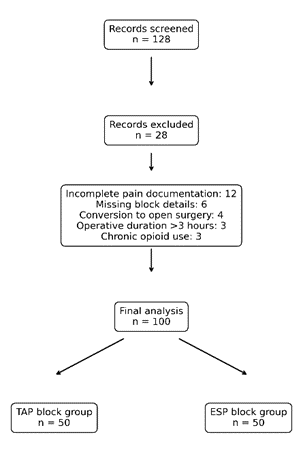
Figure 1: Patient Flow Diagram
Baseline Characteristics
Baseline demographic and clinical characteristics were comparable between the two groups. The mean age was 36.9 ± 8.9 years in the TAP group and 40.2 ± 8.4 years in the ESP group. Mean BMI was 44.1 ± 2.6 kg/m² in the TAP group and 44.7 ± 2.3 kg/m² in the ESP group. The distribution of sex, ASA status, OSA, hypertension, diabetes mellitus, type of bariatric procedure, and operative duration did not differ significantly between groups.
Table 1. Baseline demographic and operative characteristics
|
Variable |
TAP group, n=50 |
ESP group, n=50 |
p-value |
|
Age, years |
36.9 ± 8.9 |
40.2 ± 8.4 |
0.052 |
|
Female sex |
31 (62.0%) |
29 (58.0%) |
0.683 |
|
BMI, kg/m² |
44.1 ± 2.6 |
44.7 ± 2.3 |
0.233 |
|
ASA III |
23 (46.0%) |
24 (48.0%) |
0.841 |
|
Obstructive sleep apnea |
20 (40.0%) |
22 (44.0%) |
0.685 |
|
Hypertension |
17 (34.0%) |
18 (36.0%) |
0.834 |
|
Diabetes mellitus |
13 (26.0%) |
14 (28.0%) |
0.822 |
|
Sleeve gastrectomy |
40 (80.0%) |
38 (76.0%) |
0.629 |
|
Gastric bypass |
10 (20.0%) |
12 (24.0%) |
0.629 |
|
Operative duration, minutes |
96.7 ± 19.7 |
95.9 ± 17.6 |
0.832 |
Postoperative Pain Scores
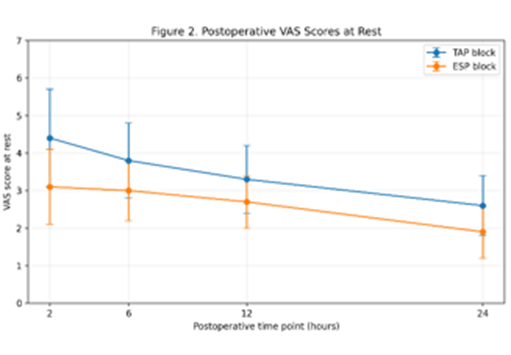
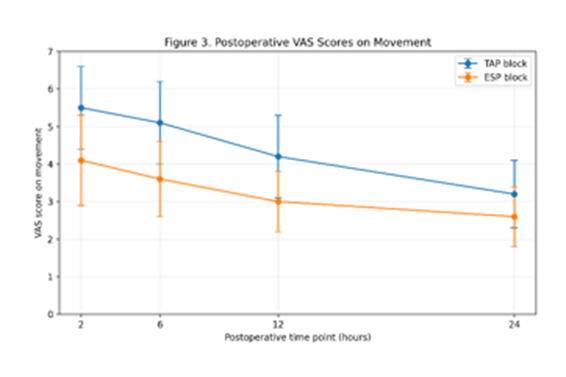
Postoperative VAS scores at rest were significantly lower in the ESP group compared with the TAP group at all recorded time points. At 2 hours, mean VAS at rest was 4.4 ± 1.3 in the TAP group compared with 3.1 ± 1.0 in the ESP group. This difference remained significant at 6, 12, and 24 hours. Similar findings were observed for VAS scores on movement.
Table 2. Postoperative VAS pain scores at rest and on movement
|
Time point |
TAP group, n=50 |
ESP group, n=50 |
p-value |
|
VAS at rest, 2 hours |
4.4 ± 1.3 |
3.1 ± 1.0 |
<0.001 |
|
VAS at rest, 6 hours |
3.8 ± 1.0 |
3.0 ± 0.8 |
<0.001 |
|
VAS at rest, 12 hours |
3.3 ± 0.9 |
2.7 ± 0.7 |
<0.001 |
|
VAS at rest, 24 hours |
2.6 ± 0.8 |
1.9 ± 0.7 |
<0.001 |
|
VAS on movement, 2 hours |
5.5 ± 1.1 |
4.1 ± 1.2 |
<0.001 |
|
VAS on movement, 6 hours |
5.1 ± 1.1 |
3.6 ± 1.0 |
<0.001 |
|
VAS on movement, 12 hours |
4.2 ± 1.1 |
3.0 ± 0.8 |
<0.001 |
|
VAS on movement, 24 hours |
3.2 ± 0.9 |
2.6 ± 0.8 |
0.001 |
Repeated-measures analysis demonstrated a significant reduction in VAS scores over time in both groups. There was also a significant between-group effect favoring ESP block and a significant group-by-time interaction, suggesting a more favorable pain trajectory in the ESP group. A visual representation of this is presented in Figures 2 and 3.
Opioid Consumption and Rescue Analgesia
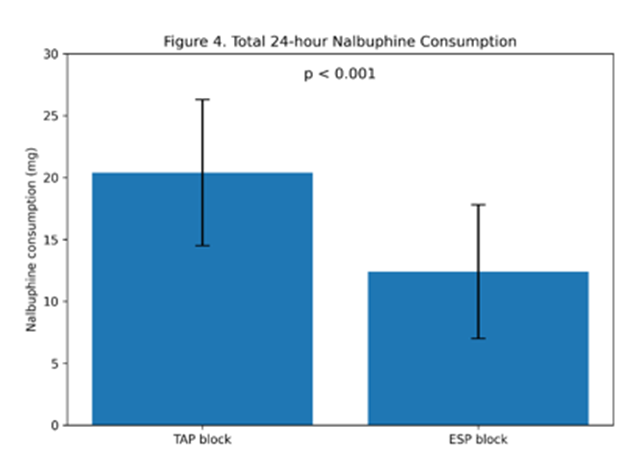
Total 24-hour nalbuphine consumption was significantly lower in the ESP group than in the TAP group (12.4 ± 5.4 mg vs 20.4 ± 5.9 mg, p < 0.001) (Figure 4). The median time to first rescue analgesic was longer in the ESP group compared with the TAP group: 138 minutes versus 71 minutes, respectively. Rescue analgesia was required in 84.0% of patients in the TAP group compared with 58.0% in the ESP group.
Table 3. Postoperative analgesic and recovery outcomes
|
Outcome |
TAP group, n=50 |
ESP group, n=50 |
p-value |
|
24-hour nalbuphine consumption, mg |
20.4 ± 5.9 |
12.4 ± 5.4 |
<0.001 |
|
Time to first rescue analgesic, minutes |
71 (53–99) |
138 (97–176) |
<0.001 |
|
Rescue analgesia required |
42 (84.0%) |
29 (58.0%) |
0.004 |
|
PONV within 24 hours |
16 (32.0%) |
7 (14.0%) |
0.032 |
|
Sedation |
10 (20.0%) |
3 (6.0%) |
0.037 |
|
Time to ambulation, hours |
8.9 ± 2.6 |
6.7 ± 2.4 |
<0.001 |
|
Block-related complication |
0 (0.0%) |
0 (0.0%) |
— |
Multivariable Analysis
After adjustment for BMI, ASA status, OSA, and type of bariatric procedure, ESP block remained independently associated with lower 24-hour opioid consumption. Adjusted analysis showed an estimated mean reduction of 7.6 mg in nalbuphine requirement in the ESP group compared with the TAP group. ESP block was also associated with lower odds of rescue analgesic requirement and PONV.
Table 4. Adjusted analysis of selected postoperative outcomes
|
Outcome |
Adjusted effect estimate for ESP vs TAP |
95% CI |
p-value |
|
24-hour nalbuphine consumption |
−7.6 mg |
−9.9 to −5.3 |
<0.001 |
|
Time to ambulation |
−1.9 hours |
−2.9 to −0.9 |
<0.001 |
|
Rescue analgesia required |
aOR 0.28 |
0.11–0.73 |
0.009 |
|
PONV within 24 hours |
aOR 0.32 |
0.11–0.91 |
0.033 |
|
Sedation |
aOR 0.25 |
0.06–0.99 |
0.048 |
DISCUSSION:
In this retrospective comparative study, patients who received an erector spinae plane (ESP) block demonstrated superior postoperative analgesic outcomes compared with those who received a transversus abdominis plane (TAP) block following elective laparoscopic bariatric surgery. The ESP group had consistently lower VAS scores at rest and on movement at 2, 6, 12, and 24 hours postoperatively. In addition, ESP block was associated with significantly lower 24-hour nalbuphine consumption, longer time to first rescue analgesia, lower requirement for rescue analgesics, reduced incidence of postoperative nausea and vomiting (PONV), lower sedation rates, and earlier ambulation. These findings suggest that ESP block may offer a clinically meaningful opioid-sparing and recovery-enhancing effect in bariatric surgical patients.
The findings of the present study are clinically relevant because postoperative pain control in bariatric surgery is challenging. Patients with morbid obesity frequently have associated comorbidities such as obstructive sleep apnea, reduced pulmonary reserve, hypertension, diabetes mellitus, and increased sensitivity to the respiratory depressant effects of opioids. For this reason, enhanced recovery pathways in bariatric surgery emphasize multimodal, opioid-sparing analgesia to improve respiratory safety, facilitate mobilization, and reduce opioid-related adverse events [11]. In the present study, the reduction in nalbuphine requirement in the ESP group is therefore not only statistically significant but also clinically important. Lower opioid exposure may explain the reduced sedation and PONV observed in the ESP group, both of which are important determinants of early recovery after laparoscopic bariatric procedures.
The superior analgesic profile observed with ESP block may be explained by the anatomical and pharmacological characteristics of the block. TAP block provides analgesia by depositing local anesthetic between the internal oblique and transversus abdominis muscles, targeting the anterior abdominal wall nerves. This makes it useful for somatic pain arising from trocar sites and abdominal wall incision. However, TAP block has limited effect on visceral pain, which is an important component of discomfort following laparoscopic bariatric surgery due to pneumoperitoneum, gastric manipulation, traction, and diaphragmatic irritation. ESP block, in contrast, involves deposition of local anesthetic deep to the erector spinae muscle, where spread may occur in a cranio-caudal direction and potentially toward the paravertebral space. This may allow coverage of both somatic and visceral afferent pathways, offering a broader analgesic effect than TAP block [12,13].
The pain trajectory in this study supports this proposed mechanism. VAS scores were lower in the ESP group at all postoperative intervals, both at rest and on movement. The difference was particularly evident in the early postoperative period, when pain is usually most intense and opioid requirements are highest. Similar findings have been reported in previous bariatric surgery trials. Elshazly et al. compared ESP block with TAP block in patients with obesity undergoing laparoscopic bariatric surgery and reported lower mean VAS scores during the first 24 hours in the ESP group, along with longer time to first rescue analgesia and improved feasibility of block performance [13]. Abdelhamid et al. also compared bilateral ESP block with subcostal TAP block and systemic opioid analgesia in patients undergoing sleeve gastrectomy and found that ESP block produced lower pain scores and reduced postoperative opioid consumption compared with TAP block at selected time points [14]. These findings are consistent with the present results and support the potential superiority of ESP block in this patient population.
The reduction in opioid consumption observed in the ESP group is also consistent with recent evidence. Mostafa et al. demonstrated that ultrasound-guided ESP block provided satisfactory analgesia after laparoscopic bariatric surgery and decreased postoperative analgesic requirements [15]. Similarly, ul Huda et al. reported that ESP block significantly reduced intraoperative and 24-hour postoperative opioid consumption in patients undergoing laparoscopic sleeve gastrectomy [16]. In the present study, 24-hour nalbuphine consumption was substantially lower in the ESP group than in the TAP group. This difference remained significant after adjustment for BMI, ASA status, OSA, and procedure type, suggesting that the observed benefit was not solely explained by baseline patient characteristics or surgical variation.
Although TAP block performed less favorably than ESP block in this study, it should not be interpreted as ineffective. TAP block remains a useful component of multimodal analgesia in abdominal and bariatric surgery. Recent systematic reviews have shown that TAP block can reduce postoperative pain scores after laparoscopic sleeve gastrectomy when compared with no block or standard analgesia alone [17,18]. However, its effect on breakthrough analgesia consumption, time to rescue analgesia, PONV, ambulation, and length of stay has been less consistent across trials [17]. This may be because TAP block primarily covers anterior abdominal wall somatic pain, while laparoscopic bariatric pain has a mixed somatic and visceral component. Therefore, TAP block may be more effective when incisional pain predominates, whereas ESP block may provide additional benefit where visceral pain and opioid-sparing are major concerns.
The lower incidence of PONV and sedation in the ESP group is another important finding. PONV is common after bariatric surgery and can delay oral intake, prolong observation, worsen patient discomfort, and increase risk of dehydration. Sedation is also particularly concerning in patients with obesity and OSA, as it may worsen airway obstruction and hypoventilation. In the present study, the lower PONV and sedation rates likely reflect reduced nalbuphine exposure in the ESP group. A recent systematic review of ESP block in laparoscopic surgery reported reduced opioid consumption and a lower risk of PONV when ESP block was compared with placebo, although PONV differences between ESP and TAP groups may vary depending on study design, opioid regimen, and antiemetic protocol [12]. This suggests that opioid-sparing regional analgesia may provide recovery benefits beyond pain score reduction alone.
Earlier ambulation in the ESP group is also meaningful in the bariatric population. Early mobilization is a core element of enhanced recovery and may reduce the risk of atelectasis, venous thromboembolism, ileus, and prolonged hospitalization. Better pain control during movement likely allowed ESP block patients to sit, stand, and mobilize earlier. In addition, reduced opioid use may have decreased sedation, dizziness, nausea, and delayed gastrointestinal recovery. Elshazly et al. reported earlier return of intestinal function in the ESP group compared with the TAP group, suggesting that ESP block may support early postoperative recovery beyond analgesia alone [13]. Although the present study did not assess bowel function or length of stay, the earlier ambulation observed in the ESP group is consistent with the broader recovery benefits reported in the literature.
The multivariable analysis strengthens the interpretation of the findings. After adjustment for BMI, ASA status, OSA, and type of bariatric procedure, ESP block remained independently associated with lower opioid consumption, reduced rescue analgesia requirement, lower PONV, lower sedation, and earlier ambulation. This is important because bariatric patients are heterogeneous, and analgesic outcomes can be affected by BMI, OSA, comorbidities, surgical duration, technical difficulty, and procedure type. Adjustment for these confounders helps improve the credibility of the observed association between block type and postoperative outcomes. However, as this was a retrospective observational study, residual confounding cannot be fully excluded.
No major block-related complications were observed in either group. This supports the safety of ultrasound-guided fascial plane blocks when performed by trained anesthesiologists. ESP block may be particularly attractive in patients with obesity because it is performed away from the peritoneal cavity and major neuraxial structures, and ultrasound visualization of bony landmarks such as transverse processes may be relatively straightforward. In contrast, TAP block in patients with high BMI may be technically challenging due to increased abdominal wall thickness and difficulty identifying fascial planes. Nevertheless, the safety findings should be interpreted cautiously, as retrospective studies may underreport minor complications if documentation is incomplete.
Strengths
This study has several strengths. First, it addresses a clinically important question in a high-risk surgical population. Second, the groups were comparable in terms of age, sex, BMI, ASA status, OSA, comorbidities, type of procedure, and operative duration. Third, pain was assessed at multiple postoperative time points, allowing evaluation of pain trajectory rather than a single pain score. Fourth, the study included several clinically meaningful secondary outcomes, including opioid consumption, rescue analgesia, PONV, sedation, ambulation, and block-related complications. Finally, multivariable adjustment was performed to account for key confounders.
Limitations
The study also has important limitations. The retrospective design makes it vulnerable to documentation bias, selection bias, and residual confounding. The choice of block may have depended on anesthesiologist preference, expertise, patient anatomy, availability of equipment, or evolving departmental practice. Pain scores may not have been recorded with the same consistency across all patients. The type, timing, volume, and concentration of local anesthetic may also vary in real-world retrospective records unless standardized institutional protocols are used. In addition, the study assessed only early postoperative outcomes within 24 hours and did not include patient satisfaction, quality of recovery scores, pulmonary function, length of hospital stay, readmission, or cost-effectiveness. Future prospective randomized controlled trials should standardize block technique, local anesthetic dose, background analgesic regimen, antiemetic protocol, and recovery endpoints. Larger multicenter studies would also help determine whether ESP block should be adopted as a preferred regional analgesic technique in bariatric enhanced recovery protocols.
CONCLUSION:
In summary, the present study suggests that ESP block may provide superior postoperative analgesia compared with TAP block in patients undergoing laparoscopic bariatric surgery. The benefits observed in pain scores, opioid consumption, rescue analgesia requirement, PONV, sedation, and ambulation support the use of ESP block as part of a multimodal opioid-sparing analgesic strategy. TAP block remains useful for anterior abdominal wall analgesia, but ESP block may offer broader analgesic coverage and better early recovery outcomes in morbidly obese bariatric patients. These findings should be confirmed through prospective randomized studies using standardized protocols and patient-centered recovery outcomes.
REFERENCES:
1. De Cassai A, Tulgar S, Carron M, Navalesi P. Regional anesthesia in bariatric surgery. Curr Opin Anaesthesiol. 2025;38(5):611-617.
2. Hasnain F, Saeed M, Shah SQA, Riaz MM, Shareef MH. Efficacy of Erector Spinae Block versus Transversus Abdominis Plane Block in Post-Operative Pain Control After Laparoscopic Cholecystectomy. Pak Armed Forces Med J. 2025;75(2):277-280.
3. Ali M, Yasin B, Khan S, Ali I, Abdullah H, Tarar HM. Ultrasound-Guided Erector Spinae Plane Block versus Oblique Subcostal Transversus Abdominis Plane Block for Post-Operative Analgesia of Adult Patients Undergoing Laparoscopic Cholecystectomy. Pak Armed Forces Med J. 2023;73(5):1245-1248.
4. Hung KC, Liu WC, Hsu CW, Wu JY, Liao SW, Chen IW. Efficacy of the Erector Spinae Plane Block on Analgesic Outcomes in Patients Undergoing Metabolic Surgery: A Meta-Analysis of Randomized Controlled Trials. Obes Surg. 2025;35(3):1135-1145.
5. Gao X, Tian T, Xue FS. Erector Spinae Plane Block versus Transversus Abdominis Plane Block in Laparoscopic Hysterectomy: A Randomized Controlled Trial. J Obstet Anesth. 2022;39:112-118.
6. Elshazly M, Ahmed A, Fawzy M, Hassan M. Feasibility and efficacy of Erector Spinae Plane Block versus Transversus Abdominis Plane Block in Laparoscopic Bariatric Surgery: A Randomized Comparative Trial. Korean J Anesthesiol. 2022;75(6):502-509.
7. Ahmed Z, Malik MA, Khan N, Javed A. Comparison of Analgesic Efficacy of Erector Spinae Plane Block and Transversus Abdominis Plane Block in Abdominal Surgeries. J Pak Med Assoc. 2021;71(8):1995-2000.
8. El-Ghazaly HH, Hassan M, Mahmoud AA. Analgesic Effect of Erector Spinae Plane Block versus Transversus Abdominis Plane Block After Elective Cesarean Section. Ain-Shams J Anesthesiol. 2022;14(1):10-15.
9. Abate SM, Belihu AE. Efficacy of low-dose bupivacaine with intrathecal fentanyl for cesarean section on maternal hemodynamic: Systematic review and meta-analysis. Saudi J Anaesth. 2019;13(4):340-351.
10. Park J, Kim E, Lee H, Seo H. Quality of recovery and analgesia after total abdominal hysterectomy under general anesthesia: A randomized controlled trial of TAP block vs epidural analgesia vs parenteral medications. Br J Anaesth. 2019;123(4):456-464.
11. Stenberg E, Dos Reis Falcão LF, O’Kane M, Liem R, Pournaras DJ, Salminen P, et al. Guidelines for perioperative care in bariatric surgery: Enhanced Recovery After Surgery (ERAS) Society recommendations: a 2021 update. World J Surg. 2022;46(4):729-751.
12. Oraee S, Rajai Firouzabadi S, Mohammadi I, Alinejadfard M, Golsorkh H, Hatami S. Erector spinae plane block for laparoscopic surgeries: a systematic review and meta-analysis. BMC Anesthesiol. 2024;24:389.
13. Elshazly M, EL-Halafawy YM, Mohamed DZ, Wahab KAE, Mohamed TMK. Feasibility and efficacy of erector spinae plane block versus transversus abdominis plane block in laparoscopic bariatric surgery: a randomized comparative trial. Korean J Anesthesiol. 2022;75(6):502-509.
14. Abdelhamid BM, Khaled D, Mansour MA, Hassan MM. Comparison between the ultrasound-guided erector spinae block and the subcostal approach to the transversus abdominis plane block in obese patients undergoing sleeve gastrectomy: a randomized controlled trial. Minerva Anestesiol. 2020;86(8):816-826.
15. Mostafa SF, Abdelghany MS, Abu Elyazed MM. Ultrasound-guided erector spinae plane block in patients undergoing laparoscopic bariatric surgery: a prospective randomized controlled trial. Pain Pract. 2021;21(4):445-453.
16. ul Huda A, Alshahrani AS, Yasir M, Sawilah A, Alharthi AAN. Erector spinae block reduces intraoperative and postoperative opioid consumption in patients undergoing laparoscopic sleeve gastrectomy: a randomized controlled trial. Qatar Med J. 2024;2024(4):58.
17. Davey MG, Conneely JC, Bolger JC, Robb WB, Donlon NE. Transversus abdominus plane block for laparoscopic sleeve gastrectomy: a systematic review and meta-analysis of randomized clinical trials. Obes Surg. 2025;35(10):4224-4233.
18. Filardi K, Filardi R, Wegner B, et al. Ultrasound-guided transversus abdominis plane block as an effective path to reduce opioid consumption after laparoscopic bariatric surgery: a systematic review and meta-analysis of randomized controlled trials. Obes Surg. 2024;34(11):4244-4254.
19. Wang Y, Zuo S, Ma Y, Shen J, Chu Q, Yang Z. Effect of ultrasound-guided erector spinae plane block on recovery after laparoscopic sleeve gastrectomy in patients with obesity: a randomized controlled trial. Clin Ther. 2023;45(9):894-900.