FIVE REPRESENTATIVE CASES OF CONCOMITANT ABDOMINOPLASTY AND COMPLEX INCISIONAL HERNIA REPAIR.
- Ashwini kumar , Assistant Professor, MBBS, MS, Department Of General Surgery, AIIMS Patna, India.
- Sanjit Prasad , Assistant professor, General Surgery, Department Of General Surgery, AIIMS Patna, India.
Article Information:
Abstract:
Background: Concomitant abdominoplasty and complex incisional hernia repair represent a challenging yet effective approach for patients presenting with abdominal wall deformities, excess skin, and large or complex hernias following previous abdominal surgeries. This case series describes five representative cases undergoing combined abdominal wall reconstruction with abdominoplasty and repair of complex incisional hernias. Patients were evaluated preoperatively with detailed clinical assessment and appropriate imaging to determine the size, location, and complexity of the hernia defects. The surgical approach involved meticulous dissection, hernia sac management, fascial reconstruction using appropriate mesh reinforcement where indicated, and simultaneous removal of excess abdominal skin and soft tissue through abdominoplasty techniques. All five patients underwent successful combined procedures with satisfactory restoration of abdominal wall integrity and improvement in abdominal contour. Postoperative outcomes were assessed in terms of wound healing, seroma formation, infection, recurrence, functional improvement, and aesthetic satisfaction. The combined approach allowed correction of both functional and cosmetic concerns in a single operative session while avoiding staged procedures. Although technically demanding due to the increased risk of wound-related complications, careful patient selection, optimization of comorbidities, adherence to abdominal wall reconstruction principles, and appropriate surgical planning can result in favourable outcomes. This case series highlights the feasibility and benefits of simultaneous abdominoplasty and complex incisional hernia repair as an integrated approach for selected patients requiring abdominal wall restoration.
Keywords:
Article :
INTRODUCTION:
Abdominoplasty is among the most frequently performed aesthetic procedures by plastic surgeons[1] It is commonly undertaken to address fascial laxity or diastasis recti, which often leads to the development of abdominal wall hernias. These hernias occur when intra-abdominal contents protrude into a hernial sac, presenting a complex challenge for surgical repair, particularly in cases of massive ventral hernias. The abdominoplasty approach not only facilitates access to all components of the abdominal wall but also helps identify previously undetected hernias, resulting in a more aesthetically pleasing postoperative appearance.The goal of an ideal reconstruction is multifaceted: it must correct and prevent visceral eventration, provide dynamic muscle support, and enable a tension-free repair in a single-stage procedure.[2] Various techniques have been developed to enhance the surgical approach to abdominoplasty, including the use of a transverse lower abdominal incision and the resection of excess skin.[3] These techniques have been effectively incorporated into the management of ventral incisional hernias.
A significant consideration in hernia repair is the use of synthetic materials. While large sheets of synthetic material can be employed, they often result in a rigid, noncompliant, and adynamic abdominal wall, making them unsuitable in cases of contamination. Recognizing the limitations of synthetic materials, Ramirez et al. introduced the "components separation technique" in 1990. This innovative method bridges the fascial gap without the need for prosthetic material, allowing for up to 10 cm of unilateral advancement and facilitating a tension-free abdominal closure.[4]
This manuscript describes the application of abdominoplasty in conjunction with hernia repair, emphasizing the benefits of this combined approach in improving both functional and aesthetic outcomes for patients with large incisional hernias. Through a detailed exploration of patient selection, surgical techniques, and postoperative results, we aim to provide a comprehensive understanding of the advantages and challenges associated with this combined procedure.
CASE DESCRIPTIONS :
Case 1
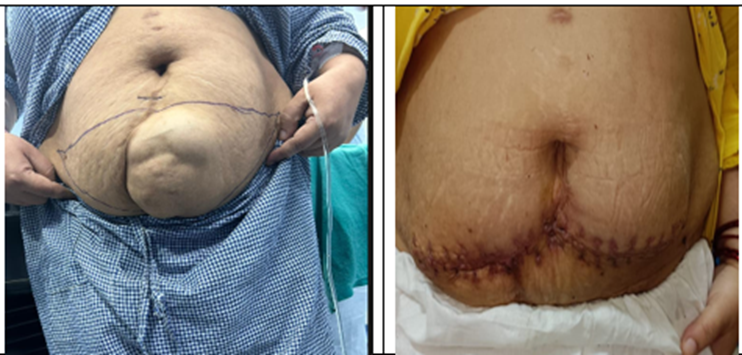
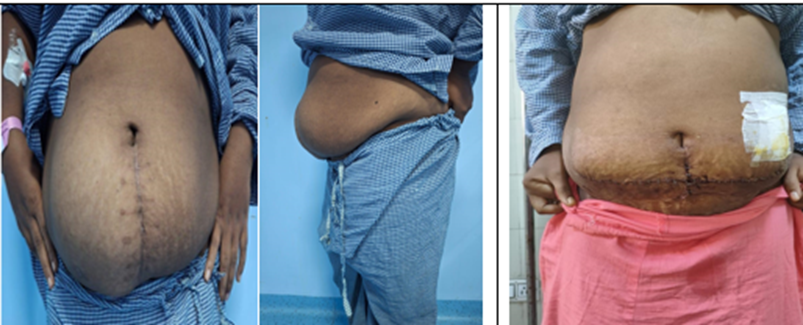
A 38-year-old female with a primary midline incisional hernia (EHS M4W2) following previous laparotomy presented with abdominal wall laxity and poor abdominal contour. She underwent retrorectus mesh repair with concomitant abdominoplasty. The postoperative course was uneventful. At 90-day follow-up, the patient demonstrated excellent contour restoration, marked improvement in HerQLes score, and no evidence of recurrence.
Case 2
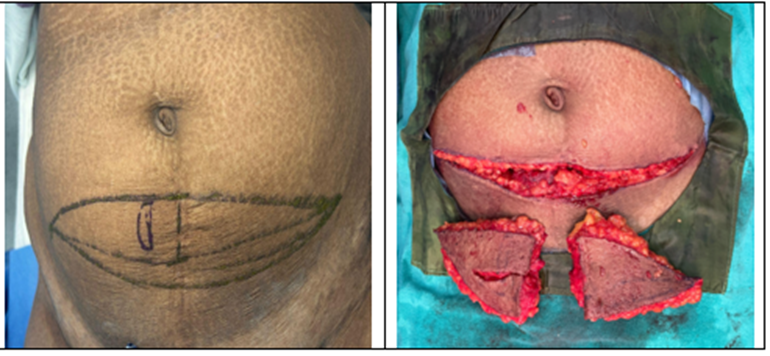
A 45-year-old multiparous female presented with a recurrent incisional hernia (EHS M5W3) associated with redundant lower abdominal skin. Posterior component separation with transversus abdominis release (TAR), retromuscular polypropylene mesh placement, and abdominoplasty were performed. A small postoperative seroma resolved with aspiration. Functional recovery and cosmetic outcome were excellent.
Case 3
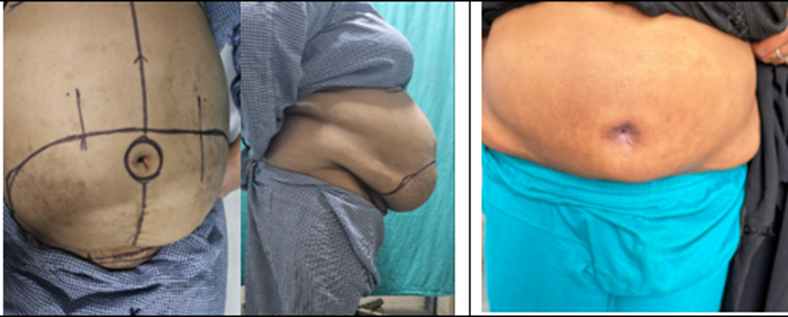
A 41-year-old woman with a large infraumbilical incisional hernia and significant abdominal wall laxity underwent retromuscular mesh repair with progressive component separation and simultaneous abdominoplasty. Recovery was uncomplicated, with significant improvement in abdominal wall contour and quality of life. No recurrence was detected during follow-up.
Case 4
A 52-year-old female with a complex midline incisional hernia (EHS M4W3) after previous gynecological surgery underwent TAR with retromuscular mesh reconstruction and abdominoplasty. Minor superficial surgical-site infection responded to dressings and antibiotics. At 3 months, the patient had excellent scar appearance, improved abdominal contour, and no recurrence
Case 5
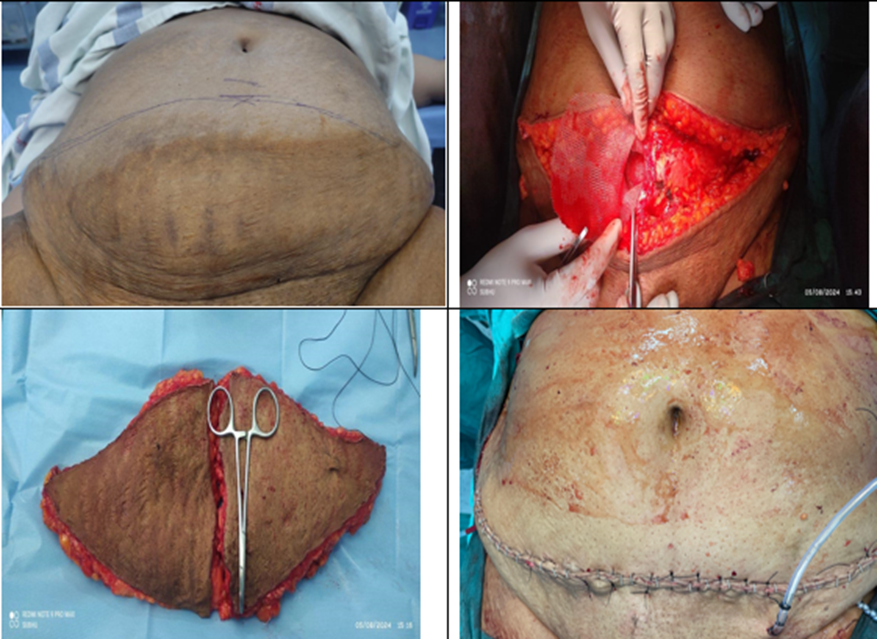
A 47-year-old female with a wide incisional hernia and severe rectus diastasis underwent single-stage abdominal wall reconstruction using retrorectus mesh repair and concomitant abdominoplasty. Mild postoperative seroma resolved conservatively. At 90 days, the patient reported marked functional improvement, high satisfaction with cosmetic appearance, and maintained fascial integrity without recurrence.
|
Case |
Age/Sex |
Clinical Presentation |
Hernia Characteristics (EHS Classification) |
Previous Surgery / Etiology |
Surgical Procedure Performed |
Postoperative Complications |
Follow-up Outcome |
|
Case 1 |
38 years / Female |
Primary midline incisional hernia with abdominal wall laxity and poor abdominal contour |
EHS M4W2 |
Previous laparotomy |
Retrorectus mesh repair with concomitant abdominoplasty |
No postoperative complications |
At 90-day follow-up, excellent contour restoration, marked improvement in HerQLes score, and no evidence of recurrence |
|
Case 2 |
45 years / Female |
Recurrent incisional hernia with redundant lower abdominal skin in a multiparous patient |
EHS M5W3 |
Previous abdominal surgery with recurrent hernia |
Posterior component separation with transversus abdominis release (TAR), retromuscular polypropylene mesh placement, and abdominoplasty |
Small postoperative seroma managed successfully with aspiration |
Excellent functional recovery and cosmetic outcome with maintained abdominal wall integrity |
|
Case 3 |
41 years / Female |
Large infraumbilical incisional hernia with significant abdominal wall laxity |
Large infraumbilical defect |
Previous abdominal surgery |
Retromuscular mesh repair with progressive component separation and simultaneous abdominoplasty |
No postoperative complications |
Significant improvement in abdominal wall contour and quality of life; no recurrence during follow-up |
|
Case 4 |
52 years / Female |
Complex midline incisional hernia with abdominal wall deformity |
EHS M4W3 |
Previous gynecological surgery |
Transversus abdominis release (TAR) with retromuscular mesh reconstruction and abdominoplasty |
Minor superficial surgical-site infection treated with dressings and antibiotics |
At 3 months, excellent scar appearance, improved abdominal contour, and no recurrence |
|
Case 5 |
47 years / Female |
Wide incisional hernia with severe rectus diastasis and abdominal wall laxity |
Wide incisional hernia defect |
Previous abdominal surgery |
Single-stage abdominal wall reconstruction with retrorectus mesh repair and concomitant abdominoplasty |
Mild postoperative seroma managed conservatively |
At 90 days, marked functional improvement, high cosmetic satisfaction, and preserved fascial integrity without recurrence |
Laboratory and Investigation Findings in Patients Undergoing Concomitant Abdominoplasty and Complex Incisional Hernia Repair
|
Case |
Routine Laboratory Investigations |
Imaging / Radiological Assessment |
Additional Preoperative Evaluation |
Key Findings |
|
Case 1 |
Complete blood count, renal function tests, liver function tests, serum electrolytes, coagulation profile were within normal limits |
Contrast-enhanced CT abdomen revealed a primary midline incisional hernia (EHS M4W2) with abdominal wall laxity |
Preoperative anaesthetic evaluation and nutritional assessment |
Adequate haemoglobin level, normal metabolic profile, and suitable for elective abdominal wall reconstruction |
|
Case 2 |
Complete blood count, blood glucose profile, renal and liver function tests, coagulation parameters were assessed |
CT abdomen demonstrated recurrent incisional hernia (EHS M5W3) with a large abdominal wall defect and redundant lower abdominal tissue |
Cardiopulmonary assessment and optimization of comorbid conditions before surgery |
No significant laboratory abnormality; imaging confirmed need for posterior component separation and mesh reconstruction |
|
Case 3 |
Routine haematological and biochemical investigations were within acceptable limits |
CT abdomen showed a large infraumbilical incisional hernia with abdominal wall laxity and defect characteristics suitable for reconstruction |
Preoperative abdominal wall assessment and anaesthesia fitness evaluation |
No contraindication for combined repair; imaging guided mesh placement and component separation planning |
|
Case 4 |
Complete blood count, renal function tests, liver function tests, coagulation profile, and inflammatory markers were evaluated |
CT abdomen revealed complex midline incisional hernia (EHS M4W3) following previous gynecological surgery |
Infection screening, nutritional evaluation, and cardiopulmonary assessment |
Baseline investigations were satisfactory; defect complexity necessitated TAR with retromuscular mesh reconstruction |
|
Case 5 |
Haematological profile, metabolic panel, coagulation studies, and nutritional parameters were assessed |
CT abdomen demonstrated wide incisional hernia with severe rectus diastasis and loss of abdominal wall integrity |
Preoperative assessment including anaesthetic clearance and abdominal wall functional evaluation |
Investigations supported elective single-stage abdominal wall reconstruction with retrorectus mesh repair |
DISCUSSION:
Concomitant abdominoplasty with complex incisional hernia repair has gained increasing attention as a single-stage approach for patients presenting with both functional abdominal wall defects and aesthetic deformities. In the present case series of five patients, combined abdominal wall reconstruction with mesh reinforcement and abdominoplasty resulted in satisfactory functional recovery, improvement in abdominal contour, high patient satisfaction, and absence of hernia recurrence during short-term follow-up. The findings support the feasibility of integrating abdominal wall reconstruction with aesthetic correction in carefully selected patients.
Similar observations were reported by Marcaccini G et al. [5] who evaluated patients undergoing combined abdominoplasty and incisional hernia repair and demonstrated that simultaneous correction of abdominal wall defects and excess skin can provide excellent functional and aesthetic outcomes without significantly increasing morbidity when appropriate surgical principles are followed. They emphasized the importance of patient selection, adequate vascular preservation of abdominal flaps, and appropriate mesh positioning to reduce wound-related complications.
Pilco RM et al. [6] described their experience with complex abdominal wall reconstruction combined with abdominoplasty techniques and reported favourable outcomes in terms of abdominal contour restoration, improved quality of life, and low recurrence rates. Their study highlighted that posterior component separation techniques, including transversus abdominis release (TAR), provide reliable fascial closure and allow reinforcement with large retromuscular mesh in complex hernia defects. In our series, similar principles were applied, with TAR and retromuscular mesh reconstruction being utilized in patients with larger and recurrent defects.
The role of mesh reinforcement in complex incisional hernia repair has been extensively studied. Novitsky et al.[7] introduced the transversus abdominis release technique as an effective posterior component separation method for large ventral hernias, demonstrating durable abdominal wall reconstruction with acceptable complication rates. The use of retrorectus mesh placement and component separation in our cases was consistent with these established reconstructive principles and contributed to maintaining fascial integrity during follow-up.
Sauerland et al. [8] evaluated the outcomes of simultaneous abdominoplasty and ventral/incisional hernia repair and reported that although combined procedures may carry a higher risk of wound-related complications, they provide significant advantages by avoiding multiple surgeries and improving patient satisfaction. Careful perioperative management, meticulous dissection, and optimization of patient-related risk factors were identified as key factors for successful outcomes.⁴ In the present case series, minor complications such as seroma and superficial surgical-site infection were managed conservatively, and all patients achieved favourable functional and cosmetic results.
CONCLUSION:
Concomitant abdominoplasty and complex incisional hernia repair is a feasible and effective single-stage approach for selected patients with abdominal wall defects associated with excess skin, laxity, and contour deformities. In this case series of five patients, advanced abdominal wall reconstruction techniques, including retrorectus mesh placement, posterior component separation, and transversus abdominis release, combined with abdominoplasty, resulted in successful restoration of abdominal wall function and satisfactory aesthetic outcomes. Minor postoperative complications were managed conservatively, with no recurrence observed during follow-up. This combined approach provides the advantage of addressing both functional and cosmetic concerns in a single operative procedure, improving patient quality of life and satisfaction. Careful patient selection, meticulous surgical planning, appropriate mesh reinforcement, and adherence to abdominal wall reconstruction principles are essential to achieve durable and favourable outcomes.
REFERENCES:
1. Matos Jr WN, Ribeiro RC, Marujo RA, da Rocha RP, da Silva Ribeiro SM, Carrillo Jiminez FV. Classification for indications of lipoabdominoplasty and its variations. Aesthetic Surgery Journal. 2006 Jul 1;26(4):417-31.
2. Shermak MA. Hernia repair and abdominoplasty in gastric bypass patients. Plastic and reconstructive surgery. 2006 Apr 1;117(4):1145-50.
3. Robertson JD, de la Torre JI, Gardner PM, Grant III JH, Fix RJ, Vásconez LO. Abdominoplasty repair for abdominal wall hernias. Annals of plastic surgery. 2003 Jul 1;51(1):10-6.
4. Ramirez OM, Ruas E, Dellon AL. “Components separation” method for closure of abdominal-wall defects: an anatomic and clinical study. Plastic and reconstructive surgery. 1990 Sep 1;86(3):519-26.
5. Marcaccini G, Bagalà E, Huang HS, Saini R, Grimaldi L, Shadid O, Cuomo R, Seth I, Munasinghe N, Rozen WM. Combined Abdominoplasty and Ventral Hernia Repair: A Systematic Review of Surgical and Patient-Centered Outcomes. Aesthetic plastic surgery. 2026 May 19:1-6.
6. Pilco RM, Salazar ER, Lasso JS, Quiroz FD, Barberan OS, Pesantes LH, Parrado JD. Functional and aesthetic outcomes of combined reconstructive tchniques in complex abdominal surgery. Ibero-American Journal of Health Science Research. 2024 Jul 28;4(2):64-71.
7. Novitsky YW, Elliott HL, Orenstein SB, Rosen MJ. Transversus abdominis muscle release: a novel approach to posterior component separation during complex abdominal wall reconstruction. The American journal of surgery. 2012 Nov 1;204(5):709-16.
8. Sauerland S, Walgenbach M, Habermalz B, Seiler CM, Miserez M. Laparoscopic versus open surgical techniques for ventral or incisional hernia repair. Cochrane database of systematic reviews. 2011(3).