Invincible Candy Game - Bridging Fun and Fundamentals in Medical Education Through a Novel Edutainment Approach for First Year Mbbs Students.
- S.Chuhitha , Assistant Professor Department of Biochemistry Sri Venkateswara Medical College.Tirupati
- T. Uma , Assistant Professor Department of Biochemistry Sri Venkateswara Medical College.Tirupati.
- P. Swathi , Associate Professor Department of Biochemistry Sri Venkateswara Medical College.Tirupati.
- N. Madhavilatha , Professor and HOD Department of Biochemistry Sri Venkateswara Medical College.Tirupati.
- M. Venkateswarlu , Professor Department of Biochemistry Sri Venkateswara Medical College.Tirupati.
Article Information:
Abstract:
Background: Need for the Innovation – Game based teaching activities can create a fascinating learning environment for the students to improve their study outcomes. To enhance student training on metabolic changes and diagnosis of Diabetes mellitus we developed an off-line game . Diabetes mellitus can be challenging topic for medical students because the disease effects numerous organ systems. Description of the Innovation- In this 90 mins game,223 first year MBBS students divided into two batches played a Ludo game drawn on the floor using colour chalks. Students are divided into four teams, One player will be selected from each team who act themselves as pawns and had to move along the squares after answering the correct multiple choice questions on Diabetes mellitus. The first team to reach the centre of the Ludo game won. Pre-test and post -test in the form of 10 multiple choice questions are provided to measure the perception of knowledge on the topic to all students (kirkpatrick level 2). We asked the participants to rate their confidence on Diabetes , before and after game on a 5-point Likert scale (1= not at all confident ,5= extremely confident ). We asked the participants to rate how helpful the invincible candy game on Diabetes for learning on 4-point Likert scale (1= not helpful ,4= very helpful). Outcomes– Medical knowledge scores improved from 7.5 to 8.2 (10 point scale p<0.01 ). Students confidence ratings and feedback were very positive. Reflections- This educational game both physical and digital is effective in promoting active student learning by making education more interactive and enjoyable.
Keywords:
Article :
INTRODUCTION:
The global surge in incidence of Diabetes mellitus underscores the critical need for medical undergraduates to acquire a thorough understanding of this disease. The traditional learning methods including didactic lectures, textbook readings and clinical cases provide foundational knowledge but often lack interactive elements that can enhance engagement and retention. Emerging research highlights that integrating interactive tools both digital and non-digital into medical curriculam can effectively address these limitations providing students more dynamic learning experiences. (1)
Among the array of interactive tools, educational board games have demonstrated unique advantages. They not only enhance critical thinking skills but also foster a collaboration and encourage face to face interaction and collaborative learning.(2) Despite their benefits, the widespread adoption of games is still limited by various practical, pedagogical, and technological challenges. Designing an effective board game to cover complex topics can be time-intensive, and its implementation may require substantial facilitation to ensure alignment with learning outcomes.(3)
Gamification has been widely documented for its benefits in enhancing the learning process and improving student engagement. , Twist and Ragsdale study on games emphasize the versatility and potential benefits of game based learning approaches.(1) MedEdPORTAL has published a number of resources related to games in medical education, however most are jeopardy-style games.(4)
Game based teaching activities can create a fascinating learning environment for the students to improve their study outcomes. To enhance student training on metabolic changes and diagnosis of Diabetes mellitus we developed an off-line game . Diabetes mellitus can be challenging topic for medical students because the disease effects numerous organ systems.
Aim-
The aim of the study is to evaluate the impact of “Invincible candy game” approach on first year medical undergraduate students knowledge perception on the topic- Metabolic changes and Diagnosis of Diabetes mellitus, as a part of vertical integration in the department of Biochemistry.
Objectives-
1.To measure students perception of knowledge on the metabolic changes and diagnosis of Diabetes mellitus by providing 10 multiple choice questions as Pre-test and Post-test (Kirkpatrick level 2).
2. To measure the confidence levels in the topics of Diabetes mellitus before and after the game on a 5= point Likert scale (1= not at all confident, 5= extremely confident).
3. To measure students satisfaction (Kirkpatrick level 1) and how helpful the invincible candy game for learning on a 4- point Likert scale (1=not helpful, 4= very helpful).
METHODOLOGY:
This study includes first year medical undergraduates (2024-25) studying in Sri Venkateswara medical college, Department of Biochemistry. This phase was selected based on its significance as students in pre-clinical phase are developing foundational knowledge and to emphasize the purpose of vertical integration as per the CBME curriculum -2024.The topic Diabetes mellitus is selected as it is a part of six integrated modules. The students already receive didactic lecture on the topic Diabetes mellitus . All the students are enrolled after obtaining the Institutional Scientific Committee and Institutional Ethics committee.
Inclusion criteria-
Participants included are first year MBBS undergraduates provided written informed consent indicating their willingness to engage in research and had not previously studied Diabetes in detail.
Exclusion criteria:
Individuals are excluded if they dropped out during the study or if they reported having previously studied the topic Diabetes in depth .
Study population-
Both boys and girls studying in first year MBBS , in the department of Biochemistry ,in SVMC Tirupati
Study tools- Questionnare
Study variables- Pre-test, Post-test perception of knowledge, confidence levels, satisfaction
levels.
Sample size- Cohen formula n= 2 (Zα +Zβ)2 = 64
d2
n= sample size per group= 64 per group= 128
Zα- 1.96, Zβ- 0.84 , d= effect size medium= 0.5
Game play and rules-
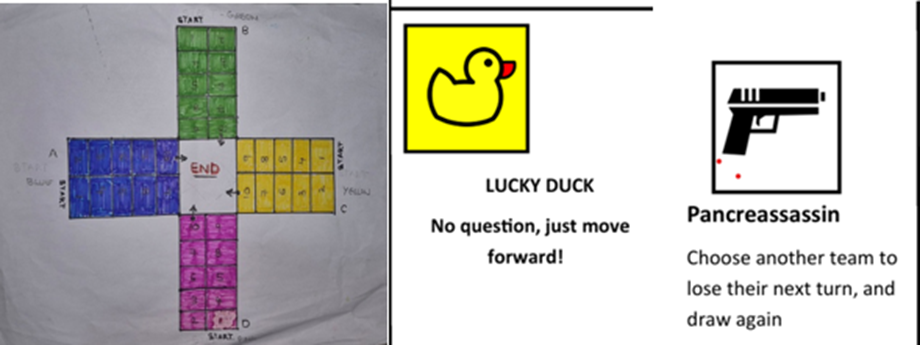
We designed a Ludo like game drawn on the floor in two demonstration halls in the department of Biochemistry using colour chalks. All the students are divided into two groups. In each group again students are divided into four teams. The four teams are spaced around the candy game which is drawn on the floor.( Appendix A ). Before the game began, one facilitator oriented students to gameplay and rules. One player will be selected from each team who act themselves as pawns and had to move along the squares after answering the correct multiple choice questions are displayed on screen. With each correct answer the player of that team move forward on the square. If a team answered incorrectly , it did not advance on the game,the next team took a turn. The facilitator was available to answer questions and clarify game rules when necessary. Each team will get 10 questions.The team to reach the centre of the Ludo game first won the game.
We included a lucky dip in between the questions . They may get a Lucky duck (Appendix B) card which allows the team to move forward one square without answering a question or a Pancreassasin card which gives a chance for the team to select another team to lose its next turn(Appendix C).
Session timeline
• Pretest (10 min): Participants completed a pretest consisting of 10 MCQs designed to assess baseline knowledge. (Appendix D)
• Game play (60 min): Participants engaged in the game based learning session .
• Post-test (10 min): Immediately following the game, participants completed the same 10 MCQs to assess knowledge.
• Feedback Collection (10 min): Participants in the game-based learning group provided feedback about the gamified approach.
Data collection
To measure knowledge (Kirkpatrick level 2), we created 20 multiple-choice questions about metabolic changes and diagnosis of Diabetes. We divided these 20 questions into two sets of 10, with each participant receiving one set pre-test and the other set post-test (Appendix D). To measure students’ perception of their knowledge (Kirkpatrick level 2), we asked the participants to rate their confidence in topics before and after the intervention on a 5-point Likert scale (1 = not at all confident,5= extremely confident). To measure students’ satisfaction (Kirkpatrick level 1), we asked the participants to rate how helpful different aspects of the Invincible Candy game were for learning on a 4-point Likert scale (1 = not helpful,4= very helpful)
Ethical consideration-
Before collecting data all participants are briefed about the purpose of the study and written informed consent obtained. Participants are given the right to withdraw consent at any stage .
Data Analysis-
We compared the number of knowledge questions correct before and after the intervention using a paired two-tailed t test. We compared confidence ratings for each item before and after the intervention using a paired two-tailed t test. We used descriptive statistics for ratings of the helpfulness of the activity. For all tests,alpha was set to 0.05.
RESULTS:
A paired- sample t- test was conducted to compare pre-test and post test scores. Results showed that post- test scores (M=8.2, SD=0.6) were significantly higher than pre-test scores (M= 7.5)p<o.oo1.This indicates a statistically significant improvement from pre-test to post-test.
Table-1
|
Variable |
Mean |
SD |
P value |
|
Pre- test |
7.5 |
+ 0.7 |
significant |
|
Post-test |
8.2 |
+ 0.6 |
significant |
Table -2 Mean scores of confidence levels
|
Variable |
Mean |
SD |
P value |
|
Pre- test |
2.8 |
+1.2 |
significant |
|
Post-test |
3.4 |
+ 0.6 |
significant |
Students rated the helpfulness of this activity on a 4-point scale (1 = not helpful,4= very helpful). A majority of students deemed the activity helpful or very helpful for learning diabetes (96% with 3or 4 with mean 3.4). Students' perceptions of the helpfulness of the intervention were generally positive. As shown in Figure 1, the majority of respondents rated the intervention as very helpful (n = 143, 64.1%). A further 50 students (22.4%) indicated that the intervention was helpful, while 20 students (9.0%) rated it as slightly helpful. Only 10 students (4.5%) reported that the intervention was not helpful. Overall, 86.5% of respondents selected either "Helpful" or "Very Helpful," indicating a high level of perceived usefulness of the intervention.
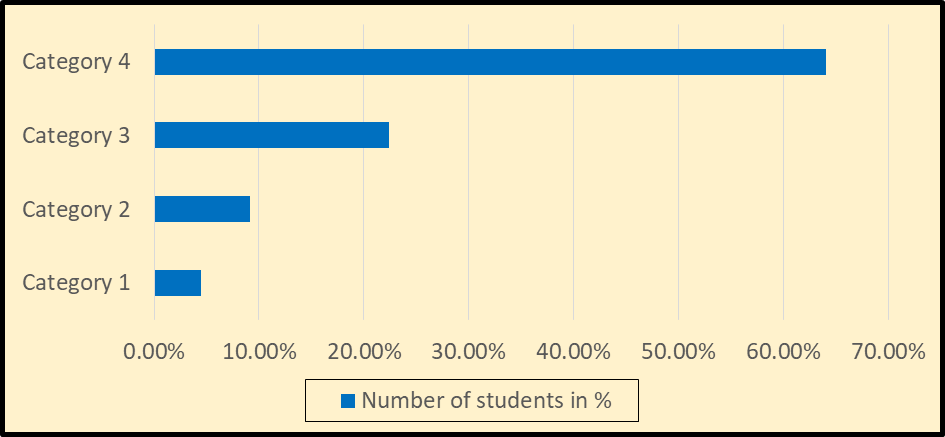
Figure 1. Distribution of students' ratings of the helpfulness of the intervention on a 4-point Likert scale (1 = Not Helpful, 2 = Slightly Helpful, 3 = Helpful, 4 = Very Helpful; N = 223).
Feedback of students-
“Excellent!! Really well thought out and planned, very interactive and educational.”
“Excellent way to educate residents on cost effective care.
Also a great learning opportunity.”
“Excellent and fun game, great way to encourage learning
and discussion!”
“Very innovative and novel way of learning. Most
entertaining way to gain knowledge.”
“Fantastic initiative. I learned, I had fun with my peers,
Appendix-A, B, C
DISCUSSION:
Diabetes is a complex multifaceted condition where medical students require robust understanding. Traditional methods of education such as didactic lectures lack interactive and engaging elements for deeper learning. Gamification has been widely documented for its benefits in enhancing the learning process and improving student engagement (5). This invincible candy game is a novel approach not only reinforce students knowledge about diabetes but also make them to actively participate as the students in the game moves along the squares. Based on the pre-test and Post-test data, students feedback it was both effective in achieving the learning objectives and engaging to students.
Our results showed the improvement both in knowledge based test questions and confidence. There was also high student satisfaction. One limitation in our game was availability of physical space. Second one is , as it a ludo like game drawn on the floor only few students can be involved in playing which is not like in board games. Other than this the practical benefits are evident as it is cost effective and facilitates face to face interaction. Minimal preparation is needed for this,and the game can be easily adapted to varying size groups. Active discussion among students was observed throughout the game which promotes collaborative learning.
CONCLUSION:
Looking ahead the widespread adoption of gamification in medical education has the potential to create an impact by integrating these engaging and interactive tools into curriculum for future generation of health care professional. On the success of this one we hope to develop similar creative, innovative educational games in future.
REFERENCES:
1. Twist K, Ragsdale J. Candy gland: a diabetes board game for medical students. Mededportal. 2022;18:11294.
2. Arayapisit T, Pojmonpiti D, Dansirisomboon K, Jitverananrangsri K, Poosontipong D, Sipiyaruk K. An educational board game for learning orofacial spaces: an experimental study comparing collaborative and competitive approaches. Anat Sci Educ. 2023;16(4):666–76.
3. Bochennek K, Wittekindt B, Zimmermann S, Klingebiel T. More than mere games: a review of card and board games for medical education. Med Teach. 2007;29(9–10):941–8.
4. Cusick J. A Jeopardy-style review game using team clickers. MedEdPORTAL. 2016;12:10485.
5. Dahalan F, Alias N, Shaharom MSN. Gamification and game based learning for vocational education and training: a systematic literature review. Educ Inform Technol. 2023;29(2):1279–317.