Comparative Evaluation of Suturing, Stapling, and Tissue Adhesives for Scalp Laceration Repair: A Retrospective Two-Year Analysis.
- Sirigireddy Vijayabhaskara Reddy , Associate Professor, Department of General Surgery, SVS Medical College, Mahabubnagar, Telangana, India.
- Kamalam Anand , Associate Professor, Department of General Surgery, SVS Medical College, Mahabubnagar, Telangana, India.
- Guvvala V. Ramana Reddy , Professor & HOD, Department of General Surgery, SVS Medical College, Mahabubnagar, Telangana, India.
- Spandana Pottapenjara , Third Year Resident, Department of General Surgery, SVS Medical College, Mahabubnagar, Telangana, India.
- Vineela Nukala , Third Year Resident, Department of General Surgery, SVS Medical College, Mahabubnagar, Telangana, India.
- Srivardhan Thota , Third Year Resident, Department of General Surgery, SVS Medical College, Mahabubnagar, Telangana, India.
- Sai Krishna Dodda , First Year Resident, Department of General Surgery, Kamineni Institute of Medical College, LB Nagar, Telangana, India.
- Arun Kulkarni , First Year Resident, Department of General Surgery, SVS Medical College, Mahabubnagar, Telangana, India.
Article Information:
Abstract:
Background: Scalp lacerations represent one of the most frequently encountered traumatic soft-tissue injuries in emergency medicine and surgical departments. The primary goal of acute wound management is to achieve rapid restoration of anatomical skin integrity while minimizing the risk of wound infection, adverse scarring, and functional impairment. Objectives: To retrospectively compare suturing, stapling, and tissue adhesive closure for scalp lacerations, with an emphasis on: patient satisfaction (Visual Analogue Scale), postoperative complications (ASEPSIS score), and cosmetic outcomes (Modified Hollander score), and to determine the most effective method for routine clinical use. Methods: The Retrospective Observational Study was conducted at the Emergency Department and Department of Surgery at SVS Medical College and Hospital in Mahabubnagar over the course of two years, from January 2022 to January 2024. The study was approved by the Institutional Ethical Committee before it began. Participants received information on the goals, methods, possible dangers, and advantages of the study. Results: Assessments were performed on Day 7 and Day 15 using the Visual Analogue Scale (VAS) for patient comfort, the ASEPSIS scoring system for wound complications, and the Modified Hollander scale for cosmetic outcome. Conclusion: Tissue adhesives provided the highest overall performance across all evaluated parameters, offering superior patient comfort, optimal cosmetic results.
Keywords:
Article :
INTRODUCTION:
The main objective of wound repair is to restore skin integrity and, while doing this to reduce rate of infection, scarring, and functional impairment.[1] Scalp wounds are less visible and are typically closed with less attention to detail. Three principles guide repair of scalp lacerations. First, cleanse, irrigate, and remove foreign material to minimize infection. Second, limit debridement of skin edges because the excellent blood supply enables tissues to recover that initially appear nonviable. And third, if local anaesthetic infiltration distorts anatomy and hinders wound edge alignment, use regional nerve blocks.[2]
Lacerations are repaired with sutures, staples, adhesive tapes, and tissue adhesives. Each method has its own advantages and disadvantages.[3] Suturing is the most commonly used method in laceration repair.[4] It is the strongest of all wound closure materials and allows best approximation of wound edges irrespective of wound shape. However, it is also the most time-consuming and user-dependent among all techniques available.
Repair via stapling is another method used for scalp lacerations. It is preferable to suturing in emergency services because it is a quicker and less painful procedure and associated with a lower cost and risk of needle stick injury to the operator. It is also preferred in paediatric age groups owing to the above-mentioned properties.[5-7]
Hair apposition technique (HAT) is an alternative technique in scalp lacerations. Hair apposition technique was first defined by Hock et al. in 2002. In this technique, 4–5 strands of hair are grasped on each side of the wound. These strands are crossed once and a drop of glue is placed where the strands cross to secure the wound.[7-8]
There are relatively few studies assessing the effectiveness of different techniques in outcomes of repair of scalp lacerations. The present study was designed with the aim of retrospectively comparing the effectiveness three techniques i.e., suturing, stapling, and hair apposition techniques (HAT) which were used for repair of scalp lacerations in patients who presented to the emergency department with scalp lacerations.
AIMS AND OBJECTIVES
Aim
To retrospectively compare the effectiveness of suturing, stapling, and tissue adhesive techniques used in repair of scalp lacerations in patients who presented to emergency department with scalp laceration with respect to patient satisfaction, aesthetic outcome and complication rates.
Objectives
1. To retrospectively assess the effectiveness of suturing technique used in repair of scalp lacerations in patients who presented to emergency department with scalp laceration with respect to patient satisfaction, Aesthetic outcome and complication rates.
2. To retrospectively assess the effectiveness of stapling technique used in repair of scalp lacerations in patients who presented to emergency department with scalp laceration with respect to patient satisfaction, Aesthetic outcome and complication rates.
3. To retrospectively assess the effectiveness tissue adhesive technique used in repair of scalp lacerations in patients who presented to emergency department with scalp laceration with respect to patient satisfaction, Aesthetic outcome and complication rates.
4. To compare the effectiveness of suturing, stapling, and tissue adhesive techniques used in repair of scalp lacerations in patients who presented to emergency department with scalp laceration with respect to patient satisfaction, Aesthetic outcome and complication rates.
MATERIALS AND METHODS:
The current Retrospective Observational Study was conducted for a period of 2 years from Jan 2022 to Jan 2024 in Emergency department and department of Surgery, SVS Medical College and hospital, Mahabubnagar. Approval was taken from the Institutional Ethical Committee before commencing the study. The participants were informed regarding the purpose, procedures, risks and benefits of the study.
Sample Size
A total of 150 eligible patients with scalp lacerations were included and categorized into three equal groups (n = 50 each) based on the closure technique used.
Inclusion Criteria
1. Linear lacerations
2. Laceration length shorter than 10 cm
3. Laceration repair carried out with the method of simple spaced percutaneous
4. suturing using 4/0 monofilament suture material
5. Laceration repair carried out with stapling
6. Laceration repair carried out with tissue adhesive.
Exclusion Criteria
1. Nonlinear lacerations
2. Contaminated wounds
3. Active arterial bleeding
4. Unstable vital signs or shock
5. Altered consciousness
6. Irregular wound edges and associated tissue loss
7. Immuno compromised patients
8. Comorbiditiy patients
Methods
Patients with scalp lacerations and treated by any of the following three techniques were retrospectively divided into three groups
➢Group 1: who were applied tissue suturing technique.
➢Group 2: who were applied stapling technique.
➢Group 3: who were applied tissue adhesive technique.
Cosmetic problems, patient satisfaction, wound healing status, and complications were determined from the files of the patients who returned for follow-up examination on 7th &15th days of suturing.
After gathering data of the patients with scalp lacerations who were applied any of the tissue adhesive, suturing or stapling methods. Method of wound closure was made to physician preference. The applied technique, satisfaction of the patient and complication parameters were recorded on study forms.
Patient satisfaction was assessed by degree of pain in patients which was evaluated with visual analog scale (VAS). Complications were assessed by the Additional treatment, the presence of Serous discharge, Erythema, Purulent exudate, and Separation of the deep tissues, the Isolation of bacteria, and the duration of inpatient Stay (ASEPSIS) score for wound Infection; defined with redness and purulent wound drainage. Cosmetic problems were defined objectively by using the modified Hollander cosmesis scale. ASEPSIS is an acronym of seven wound assessment parameters. It’s a quantitative scoring method that provides a numerical score related to the severity of wound infection using objective criteria based on wound appearance and the clinical consequences of the infection.
Statistical Analysis
Data was analysed with MS Excel and SPSS 23.0. Comparison between groups for all continuous/ ordinal data was done by using student t-test and ANOVA. Categorical data was analysed using F-test, Chi-square test. P value of <0.05 was considered significant.
RESULTS:
The present study was conducted to retrospectively compare the effectiveness three techniques i.e. suturing, stapling, and hair apposition techniques (HAT) using tissue Adhesives which were used for repair of scalp lacerations in patients who presented to the emergency department with scalp lacerations. A total of 150 patients were divided into three groups based on technique of scalp laceration repair:
1. Group 1: Suturing (N=50)
2. Group 2: Stapling (N=50)
3. Group 3: Tissue adhesives (N=50)
Following are the results
Age
Mean age was similar across the three groups: 34.22 ± 13.05 years in the suturing group, 39.42 ± 12.43 years in the stapling group, and 37.98 ± 13.33 years in the adhesive group.
The difference in the mean age of the three study groups was not found to be statistically significant. (P>0.05) Thus, the three study groups were observed to be comparable in terms of their age.
Patient Satisfaction (VAS)
Group 1
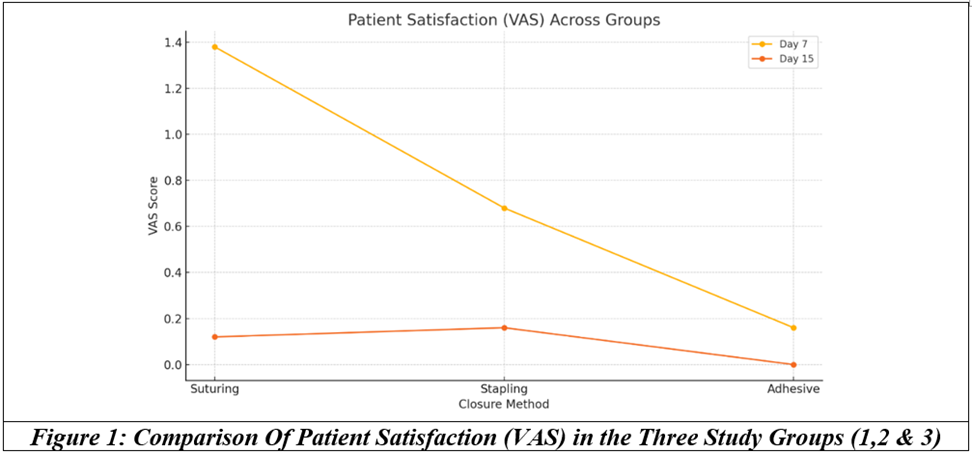
The mean (+-standard deviation) patient satisfaction scores as assessed by visual analogue scale (VAS) age in group 1 [Suturing] (N=50) on Day 7 was observed to be 1.38 (+-0.07) and on Day 15 it was observed to be 0.12 (+-0.05). The difference in mean patient satisfaction scores on day 7 and day 15 was found to be highly significant statistically. (P<0.001).
Group 2
The mean (+-standard deviation) patient satisfaction scores as assessed by visual analogue scale (VAS) age in group 2 [Stapling] (N=50), on Day 7 was observed to 44 be 0.68(+-0.07) and on Day 15, it was observed to be 0.16 (+-0.05). The difference in mean patient satisfaction scores on day 7 and day 15 was found to be highly significant statistically. (P<0.001).
Group 3
The mean (+-standard deviation) patient satisfaction scores as assessed by visual analogue scale (VAS) in group 3 [Tissue adhesives] (N=50) on Day 7 was observed to be 0.16(+-0.05) and on Day 15 it was observed to be 0.00(0.00). The difference in mean patient satisfaction scores on day 7 and day 15 was found to be highly significant statistically. (P<0.001)
Thus, as regards patient satisfaction; on day 7 group 3 [Tissue adhesives] patients had highly significantly lower mean patient satisfaction scores compared to group 2 [Stapling] and group 1 [Suturing]. Group 2 [Stapling] had significantly lower mean patient satisfaction scores compared to group 1 [Suturing].
On day 14; group 3 [Tissue adhesives] patients had significantly lower mean patient satisfaction scores compared to group 2 [Stapling] and group 1 [Suturing]. Group 2 [Stapling] had significantly lower mean patient satisfaction scores compared to group 1 [Suturing].
In Both groups; group 1 [Suturing] and group 2 [Stapling] when the difference in the mean patient satisfaction scores on day 7 was compared with those on day 15; differences were found to be highly significant statistically (P<0.001) and in group 3 it was found to be statistically significant (P<0.05).
Thus group 3 [Tissue adhesives] was found to be most effective in terms of patient satisfaction on both days 7 & 15. Comparison of patient satisfaction in the three study groups is depicted in Table 1 and figure 1.
Table 1: Comparison Of Patient Satisfaction (VAS) in the Three Study Groups (1,2 & 3)
|
Patient Satisfaction (VAS) |
Group1N=50 |
Group 2N=50 |
Group 3N=50 |
P Value |
|
Day 7 |
1.38(+-0.07) |
0.68(+-0.07) |
0.16(+-0.05) |
<0.001** |
|
Day 14 |
0.12(+-0.05) |
0.16(+-0.05) |
0.00(0.00) |
<0.05* |
|
P Value |
<0.001** |
<0.001** |
<0.05* |
Complications (ASEPSIS Score)
Group 1
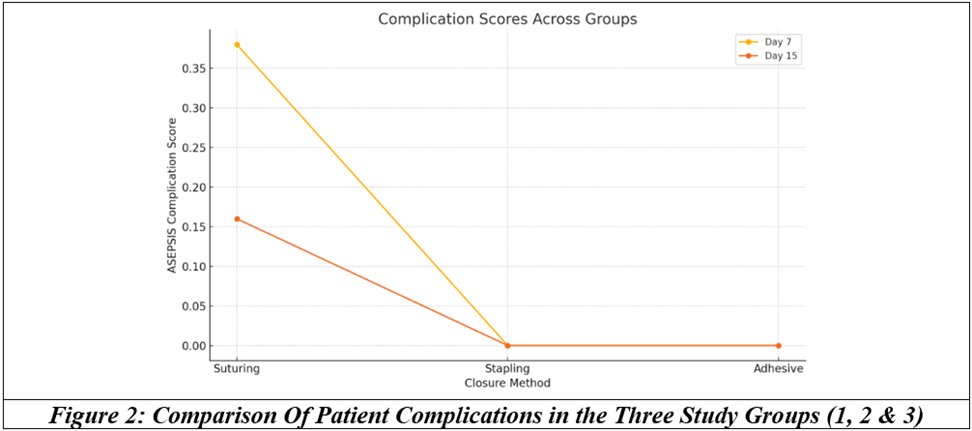
The mean (+-standard deviation) complications score as assessed by ASEPSIS score in group 1 [Suturing] (N=50) on Day 7 was observed to be 0.38(+-0.73) and on Day 15 it was observed to be 0.16 (+-0.55). The difference in mean complications scores on day 7 and day 15 was found to be significant statistically. (P<0.05).
Group 2
The mean (+-standard deviation) complications score as assessed by ASEPSIS score in group 2 [Stapling] (N=50), on Day 7 was observed to be 0.00 (+-0.00) and on Day 15, it was observed to be 0.00 (+-0.00).
Group 3
The mean (+-standard deviation) complications score as assessed by ASEPSIS score in group 3 [Tissue adhesives] (N=50) on Day 7 was observed to be 0.00 (+- 0.00) and on Day 15 it was observed to be 0.00(0.00).
Thus, as regards complications; on day 7, group 2 [Stapling] and group 3 [Tissue adhesives] patients had no complications which was also observed on day 15, thus group 2 [Stapling] and group 3 [Tissue adhesives] were found to be equally more effective in than group 1 [Suturing] in terms of complications on both days 7 & 15. Comparison of complications in the three study groups is depicted in Table 2 and figure 2.
Table 2: Comparison Of Patient Complications in the Three Study Groups (1, 2 & 3)
|
Complications |
Group 1 N=50 |
Group 2 N=50 |
Group 3 N=50 |
|
Day 7 |
0.38(+-0.73) |
0.00 (+-0.00) |
0.00(+-0.00) |
|
Day 14 |
0.16(+-0.55) |
0.00 (+-0.00) |
0.00(+-0.00) |
|
P value |
<0.05* |
||
|
<0.05*: statistically significant |
|||
Aesthetic Outcome
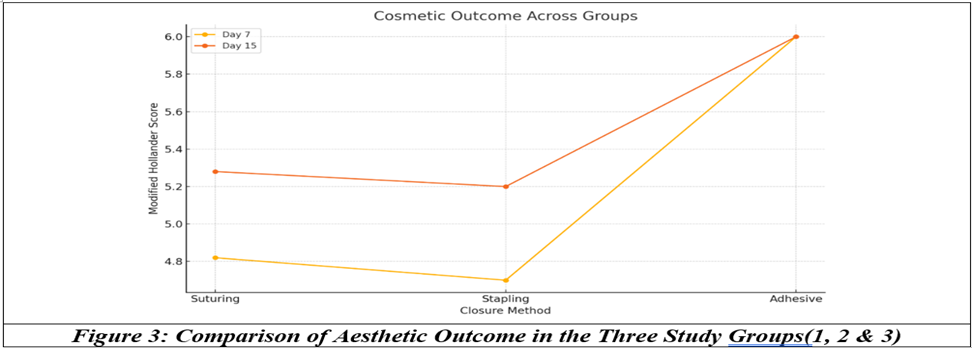
Cosmetic results, assessed using the Modified Hollander cosmesis scale, improved in all groups between Day 7 and Day 15. In the suturing group, mean scores rose from 4.82 ± 0.75 to 5.28 ± 0.76 (p < 0.05). The stapling group exhibited an increase from 4.70 ± 0.51 to 5.20 ± 0.40 (p < 0.001). The tissue adhesive group, however, consistently achieved the maximum attainable score of 6.00 ± 0.00 at both assessments, indicating uniformly optimal cosmetic results. When comparing the three methods, tissue adhesives clearly provided the best aesthetic outcome, followed by stapling and then suturing.
Comparison of aesthetic outcome in the three study groups is depicted in Table 3 and figure 3.
Table 3: Comparison of Aesthetic Outcome in the Three Study Groups (1, 2 & 3)
|
Aesthetic Outcome |
Group1N=50 |
Group 2N=50 |
Group 3N=50 |
|
Day 7 |
4.82(+-0.75) |
4.70(+-0.51) |
6.00(0.00) |
|
Day 14 |
5.28(+-0.76) |
5.20(+-0.40) |
6.00(0.00) |
|
P Value |
<0.05* |
<0.001** |
- |
DISCUSSION:
Scalp laceration repair aims to restore anatomical continuity while minimizing pain, infection, and visible scarring. Although suturing offers excellent tensile strength and reliable wound edge approximation, it is relatively time-consuming, operator-dependent, and associated with greater procedural discomfort. The present study demonstrated that suturing was linked with higher pain scores and a small but notable rate of minor complications when compared with stapling and tissue adhesives. Stapling provided rapid closure, reduced operator fatigue, and eliminated the risk of needle-stick injury, making it particularly useful in high-volume emergency departments and in patients who cannot tolerate prolonged procedures.[3] The absence of complications and satisfactory cosmetic scores observed with stapling in this cohort supports its role as an efficient alternative to suturing.[3,6]
Cyanoacrylate-based tissue adhesives emerged as the most patient-friendly technique. Their traumatic mode of application, lack of need for removal, and excellent cosmetic outcomes translated into the lowest VAS scores and maximal Hollander scores across all time points.[4,5] These findings mirror the growing body of international evidence favouring adhesive-based techniques and hair apposition methods for simple linear scalp lacerations.[8,9] The near-zero complication rates in both stapling and adhesive groups likely reflect reduced tissue handling and minimal foreign-body reaction compared with sutures. Overall, the results underscore a paradigm shift towards less invasive closure options in appropriately selected patients, while recognizing that suturing remains indispensable when deeper structural support or meticulous haemostasis is required.
CONCLUSION:
Tissue adhesives provided the highest overall performance across all evaluated parameters, offering superior patient comfort, optimal cosmetic results, and negligible complications in the management of uncomplicated linear scalp lacerations. Stapling is a safe, rapid, and cosmetically acceptable alternative, particularly suitable for busy emergency settings. Suturing remains essential in complex wounds where enhanced mechanical support, layered closure, or precise control of bleeding is necessary. Wider adoption of tissue adhesive techniques, especially in resource-limited settings, may Improve patient experience and streamline emergency department workflow.
REFERENCES:
1. Azmat CE, Council M. Wound Closure Techniques. 2023 Jun 26. In: StatPearls [Internet]. Treasure Island (FL): StatPearls Publishing 2026.
2. King ME, Kinney AY. Tissue adhesives: a new method of wound repair. Nurse Pract 1999;24(10):66, 69-70, 73-4.
3. MacGregor FB, McCombe AW, King PM, et al. Skin stapling of wounds in the accident department. Injury 1989;8:347-8.
4. Singer AJ, Quinn JV, Hollander JE. The cyanoacrylate topical skin adhesives. Am J Emerg Med 2008;26(4):490-6.
5. Kavalci C, Cevik Y, Durukan P, et al. Comparison of different suture techniques. Journal of Clinical and Analytical Medicine 2015;6(1):15-7.
6. Kanegaye JT, Vance CW, Chan L, et al. Comparison of skin stapling devices and standard sutures for pediatric scalp lacerations: a randomized study of cost and time benefits. J Pediatr 1997;130(5):808-13.
7. Hock MO, Ooi SB, Saw SM, et al. A randomized controlled trial comparing the hair apposition technique with tissue glue to standard suturing in scalp lacerations (HAT study). Ann Emerg Med 2002;40(1):19-26.
8. Ong ME, Coyle D, Lim SH, et al. Cost-effectiveness of hair apposition technique compared with standard suturing in scalp lacerations. Ann Emerg Med 2005;46(3):237-42.
9. Aukerman DF, Sebastianelli WJ, Nashelsky J. Clinical inquiries. How does tissue adhesive compare with suturing for superficial lacerations? J Fam Pract 2005;54(4):378.