CASE REPORT: EFFICACY OF ULTRASOUND GUIDED TAP BLOCK FOR ANAESTHESIA IN A PATIENT UNDERGOING OPEN HERNIOPLASTY.
- Ashita Shetty , Senior Resident, Department of Anaesthesia, Yenepoya Medical College, Mangalore, Karnataka, India.
- Sanjay Tyagraj , Consultant, Department of Anaesthesiology, CG Hospital, Davangere, Karnataka, India.
Article Information:
Abstract:
Background: TAP block has been commonly used for analgesia in various abdominal surgeries. However, TAP block as a sole anaesthetic technique is rarely used. Case: A 27 year old male was admitted to hospital with symptoms of severe lower abdominal pain and was diagnosed with strangulated left inguinal hernia. Patient was a known case of chronic kidney disease and hypertension undergoing regular hemodialysis. The patient had undergone heparinized hemodialysis 1 day prior to admission. As the patient's BP was 180/110mmHg, INR was 2.7 and patient was not nil by mouth, B/L TAP block was considered as sole anaesthetic technique for the hernioplasty surgery. Ultrasound guided B/L TAP block was performed and an injection of 15ml of Inj.ropivacaine 0.5% with Inj. DEXAMETHASONE 4mg and Inj. DEXMEDETOMIDINE 10µg as given on either side. After confirming the blockade surgery was performed successfully. The intraoperative and postoperative vitals were stable. Patient underwent dialysis the day after surgery and was discharged after 2 days. Conclusion: Open hernioplasty for a patient with chronic kidney disease and hypertension with left inguinal hernia with strangulation was performed under B/L TAP block. The patient was hemodynamically stable through intraoperative and postoperative period.
Keywords:
Article :
INTRODUCTION:
Transversus abdominis plane block was introduced by Rafi in 2001. In TAP block the local anaesthetic solution is injected between the internal oblique and transverse abdominis muscle to block the spinal roots from T6 to L1 thereby reducing pain in the abdominal wall(1). Initially TAP block was performed under blind technique and have limited application (2). But now with the ultrasound guided technique the TAP block is being performed more efficiently with better outcomes. TAP block is usually used mainly for postoperative analgesia for abdominal surgeries. It is rarely used as sole anaesthesia technique. It is used as a sole anaesthesia technique is cases where patient has multiple systemic disorders and where general anaesthesia is contraindicated. In this case the patient had CKD with HTN, patient was on heparinized dialysis. Patient was diagnosed with strangulated inguinal hernia and was not nil by mouth. Therefore surgery was performed under TAP Block as sole anaesthesia technique and was uneventful.
CASE REPORT:
A 27 year old male (160cms, 60kgs) was admitted to the hospital due to lower abdominal pain. Patient gives history of left groin swelling since 6 months. On examination abdomen was soft and tenderness was noted in the left iliac region.Ultrasound scanning showed anterior abdominal wall defect measuring 2.4cms with with bowel and omentum as its contents reaching till scrotum with suspicion of strangulation, mild ascites and left sided pleural effusion. Patient is known case of chronic kidney disease and hypertension since 6 months. Patient is on regular hemodialysis and has an AV fistula on the left forearm. Patient is on T.ARKAMINE 100mg TID and T.CILACAR 10mg BD dose since past 2 months. Patient underwent last hemodialysis 1 day prior. Patient was not nil by mouth. Patient gives history of blood transfusions 3 months back and was uneventful. Patient was posted for open hernioplasty. On examination PR – 80/min, BP – 180/110mmHg, SpO2 – 97% @Room air. Routine blood investigations showed Hemoglobin of 8.1gm/dl, Platelet count of 80,000, deranged coagulation profile with the INR of 2.7, Urea – 180mg/dl, creatinine – 14.4mg/dl, Na+ - 136mEq/lt, K+ - 5.4mEq/lt, Cl- - 103mEq/lt. ECG shows sinus tachycardia. 2D ECHO showed ejection fraction of 63% and left ventricular hypertrophy.
Considering everything above ultrasound guided TAP block was considered as safe and effective approach for anaesthesia. After taking high risk and written informed consent, patient was shifted to operation theatre. Standard ASA monitors consisting of ECG, pulse oxygen saturation and non invasive blood pressure monitoring was done. A venous line with 18G cannula was secured. A TAP block was performed bilaterally using an ultrasound machine with the linear probe. Under aspectic precautions the ultrasound probe is placed in the transverse orientation along the anterior axillary line between the subcostal margin and iliac crest. This allows the visualization of three abdominal wall muscles (external oblique, internal oblique and transverse abdominis) along with the deeper structures of viscera and peritoneum. The needle is inserted in plane and advanced anterior to posterior under continual visualization until the tip is between internal oblique and transverse abdominis. After negative aspiration, 15ml of INJ.ROPIVACAINE 0.5% and INJ.DEXAMETHASONE 4mg and Inj. DEXMEDETOMIDINE 10µg was injected. Separation of internal oblique and transverse abdominis was visible with local anaesthetic in between. Similar procedure was done on the other side by using 15ml of INJ.ROPIVACAINE 0.5% with 4mg INJ.DEXAMETHASONE and Inj.DEXMEDETOMIDINE 10µg was injected. After 20 mins the level of the block was assessed. The surgical area was well anaesthetized. During the bowel handling patient had mild discomfort for which Inj.FENTANYL 50µg was given, following which patient was comfortable and stable. The procedure was completed in 1 hour. The procedure was uneventful and patient was pain free. Intraoperative and postoperative vitals were stable. Postoperative sedation and pain score was recorded.The modified Ramsay Sedation score was 1 and Pain score according to Numerical rating scale was 0. The duration of the TAP block was around 14 hours. There were no complications of the TAP block including visceral damage, bleeding and systemic toxicity. Patient underwent hemodialysis after 24 hours. Patient was discharged after 2 days.
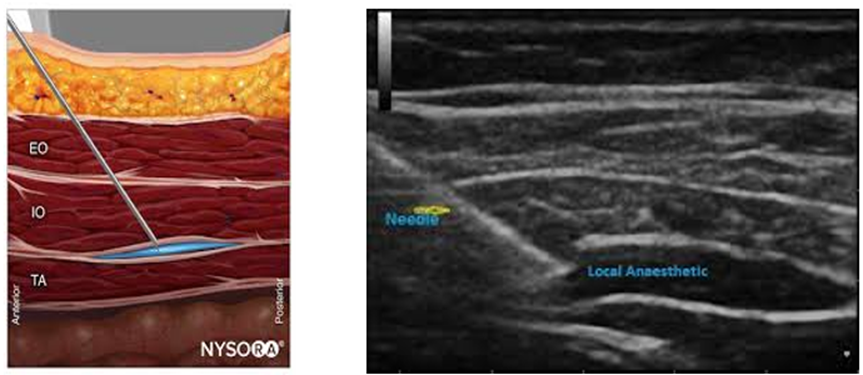
Fig. A. Anatomy of TAP block; Fig. B. Ultrasound image of the TAP block
DISCUSSION:
Patients with multiple comorbidities will have increased risk of anaesthesia and perioperative period(3). Proper perioperative pain management reduces the severity of surgery induced stress response, leading to lower morbidity rates and early postoperative recovery(4). Previous studies have showed the effectiveness of TAP block for postoperative pain management complementary to general anaesthesia in various abdominal surgeries(5,6). However few trials have used TAP block as sole technique for hernioplasty surgery.
In this case, a middle age man of 27years who is known case of hypertension and chronic kidney disease on dialysis, presented with lower abdominal pain. Ultrasound scanning indicated left strangulated inguinal hernia. Because of his comorbidities and medical history, deranged renal function test (creatinine – 14.4mg/dl) and coagulation profile (INR-1.9), subarachnoid block, epidural block and a general anaesthesia seemed inappropriate. Thus ultrasound guided TAP block was considered as safe and effective approach. As a result patient had complete analgesia with good hemodynamic stability.
Previous reports showed bilateral continuous TAP blocks to attain sufficient analgesia(7). But in this a single injection of TAP block bilaterally was given ultrasound guided which provided effective analgesia. One of the drawback of ultrasound guided TAP block is short duration block, therefore adjuvant drugs are essential to prolong duration of action. Dexmedetomidine, dexamethasone and clonidine are proved effective adjuvants to prolong the duration(8). In this case Inj. DEXMEDETOMIDINE 10µg and Inj.DEXAMETHASONE 4mg was added to Inj.ROPIVACAINE 0.5% 15ml to increase the duration of action(approximately 14hours), which is longer than duration of TAP block with Inj.BUPIVACAINE 0.5% (6-8hours) shown in previous studies(9).
There was no TAP procedure related complications like visceral damage and bleeding which may be attributed to ultrasound guided technique. Moreover Inj.DEXMEDETOMIDINE as an adjuvant improved the block duration and efficacy but did not effect the sedation score, which was similar to the previous report(10).
CONCLUSION:
A middle age man with hypertension and Chronic kidney disease underwent emergency hernioplasty procedure successfully under ultrasound guided bilateral TAP block. TAP block can be considered as safe anaesthesia technique in patient with multiple comorbidities as it causes no pain and minimal hemodynamic changes. Therefore TAP block can be considered as safe and effective mode of anaesthesia in patients with multiple comorbidities for abdominal surgeries.
REFERENCES:
1. Rafi AN. Abdominal field block: a new approach via the lumbar triangle. Anaesthesia. (2001) 56:1024–6. doi: 10.1111/j.1365-2044.2001.2279-40.
2. Tsai HC, Yoshida T, Chuang TY, Yang SF, Chang CC, Yao HY, et al. Transversus abdominis plane block: an updated review of anatomy and techniques. Biomed Res Int. (2017) 2017:1–12. doi: 10.1155/2017/8284363
3. Young MJ, Gorlin AW, Modest VE, Quraishi SA. Clinical implications of the transversus abdominis plane block in adults. Anesthesiol Res Pract. (2012) 2012:731645. doi: 10.1155/2012/731645
4. McDonnell JG, Curley G, Carney J, Benton A, Costello J, Maharaj CH, et al. The analgesic efficacy of transversus abdominis plane block after abdominal surgery: a prospective randomized controlled trialAnesth Analg. (2007) 104:193–7.
5. Niraj G, Searle A, Mathews M, Misra V, Baban M, Kiani S, et al. Analgesic efficacy of ultrasound-guided transversus abdominis plane block in patients undergoing open appendicectomy. Br J Anaesth. (2009) 103:601–5. doi: 10.1093/bja/aep175
6. Atim A, Bilgin F, Kilickaya O, Purtuloglu T, Alanbay I, Orhan ME, et al. The efficacy of ultrasound-guided transversus abdominis plane block in patients undergoing hysterectomy. Anaesth Intens Care. (2011) 39:630. doi: 10.1177/0310057X1103900415
7. Katakura Y, Sakurai A, Endo M, Hamada T, Nomoto M, Yamada H, et al. [Safe and effective analgesia with bilateral continuous TAP block for a patient with marfan syndrome after open abdominal aortic aneurysm Repair]. Masui. (2016) 65:621.
8. Xuan C, Yan W, Wang D, Li C, Ma H, Mueller A, et al. The facilitatory effects of adjuvant pharmaceutics to prolong the duration of local anesthetic for peripheral nerve block: a systematic review and network meta-analysis. Anesth Analg. (2021) 133:620–9. doi: 10.1213/ANE.0000000000005640
9. Ammar AS, Mahmoud KM. Effect of adding dexamethasone to bupivacaine on transversus abdominis plane block for abdominal hysterectomy: a prospective randomized controlled trial. Saudi J Anaesth. (2012) 6:229–33. doi: 10.4103/1658-354X.101213
10. Pan W, Liu G, Li T, Sun Q, Jiang M, Liu G, et al. Dexmedetomidine combined with ropivacaine in ultrasound-guided tranversus abdominis plane block improves postoperative analgesia and recovery following laparoscopic colectomy. Exp Ther Med. (2020) 19:2535–42. doi: 10.3892/etm.2020.8508.