Transversus Abdominis Plane Block versus Port-site Infiltration for Postoperative Analgesia in Laparoscopic Abdominal Surgery: A Comparative Observational Study.
- Vandana hebballi , Assistant Professor. Department of Anesthesiology, Shimoga institute of medical sciences, Karnataka, India.
- Sudha Shree P , Assistant Professor. Department of Anesthesiology, Kanachur institute of medical Science, Karnataka, India.
- Sushma Pattar , Assistant Professor. Department of Anesthesiology, Shivamogga Institute of Medical Sciences, Karnataka, India.
- Savita Patil , Assistant Professor, Department of Anesthesiology, Karnataka Medical College and Research Institute (KMC-RI) Karnataka, India.
Article Information:
Abstract:
Background: Postoperative pain after laparoscopic abdominal surgery remains clinically relevant despite smaller incisions, because port-site somatic pain, pneumoperitoneum-related discomfort and early movement-related pain can delay mobilisation and increase rescue analgesic use. Transversus abdominis plane (TAP) block is intended to improve abdominal wall analgesia, while port-site infiltration remains a simpler and widely used technique. OBJECTIVES: To compare postoperative pain scores, time to first rescue analgesia, 24-hour opioid consumption, adverse effects, patient satisfaction and hospital stay between patients receiving TAP block and those receiving port-site infiltration. MATERIALS AND METHODS: This comparative observational study included 80 adult patients divided equally into TAP and port-site infiltration groups. Study period: 2023-2025. The TAP group received 20 mL of 0.25% bupivacaine, while the port-site group received 10 mL of 0.25% bupivacaine as local infiltration. Pain was assessed using visual analogue scale (VAS) scores at rest and during movement at 2, 6, 12 and 24 hours after surgery. Time to first rescue analgesia, total opioid consumption over 24 hours, nausea, vomiting, satisfaction score and hospital stay were recorded. Unadjusted group comparisons were performed using independent-samples t-test, Mann-Whitney U test, chi-square test or Fisher exact test, as appropriate. Because baseline imbalance was evident, an exploratory adjusted regression was performed for key continuous outcomes. The analysis was deliberately interpreted as observational and associative, not as a randomized treatment-effect estimate. RESULTS: Each group included 40 patients. The groups were materially imbalanced at baseline, including complete separation by gender; all TAP-group patients were recorded as male and all port-site patients as female. The TAP group had consistently lower VAS scores at all postoperative time points at rest and during movement (all p<0.001). Time to first rescue analgesia was longer in the TAP group (587.50 ± 90.09 min) than in the port-site group (242.88 ± 60.34 min), with a mean difference of 344.62 min (95% CI 310.41 to 378.84; p<0.001). Total 24-hour opioid consumption was lower in the TAP group (3.60 ± 1.41 mg vs 12.22 ± 4.80 mg; p<0.001). In exploratory regression adjusted for age, BMI, ASA status and surgical duration, TAP block remained associated with longer rescue-free interval and lower opioid consumption, although gender could not be adjusted because of perfect collinearity with group membership. Therefore, sex-related confounding remains unresolved. CONCLUSION: TAP block was associated with better postoperative analgesic profile, delayed rescue analgesia and lower opioid requirement compared with port-site infiltration. However, because baseline imbalance was substantial and gender was inseparable from group membership in the present cohort, the findings should be interpreted as hypothesis-generating associative evidence rather than definitive causal proof. A randomized, demographically balanced study is required before firm comparative efficacy claims can be made.
Keywords:
Article :
INTRODUCTION:
Postoperative pain is not just an expected symptom after surgery; when poorly controlled, it affects breathing, sleep, ambulation, patient confidence and discharge readiness. Contemporary postoperative pain guidance therefore emphasises a planned, procedure-sensitive and multimodal approach rather than late rescue treatment alone.[1] In laparoscopic abdominal surgery, the clinical picture is slightly deceptive. The wounds are small, yet patients may still report moderate pain during coughing, turning in bed or early mobilisation. For busy Indian surgical units, where day-care pathways and early discharge are increasingly expected but staffing and recovery-area time remain stretched, this early pain window matters.
Opioids remain useful rescue agents, but dependence on opioids alone is rarely ideal. Nausea, vomiting, dizziness, ileus, sedation and delayed oral intake can reduce the very recovery gains expected from minimally invasive surgery. International consensus guidance on postoperative nausea and vomiting recognises opioid exposure as one of the modifiable perioperative contributors to PONV risk.[2] Procedure-specific recommendations for laparoscopic cholecystectomy, a frequently studied model for port-site abdominal pain, also place opioid use mainly in the rescue position and support local anaesthetic techniques as part of multimodal analgesia.[3]
The transversus abdominis plane block was originally described as an abdominal field block through the lumbar triangle, targeting the neurofascial plane of the abdominal wall.[4] With ultrasound guidance, the technique became more reproducible, allowing local anaesthetic deposition between the internal oblique and transversus abdominis muscles.[5] Early clinical work reported effective postoperative analgesia after abdominal surgery.[6] Subsequent reviews have generally suggested reduced early pain scores and lower analgesic requirement after laparoscopic procedures, although the magnitude of benefit varies by surgical procedure, block approach, local anaesthetic technique and comparator.[7,8]
Port-site infiltration is attractive because it is technically simple, inexpensive and does not require the same block expertise or ultrasound availability. That practicality is relevant in district and teaching-hospital settings in India. Yet its analgesic field is localised to trocar wounds and may be less resilient during movement if pain arises from a broader abdominal wall distribution. Indian and international studies comparing subcostal or laparoscopic-guided TAP techniques with port-site infiltration have therefore remained clinically important, especially for laparoscopic cholecystectomy and similar upper abdominal port-site procedures.[9,10]
The present study compared TAP block with port-site infiltration in patients undergoing laparoscopic abdominal surgery. The main intention was not merely to document lower pain scores, but to examine whether the analgesic technique was associated with delayed rescue analgesia, lower opioid use, fewer adverse effects, improved satisfaction and shorter hospital stay during the first postoperative day.
MATERIALS AND METHODS:
Study Design and Setting
This was a comparative observational study conducted among adult patients undergoing laparoscopic abdominal surgery during 2023-2025. The comparison groups were analysed as recorded clinical cohorts and were not treated as randomized or demographically equivalent groups.
Study Population
A total of 80 patients were included. Forty patients received TAP block with 20 mL of 0.25% bupivacaine, and 40 patients received port-site infiltration with 10 mL of 0.25% bupivacaine for postoperative analgesia.
Inclusion Criteria
Adult patients undergoing laparoscopic abdominal surgery and receiving either TAP block or port-site infiltration as part of postoperative analgesic management were included.
Exclusion Criteria
Patients not meeting the inclusion criteria or those without complete 24-hour postoperative assessment records were excluded from the final analysis.
Sample Size and Sampling Method
The study included 80 patients, with 40 patients in each group. Patients were analysed according to the analgesic technique they received. Since group formation was not handled as randomized and the final analyzable groups showed substantial baseline separation, particularly complete gender separation, the comparison was interpreted as non-random and vulnerable to selection bias.
Baseline Comparability and Confounding Control
Baseline characteristics were examined before interpreting outcome differences. The complete gender separation was retained in the analysis rather than altered post-hoc. Since gender and analgesic group were perfectly collinear, sex-adjusted modelling, sex-stratified comparison and propensity adjustment including gender were not statistically defensible in this cohort. Therefore, the adjusted analysis was restricted to age, BMI, ASA physical status and duration of surgery and was treated only as an exploratory sensitivity analysis.
Analgesic Technique
Patients were analysed according to the recorded analgesic technique: TAP block group and port-site infiltration group. In the TAP block group, 20 mL of 0.25% bupivacaine was administered as the regional analgesic technique. In the port-site infiltration group, 10 mL of 0.25% bupivacaine was infiltrated at the port sites. Additional perioperative technical variables, including specific TAP approach, image guidance, background non-opioid analgesia, antiemetic prophylaxis and rescue-opioid schedule, were not entered into subgroup analysis.
Outcome Measures
Pain intensity was assessed using VAS scores at rest and during movement at 2, 6, 12 and 24 hours postoperatively. Secondary outcomes included time to first rescue analgesia in minutes, total opioid consumption during the first 24 hours, nausea, vomiting, satisfaction score and duration of hospital stay in hours. Nausea and vomiting were analysed as binary recorded events; because severity grading and antiemetic exposure were not available for adjusted analysis, these outcomes were reported descriptively with cautious interpretation.
Statistical Analysis
Continuous variables were summarised as mean ± standard deviation and, where useful, median with range. Categorical variables were summarised as frequency and percentage. VAS scores were compared using Mann-Whitney U test. Continuous outcomes were compared using independent-samples t-test. Categorical outcomes were compared using chi-square test or Fisher exact test depending on cell distribution.
Because the groups were not comparable at baseline, exploratory multivariable linear regression was performed for selected continuous outcomes, adjusting for age, BMI, ASA physical status and duration of surgery. Gender was not included in the adjusted model because it was perfectly collinear with the comparison group. Given the zero-event cells for nausea and vomiting in the TAP group, adverse-event comparisons were interpreted as descriptive group differences rather than stable estimates of preventive effect. A p-value <0.05 was considered statistically significant. The adjusted analysis was treated as sensitivity analysis, not as a substitute for randomization.
RESULTS:
Eighty patients were analysed, with 40 patients in the TAP group and 40 in the port-site infiltration group. Baseline characteristics are presented in Table 1. The TAP group was younger and had lower mean BMI and shorter mean duration of surgery. The groups also differed in ASA distribution. Most importantly, gender was completely separated by group, with all TAP-group patients recorded as male and all port-site group patients recorded as female. This prevents sex-adjusted estimation, strongly suggests non-comparable group formation, and makes unqualified causal interpretation unsafe.
Table 1. Baseline demographic and perioperative characteristics
|
Characteristic |
TAP group (n=40) |
Port-site group (n=40) |
p-value |
|
Age (years), mean ± SD |
38.42 ± 9.03 |
47.33 ± 10.71 |
<0.001 |
|
Gender, n (%) |
Male 40 (100.0); Female 0 (0.0) |
Male 0 (0.0); Female 40 (100.0) |
<0.001 |
|
BMI (kg/m²), mean ± SD |
28.16 ± 3.25 |
31.23 ± 4.52 |
<0.001 |
|
ASA physical status I/II/III, n |
24/16/0 |
16/17/7 |
0.013 |
|
Duration of surgery (min), mean ± SD |
74.35 ± 12.43 |
87.55 ± 19.41 |
<0.001 |
SD: standard deviation; ASA: American Society of Anesthesiologists. p-values were calculated using independent-samples t-test for continuous variables, Fisher exact test for gender and chi-square test for ASA class. The complete separation of gender between groups should be considered a major baseline imbalance; this pattern cannot be statistically corrected within the available 80-patient cohort.
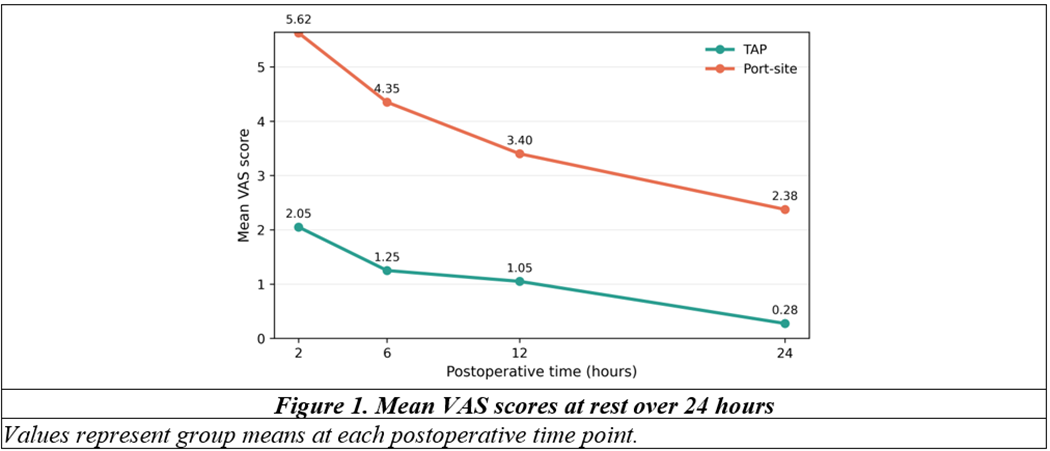
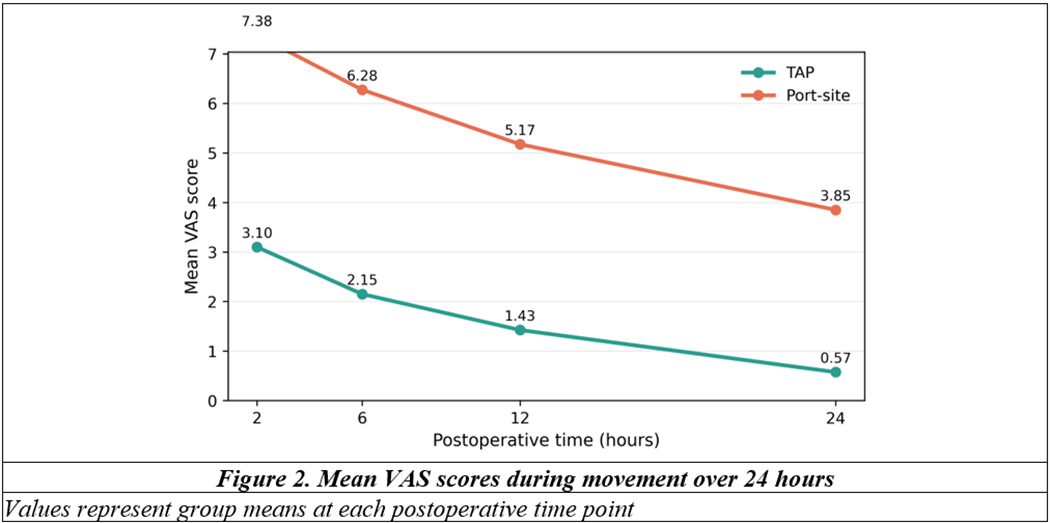
Pain scores at rest and during movement were consistently lower in the TAP group at each postoperative assessment point (Table 2). At rest, mean VAS score at 2 hours was 2.05 ± 0.68 in the TAP group compared with 5.62 ± 1.39 in the port-site group (p<0.001). By 24 hours, rest pain had decreased to 0.28 ± 0.45 in the TAP group and 2.38 ± 1.00 in the port-site group (p<0.001). A similar pattern was observed during movement, where 24-hour VAS score remained lower in the TAP group (0.57 ± 0.71 vs 3.85 ± 1.37; p<0.001). The time-course of VAS scores is shown in Figure 1 and Figure 2.
Table 2. Postoperative VAS scores at rest and during movement
|
Time Point and Condition |
TAP Group (n=40), mean ± SD |
Port-Site Group (n=40), mean ± SD |
p-value |
|
2 h at rest |
2.05 ± 0.68 |
5.62 ± 1.39 |
<0.001 |
|
2 h on movement |
3.10 ± 0.81 |
7.38 ± 1.66 |
<0.001 |
|
6 h at rest |
1.25 ± 0.71 |
4.35 ± 1.12 |
<0.001 |
|
6 h on movement |
2.15 ± 0.80 |
6.28 ± 1.69 |
<0.001 |
|
12 h at rest |
1.05 ± 0.68 |
3.40 ± 1.01 |
<0.001 |
|
12 h on movement |
1.43 ± 0.90 |
5.17 ± 1.63 |
<0.001 |
|
24 h at rest |
0.28 ± 0.45 |
2.38 ± 1.00 |
<0.001 |
|
24 h on movement |
0.57 ± 0.71 |
3.85 ± 1.37 |
<0.001 |
|
VAS: visual analogue scale. p-values were calculated using Mann-Whitney U test |
|||
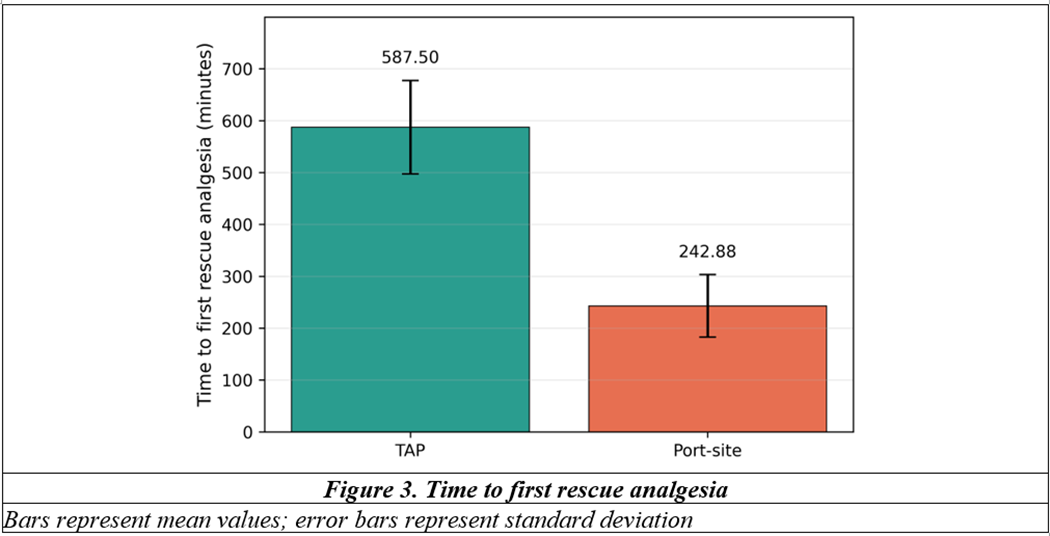
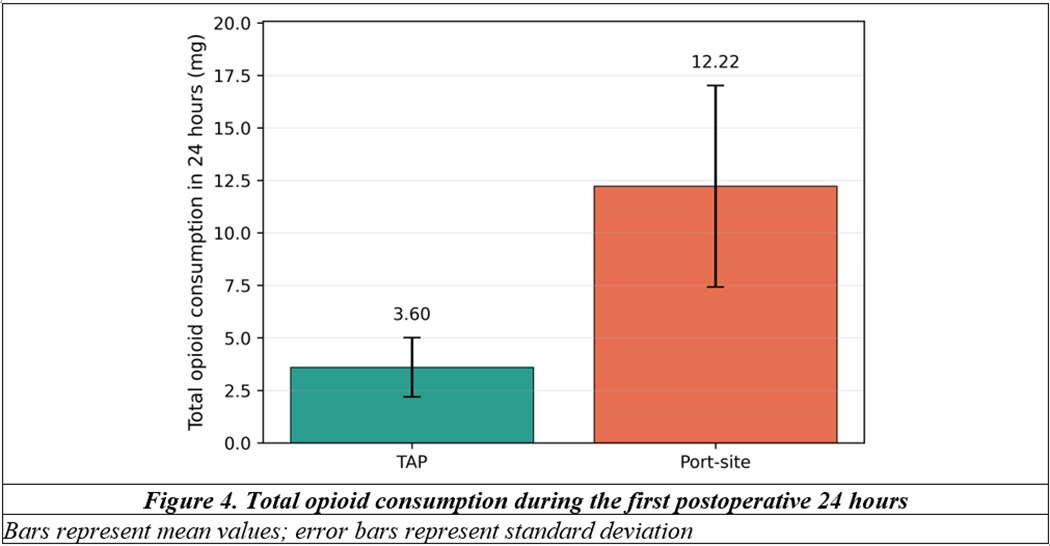
Rescue analgesic outcomes are shown in Table 3. The TAP group had a markedly longer time to first rescue analgesia than the port-site group (587.50 ± 90.09 min vs 242.88 ± 60.34 min; mean difference 344.62 min, 95% CI 310.41 to 378.84; p<0.001). Total 24-hour opioid consumption was also significantly lower in the TAP group (3.60 ± 1.41 mg vs 12.22 ± 4.80 mg; mean difference -8.62 mg, 95% CI -10.22 to -7.03; p<0.001). These differences are illustrated in Figure 3 and Figure 4.
Table 3. Rescue analgesia, opioid consumption, satisfaction and hospital stay.
|
Outcome |
TAP group (n=40) |
Port-site group (n=40) |
Mean difference (95% CI)* |
p-value |
|
Time to first rescue analgesia (min), mean ± SD |
587.50 ± 90.09 |
242.88 ± 60.34 |
344.62 (310.41 to 378.84) |
<0.001 |
|
Total opioid consumption in 24 h (mg), mean ± SD |
3.60 ± 1.41 |
12.22 ± 4.80 |
-8.62 (-10.22 to -7.03) |
<0.001 |
|
Satisfaction score, mean ± SD |
8.90 ± 0.78 |
5.55 ± 1.99 |
3.35 (2.67 to 4.03) |
<0.001 |
|
Hospital stay (h), mean ± SD |
23.35 ± 2.80 |
35.48 ± 6.75 |
-12.12 (-14.44 to -9.81) |
<0.001 |
|
*Mean difference calculated as TAP minus port-site group. CI: confidence interval; SD: standard deviation |
||||
Exploratory adjusted analysis is presented in Table 4. After adjustment for age, BMI, ASA physical status and duration of surgery, TAP block remained associated with lower early and 24-hour VAS scores, longer time to rescue analgesia, lower opioid consumption, higher satisfaction and shorter hospital stay. This analysis could not adjust for gender because gender and group were completely collinear in this cohort; therefore, the adjusted findings should be read as sensitivity estimates rather than corrected treatment effects.
Table 4. Exploratory adjusted association between analgesic technique and key continuous outcomes
|
Outcome |
Adjusted beta for TAP vs port-site (95% CI)* |
p-value |
|
VAS at rest, 2 h |
-2.76 (-2.98 to -2.54) |
<0.001 |
|
VAS on movement, 2 h |
-3.29 (-3.56 to -3.02) |
<0.001 |
|
VAS at rest, 24 h |
-1.55 (-1.73 to -1.37) |
<0.001 |
|
VAS on movement, 24 h |
-2.48 (-2.74 to -2.21) |
<0.001 |
|
Time to first rescue analgesia (min) |
288.93 (270.64 to 307.22) |
<0.001 |
|
Total opioid consumption in 24 h (mg) |
-6.12 (-6.98 to -5.26) |
<0.001 |
|
Satisfaction score |
2.26 (1.92 to 2.60) |
<0.001 |
|
Hospital stay (h) |
-8.19 (-9.29 to -7.09) |
<0.001 |
*Adjusted beta represents the estimated TAP minus port-site difference after adjustment for age, BMI, ASA physical status and duration of surgery. Gender was not included because of perfect collinearity with group allocation. The model should be interpreted as exploratory because residual confounding, especially sex-related confounding, remains unresolved. CI: confidence interval.
Patient satisfaction was higher in the TAP group than in the port-site group (8.90 ± 0.78 vs 5.55 ± 1.99; p<0.001). Hospital stay was shorter in the TAP group (23.35 ± 2.80 h) than in the port-site group (35.48 ± 6.75 h), with a mean difference of -12.12 h (95% CI -14.44 to -9.81; p<0.001).
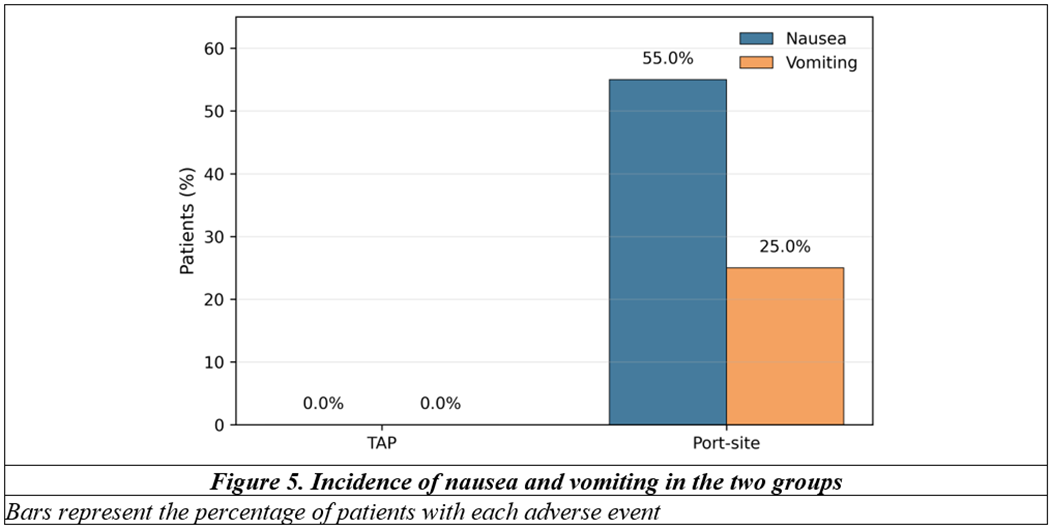
Adverse effects are summarised in Table 5. Nausea was reported in 22 patients (55.0%) in the port-site group and in none of the patients in the TAP group (p<0.001). Vomiting occurred in 10 patients (25.0%) in the port-site group and in none of the patients in the TAP group (p=0.001). Because zero nausea and vomiting events were recorded in the TAP group, this finding should be interpreted alongside the observational design, possible differences in antiemetic exposure, sex distribution, baseline PONV risk and the imbalance already described. The comparative adverse-event profile is displayed in Figure 5.
Table 5. Postoperative nausea and vomiting
|
Adverse event |
TAP group (n=40), n (%) |
Port-site group (n=40), n (%) |
p-value |
|
Nausea |
0 (0.0) |
22 (55.0) |
<0.001 |
|
Vomiting |
0 (0.0) |
10 (25.0) |
0.001 |
p-values were calculated using Fisher exact test. Because of zero-event cells, no risk ratio was emphasised for adverse events.
DISCUSSION:
This study found a consistent association between TAP block and improved early postoperative analgesic outcomes. Across every measured time point, pain scores at rest and during movement were lower in the TAP group. More importantly, the analgesic advantage was not restricted to a numerical pain score. Time to first rescue analgesia was prolonged by nearly 5.7 hours, total opioid consumption was lower, satisfaction was higher and hospital stay was shorter. In a practical ward environment, these linked outcomes are often more meaningful than a single VAS value.
The biological plausibility of this finding is strong. The TAP is an interfascial plane through which thoracolumbar nerves supplying the anterolateral abdominal wall travel. Cadaveric and radiological evaluation has shown local anaesthetic spread across this plane, supporting its role as a somatic abdominal wall block.[11] Port-site infiltration, in contrast, directly treats trocar wounds but may not provide the same field coverage during coughing, turning and active mobilisation. That distinction probably explains why the difference in this study remained prominent during movement, not only at rest.
Several earlier studies support this direction of effect, although the literature is not completely uniform. Petersen et al. reported beneficial effects of TAP block after laparoscopic cholecystectomy in day-case surgery, particularly for opioid requirements and movement-related pain.[12] Other investigators, however, have not always found TAP block superior to local anaesthetic infiltration of trocar sites, underlining that block approach, surgical procedure, local anaesthetic volume, timing and background multimodal analgesia can change the observed effect size.[13]
Indian evidence is especially relevant because analgesic pathways must remain feasible in hospitals where ultrasound access, trained regional anaesthesia manpower and turnover pressure vary across institutions. Bava et al. reported favourable analgesic effects of ultrasound-guided TAP block over local infiltration in single-incision laparoscopic cholecystectomy, and Oksar et al. described TAP block as a useful component of multimodal analgesia for laparoscopic cholecystectomy.[14,15] The present findings are directionally close to these reports, particularly with respect to lower 24-hour analgesic requirement and better patient-reported comfort.
The comparison with port-site infiltration deserves careful clinical interpretation. Port-site infiltration remains simple, cheap and guideline-compatible for several laparoscopic procedures. It should not be dismissed. Recent procedure-specific recommendations continue to recognise port-site local anaesthetic infiltration as a useful regional technique, while TAP block is often positioned as a second-line regional option depending on expertise, patient factors and anticipated pain burden. A laparoscopy-guided TAP approach has also shown better postoperative pain relief than port-site infiltration in a randomized setting, suggesting that the technique can be adapted to resource and workflow realities when expertise is available.[16]
The adverse-event findings require careful wording. Nausea and vomiting were recorded only in the port-site group, which also had higher opioid consumption. This direction is compatible with known opioid-related PONV physiology and the rationale for opioid-sparing analgesia, but the absence of recorded events in the TAP group should not be overread. Differences in prophylactic antiemetic use, documentation intensity, baseline risk factors and sex distribution could all influence this endpoint. Since PONV risk is not purely opioid-dependent, the zero-event pattern may also reflect ascertainment or cohort-composition effects. In Indian wards, where postoperative vomiting can delay oral intake, increase nursing workload and worry families, even modest reduction in PONV has practical value, but this study should not claim definitive PONV prevention.
The major limitation is baseline imbalance. Gender distribution was completely separated by group, and age, BMI, ASA status and duration of surgery also differed. Since all TAP patients were male and all port-site patients were female, the treatment comparison cannot be separated from sex in the present analysis. This is more than a routine covariate imbalance; it indicates that the groups were structurally non-comparable for at least one major demographic variable. Exploratory regression adjusted for age, BMI, ASA status and surgical duration did not remove the observed direction of association, but it cannot correct perfect gender collinearity, unmeasured confounding or selection bias. The results should therefore be read as comparative associations within this cohort rather than definitive proof of superiority. Second, the exact local anaesthetic protocol, block approach, antiemetic prophylaxis, background multimodal analgesia and group-formation pathway require clear documentation in the final methods record. Third, longer follow-up beyond 24 hours was not assessed. Finally, unmeasured operative heterogeneity and surgeon-related factors could influence the measured endpoints.
Even with these limitations, the findings are clinically usable, provided they are not overstated. TAP block appeared to offer a broader and more durable analgesic profile than port-site infiltration in the first postoperative day. For hospitals with trained personnel and appropriate monitoring, it may be a reasonable opioid-sparing component of multimodal analgesia. For smaller centres, port-site infiltration remains a practical low-resource option, particularly when regional block expertise or ultrasound availability is limited. The present findings are best used to justify a better-controlled prospective study rather than to make a final practice-changing claim.
CONCLUSION:
TAP block was associated with significantly lower postoperative VAS scores at rest and during movement, longer time to first rescue analgesia, reduced 24-hour opioid consumption, higher satisfaction and shorter hospital stay compared with port-site infiltration. Nausea and vomiting were recorded less frequently in the TAP group, although this adverse-event difference should be interpreted cautiously because of zero-event cells and possible differences in baseline risk or documentation. The findings support TAP block as a potentially useful opioid-sparing component of multimodal analgesia after laparoscopic abdominal surgery. Because the groups were markedly imbalanced at baseline, especially by gender, the conclusion should remain measured and associative, pending confirmation in a randomized, demographically balanced study with a clearly documented allocation pathway and uniform perioperative analgesic and antiemetic protocol.
REFERENCES:
1. Chou R, Gordon DB, de Leon-Casasola OA, Rosenberg JM, Bickler S, Brennan T, et al. Management of postoperative pain: A clinical practice guideline from the American Pain Society, the American Society of Regional Anesthesia and Pain Medicine, and the American Society of Anesthesiologists' Committee on Regional Anesthesia, Executive Committee, and Administrative Council. J Pain 2016;17(2):131-57. doi:10.1016/j.jpain.2015.12.008.
2. Gan TJ, Belani KG, Bergese S, Chung F, Diemunsch P, Habib AS, et al. Fourth consensus guidelines for the management of postoperative nausea and vomiting. Anesth Analg 2020;131(2):411-48. doi:10.1213/ANE.0000000000004833.
3. Barazanchi AWH, MacFater WS, Rahiri JL, Tutone S, Hill AG, Joshi GP, et al. Evidence-based management of pain after laparoscopic cholecystectomy: a PROSPECT review update. Br J Anaesth 2018;121(4):787-803. doi:10.1016/j.bja.2018.06.023.
4. Rafi AN. Abdominal field block: a new approach via the lumbar triangle. Anaesthesia 2001;56(10):1024-16. doi:10.1046/j.1365-2044.2001.02279-40.x.
5. Hebbard P, Fujiwara Y, Shibata Y, Royse C. Ultrasound-guided transversus abdominis plane (TAP) block. Anaesth Intensive Care 2007;35(4):616-7.
6. McDonnell JG, O'Donnell B, Curley G, Heffernan A, Power C, Laffey JG. The analgesic efficacy of transversus abdominis plane block after abdominal surgery: a prospective randomized controlled trial. Anesth Analg. 2007;104(1):193-7. doi:10.1213/01.ane.0000250223.49963.0f.
7. Zhao X, Tong Y, Ren H, Ding XB, Wang X, Zong JY, et al. Transversus abdominis plane block for postoperative analgesia after laparoscopic surgery: a systematic review and meta-analysis. Int J Clin Exp Med 2014;7(9):2966-75.
8. Peng K, Ji FH, Liu HY, Wu SR. Ultrasound-guided transversus abdominis plane block for analgesia in laparoscopic cholecystectomy: a systematic review and meta-analysis. Med Princ Pract 2016;25(3):237-46. doi:10.1159/000444688.
9. Suseela I, Anandan K, Aravind A, Kaniyil S. Comparison of ultrasound-guided bilateral subcostal transversus abdominis plane block and port-site infiltration with bupivacaine in laparoscopic cholecystectomy. Indian J Anaesth 2018;62(7):497-501. doi:10.4103/ija.IJA_55_18.
10. Wang W, Wang L, Gao Y, Guo X, Ran B, Ma Y. A meta-analysis of randomized controlled trials concerning the efficacy of transversus abdominis plane block for pain control after laparoscopic cholecystectomy. Front Surg 2021;8:700318. doi:10.3389/fsurg.2021.700318.
11. McDonnell JG, O'Donnell BD, Farrell T, Gough N, Tuite D, Power C, et al. Transversus abdominis plane block: a cadaveric and radiological evaluation. Reg Anesth Pain Med 2007;32(5):399-404. doi:10.1016/j.rapm.2007.03.011.
12. Petersen PL, Stjernholm P, Kristiansen VB, Torup H, Hansen EG, Mitchell AU, et al. The beneficial effect of transversus abdominis plane block after laparoscopic cholecystectomy in day-case surgery: a randomized clinical trial. Anesth Analg 2012;115(3):527-33. doi:10.1213/ANE.0b013e318261f16e.
13. Ortiz J, Suliburk JW, Wu K, Bailard NS, Mason C, Minard CG, et al. Bilateral transversus abdominis plane block does not decrease postoperative pain after laparoscopic cholecystectomy when compared with local anesthetic infiltration of trocar insertion sites. Reg Anesth Pain Med 2012;37(2):188-92. doi:10.1097/AAP.0b013e318244851b.
14. Bava EP, Ramachandran R, Rewari V, Chandralekha, Bansal VK, Trikha A. Analgesic efficacy of ultrasound guided transversus abdominis plane block versus local anesthetic infiltration in adult patients undergoing single incision laparoscopic cholecystectomy: a randomized controlled trial. Anesth Essays Res. 2016;10(3):561-7. doi:10.4103/0259-1162.186620.
15. Oksar M, Koyuncu O, Turhanoglu S, Temiz M, Oran MC. Transversus abdominis plane block as a component of multimodal analgesia for laparoscopic cholecystectomy. J Clin Anesth 2016;34:72-8. doi:10.1016/j.jclinane.2016.03.033.
16. Vindal A, Sarda H, Lal P. Laparoscopically guided transversus abdominis plane block offers better pain relief after laparoscopic cholecystectomy: results of a triple blind randomized controlled trial. Surg Endosc 2021;35(4):1713-21. doi:10.1007/s00464-020-07550-7.