Postoperative Recovery Profiles with Opioid-Sparing versus Conventional Anaesthesia: A Secondary Non-randomised Comparative Analysis.
- Sudha Shree P , Assistant Professor, Department of Anesthesiology, Kanachur Institute of Medical Science, Karnataka, India.
- Yuvaraj M K , Professor and Head, Department of Anesthesiology, Chikkamagaluru Institute of Medical Sciences, Karnataka, India.
- Manasa S , Assistant Professor, Department of Anesthesiology, Chikkamagaluru Institute of Medical Sciences Karnataka, India.
- Savita Patil , Assistant professor, Department of Anaesthesiology, Karnataka Medical College and Research Institute (KMC-RI) Karnataka, India.
Article Information:
Abstract:
Background: Opioid-sparing perioperative strategies seek to preserve analgesia while reducing opioid-related adverse effects and supporting early recovery. Their observed benefit, however, depends on patient risk, procedure characteristics, and the accompanying non-opioid regimen. OBJECTIVE: To compare early recovery, postoperative pain, opioid requirements, postoperative nausea and vomiting, discharge readiness, and satisfaction between patients managed with opioid-sparing and conventional anaesthesia. METHODS: This secondary, non-randomised comparative analysis included 80 coded perioperative records, with 40 patients in each anaesthetic-strategy group. Cases were classified according to the strategy recorded for each patient; no treatment assignment was undertaken within the present analysis. The study period was 2023-2025. Outcomes included recorded recovery intervals, visual analogue scale (VAS) pain scores at 1, 6, 12, and 24 hours, 24-hour morphine-equivalent opioid use, time to first rescue analgesia, postoperative nausea and vomiting (PONV), sedation, post-anaesthesia care unit (PACU) stay, discharge readiness, hospital stay, and satisfaction. Holm correction was applied across 20 outcome comparisons. An exploratory overlap-weighted sensitivity analysis used propensity scores derived from age, sex, body mass index, ASA physical status, and surgical duration, with HC3 robust standard errors. RESULTS: The opioid-sparing group was younger (37.27 ± 7.34 vs 51.98 ± 6.01 years), had a lower body mass index (24.24 ± 2.42 vs 30.18 ± 2.58 kg/m²), and included no ASA III patients, whereas 19/40 conventional-group patients were ASA III. Unadjusted time to extubation was 6.83 ± 1.50 versus 12.57 ± 1.84 minutes, time to Aldrete score ≥9 was 9.60 ± 1.71 versus 15.55 ± 1.68 minutes, 24-hour opioid use was 4.83 ± 1.48 versus 19.07 ± 3.24 mg morphine equivalent, and first rescue analgesia occurred at 144.80 ± 21.58 versus 47.58 ± 9.00 minutes (all Holm-adjusted p<0.001). PONV occurred in 0/40 and 28/40 patients. Overlap weighting reduced measured baseline imbalance but yielded an effective sample size of 18.17. Weighted differences remained in the same direction for extubation (-2.08 minutes, 95% CI -2.67 to -1.50), Aldrete ≥9 (-2.52 minutes, 95% CI -3.17 to -1.88), 24-hour opioid use (-9.19 mg, 95% CI -9.93 to -8.45), rescue analgesia (+62.89 minutes, 95% CI 56.37 to 69.40), and PACU stay (-11.77 minutes, 95% CI -13.88 to -9.66); all Holm-adjusted p<0.001. CONCLUSION: Opioid-sparing anaesthesia was associated with favourable recovery and analgesic outcomes in the unadjusted analysis, and the direction of association remained similar after overlap weighting. The small effective overlap sample, marked baseline non-equivalence, and incomplete procedure-specific protocol information prevent causal attribution.
Keywords:
Article :
INTRODUCTION:
Recovery after surgery is shaped by more than the technical success of the operation. Pain, residual sedation, nausea, delayed mobilisation, and prolonged post-anaesthesia care can each slow the return to functional independence. Modern perioperative practice therefore treats recovery as an integrated outcome rather than a sequence of isolated physiological measurements. This approach emerged from work showing that surgical stress, anaesthetic exposure, analgesic technique, and postoperative care interact to determine the pace and quality of convalescence.[1] Enhanced Recovery After Surgery pathways subsequently formalised this principle by combining evidence-based perioperative interventions to reduce morbidity and shorten recovery.[2]
Opioids remain effective analgesics, but their perioperative use is accompanied by clinically relevant adverse effects, including nausea, vomiting, sedation, respiratory depression, ileus, and delayed mobilisation. Contemporary postoperative pain guidelines accordingly recommend multimodal analgesia, with non-opioid agents and regional techniques selected according to the procedure and patient rather than replacing one rigid regimen with another.[3] In enhanced recovery pathways, the practical aim is usually opioid minimisation, not indiscriminate opioid exclusion. Multimodal regimens act at different nociceptive pathways and may permit lower opioid exposure while maintaining acceptable analgesia.[4]
Consensus guidance on perioperative opioid minimisation emphasises that an opioid-sparing plan should remain clinically proportionate, measurable, and responsive to rescue requirements.[5] Evidence from systematic reviews suggests that reducing intraoperative opioid exposure may lower PONV, although improvements in postoperative pain, opioid consumption, and PACU duration have not been uniform across studies.[6] A more recent meta-analysis similarly found less PONV with opioid-free anaesthesia, but only modest or inconsistent gains in several other recovery endpoints, together with increased bradycardia in some regimens.[7] These mixed findings make local outcome data important, particularly in settings where drug availability, monitoring resources, and staffing patterns influence the feasibility of multimodal care.
The present study compared postoperative recovery profiles between patients managed with an opioid-sparing anaesthetic strategy and those receiving conventional anaesthesia. The analysis focused on emergence, attainment of recovery criteria, pain at rest and during movement, rescue analgesia, cumulative opioid exposure, PONV, sedation, PACU stay, discharge readiness, hospital stay, and patient satisfaction.
MATERIALS AND METHODS:
Study Design and Setting
A secondary, non-randomised comparative analysis was performed using coded patient-level perioperative records from adults who received general anaesthesia. Cases were classified according to the anaesthetic strategy recorded for that episode: opioid-sparing or conventional opioid-based anaesthesia. No randomisation or treatment assignment was undertaken within the present analysis.
Study Period
2023-2025.
Study Population
All 80 records with a documented strategy group and complete recorded recovery outcomes were included, comprising 40 patients in each group. Participants were 25-62 years of age and had ASA physical status I-III. Records without a strategy classification or key recovery outcomes were not analytically eligible. Procedure category was not recorded, so procedure-specific restriction, stratification, or interpretation was not possible. Patient identifiers were coded, and no direct identifiers were used in the analysis.
Anaesthetic Management
The two groups represented the anaesthetic strategy recorded for each case. Intraoperative fentanyl exposure was available in micrograms and was analysed as a measured perioperative variable. Specific induction and maintenance drugs, non-opioid adjuncts, regional or local anaesthetic techniques, antiemetic prophylaxis, neuromuscular blockade and reversal, and postoperative background analgesics were not available as analysable variables. Accordingly, the study evaluates strategy-level recovery profiles and does not estimate the efficacy of any single drug or technique.
Outcome Assessment
Recorded intervals to extubation, eye opening, and attainment of an Aldrete score of at least 9 were evaluated as early recovery outcomes. Pain was recorded on a 0-10 VAS at rest and during movement at 1, 6, 12, and 24 hours, with higher scores indicating greater pain. Analgesic outcomes were total opioid use during the first 24 hours, expressed in milligrams of morphine equivalent, and time to first rescue analgesia. Additional outcomes were PONV, Ramsay sedation score at 1 hour, PACU length of stay, recorded discharge-readiness time, hospital stay, and satisfaction on a five-point scale, with higher scores indicating greater satisfaction. Ramsay scores were interpreted as 1, anxious or agitated; 2, cooperative, oriented, and tranquil; and 3, responding to commands only.
Sample Size
All 80 analytically eligible records were included, with 40 in each group. No post hoc power calculation was used. Precision is presented through 95% confidence intervals, and the absence of a documented a priori sample-size calculation is recognised as a limitation.
Statistical Analysis
Continuous variables were summarised as mean ± standard deviation and compared using Welch independent-samples t tests. Categorical variables were analysed using chi-square or Fisher exact tests as appropriate, while Ramsay sedation and satisfaction scores were compared using Mann-Whitney U tests. Holm step-down correction was applied across the 20 outcome comparisons reported in Tables 2-4; baseline comparisons were descriptive and were not included in this multiplicity family. To examine whether the direction of selected continuous-outcome differences persisted among patients with more comparable measured profiles, an exploratory overlap-weighted analysis was performed. Propensity scores for membership in the opioid-sparing group were estimated using logistic regression with age, sex, BMI, ASA physical status entered as an ordinal covariate, and duration of surgery. Opioid-sparing records received weights of 1-p and conventional records received weights of p, where p was the estimated propensity score. Weighted mean differences were estimated using weighted least squares with HC3 robust standard errors. The eight sensitivity-model p values were separately Holm-adjusted. Effective sample size was calculated from the weights to quantify common support. PONV was not modelled because zero events in the opioid-sparing group precluded stable binary regression. Analyses were performed using Python 3.13.5, SciPy 1.17.0, and statsmodels 0.14.6. A two-sided p value <0.05 was considered statistically significant.
RESULTS:
Eighty participants were analysed, with 40 in each group. Sex distribution was similar, but the groups differed across several clinically important baseline variables. The opioid-sparing group was younger, had a lower BMI and lower ASA physical status, and underwent shorter surgery and anaesthesia (Table 1). The absence of ASA III patients in the opioid-sparing group and the magnitude of the age, BMI, and duration differences indicate marked baseline non-equivalence.
Table 1. Baseline demographic and perioperative characteristics
|
Variable |
Opioid-sparing (n=40) |
Conventional (n=40) |
p value |
|
Age (years) |
37.27 ± 7.34 |
51.98 ± 6.01 |
<0.001 |
|
Male/Female, n |
22/18 |
18/22 |
0.502 |
|
BMI (kg/m²) |
24.24 ± 2.42 |
30.18 ± 2.58 |
<0.001 |
|
ASA I/II/III, n |
23/17/0 |
3/18/19 |
<0.001 |
|
Duration of surgery (min) |
54.40 ± 6.13 |
68.35 ± 6.64 |
<0.001 |
|
Anaesthesia time (min) |
81.08 ± 8.19 |
101.47 ± 8.36 |
<0.001 |
|
|
|||
|
Values are mean ± SD or number of patients. ASA: American Society of Anesthesiologists physical status; BMI: body mass index |
|||
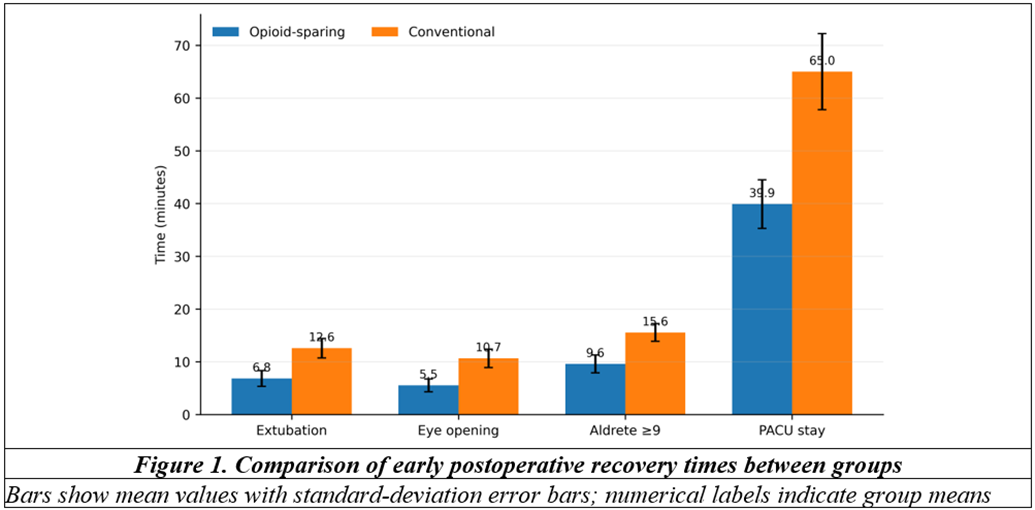
Intraoperative fentanyl exposure was markedly lower in the opioid-sparing group. Recorded intervals to extubation, eye opening, attainment of Aldrete score ≥9, and PACU discharge were shorter (Table 2 and Figure 1). At 1 hour, Ramsay score 3 was recorded in 21 opioid-sparing patients and none of the conventional patients, while score 1 occurred in 19 conventional patients and none of the opioid-sparing patients (Holm-adjusted p<0.001). Thus, faster recorded recovery intervals coexisted with a higher level of arousable sedation at the one-hour assessment.
Table 2. Intraoperative opioid exposure and early recovery outcomes
|
Outcome |
Opioid-sparing (n=40) |
Conventional (n=40) |
Holm-adjusted p value |
|
Intraoperative fentanyl (µg) |
16.88 ± 11.86 |
234.75 ± 33.43 |
<0.001 |
|
Time to extubation (min) |
6.83 ± 1.50 |
12.57 ± 1.84 |
<0.001 |
|
Time to eye opening (min) |
5.53 ± 1.22 |
10.65 ± 1.75 |
<0.001 |
|
Time to Aldrete ≥9 (min) |
9.60 ± 1.71 |
15.55 ± 1.68 |
<0.001 |
|
Ramsay score 1/2/3 at 1 h, n |
0/19/21 |
19/21/0 |
<0.001 |
|
PACU length of stay (min) |
39.90 ± 4.61 |
65.03 ± 7.21 |
<0.001 |
|
Values are mean ± SD or number of patients. PACU: post-anaesthesia care unit. Ramsay score: 1, anxious/agitated; 2, cooperative and tranquil; 3, responds to commands only. Outcome p values were Holm-adjusted across the 20 comparisons in Tables 2-4 |
|||
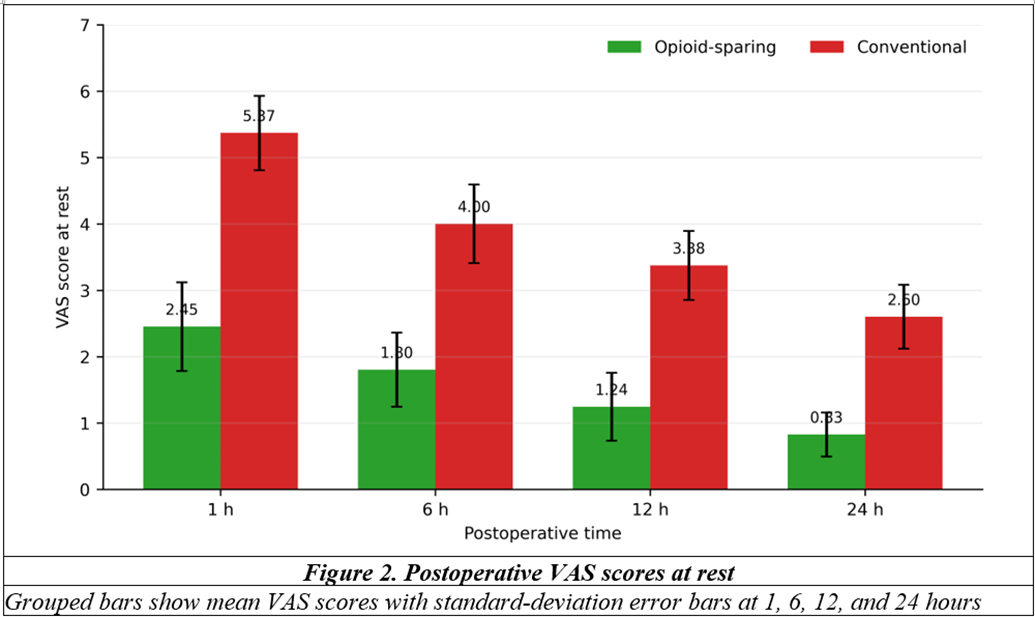
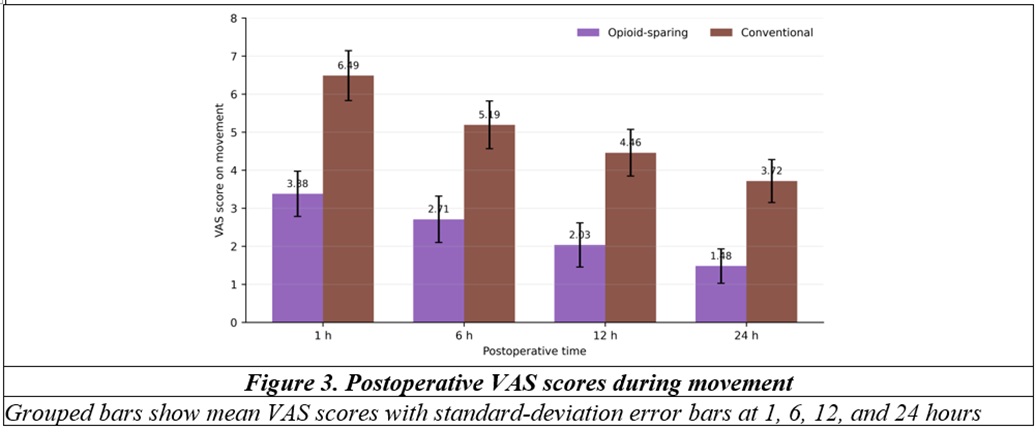
Pain scores were lower in the opioid-sparing group at every recorded time point, both at rest and during movement (Table 3). The temporal pattern is shown in Figures 2 and 3. In the unadjusted analysis, 24-hour opioid consumption was lower by 14.24 mg morphine equivalent, and the first rescue dose was recorded 97.23 minutes later on average; both Holm-adjusted p<0.001.
Table 3. Postoperative pain and analgesic outcomes
|
Outcome |
Opioid-sparing (n=40) |
Conventional (n=40) |
Holm-adjusted p value |
|
VAS at rest, 1 h |
2.45 ± 0.67 |
5.37 ± 0.56 |
<0.001 |
|
VAS on movement, 1 h |
3.38 ± 0.59 |
6.49 ± 0.66 |
<0.001 |
|
VAS at rest, 6 h |
1.80 ± 0.56 |
4.00 ± 0.59 |
<0.001 |
|
VAS on movement, 6 h |
2.71 ± 0.61 |
5.19 ± 0.63 |
<0.001 |
|
VAS at rest, 12 h |
1.24 ± 0.51 |
3.38 ± 0.52 |
<0.001 |
|
VAS on movement, 12 h |
2.03 ± 0.58 |
4.46 ± 0.61 |
<0.001 |
|
VAS at rest, 24 h |
0.83 ± 0.33 |
2.60 ± 0.48 |
<0.001 |
|
VAS on movement, 24 h |
1.48 ± 0.45 |
3.72 ± 0.57 |
<0.001 |
|
Total opioid, 24 h (mg ME) |
4.83 ± 1.48 |
19.07 ± 3.24 |
<0.001 |
|
Time to first rescue analgesia (min) |
144.80 ± 21.58 |
47.58 ± 9.00 |
<0.001 |
|
Values are mean ± SD. VAS: visual analogue scale, 0-10, with higher scores indicating greater pain; ME: morphine equivalent. Outcome p values were Holm-adjusted across the 20 comparisons in Tables 2-4 |
|||
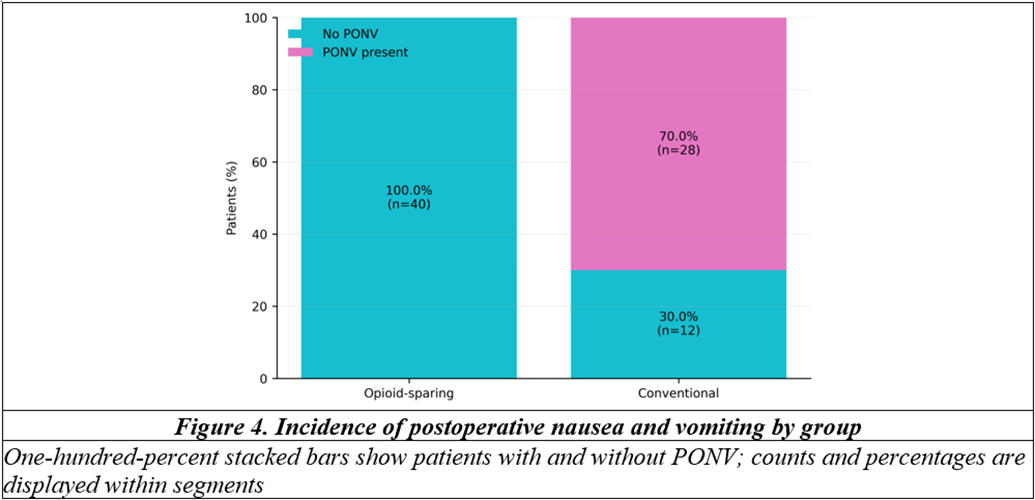
No patient in the opioid-sparing group experienced recorded PONV, compared with 28/40 patients (70.0%) in the conventional group (Fisher exact test, Holm-adjusted p<0.001; Figure 4). Recorded discharge readiness was earlier, all opioid-sparing patients had a one-day hospital stay, and satisfaction scores were higher (Table 4).
Table 4. Postoperative adverse effects, discharge, and satisfaction
|
Outcome |
Opioid-sparing (n=40) |
Conventional (n=40) |
Holm-adjusted p value |
|
PONV, n (%) |
0 (0.0) |
28 (70.0) |
<0.001 |
|
Discharge readiness (h) |
4.86 ± 0.55 |
7.88 ± 0.86 |
<0.001 |
|
Hospital stay: 1/2 days, n |
40/0 |
21/19 |
<0.001 |
|
Satisfaction score 1/2/3/4/5, n |
0/0/0/13/27 |
0/18/14/8/0 |
<0.001 |
|
Values are mean ± SD or number of patients (%). PONV: postoperative nausea and vomiting. Satisfaction was scored from 1 to 5, with higher values indicating greater satisfaction. Outcome p values were Holm-adjusted across the 20 comparisons in Tables 2-4 |
|||
Holm correction across the 20 outcome comparisons did not alter statistical significance; every corrected p value remained <0.001. Overlap weighting achieved close mean balance in the five measured baseline covariates used to estimate the propensity score, but the effective sample size was only 9.54 conventional and 8.63 opioid-sparing records (18.17 in total), confirming limited common support. Weighted estimates remained directionally favourable for early recovery, one-hour pain, 24-hour opioid use, time to rescue analgesia, and discharge readiness (Table 5). PONV was not modelled because the absence of events in the opioid-sparing group prevented stable binary regression. These weighted estimates describe the measured overlap population and are not causal effects.
Table 5. Overlap-weighted sensitivity estimates for selected continuous outcomes
|
Outcome |
Overlap-weighted mean difference |
95% CI |
Holm-adjusted p value |
|
Time to extubation (min) |
-2.08 |
-2.67 to -1.50 |
<0.001 |
|
Time to Aldrete score ≥9 (min) |
-2.52 |
-3.17 to -1.88 |
<0.001 |
|
PACU length of stay (min) |
-11.77 |
-13.88 to -9.66 |
<0.001 |
|
VAS at rest, 1 h |
-1.49 |
-1.78 to -1.19 |
<0.001 |
|
VAS on movement, 1 h |
-1.70 |
-1.96 to -1.43 |
<0.001 |
|
Total opioid use, 24 h (mg ME) |
-9.19 |
-9.93 to -8.45 |
<0.001 |
|
Time to first rescue analgesia (min) |
+62.89 |
56.37 to 69.40 |
<0.001 |
|
Discharge readiness (h) |
-1.49 |
-1.74 to -1.25 |
<0.001 |
|
Weighted mean differences are opioid-sparing minus conventional. Propensity scores included age, sex, BMI, ASA physical status as an ordinal covariate, and surgical duration; overlap weights were 1-p for opioid-sparing records and p for conventional records. Estimates used weighted least squares with HC3 robust standard errors. The combined effective sample size was 18.17. P values were Holm-adjusted across the eight weighted models. Negative values indicate lower outcomes; the positive rescue-analgesia estimate indicates a longer interval. CI: confidence interval; ME: morphine equivalent; PACU: post-anaesthesia care unit; VAS: visual analogue scale |
|||
DISCUSSION:
This secondary comparative analysis showed a consistently favourable unadjusted recovery profile in the opioid-sparing group. Recorded emergence and PACU recovery intervals were shorter, pain scores and cumulative opioid use were lower, rescue analgesia occurred later, PONV was absent, and discharge readiness was earlier. The direction of selected differences remained similar in the overlap-weighted sensitivity analysis. Yet the weighting reduced the effective sample to 18.17 records, indicating that only a narrow portion of the two groups had comparable measured baseline profiles. The weighted estimates therefore support the descriptive pattern but cannot establish that anaesthetic strategy alone produced the observed outcomes.
The lower incidence of PONV is directionally consistent with international guidance, which identifies perioperative opioid minimisation as one component of baseline-risk reduction.[8] Meta-analytic evidence has likewise shown less PONV with opioid-free or opioid-minimised anaesthesia, although the regimens and rescue pathways vary considerably.[9] A randomised study in laparoscopic gynaecological surgery found lower PACU nausea, pain, and rescue opioid use with an opioid-sparing regimen, but no reduction in PACU or hospital stay.[10] The larger crude differences observed here may reflect a mixture of opioid exposure, baseline health, procedure duration, antiemetic practice, and unmeasured components of multimodal care. Overlap weighting balances the measured covariate means used in the propensity model, but it cannot account for those unmeasured factors.
Early recovery was assessed using recorded intervals to extubation, eye opening, and attainment of an Aldrete score of at least 9. The Aldrete framework was developed to standardise physiological recovery after anaesthesia[11] and was later revised to incorporate pulse oximetry.[12] In the crude analysis, PACU stay was approximately 25 minutes shorter in the opioid-sparing group; the overlap-weighted difference was 11.77 minutes. This estimate may be operationally relevant in high-volume public hospitals, where PACU occupancy affects theatre flow, but the small effective overlap sample and absence of standardised discharge criteria require caution.
A noteworthy finding was the higher Ramsay sedation score at one hour in the opioid-sparing group. A score of 3 denotes response to commands only, whereas a score of 2 denotes a cooperative, oriented, tranquil patient. Thus, lower opioid exposure did not translate into uniformly lighter sedation. This is biologically plausible because opioid-sparing pathways may use other sedating adjuncts, and consensus recommendations emphasise that the effects of an opioid-minimisation strategy depend on the accompanying agents.[5] The finding deserves explicit attention in ambulatory pathways and in settings where postoperative observation is constrained.
The sustained reduction in VAS scores and 24-hour opioid use suggests that the opioid-sparing pathway was associated with analgesia rather than simply lower recorded opioid exposure. Multimodal analgesia is most effective when mechanistically distinct treatments are combined while rescue therapy remains available for breakthrough pain.[13] Enhanced recovery literature similarly supports balanced, procedure-specific opioid reduction rather than a universal opioid-free mandate.[14] In the overlap-weighted analysis, the one-hour VAS differences were 1.49 points at rest and 1.70 points during movement, while time to first rescue analgesia was 62.89 minutes longer. Interpretation remains constrained because the rescue threshold, rescue drug, background analgesics, regional technique, and morphine-equivalent conversion method were not specified.
Earlier discharge readiness and the shorter observed hospital stay may be relevant to Indian hospitals where PACU capacity and ward turnover are constrained. Yet these endpoints are vulnerable to procedure type, social circumstances, institutional discharge rules, comorbidity, and surgeon preference. Because procedure category and discharge criteria were unavailable, the present findings should be regarded as hypothesis-supporting evidence of possible resource benefit rather than proof of improved efficiency.
Limitations
The principal limitation is marked baseline non-equivalence. Overlap weighting improved balance for measured covariate means, but the combined effective sample size was only 18.17 and no opioid-sparing patient had ASA physical status III. The sensitivity estimates therefore apply to a restricted overlap population and remain vulnerable to residual and unmeasured confounding. The original recruitment and allocation process, procedure category, individual anaesthetic components, antiemetic prophylaxis, background analgesia, rescue protocol, morphine-equivalent conversion method, and discharge-readiness criteria were not specified. No documented a priori sample-size calculation was available. Multiple outcomes were examined; Holm correction reduced the risk of false-positive inference, but the analysis remains exploratory. PONV was recorded only as present or absent, and the study-specific satisfaction rating was not independently validated. Ramsay sedation and satisfaction were ordinal, while longer-term outcomes such as persistent pain, readmission, and delayed adverse events were not assessed.
CONCLUSION:
Within this secondary, non-randomised comparative analysis, opioid-sparing anaesthesia was associated with shorter recorded recovery intervals, lower postoperative pain, reduced 24-hour opioid consumption, later rescue analgesia, less PONV, shorter PACU stay, earlier discharge readiness, and greater satisfaction. Directionally similar estimates were obtained in an overlap-weighted sensitivity analysis, while one-hour Ramsay scores indicated greater arousable sedation in the opioid-sparing group. The small effective overlap sample, major baseline differences, and incomplete procedural and protocol information preclude causal interpretation. Confirmation requires a prospectively specified, procedure-specific study with balanced allocation and complete reporting of anaesthetic, antiemetic, analgesic, rescue, and discharge protocols.
REFERENCES:
1. Kehlet H, Dahl JB. Anaesthesia, surgery, and challenges in postoperative recovery. Lancet 2003;362(9399):1921-1928. doi:10.1016/S0140-6736(03)14966-5.
2. Ljungqvist O, Scott M, Fearon KC. Enhanced Recovery After Surgery: a review. JAMA Surg 2017;152(3):292-8. doi:10.1001/jamasurg.2016.4952.
3. Chou R, Gordon DB, de Leon-Casasola OA, Rosenberg JM, Bickler S, Brennan T, et al. Management of postoperative pain: a clinical practice guideline from the American Pain Society, the American Society of Regional Anesthesia and Pain Medicine, and the American Society of Anesthesiologists. J Pain 2016;17(2):131-57. doi:10.1016/j.jpain.2015.12.008.
4. Beverly A, Kaye AD, Ljungqvist O, Urman RD. Essential elements of multimodal analgesia in Enhanced Recovery After Surgery guidelines. Anesthesiol Clin 2017;35(2):e115-43. doi:10.1016/j.anclin.2017.01.018.
5. Wu CL, King AB, Geiger TM, Grant MC, Grocott MPW, Gupta R, et al. American Society for Enhanced Recovery and Perioperative Quality Initiative joint consensus statement on perioperative opioid minimization in opioid-naive patients. Anesth Analg 2019;129(2):567-77. doi:10.1213/ANE.0000000000004194.
6. Frauenknecht J, Kirkham KR, Jacot-Guillarmod A, Albrecht E. Analgesic impact of intra-operative opioids versus opioid-free anaesthesia: a systematic review and meta-analysis. Anaesthesia 2019;74(5):651-62. doi:10.1111/anae.14582.
7. Feenstra ML, Jansen S, Eshuis WJ, van Berge Henegouwen MI, Hollmann MW, Hermanides J. Opioid-free anesthesia: a systematic review and meta-analysis. J Clin Anesth 2023;90:111215. doi:10.1016/j.jclinane.2023.111215.
8. Gan TJ, Belani KG, Bergese S, Chung F, Diemunsch P, Habib AS, et al. Fourth consensus guidelines for the management of postoperative nausea and vomiting. Anesth Analg 2020;131(2):411-48. doi:10.1213/ANE.0000000000004833.
9. Zhang Y, Ma D, Lang B, Zang C, Sun Z, Ren S, et al. Effect of opioid-free anesthesia on the incidence of postoperative nausea and vomiting: a meta-analysis of randomized controlled studies. Medicine (Baltimore) 2023;102(38):e35126. doi:10.1097/MD.0000000000035126.
10. Nam SW, Do SH, Hwang JW, Park I, Hwang I, Na HS. Effects of opioid-sparing general anesthesia on postoperative nausea and vomiting in laparoscopic gynecological surgery. Korean J Anesthesiol 2024;77(6):605-613. doi:10.4097/kja.24336.
11. Aldrete JA, Kroulik D. A postanesthetic recovery score. Anesth Analg 1970;49(6):924-934.
12. Aldrete JA. The post-anesthesia recovery score revisited. J Clin Anesth 1995;7(1):89-91. doi:10.1016/0952-8180(94)00001-K.
13. Kaye AD, Urman RD, Rappaport Y, Siddaiah H, Cornett EM, Belani K, et al. Multimodal analgesia as an essential part of enhanced recovery protocols in the ambulatory settings. J Anaesthesiol Clin Pharmacol 2019;35(Suppl 1):S40-5. doi:10.4103/joacp.JOACP_51_18.
14. Echeverria-Villalobos M, Stoicea N, Todeschini AB, Fiorda-Diaz J, Uribe AA, Weaver T, et al. Enhanced Recovery After Surgery: a perspective review of postoperative pain management under ERAS pathways and its role on the opioid crisis in the United States. Clin J Pain 2020;36(3):219-26. doi:10.1097/AJP.0000000000000792.