A CASE STUDY OF POTT’S SPINE EXTENDING FROM D5–L2 IN A PATIENT WITH CONGENITAL SCOLIOSIS PRESENTING WITH PROGRESSIVE LOWER LIMB WEAKNESS.
- Amrita Hui , MD Medicine, Department of General Medicine, Sri Devaraj Urs Medical College (SDUMC), Tamaka, Kolar, Karnataka – 563103.
Article Information:
Abstract:
Background: Pott’s spine is the most common form of skeletal tuberculosis and can lead to severe neurological deficits and spinal deformity if not diagnosed early. Its occurrence in patients with pre-existing spinal deformities like congenital scoliosis increases diagnostic and therapeutic complexity. Case Description: A 40-year-old female with congenital scoliosis presented with progressive lower limb weakness (right > left) and paresthesia. MRI revealed extensive D5–L2 vertebral destruction with multiple spinal, paraspinal, and epidural abscesses, along with spinal cord compression and gibbus deformity. HRCT chest showed features suggestive of pulmonary tuberculosis. The patient was managed with antitubercular therapy and supportive care. Conclusion: Early recognition of spinal tuberculosis in structurally abnormal spines is crucial to prevent irreversible neurological impairment and deformity. Multimodal imaging and timely treatment play a key role in improving outcomes.
Keywords:
Article :
INTRODUCTION:
Tuberculosis remains a major global health problem, with spinal tuberculosis (Pott’s disease) being the most common form of skeletal involvement, accounting for 15–20% of extrapulmonary cases [1]. It typically affects thoracic and lumbar vertebrae, leading to vertebral destruction, spinal deformity, and neurological deficits such as lower limb weakness [2]. This case describes a 40-year-old female with congenital scoliosis who developed extensive Pott’s spine (D5–L2) with progressive neurological impairment. Early diagnosis and treatment are crucial to prevent permanent disability and deformity.
CASE PRESENTATION :
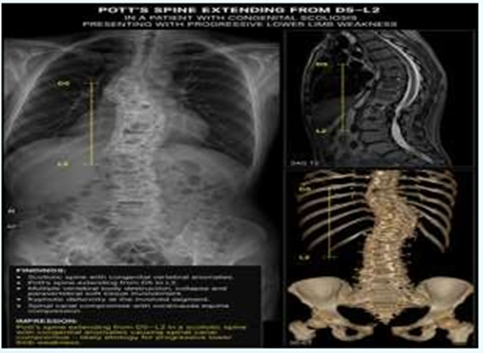
A 40-year-old female with congenital scoliosis presented with gradually progressive bilateral lower limb weakness (right more than left) and paresthesia over one year, without bowel or bladder involvement. Examination revealed hypotonia, marked motor weakness, exaggerated reflexes, and bilateral extensor plantar responses. MRI showed extensive D5–L2 vertebral destruction with gibbus deformity, paraspinal and epidural abscesses, and spinal cord compression, while HRCT thorax suggested active-on-old pulmonary tuberculosis. She was diagnosed with spinal tuberculosis (Pott’s spine) with neurological deficit and managed conservatively with antitubercular therapy and supportive treatment, highlighting the need for early diagnosis to prevent permanent disability.
CONCLUSION:
This case highlights extensive Pott’s spine (D5–L2) in a patient with congenital scoliosis, presenting with progressive lower limb weakness and neurological deficits. MRI confirmed multilevel vertebral destruction with abscess formation and cord compression. Early diagnosis and prompt antitubercular therapy are essential to prevent irreversible neurological damage and deformity.
REFERENCES:
1. Tuli SM, editor. Tuberculosis of the skeletal system. JP Medical Ltd; 2016 Mar 30
2. World Health Organization. Global tuberculosis report 2024. Geneva. World Health Organization. 2025.