COMPARATIVE STUDY ON EFFECT OF DEXMEDETOMIDINE AND DEXAMETHASONE ON POSTOPERATIVE NAUSEA AND VOMITING IN PATIENTS UNDERGOING LAPAROSCOPIC CHOLECYSTECTOMY:A PARALLEL GROUP RANDOMISED CLINICAL TRIAL.
- Krishanu Majumdar , Senior Resident, M.B.B.S., M.D. (Anaesthesiology), Department of Anaesthesiology and Critical Care Medicine, Murshidabad Medical College and Hospital, 73, Station Road, Raninagar, Gora Bazar, Berhampore, West Bengal – 742101.
- Madhabi Roy , Senior Resident, M.B.B.S., M.D. (Anaesthesiology), Department of Anaesthesiology and Critical Care Medicine, Nil Ratan Sircar Medical College and Hospital, 138, AJC Bose Road, Sealdah, Raja Bazar, Kolkata, West Bengal – 700014.
- Shanta Ganguly , Assistant Professor, M.B.B.S., M.D. (Anaesthesiology), Department of Anaesthesiology and Critical Care Medicine, College of Medicine and JNM Hospital, Block A2, Kalyani, West Bengal – 741235.
- Madhumita Ray , Professor, M.B.B.S., M.D. (Anaesthesiology), Department of Anaesthesiology and Critical Care Medicine, College of Medicine and JNM Hospital, Block A2, Kalyani, West Bengal – 741235.
Article Information:
Abstract:
Introduction: Laparoscopic cholecystectomy is the surgical treatment of choice for cholelithiasis but this procedure is associated with a high rate of postoperative nausea and vomiting (PONV).Nausea and vomiting are some of the most common complaints of patients after any anaesthesia, which is often associated with postoperative pain. Aims &objectives: Evaluation of effect of study drug on postoperative nausea and vomiting in laparoscopic cholecystectomy.Effect of study drug on postoperative analgesia. Effect of study drug on perioperative haemodynamic Materials & Methods: This study was designed as a single-blinded parallel group randomised clinical trial conducted in the New OT Complex, recovery room, and General Surgery Ward of COMJNMH, Kalyani. The study was carried out over a period of 1 year with a total sample size of 104 patients. Result: The mean postoperative nausea and vomiting (PONV) score was significantly lower in the Dexmedetomidine group compared to the Dexamethasone group. Patients receiving Dexamethasone had a mean nausea and vomiting score of 3.85 ± 0.66 (median: 4, range: 2–5), whereas those receiving Dexmedetomidine had a mean score of 2.81 ± 0.68 (median: 3, range: 1–4). This difference was highly statistically significant (p < 0.0001). Conclusion: We concluded that both Dexamethasone and Dexmedetomidine groups had comparable baseline diagnosis and comorbidity profiles, allowing a reliable comparison between the two groups. GB sludge was the most common diagnosis, followed by calculous cholecystitis and chronic cholecystitis, with no significant difference in diagnosis distribution.
Keywords:
Article :
INTRODUCTION:
The preferred surgical method for treating cholelithiasis is laparoscopic cholecystectomy; nevertheless, this procedure has a high rate of postoperative nausea and vomiting (PONV) [1].Following any anesthesia, patients frequently complain of nausea and vomiting, which are frequently linked to postoperative pain. Twenty to thirty percent of patients experience postoperative nausea and vomiting up to twenty-four hours after surgery. This could be because anesthetic medications affect the medulla oblongata's vomiting control area. Complications include aspiration pneumonia, ruptured abdomen, and airway obstruction can result from postoperative nausea and vomiting.
Dehydration, electrolyte imbalances, hypertension, suture straining, increased bleeding from skin flaps, and delayed discharge are all consequences of postoperative vomiting. If the lingering effects of anesthetic medications diminish airway reflexes, this consequence may raise the risk of pulmonary aspiration [2].Dopamine and serotonin receptor antagonists, corticosteroids, antihistamines, sedatives, and anticholinergics are among the medications that have been utilized to treat this illness thus far. Metoclopramide and Droperidol are the most widely used medications to treat nausea and vomiting. These agents have been limited in certain cases due to complications like fatigue and restlessness, lack of awareness of time and place, extra pyramidal symptoms, cardiovascular complications, hypotension, orthostatic hypotension, drowsiness, akathisia, elevated liver enzymes, and agranulocytosis [3].
Drug therapy and complementary therapies, which can be used alone or in conjunction with conventional treatments, have now taken the place of the aforementioned medications [4]. Because of its anxiolytic, sedative, analgesic, sympatholytic, and hemodynamic regulating effects, dexmedetomidine, a strong alpha-2-adrenergic receptor agonist, has been used extensively [5]. One corticosteroid medication that lowers inflammation and impairs immunity is dexamethasone. Dexamethasone is a readily available and inexpensive medication used to manage nausea and vomiting following surgery. Dexamethasone's anti-nausea and anti-vomiting properties have been demonstrated in chemotherapy patients over the past 20 years. Evaluation of effect of study drug on postoperative nausea and vomiting in laparoscopic cholecystectomy. Effect of study drug on postoperative analgesia. Effect of study drug on perioperative haemodynamic.
MATERIALS AND METHODS:
Type of Study: A single blinded parallel group randomised clinical trial
Place of Study: New OT Complex, recovery room and General surgery ward COMJNMH, Kalyani
Study Duration: 1 year
Sample Size: 104
Inclusion Criteria:
• Patients who have given written informed consent
• Age : 18-65 years
• ASA grade : I and II
• Body Mass Index(BMI) ≤ 35
• Body Weight ≥ 50kg
• Patients of all gender undergoing elective laparoscopic cholecystectomy.
Exclusion Criteria:
• History of drug abuse
• Pregnancy
• History of allergy /known contraindication to the drugs used in study.
• Patient who cannot communicate,understand and follow commands due to any reason.
• History of Gastroparesis, Gastro oesophageal reflux disorder.
• Any additional confounding factors that itself may lead to PONV.
• Any patient who decides to opt out from study at any point of time.
Study Variables:
• Postoperative nausea and vomiting (PONV) score
• Incidence of postoperative nausea
• Incidence of postoperative vomiting
• Requirement of rescue antiemetic medication
• Dose of rescue antiemetic required
• Time to first requirement of rescue antiemetic
• Time interval for rescue analgesia requirement
• Postoperative pain assessment score
• Patient recovery profile after surgery
Statistical Analysis:
Data were entered into Excel and subsequently analyzed using SPSS and GraphPad Prism. Continuous variables were summarized as means with standard deviations, while categorical variables were presented as counts and percentages. Comparisons between independent groups were performed using two-sample t-tests, and paired t-tests were applied for correlated (paired) data. Categorical data were compared using chi-square tests, with Fisher’s exact test applied when expected cell counts were small. A p-value of ≤ 0.05 was considered statistically significant.
RESULTS:
Table 1: Association between Diagnoses
|
|
Diagnosis |
Dexamethasone |
Dexmedetomidine |
Total |
p-value |
|
Diagnosis |
Calculous Cholecystitis |
16 (31.4) |
20 (37.7) |
36 (34.6) |
0.7558 |
|
Chronic Cholecystitis |
14 (27.5) |
12 (22.6) |
26 (25.0) |
||
|
GB Sludge |
21 (41.2) |
21 (39.6) |
42 (40.4) |
||
|
Total |
51 (100.0) |
53 (100.0) |
104 (100.0) |
||
|
Comorbidity |
Hypertension |
1 (2.0) |
4 (7.5) |
5 (4.8) |
0.183 |
|
Nil |
50 (98.0) |
49 (92.5) |
99 (95.2) |
||
|
Total |
51 (100.0) |
53 (100.0) |
104 (100.0) |
Table 2: Association between ASA
|
ASA Grade |
Dexamethasone |
Dexmedetomidine |
Total |
p-value |
|
Grade 1 |
48 (94.1) |
35 (66.0) |
83 (79.8) |
0.0003 |
|
Grade 2 |
3 (5.9) |
18 (34.0) |
21 (20.2) |
|
|
Total |
51 (100.0) |
53 (100.0) |
104 (100.0) |
Table 3: Distribution of mean Nausea Vomiting Score
|
|
Number |
Mean |
SD |
Minimum |
Maximum |
Median |
P-value |
|
|
Nausea Vomiting Score |
DEXAM |
27 |
3.8519 |
0.6624 |
2 |
5 |
4 |
<0.0001 |
|
DEXME DETOMI DINE |
27 |
2.8148 |
0.6815 |
1 |
4 |
3 |
||
Table 4: Distribution of mean Rescue Antiemetic Dose (mg)
|
Number |
Mean |
SD |
Minimum |
Maximum |
Median |
P-value |
|||
|
RESCUE ANTIEMETIC DOSE(mg) |
DEXAM ETHASO NE |
27 |
4.7457 |
1.9314 |
0 |
8 |
4 |
0.0039 |
|
|
DEXME DETOMI DINE |
27 |
5.1953 |
1.8213 |
4 |
8 |
4 |
|||
Table 5: Distribution of mean Time Gap Post -OP for Rescue Analgesia (mins):
|
Number |
Mean |
SD |
Minimum |
Maximum |
Median |
P-value |
|||
|
TIME GAP POST -OP FOR RESCUE ANALGES IA TIME GAP (mins) |
DEXAM ETHASO NE |
27 |
457.1481 |
177.3531 |
179.000 0 |
720.000 0 |
480.00 00 |
0.0034 |
|
|
DEXME DETOMI DINE |
27 |
430.5185 |
170.3990 |
149.000 0 |
690.000 0 |
480.00 00 |
|||
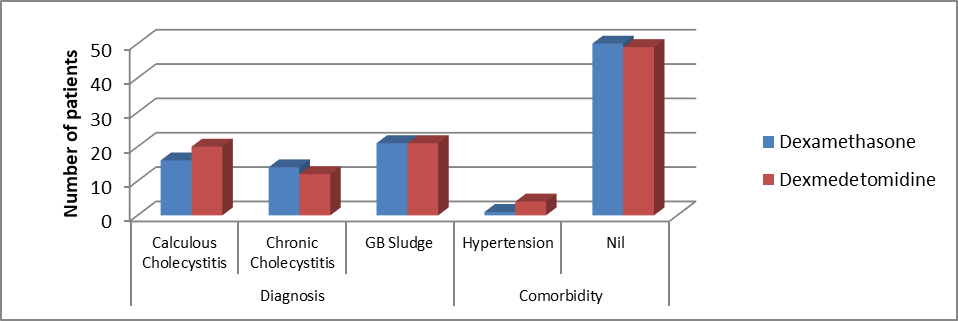
Figure 1: Association between Diagnoses
The distribution of baseline diagnosis and comorbidity was comparable between the Dexamethasone and Dexmedetomidine groups. Overall, GB sludge was the most common diagnosis, observed in 42 (40.4%) patients, followed by calculous cholecystitis in 36 (34.6%) and chronic cholecystitis in 26 (25.0%) patients. In the Dexamethasone group, GB sludge, calculous cholecystitis, and chronic cholecystitis were present in 21 (41.2%), 16 (31.4%), and 14 (27.5%) patients, respectively, while in the Dexmedetomidine group, the corresponding frequencies were 21 (39.6%), 20 (37.7%), and 12 (22.6%). The difference in diagnosis distribution between the two groups was not statistically significant (p = 0.7558). Regarding comorbidity, the majority of patients had no associated comorbidity (99; 95.2%), whereas hypertension was present in only 5 (4.8%) patients, including 1 (2.0%) in the Dexamethasone group and 4 (7.5%) in the Dexmedetomidine group.
The difference in comorbidity distribution was also not statistically significant (p = 0.183). The distribution of ASA grades differed significantly between the Dexamethasone and Dexmedetomidine groups. Overall, 83 (79.8%) patients were classified as ASA Grade 1, while 21 (20.2%) were classified as ASA Grade 2. In the Dexamethasone group, 48 (94.1%) patients were ASA Grade 1 and 3 (5.9%) were ASA Grade 2, whereas in the Dexmedetomidine group, 35 (66.0%) patients were ASA Grade 1 and 18 (34.0%) were ASA Grade 2. The difference in the distribution of ASA grades between the two groups was statistically significant (p = 0.0003). The mean postoperative nausea and vomiting (PONV) score was significantly lower in the Dexmedetomidine group compared to the Dexamethasone group. Patients receiving Dexamethasone had a mean nausea and vomiting score of 3.85 ± 0.66 (median: 4, range: 2–5), whereas those receiving Dexmedetomidine had a mean score of 2.81 ± 0.68 (median: 3, range: 1–4). This difference was highly statistically significant (p < 0.0001).
The requirement of rescue antiemetic dose was significantly different between the Dexamethasone and Dexmedetomidine groups. The mean rescue antiemetic dose in the Dexamethasone group was 4.75 ± 1.93 mg (median: 4 mg, range: 0–8 mg), whereas in the Dexmedetomidine group, the mean dose was 5.20 ± 1.82 mg (median: 4 mg, range: 4–8 mg). The difference between the two groups was statistically significant (p = 0.0039). The time interval for requirement of rescue analgesia was compared between the Dexamethasone and Dexmedetomidine groups. The mean time gap for rescue analgesia requirement in the Dexamethasone group was 457.15 ± 177.35 minutes (median: 480 minutes, range: 179–720 minutes), whereas in the Dexmedetomidine group, it was 430.52 ± 170.40 minutes (median: 480 minutes, range: 149–690 minutes). The difference between the two groups was statistically significant (p = 0.0034).
DISCUSSION:
Postoperative nausea and vomiting (PONV) remains one of the most frequent complications following laparoscopic cholecystectomy and continues to impact patient comfort and recovery. In the present randomized parallel group clinical trial, dexmedetomidine demonstrated a significantly lower postoperative nausea and vomiting score compared to dexamethasone (2.81 ± 0.68 vs 3.85 ± 0.66; p < 0.0001), indicating superior antiemetic efficacy. The baseline distribution of diagnosis and comorbidities was comparable between both groups. Gall bladder sludge was the most common indication for surgery, followed by calculous cholecystitis and chronic cholecystitis. Similar distributions have been reported by Rajpoot K et al. (2025) and 2. Lady Aqnes Kurniawati L et al. (2021), who observed that symptomatic cholelithiasis and chronic inflammatory gall bladder disease remain the leading indications for laparoscopic cholecystectomy in tertiary care settings [6,7].
This comparability ensures minimal selection bias between the study groups. In the present study, ASA grade distribution showed a statistically significant difference between groups, with a higher proportion of ASA Grade II patients in the dexmedetomidine group. However, despite this imbalance, dexmedetomidine still demonstrated better PONV control. This finding supports the robustness of its antiemetic effect across varying perioperative risk profiles. Dexmedetomidine, a selective α2-adrenergic agonist, exerts sedative, anxiolytic, and analgesic effects while reducing sympathetic outflow and perioperative opioid requirements, thereby indirectly decreasing PONV incidence. Similar findings were reported by Jin Z et al. (2018), who demonstrated reduced PONV and improved hemodynamic stability with dexmedetomidine infusion during laparoscopic surgeries [8].
Dexamethasone, a corticosteroid with anti-inflammatory and central antiemetic effects, is widely used for PONV prophylaxis. However, in the present study, dexmedetomidine showed superior efficacy. Comparable observations were made by Gianturco SL et al. (2021), who reported that dexmedetomidine provided better control of postoperative nausea compared to dexamethasone in laparoscopic procedures, likely due to its opioid-sparing properties [9]. The requirement of rescue antiemetic medication was significantly different between groups (p = 0.0039), with better outcomes observed in the dexmedetomidine group. In terms of postoperative analgesia, the time interval for rescue analgesia was significantly different between groups. Dexmedetomidine showed a more favorable analgesic profile, consistent with its central α2-mediated analgesic mechanism. BATOOL S et al. (2024) also reported prolonged postoperative analgesia and reduced opioid consumption with dexmedetomidine in laparoscopic cholecystectomy patients [10]. The superior efficacy of dexmedetomidine observed in this study may be attributed to its multimodal pharmacological actions, including inhibition of sympathetic activity, reduction of stress response, and opioid-sparing effects, all of which contribute to lower PONV incidence and improved recovery outcomes.
CONCLUSION:
We concluded that both Dexamethasone and Dexmedetomidine groups had comparable baseline diagnosis and comorbidity profiles, allowing a reliable comparison between the two groups. GB sludge was the most common diagnosis, followed by calculous cholecystitis and chronic cholecystitis, with no significant difference in diagnosis distribution. The majority of patients had no associated comorbidity, and although ASA grade distribution differed significantly, most patients in both groups were classified as ASA Grade 1. Dexmedetomidine was found to be more effective in reducing postoperative nausea and vomiting, as evidenced by significantly lower PONV scores compared with Dexamethasone. A significant difference was also observed in rescue antiemetic requirement and postoperative analgesic parameters between the groups. Overall, Dexmedetomidine showed better postoperative outcomes by improving PONV control and affecting postoperative analgesic requirements in patients undergoing laparoscopic cholecystectomy. Hence, Dexmedetomidine may be considered a beneficial perioperative adjunct for enhancing postoperative recovery and patient comfort.
REFERENCES:
1. Bianchin A, De Luca A, Caminiti A. Postoperative vomiting reduction after laparoscopic cholecystectomy with single dose of dexamethasone. Minerva anestesiologica. 2007 Jun 1;73(6):343-6.
2. McCracken G, Houston P, Lefebvre G. Guideline for the management of postoperative nausea and vomiting. Journal of obstetrics and gynaecology Canada. 2008 Jul 1;30(7):600-7.
3. Henzi I, Sonderegger J, Tramer MR. Efficacy, dose-response, and adverse effects of droperidol for prevention of postoperative nausea and vomiting. Canadian Journal of Anesthesia. 2000 Jun;47:537-51.
4. Mishriky BM, Habib AS. Metoclopramide for nausea and vomiting prophylaxis during and after Caesarean delivery: a systematic review and meta-analysis. British journal of anaesthesia. 2012 Mar 1;108(3):374-83.
5. Gupta N, Rath GP, Prabhakar H, Dash HH. Effect of intraoperative dexmedetomidine on postoperative recovery profile of children undergoing surgery for spinal dysraphism. Journal of neurosurgical anesthesiology. 2013 Jul 1;25(3):271-8.
6. Rajpoot K. Role of artificial intelligence in nanomedicine and organ-specific therapy: an updated review. Current drug targets. 2025 Jul 22.
7. Lady Aqnes Kurniawati L, Muhammad Ilham Aldika Akbar M, Budi Utomo B, Aditiawarman A. Risk Factor of Preeclampsia in a Secondary Indonesian Hospital: A Case-Control Study. Indian Journal of Forensic Medicine & Toxicology. 2021;15(3):3474-82.
8. Jin Z, Suen KC, Alam A, Hana Z, Wang D, Ma D. Dexmedetomidine: from basic science to clinical application of brain protection. InFrontiers in Clinical Drug Research-CNS and Neurological Disorders: Volume 6 2018 Sep 12 (pp. 99-157). Bentham Science Publishers.
9. Gianturco SL, Pavlech LL, Storm KD, Yuen MV, Mattingly AN. Ropivacaine hydrochloride: Summary Report.(2021)
10. BATOOL S, NARWAT Y, RA RB. Comparison of Haemodynamic Effects of Clonidine and Dexmedetomidine for Intubation using Intubating Laryngeal Mask Airway in Patients undergoing Elective Surgery under General Anaesthesia: A Randomised Clinical Study. Journal of Clinical & Diagnostic Research. 2024 Feb 1;18(2).