COMPARISON OF ANALGESIC EFFICACY OF INTRATHECAL MIDAZOLAM AND FENTANYL WITH 0.5% HYPERBARIC BUPIVACAINE IN ELECTIVE CHOLECYSTECTOMY.
- Anirban Ghoshal , Assistant Professor, Department of Anaesthesia, East West Institute of Medical Sciences and Research, Burdwan, Talit.
- Aditi Banerji , Assistant Professor, Department of Anaesthesiology, Gouri Devi Institute of Medical Sciences and Hospital, Durgapur
- Sagarnil Roy , Assistant Professor, Department of Anaesthesiology, East West Institute of Medical Sciences and Research, Burdwan, Talit.
Article Information:
Abstract:
Introduction: Effective postoperative analgesia is crucial for early recovery and patient comfort following elective cholecystectomy. Intrathecal adjuvants such as midazolam and fentanyl are commonly used with hyperbaric bupivacaine to enhance analgesic efficacy, prolong duration of block, and reduce postoperative pain. However, their comparative effectiveness remains an area of clinical interest. Aims: To compare the analgesic efficacy of intrathecal midazolam and fentanyl when used as adjuvants to 0.5% hyperbaric bupivacaine in patients undergoing elective cholecystectomy. Materials and Methods: This was a prospective, randomized, comparative clinical study conducted in the Department of Anaesthesiology at a tertiary care teaching hospital over a period of one year. The study included adult patients scheduled for elective cholecystectomy under spinal anesthesia. A total of 100 patients were enrolled and randomly allocated into two equal groups of 50 each: Group M (midazolam group) and Group F (fentanyl group). Results: In the present study, a total of 100 patients were enrolled and equally divided into two groups, Group M (n=50) and Group F (n=50). In Group M, 32 patients (64%) were classified as ASA Grade I and 18 patients (36%) were classified as ASA Grade II. In Group F, 30 patients (60%) were ASA Grade I and 20 patients (40%) were ASA Grade II.On comparison of ASA physical status between the two groups, the difference was found to be statistically not significant with a p-value of 0.67. Conclusion: Both intrathecal midazolam and fentanyl are effective adjuvants to 0.5% hyperbaric bupivacaine in elective cholecystectomy. Fentanyl provides rapid onset and better immediate analgesia, while midazolam offers prolonged postoperative pain relief with minimal side effects. The choice of adjuvant may be tailored based on clinical priorities.
Keywords:
Article :
INTRODUCTION:
Pain management remains a cornerstone of perioperative care, particularly in abdominal surgeries such as cholecystectomy, where inadequate analgesia can delay recovery, prolong hospital stay, and increase postoperative morbidity. Effective control of pain not only improves patient comfort but also reduces the neuroendocrine stress response to surgery, thereby enhancing overall outcomes [1]. Spinal anesthesia is widely used for lower abdominal and upper abdominal procedures due to its rapid onset, dense neural blockade, and favorable safety profile compared to general anesthesia in selected patients [2].
Hyperbaric bupivacaine, a long-acting amide local anesthetic, is the most commonly used agent for spinal anesthesia. At a concentration of 0.5%, it provides reliable sensory and motor blockade suitable for procedures such as elective cholecystectomy. However, its duration of action is limited, and it may not provide adequate postoperative analgesia when used alone. To overcome this limitation, various intrathecal adjuvants have been explored to prolong analgesia, reduce local anesthetic dose requirements, and minimize side effects [3].
Among these adjuvants, opioids such as fentanyl have gained widespread acceptance due to their potent analgesic effects. Intrathecal fentanyl, a highly lipophilic μ-opioid receptor agonist, acts synergistically with local anesthetics to enhance analgesia without significantly prolonging motor blockade. It provides rapid onset of analgesia and improves intraoperative and early postoperative pain control. However, its use may be associated with side effects such as pruritus, nausea, vomiting, and, rarely, respiratory depression [4,5].
Midazolam, a benzodiazepine, has also been investigated as an intrathecal adjuvant due to its antinociceptive properties mediated through γ-aminobutyric acid (GABA) receptors in the spinal cord. Intrathecal midazolam enhances analgesia by modulating nociceptive transmission and has been shown to prolong the duration of postoperative pain relief when combined with local anesthetics. Additionally, it provides mild sedation and anxiolysis without significant respiratory depression. Importantly, studies have demonstrated its safety when used in preservative-free formulations [6,7].
The comparative efficacy of intrathecal midazolam and fentanyl as adjuvants to hyperbaric bupivacaine has been the subject of several clinical investigations. While fentanyl is known for its rapid onset and superior early analgesia, midazolam has been associated with prolonged duration of analgesia and delayed requirement for rescue analgesics. However, results across studies have been variable, and the optimal choice of adjuvant remains a matter of clinical judgment [8,9].
Elective cholecystectomy, commonly performed for gallbladder diseases such as cholelithiasis, is associated with moderate postoperative pain. Effective intraoperative and postoperative analgesia is essential to facilitate early mobilization, reduce complications, and improve patient satisfaction. Although general anesthesia is traditionally used for this procedure, spinal anesthesia with appropriate adjuvants has emerged as a viable alternative in selected cases, offering advantages such as reduced postoperative nausea and vomiting, better pain control, and decreased opioid consumption [10].
The present study aims to evaluate and compare the analgesic efficacy of intrathecal midazolam and fentanyl when used as adjuvants to 0.5% hyperbaric bupivacaine in patients undergoing elective cholecystectomy. The objective is to assess differences in onset and duration of sensory and motor blockade, duration of postoperative analgesia, and time to first rescue analgesic requirement between the two groups. Additionally, the study seeks to compare hemodynamic stability, level of sedation, and incidence of adverse effects such as nausea, vomiting, pruritus, and respiratory depression, in order to determine the safer and more effective intrathecal adjuvant for improving perioperative analgesic outcomes.
MATERIALS AND METHODS:
Study Design: This study was a prospective, randomized, comparative clinical study.
Study Place: The study was conducted in the Department of Anaesthesiology at a tertiary care teaching hospital.
Study Duration: 1 year
Study Population: The study population included adult patients scheduled for elective cholecystectomy under spinal anaesthesia.
Sample Size: A total of 100 patients were included in the study and were randomly allocated into two groups of 50 each.
Group M (Midazolam group) and Group F (Fentanyl group)
Study variable:
● Age Group (Years)
● Gender
● ASA Grade
● Duration of Analgesia (min)
● Adverse Effects
Inclusion Criteria:
● Patients aged between 18 and 60 years
● Patients of either gender
● American Society of Anesthesiologists (ASA) physical status I and II
● Patients scheduled for elective cholecystectomy under spinal anesthesia
● Patients who provided informed written consent.
Exclusion Criteria:
● Patients with contraindications to spinal anesthesia (e.g., infection at injection site, coagulopathy).
● Known allergy or hypersensitivity to study drugs (bupivacaine, midazolam, fentanyl)
● Patients with significant cardiovascular, respiratory, hepatic, or renal disease
● Pregnant or lactating women
● Patients on chronic opioid or sedative therapy
● Patients with neurological or psychiatric disorders.
Statistical Analysis:
For statistical analysis data were entered into a Microsoft excel spreadsheet and then analyzed by SPSS (version 27.0; SPSS Inc., Chicago, IL, USA) and GraphPad Prism version 5. Data had been summarized as mean and standard deviation for numerical variables and count and percentages for categorical variables. Two-sample t-tests for a difference in mean involved independent samples or unpaired samples. Paired t-tests were a form of blocking and had greater power than unpaired tests. A chi-squared test (χ2 test) was any statistical hypothesis test wherein the sampling distribution of the test statistic is a chi-squared distribution when the null hypothesis is true. Without other qualification, 'chi-squared test' often is used as short for Pearson's chi-squared test. Unpaired proportions were compared by Chi-square test or Fischer’s exact test, as appropriate.
Explicit expressions that can be used to carry out various t-tests are given below. In each case, the formula for a test statistic that either exactly follows or closely approximates a t-distribution under the null hypothesis is given. Also, the appropriate degrees of freedom are given in each case. Each of these statistics can be used to carry out either a one-tailed test or a two-tailed test.
Once a t value is determined, a p-value can be found using a table of values from Student's t-distribution .If the calculated p-value is below the threshold chosen for statistical significance (usually the 0.10, the 0.05, or 0.01 level), then the null hypothesis is rejected in favour of the alternative hypothesis.
P-value ≤ 0.05 was considered for statistically significant.
RESULTS:
Table 1: Distribution of Patients by Age Group
|
Age Group (Years) |
Group M (n=50) n (%) |
Group F (n=50) n (%) |
Total (n=100) n (%) |
P value |
|
18–30 |
10 (20%) |
12 (24%) |
22 (22%) |
0.94 |
|
31–40 |
14 (28%) |
13 (26%) |
27 (27%) |
|
|
41–50 |
16 (32%) |
15 (30%) |
31 (31%) |
|
|
51–60 |
10 (20%) |
10 (20%) |
20 (20%) |
Table 2: Gender Distribution
|
Gender |
Group M (n=50) n (%) |
Group F (n=50) n (%) |
Total (n=100) n (%) |
P value |
|
Male |
28 (56%) |
30 (60%) |
58 (58%) |
0.68 |
|
Female |
22 (44%) |
20 (40%) |
42 (42%) |
Table 3: ASA Physical Status
|
ASA Grade |
Group M (n=50) n (%) |
Group F (n=50) n (%) |
Total (n=100) n (%) |
P value |
|
ASA I |
32 (64%) |
30 (60%) |
62 (62%) |
0.67 |
|
ASA II |
18 (36%) |
20 (40%) |
38 (38%) |
Table 4: Duration of Analgesia
|
Duration of Analgesia (min) |
Group M (n=50) n (%) |
Group F (n=50) n (%) |
Total (n=100) n (%) |
P value |
|
<180 |
5 (10%) |
15 (30%) |
20 (20%) |
0.01 |
|
180–240 |
15 (30%) |
20 (40%) |
35 (35%) |
|
|
>240 |
30 (60%) |
15 (30%) |
45 (45%) |
Table 5: Incidence of Adverse Effects
|
Adverse Effects |
Group M (n=50) n (%) |
Group F (n=50) n (%) |
Total (n=100) n (%) |
P value |
|
Nausea/Vomiting |
6 (12%) |
12 (24%) |
18 (18%) |
0.02 |
|
Pruritus |
2 (4%) |
10 (20%) |
12 (12%) |
|
|
Sedation |
15 (30%) |
5 (10%) |
20 (20%) |
|
|
None |
27 (54%) |
23 (46%) |
50 (50%) |
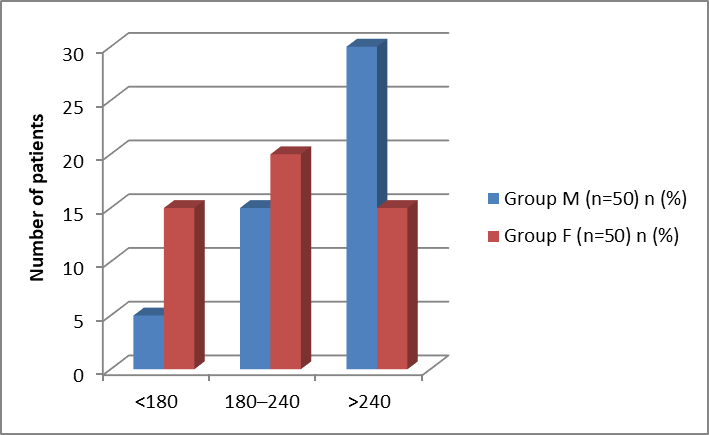
Figure 1 : Duration of Analgesia
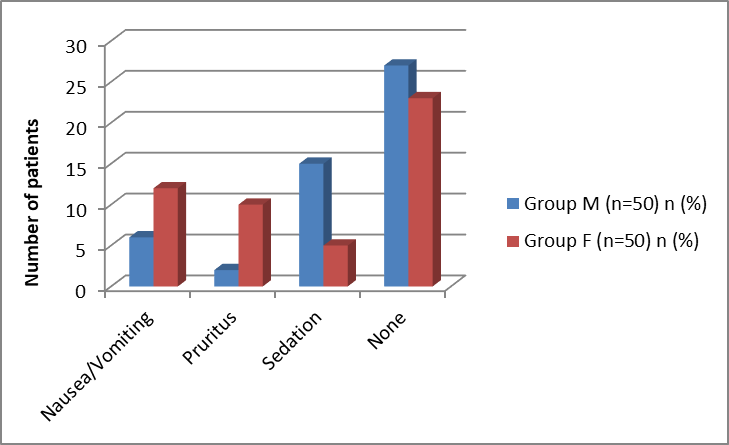
Figure 2 : Incidence of Adverse Effects
In the present study, a total of 100 patients were included and equally divided into two groups, Group M (n=50) and Group F (n=50). In Group M, 10 patients (20%) were in the age group of 18–30 years, 14 patients (28%) were in 31–40 years, 16 patients (32%) were in 41–50 years, and 10 patients (20%) were in 51–60 years. In Group F, 12 patients (24%) were in the age group of 18–30 years, 13 patients (26%) were in 31–40 years, 15 patients (30%) were in 41–50 years, and 10 patients (20%) were in 51–60 years.The comparison of age distribution between the two groups showed no statistically significant difference, with a p-value of 0.94.
In the present study, a total of 100 patients were included and divided equally into two groups, Group M (n=50) and Group F (n=50). In Group M, 28 patients (56%) were male and 22 patients (44%) were female. In Group F, 30 patients (60%) were male and 20 patients (40%) were female.On comparison of gender distribution between the two groups, the difference was found to be statistically not significant with a p-value of 0.68.
In the present study, a total of 100 patients were enrolled and equally divided into two groups, Group M (n=50) and Group F (n=50). In Group M, 32 patients (64%) were classified as ASA Grade I and 18 patients (36%) were classified as ASA Grade II. In Group F, 30 patients (60%) were ASA Grade I and 20 patients (40%) were ASA Grade II.On comparison of ASA physical status between the two groups, the difference was found to be statistically not significant with a p-value of 0.67.
In the present study, a total of 100 patients were included and equally divided into two groups, Group M (n=50) and Group F (n=50). In Group M, 5 patients (10%) had duration of analgesia less than 180 minutes, 15 patients (30%) had duration between 180–240 minutes, and 30 patients (60%) had duration of analgesia more than 240 minutes. In Group F, 15 patients (30%) had duration of analgesia less than 180 minutes, 20 patients (40%) had duration between 180–240 minutes, and 15 patients (30%) had duration of analgesia more than 240 minutes.On comparison of duration of analgesia between the two groups, the difference was found to be statistically significant with a p-value of 0.01.
In the present study, a total of 100 patients were included and equally divided into two groups, Group M (n=50) and Group F (n=50). In Group M, nausea and vomiting were observed in 6 patients (12%), pruritus in 2 patients (4%), sedation in 15 patients (30%), while 27 patients (54%) had no adverse effects. In Group F, nausea and vomiting were observed in 12 patients (24%), pruritus in 10 patients (20%), sedation in 5 patients (10%), and 23 patients (46%) had no adverse effects.On comparison of adverse effects between the two groups, the difference was found to be statistically significant with a p-value of 0.02.
DISCUSSION:
In our study, the duration of analgesia was significantly longer in the midazolam group compared to the fentanyl group (p = 0.01). A higher proportion of patients in Group M experienced prolonged analgesia beyond 240 minutes. This finding is consistent with Clark F et al [11] , who demonstrated that intrathecal midazolam significantly prolongs postoperative analgesia when added to bupivacaine due to spinal GABA-A receptor-mediated mechanisms. Similar enhancement of analgesic duration with intrathecal adjuvants has also been supported by Bordoni B [12], who described spinal modulation of nociceptive pathways.
On the other hand, fentanyl showed a relatively shorter duration of analgesia but is known for rapid onset and better early postoperative pain relief. This is in agreement with AbdelMabood AM et al. [13], who reported that intrathecal fentanyl provides excellent early analgesia without significantly prolonging overall duration of spinal anesthesia. The role of opioids in improving early postoperative analgesia has also been highlighted by Bourgeois C [14], who noted that intrathecal opioids enhance immediate pain control but may require earlier rescue analgesia.
In the present study, adverse effects were significantly higher in the fentanyl group (p = 0.02), particularly nausea, vomiting, and pruritus, whereas sedation was more commonly observed in the midazolam group. Similar findings were reported by Luong NV et al. [15], who observed increased opioid-related side effects with intrathecal fentanyl. In contrast, Ho KM [16] demonstrated that intrathecal midazolam produces mild sedation without significant respiratory depression.
The present findings are also supported by Vincenzi P [17], who emphasized the importance of multimodal analgesia in improving postoperative recovery and reducing opioid-related adverse effects. Furthermore, Rahman MH et al. [18] highlighted that intrathecal adjuvants enhance the quality and duration of spinal anesthesia. The use of spinal anesthesia in abdominal surgery, including cholecystectomy, has been shown to be safe and effective by Hossain MJ et al. (2008) [19], with improved postoperative outcomes.
CONCLUSION:
In the present study, both intrathecal midazolam and fentanyl when used as adjuvants to 0.5% hyperbaric bupivacaine were found to be effective in providing adequate surgical anesthesia for elective cholecystectomy. However, intrathecal midazolam was associated with a significantly longer duration of postoperative analgesia compared to fentanyl, whereas fentanyl provided faster onset and better early postoperative pain control.
The incidence of adverse effects was comparatively higher in the fentanyl group, particularly nausea, vomiting, and pruritus, while sedation was more commonly observed with midazolam, without any clinically significant respiratory depression. Hemodynamic parameters remained stable and comparable in both groups.
Thus, intrathecal midazolam appears to be a better alternative for prolonging postoperative analgesia with a more favorable side effect profile, while fentanyl may be preferred when rapid onset and early analgesia are the primary requirements. The choice of adjuvant should therefore be individualized based on clinical priorities and patient factors.
REFERENCES:
1. Kehlet H, Dahl JB. Anaesthesia, surgery, and challenges in postoperative recovery. Lancet. 2003;362(9399):1921–8.
2. Miller RD, Cohen NH, Eriksson LI, Fleisher LA, Wiener-Kronish JP, Young WL. Miller’s Anesthesia. 8th ed. Philadelphia: Elsevier; 2015.
3. Yaksh TL, Rudy TA. Analgesia mediated by a direct spinal action of narcotics. Science. 1976;192(4246):1357–8.
4. Ben-David B, Solomon E, Levin H, Admoni H, Goldik Z. Intrathecal fentanyl with small-dose dilute bupivacaine: better anesthesia without prolonging recovery. Anesth Analg. 1997;85(3):560–5.
5. Palmer CM. Continuous spinal anesthesia and analgesia in obstetrics. Anesth Analg. 2010;111(6):1476–9.
6. Goodchild CS, Noble J. The effects of intrathecal midazolam on sympathetic nervous system reflexes in man. Eur J Anaesthesiol. 1987;4(5):351–7.
7. Bharti N, Madan R, Mohanty PR, Kaul HL. Intrathecal midazolam added to bupivacaine improves postoperative analgesia. Br J Anaesth. 2003;91(5):760–3.
8. Kim MH, Lee YM. Intrathecal midazolam increases the analgesic effects of spinal blockade. Anesth Analg. 2001;93(3):730–4.
9. Gupta R, Verma R, Bogra J, Kohli M, Raman R, Kushwaha JK. A comparative study of intrathecal midazolam and fentanyl. J Anaesthesiol Clin Pharmacol. 2012;28(3):349–52.
10. Tzovaras G, Fafoulakis F, Pratsas K, Georgopoulou S, Stamatiou G, Hatzitheofilou C. Spinal vs general anesthesia for laparoscopic cholecystectomy. Surg Endosc. 2008;22(3):833–7.
11. Clark F, Gilbert HC. Regional analgesia in the intensive care unit: Principles and practice. Critical care clinics. 2001 Oct 1;17(4):943-66.
12. Bordoni B. Post cholecystectomy pain syndrome: Letter to Editor. Scandinavian Journal of Pain. 2024 Mar 7;24(1):20240001.
13. AbdelMabood AM, Gadallah AS, Mohamed OE, Esmail NS, Hasan AH. Comparative Study between Intrathecal (Dexmedetomidine versus Fentanyl) in Laparoscopic Cholecystectomies under Spinal Anesthesia. Egyptian Journal of Hospital Medicine. 2025 Jul 1(100).
14. Bourgeois C, Oyaert L, Van de Velde M, Pogatzki-Zahn E, Freys SM, Sauter AR, Joshi GP, Dewinter G. Pain management after laparoscopic cholecystectomy: a systematic review and procedure-specific postoperative pain management (PROSPECT) recommendations. European Journal of Anaesthesiology| EJA. 2024 Nov 1;41(11):841-55.
15. Luong NV. Evaluation of efficacy of free opioid anesthesia for laparoscopic cholecystectomy: a prospective, randomized double-blinded study. The Open Anesthesia Journal. 2020 Sep 14;14(1).
16. Ho KM, Ismail H. Use of intrathecal midazolam to improve perioperative analgesia: a meta-analysis. Anaesthesia and intensive care. 2008 May;36(3):365-73.
17. Vincenzi P, Stronati M, Garelli P, Gaudenzi D, Boccoli G, Starnari R. Segmental thoracic spinal anesthesia for laparoscopic cholecystectomy with the “hypobaric” technique: a case series. Local and Regional Anesthesia. 2023 Dec 31:31-40.
18. Rahman MH. Laparoscopic Cholecystectomy Outcomes Under Spinal-Epidural and General Anesthesia: A Prospective Randomized Trial. Saudi J Med Pharm Sci. 2025;11(4):252-6.
19. Hossain MJ, Islam MR, Anwar MM, Rahman MZ, Salim M, Islam MS, Al I. Outcomes and Complications of Spinal Anesthesia in Laparoscopic Cholecystectomy: A Prospective Study. Frontiers in Health Informatics. 2024 Dec 1;13(8).