Maternal and Early Neonatal Outcomes Following Laparoscopic vs. Open Appendectomy in Advanced Gestation: A Prospective Tri-Departmental Observational Study
- Muntakhab ul Nafae , Assistant Professor, Department of General Surgery, Madhubani Medical College, Madhubani, Bihar
- Shahira Wani , Lecturer, Department of Obstetrics & Gynecology, L.D Hospital, Government Medical College, Srinagar
- Nissar Ahmed Reshi , Consultant Paediatrics, JLNM Hospital, Srinagar.
Article Information:
Abstract:
Background: Acute appendicitis is the most common non-obstetric surgical emergency during pregnancy.In advanced gestation (second/third trimesters), LA faces resistance due to a reduced surgical field. Aims and Objective: Appendectomy is the most common cause of non-obstetric surgery in pregnant women. Our aim was to compare the clinical characteristics, peri-and post-operative data of pregnant women undergoing either laparoscopic appendectomy (LA) or open appendectomy (OA). Material and Methods: This prospective study compares maternal and neonatal safety outcomes for laparoscopic versus open appendectomy in the second and third trimesters, focusing on patients with acute appendicitis in Madhubani Medical College& Hospital, Madhubani, Bihar, with the combined role of surgeons and Pediatrician from June 2024 to March 2025 (10 months) after the approval from the ethical committee of the college. Results: The study included 44 patients, divided to two groups -11 - LA and 33– OA. One perioperative complication of intra-abdominal abscess was noted in the OA group. However, the LA group had shorter hospital stay (2.85±2.32 vs. 3.87±3.28, p=0.003), earlier mobilization time (7.5±1.9 vs. 9.8±1.3, p=0.024), and shorter time to first flatus (2.2±0.2 vs. 4.6±1.3, p=0.028) as compared to the OA group. The OA group had statistically shorter operation time than the LA group (36.86±10.3 vs. 46.36±10.27, p=0.005).There were no significant differences in demographic characteristics of the studied population. Conclusion: LA is related to shorter hospital stay, faster return to daily activities, and shorter time to first flatus. LA appears to be as safe and effective as OA in pregnant patients without increasing adverse perinatal outcomes.
Keywords:
Article :
INTRODUCTION:
Abdominal pain during pregnancy can be caused by wide variety of obstetric and non-obstetric pathology that makes diagnosis of acute appendicitis during pregnancy is a quiet challenging problem. Limitation of CT scanning, anatomical and physiological changes during pregnancy like physiological leukocytosis that could be associated with pregnancy is also a contributing factor for difficult diagnosis [1-3]. The most common non-obstetric cause for abdominal pain is acute appendicitis which has an incidence of 1 in 1500 pregnancy which is similar to the incidence in non-pregnant population [4,5]. It has been reported that maternal morbidity in acute appendicitis without perforation is 17% compared with 52% with perforation while fetal mortality in non-complicated appendicitis is 7% compared with 24% in cases with complicated appendicitis. [6-8]. In general, laparoscopic appendectomy is considered nowadays as the standard technique for treating acute appendicitis but this can be stated for non-pregnant women as in pregnant women doing laparoscopic appendectomy still having debates about its safety for both fetus and mother [9,10].
AIM AND OBJECTIVES
Appendectomy is the most common cause of non-obstetric surgery in pregnant women. Our aim was to compare the clinical characteristics, peri-and post-operative data of pregnant women undergoing either laparoscopic appendectomy (LA) or open appendectomy (OA).
MATERIALS AND METHODS:
This retrospective study aims to compare LA and LAA procedures performed on pregnant women with pre-diagnosis of appendicitis who were admitted Paediatrics, General surgery and department of OBG, at Madhubani Medical College & Hospital Madhubani, Bihar between June 2024 to March 2025, after the approval from the ethical committee of the college. A total of 44 patients (11 laparoscopic, 33 laparotomy) were included in the study. The study data were obtained and Patients diagnosed with acute appendicitis during pregnancy and treated with either laparoscopic or laparotomy methods were included in the study. Clinical symptoms (pain in the right lower quadrant, nausea/vomiting), laboratory findings (leukocytosis, elevated CRP), and imaging techniques (mostly ultrasound; magnetic resonance imaging was utilized when ultrasound was unclear) were used to make the diagnosis. Intra-operatively, the degree of appendicitis was classified as either complex (perforated, gangrenous, or with peri-appendicular abscess) or simple (non-perforated, non-gangrenous). The surgical strategy and postoperative care were chosen in part because of this rating. Patients whose gestational age was between 04 and 34 weeks, who underwent appendectomy and whose clinical data were available were included in the study. Patients with pregnancy complications (such as eclampsia, preeclampsia, and intrauterine growth retardation) were not included in the study.Demographic characteristics include age and gestational age. As operational parameters; diagnostic method, surgical approach (laparoscopic or laparotomy), duration of surgery, intraoperative and postoperative complications, postoperative hemoglobin decrease, postoperative hospitalization period were examined.In addition, parameters such as postoperative fetal outcomes; birth week, preterm birth rate, 1st and 5th Apgar scores of babies after birth and birth weights of babies were recorded separately for both groups.The operations in our study were performed by 2 different surgeons and the surgical technique for appendectomy was left to the surgeon’s preference. Written informed consent was obtained from all patients prior to surgery.
Surgical methods
Regardless of the surgical technique, endotracheal intubation and general anesthesia were utilized in every case.LA: under general anesthesia and endotracheal intubation, all patients having LA were placed in the supine position. Pneumo-peritoneum was created using an open (Hasson) method or a Veress needle, and intra-abdominal pressure was kept below 12 mm Hg. Trocars (5 mm and 10 mm) were usually put in 3 to 4 locations: 1 at the umbilicus (camera port), 1 suprapubic, and 1 or 2 in the lower right quadrant for instrument access. After visualizing the appendix, the mesoappendix was tied off using clips or bipolar cautery, and the appendix was separated at the base using a stapler or endoloop. A specimen bag was used to retrieve the specimen. Under direct vision, trocars were removed after hemostasis was verified. Anatomical layers were used to seal the skin and abdominal wall.LAA: all patients who underwent LAA were operated under general anesthesia. In the right lower quadrant, a 5 to 7 cm incision was made (usually at McBurney site or using a modified Rocky-Davis method). The peritoneum was invaded after the subcutaneous tissue and fascia were removed. They located and moved the appendix. Absorbable sutures were used to clamp and ligate the mesoappendix. After dividing and ligating the appendix base, the stump was examined for contamination or bleeding. The peritoneal cavity was irrigated in cases of local abscess or perforation. If necessary, a drain was installed. The proper sutures were used to seal the layers of the abdomen.
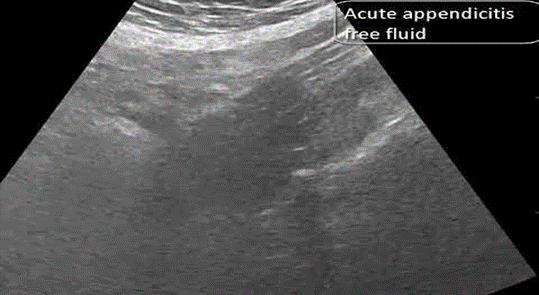
Acute Appendicitis - Free Fluid in USG
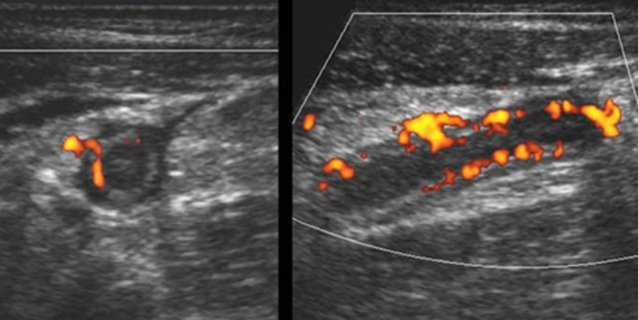
The Radiology: Appendicitis - US findings
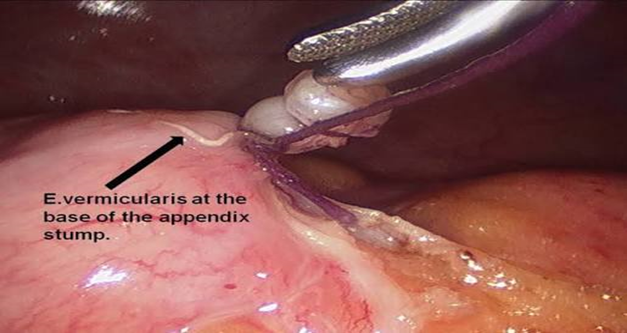
Intraoperative view demonstrating Enterobius vermicularis at the base of the appendix stump
INCLUSION &EXCLUSION CRITERIA:
Inclusion criteria required pregnant patients with acute appendicitis, age from 5 years to 55 years while exclusion criteria involved severe comorbidities, extensive abdominal surgery.Patients with pregnancy complications were not included in the study.
STATISTICAL ANALYSIS
Data was entered in MS excel and analyzed using SPSS version 17. Descriptive studies of mortalityand complications were analyzed and presented in terms of Percentages. Chi-Square Test was used to compare the proportion of death and complications between the groups.
RESULTS:
In this study, surgical and obstetric outcomes were evaluated in pregnant women who underwent LA or LAA with acute appendicitis diagnosis between June 2024 to March 2025 at Madhubani Medical College & Hospital.When the gestational age of the patients was compared during the operation, it was found to be 13.38 on average in the LA group and 22.46 on average in the LAA group, and a significant difference was observed between them.
The study included 44 patients, divided to two groups -11 - LA and 33 – OA. One perioperative complication of intra-abdominal abscess was noted in the OA group. However, the LA group had shorter hospital stay (2.85±2.32 vs. 3.87±3.28, p=0.003), earlier mobilization time (7.5±1.9 vs. 9.8±1.3, p=0.024), and shorter time to first flatus (2.2±0.2 vs. 4.6±1.3, p=0.028) as compared to the OA group. The OA group had statistically shorter operation time than the LA group (36.86±10.3 vs. 46.36±10.27, p=0.005). There were no significant differences in demographic characteristics of the studied population.
When the gravidanumbers of the patients included in the study were evaluated, there was no significant difference between the 2 groups (Table 1)
Table- 1: Demographic characteristics of the patients
|
LA |
LAA |
P-value |
|
|
Maternal age – mean (yrs.) |
22.43 |
26.48 |
0.333 |
|
Gestational age – mean (wks.) |
11.86 |
22.46 |
0.001 |
|
Gravida |
|||
|
1 |
6 |
15 |
0.176 |
|
2 |
3 |
7 |
|
|
3 |
1 |
9 |
|
|
4 |
0 |
2 |
|
|
5 |
1 |
0 |
Oncompressible, larger (>6 mm) tubular structure in the right lower quadrant with concomitant fat stranding or free fluid were among the ultrasonography findings suggestive of appendicitis. Pregnancy-related structural changes may result in a decreased appendix visualization rate.There was no significant difference between the LA and LAA groups in terms of maternal age, estimated postoperative blood loss, postoperative delivery weeks and 1st and 5th APGAR scores of the babies after birth. Although the average operation time and hospital stay in the LA group were shorter compared to the LAA group, the difference between them was not significant. When the rates of vaginal birth and cesarean section after appendectomy were examined, no significant difference was observed between the 2 groups. The most common diagnostic method for both groups was ultrasonography. No intraoperative complications were observed in either group. Three postoperative wound site infections were observed in the LA group. In the LAA group, 7 patients had wound site infection and 1 patient had postoperative abscess in the appendectomy area. Every wound infection was categorized as a superficial surgical site infection and treated conservatively with antibiotics and local wound care. There were no organ-space or deep infections found.
DISCUSSION:
In our study, we aimed to compare the maternal and fetal outcomes of laparoscopic and open appendectomy techniques in pregnant women who underwent surgery for acute appendicitis.The most striking result in our study was that no preterm labor was observed in the LA group. In the LAA group, 10 patients had preterm labor, which was found to be significantly different when the 2 groups were compared. This finding was found to be consistent with other studies showing that minimally invasive techniques reduce uterine inflammation and irritation, which are known risk factors for preterm labor [7,8]. In our study, fetal death was not observed in either group, and although concerns about the risks of Pneumo-peritoneum and fetal hypoxia during laparoscopy have been reported, this supports the evidence that LA does not increase fetal morbidity when the operation is performed with the necessary precautions [9]. No significant difference was found in the 2 groups in terms of intraoperative and postoperative complications. Although these findings contradict the study suggesting that wound infection rates increase in open surgery, our patient population may not have been large enough to detect subtle differences [10]. Although the patients in the LA group were operated on at significantly earlier gestational weeks than the LAA group (P: .001), we see that this situation did not significantly affect the Apgar score, gestational week, and birth weight between the 2 groups. This situation is consistent with studies supporting minimally invasive approaches even in the1st trimester [7]. Our study has some limitations. Since we mostly prefer open surgery after a certain gestational week in our center, we think that an earlier gestational week was observed in the LA group. In addition, our relatively small sample size (n: 11), especially in the LA group, reduces the power of analysis.
CONCLUSION:
In light of the data obtained in this study, it was observed that LA was associated with similar obstetric outcomes and complication rates compared to open appendectomy. Frequent preference of laparoscopic surgery in early weeks of pregnancy may reduce the rate of preterm birth without increasing the risk of fetal loss. However, randomized controlled studies are needed in this regard to evaluate long-term neonatal outcomes.
REFERENCES:
1. Pearl J, Price R, Richardson W. Guidelines for diagnosis, treatment, and use of laparoscopy for surgical problems during pregnancy. Surg Endosc. 2011;25:3479-92.
2. McGory ML, Zingmond DS, Tillou A. Negative appendectomy in pregnant women is associated with a substantial risk of fetal loss. J Am Coll Surg. 2007;205:534-40.
3. Yilmaz HG, Akgun Y, Bac B. Acute appendicitis in pregnancy - risk factors associated with principal outcomes: a case control study. Int J Surg. 2007;5:192-7.
4. Cox TC, Huntington CR, Blair LJ. Laparoscopic appendectomy and cholecystectomy versus open: a study in 1999 pregnant patients. Surg Endosc. 2016;30:593-602.
5. Corneille MG, Gallup TM, Bening T. The use of laparoscopic surgery in pregnancy: evaluation of safety and efficacy. Am J Surg. 2010;200:363-7.
6. Sadot E, Telem DA, Arora M. Laparoscopy: a safe approach to appendicitis during pregnancy. Surg Endosc. 2010;24:383-9.
7. Thomson JE, Kruger D, Jann-Kruger C. Laparoscopic versus open surgery for complicated appendicitis: a randomized controlled trial to prove safety. Surg Endosc. 2015;29:2027-32.
8. Cheng HT, Wang YC, Lo HC. Laparoscopic appendectomy versus open appendectomy in pregnancy: a population-based analysis of maternal outcome. Surg Endosc. 2015;29:1394-9.
9. Lemieux P, Rheaume P, Levesque I. Laparoscopic appendectomy in pregnant patients: a review of 45 cases. Surg Endosc. 2009;23:1701-5.
10. Eom JM, Hong JH, Jeon SW. Safety and clinical efficacy of laparoscopic appendectomy for pregnant women with acute appendicitis. Ann Acad Med Singapore. 2012;41:82-6.