Study on Blood Donor Profile in a District Hospital, Rajkot, Western India: A One-Year Study.
- Vatsal Mistry , Second Year Resident, Department of Pathology, PDU Medical College & Hospital, Rajkot, India
- Amit Agravat , Professor, Department of Pathology, PDU Medical College & Hospital, Rajkot, India
- Krupal Pujara , Assistant Professor, Department of Pathology, PDU Medical College & Hospital, Rajkot, India Professor and Head, Department of Pathology, PDU Medical College & Hospital, Rajkot, India.
- Gauravi Dhruva , Professor and Head, Department of Pathology, PDU Medical College & Hospital, Rajkot, India.
Article Information:
Abstract:
Background: Blood donors are the backbone of every blood transfusion service. Analysis of donor demographics and donation patterns helps blood centres plan recruitment strategies, improve donor retention, and ensure an adequate supply of safe blood. Previous Indian studies have shown that donor populations are predominantly young males and that voluntary blood donation is increasing. Aim: To study the demographic profile and donation characteristics of blood donors attending a district hospital, Rajkot, Western India over one year. Materials and Methods: A study was conducted at the Blood Centre of District Hospital, Rajkot, western India. Records of all eligible blood donors from 1 May 2025 to 30 April 2026 were reviewed. Information regarding age, sex, type of donor, ABO and Rh blood groupsand place of donation (in-house/camp) was collected. Data were entered into Microsoft Excel and analyzed using descriptive statistics. Results: A total of 21542 blood donations were recorded during the study period. The majority of donors belonged to the 18–30-year age group. Male donors constituted the majority of donations. 100% donors were voluntary donors. B positive was the commonest blood group, followed by O positive. Rh-positive blood groups accounted for the vast majority of donations. Conclusion: Young adult males constituted the largest proportion of blood donors. Increasing female participation and promoting repeat voluntary blood donation can further strengthen the blood supply at district hospitals.
Keywords:
Article :
INTRODUCTION:
Blood transfusion is an indispensable component of modern healthcare. The availability of safe blood depends on regular voluntary donations from healthy individuals. Blood donor profiling helps evaluate demographic characteristics, blood group distribution, and donation trends, thereby assisting blood centres in planning donor recruitment and inventory management.
District hospital blood centres cater to rural and semi-urban populations and often differ from tertiary care centres regarding donor characteristics. Knowledge of the donor profile is useful for developing targeted awareness programmes and improving voluntary blood donation.
Therefore, the present study was undertaken to evaluate the demographic profile of blood donors attending a district hospital blood centre over one year.
Objectives
Primary Objective-
To study the demographic profile of blood donors attending the district hospital blood centre.
Secondary Objectives
To determine age and gender distribution.
To evaluate ABO and Rh blood group distribution.
To study in-house versus outdoor camp donations (if applicable).
MATERIALS AND METHODS:
A study was carried out in district hospital, Rajkot, Western India, from 1st May 2025 to 30th April 2026. The Study Population included records ofall eligible blood donors who donated blood during the study period.
Inclusion Criteria
All successful whole blood donations during the study period.
Exclusion Criteria
Incomplete donor records.
Deferred donors.
Data Collection
Data were retrieved from:
Blood donor registration records
Blood bank software
Blood donor questionnaire
Variables Studied
Age
Gender
ABO blood group
Rh blood group
Place of donation (blood bank/outdoor camp)
Informed consent
Informed consent was obtained from all blood donors prior to blood donation according to institutional blood bank protocols.
RESULTS:
The study was carried out in Blood Centre, PDU Medical College and Civil Hospital, Rajkot, Western India, regarding the profiles of donors which showed the following results.
The age wise distribution of blood donors in our study showed a higher percentage of donors belonged to 18-30 years age group, followed by 31-40 years age group.
Table 1. Age-wise Distribution of Blood Donors
|
Age Group (Years) |
Number of blood donors |
Percentage% |
|
18–30 |
7539 |
35% |
|
31–40 |
6033 |
28% |
|
41–50 |
5385 |
25% |
|
51–60 |
2585 |
12% |
|
Total |
21542 |
100% |
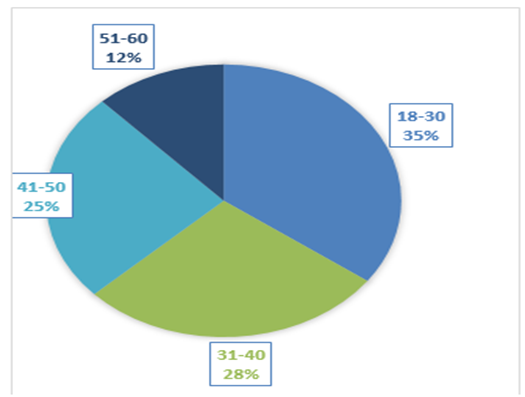
Graphical Representation of age wise distribution of blood donors.
In our study, there was a very high percentage of male donors (94.52%) compared to female donors(5.48%). It may be due to factors which caused deferral among females such as low Hemoglobin among females, period of menstruation coinciding with time of donation, females who are breastfeeding their children or they are on certain medications.
Table 2. Gender wise Distribution of blood donors
|
Gender |
Number of blood donors |
Percentage |
|
Male |
20362 |
94.52% |
|
Female |
1180 |
5.48% |
|
Total |
21542 |
100% |
Our study showed that majority of the blood donors had B positive blood group(34%) followed by O positive blood group(31%). The percentage of Rh negative blood group donors in our study was very low which is comparable to other similar studies carried out.
Table 3 :ABO and Rh Blood Group Distribution of Blood Donors
|
Blood Group |
Number of blood donors |
Percentage |
|
A+ |
4488 |
21% |
|
A− |
286 |
1.5% |
|
B+ |
7316 |
34% |
|
B− |
478 |
2% |
|
AB+ |
1739 |
8% |
|
AB− |
103 |
0.5% |
|
O+ |
6669 |
31% |
|
O− |
463 |
2% |
|
Total |
21542 |
100% |
DISCUSSION:
The present study evaluated the demographic profile of blood donors attending a district hospital blood centre. Young adults (18-30 years) constituted the largest donor population, which is comparable toPatel PA et al(23.94%),Kumar R(58%) et al, Usha S et al(54.54%),Shah et al(61.46%) which were carried out in western India.
Comparative studies of age wise distribution of blood donors
|
Study |
Region |
Year |
Major age group among blood doors |
|
Present Study |
Rajkot , Western India |
2026 |
18-30 Years (35%) |
|
Patel PA et al |
Ahmedabad, Western India |
2015 |
21-25 Years (23.94%) |
|
Usha et al |
Karnataka |
2015 |
18-24 Years (54.54%) |
|
Shah et al |
Dahod, Gujarat |
2022 |
18-24 Years(61.46%) |
Male donors predominated over female donors. This finding has been consistently reported in Indian studies and may be attributed to a higher prevalence of anaemia among women, lower body weight, and sociocultural factors.Our study results were comparable to Patel PA et al (95.48%), Shah SK, et al(92.42%), Kadam SS, et al(89%)
Comparative studies of gender wise distribution of blood donors
|
Study |
Region |
Year |
Gender wise distribution among blood doors |
|
Present Study |
Rajkot , Western India |
2026 |
Male-94.52% Female-5.48% |
|
Patel PA et al |
Ahmedabad, Western India |
2015 |
Male-95.48% Female-4.52% |
|
Kadam SS, et al |
Mumbai, India |
2015 |
Male-89% Female-11% |
|
Shah et al |
Dahod, Gujarat |
2022 |
Male-92.42% Female-7.58% |
Voluntary blood donation formed the major proportion of donations, indicating improved public awareness regarding voluntary blood donation. Repeat donors remain an important source of safe blood because they generally have lower rates of transfusion-transmitted infections.
The most common blood group observed was expected to be B positive, followed by O positive, which is similar to reports from several regions of India.
Table: Comparative studies with this study
|
Study |
Place |
No donors. studied |
ABO blood group |
Rh blood group |
||||
|
A |
B |
AB |
O |
Rh D Positive |
Rh D Negative |
|||
|
Present study |
Rajkot, Western India 2026 |
21,542 |
22.1 |
36.1 |
8.5 |
33.1 |
93.8 |
6.2 |
|
Periyavan et al |
Bengaluru, Karnataka, 2010 |
36,964 |
23.9 |
29.9 |
6.4 |
39.8 |
94.2 |
5.8 |
|
Das et al |
Vellore, Tamil Nadu, 2001 |
150,536 |
21.8 |
32.7 |
6.7 |
38.8 |
94.5 |
5.5 |
|
Mallikarjuna et al |
Davanagere, Karnataka 2012 |
19,413 |
26.1 |
29.9 |
7.2 |
36.8 |
94.5 |
5.5 |
|
Chandra et al |
Lucknow, Uttar Pradesh, 2012 |
1,40,320 |
21.7 |
39.8 |
9.3 |
29.1 |
95.7 |
4.3 |
|
Sidhu et al |
Punjab, 2003 |
1,150 |
21.9 |
37.6 |
9.3 |
31.2 |
97.3 |
2.7 |
|
Patel et al |
Western Ahmedabad, Gujarat, 2015 |
5,316 |
21.9 |
39.4 |
7.9 |
30.8 |
95.1 |
4.9 |
|
Wadhwa et al |
eastern Ahmedabad, Gujarat, 1998 |
ND |
23.3 |
35.5 |
8.8 |
32.5 |
94.2 |
5.8 |
|
Gupta et al |
Indore, Madhya Pradesh, 2012 |
17080 |
24.2 |
35.2 |
9.1 |
31.5 |
95.4 |
4.6 |
|
Naga et al |
Durgapur, West Bengal, 2012 |
3850 |
23.9 |
33.6 |
7.7 |
34.8 |
94.7 |
5.3 |
|
Studies from Other parts |
||||||||
|
Anees et al |
Punjab, Pakistan, 2007 |
2542 |
34 |
29 |
4 |
33 |
96.7 |
3.3 |
|
Pramanik et al |
Kathmandu, Nepal, 2000 |
120 |
26.2 |
22 |
4.4 |
47.5 |
80.3 |
19.7 |
|
Lyco et al |
Nairobi, Kenya, 1992 |
38898 |
20 |
32.2 |
6.1 |
41.7 |
92.8 |
7.2 |
Table shows that Frequency of A B O blood groups of the present study was compared to the studies done at at Punjab by Sidhu et al at Ahmedabad by Patel PA et al ,Lucknow by Chandra et al , and Wadhwa MK et al and at Indore by Gupta H et al. In all these studies predominant blood group was `B ‘which was followed by O, A and AB On the other hand, studies were done at ShimogaMalnad by, at Bangalore by Periyavan A et al , Mallikarjuna et al, Girish CJ et al, Das et al , and at Durgapur by Nag I et al , the commonest A B O blood group was ‘O ‘which is in contrast to present study where B is the most common A B O blood group
In other countries of the world, like in Pramanik et al in Kathmandu, Nepal, in Pakistan by Anees et al, Lyco et al in Nairobi, Kenya, showed that the blood group O was highly frequent which contrasts with our presence study.
CONCLUSION:
The donor population in the district hospital blood centre predominantly comprised young male voluntary donors. Efforts should focus on increasing female participation, encouraging repeat voluntary donation, and organizing regular awareness programmes and blood donation camps to ensure a safe and adequate blood supply.
REFERENCES:
1. World Health Organization. Blood safety and availability.
2. National Blood Transfusion Council. National Standards for Blood Centres.
3. National AIDS Control Organization. Guidelines for Blood Centres.
4. Parveen K, Khan AF, Khan AS. Int J Res Med Sci. 2021.
5. Singh AK, et al. Bioinformation. 2025.
6. Rajendra N, Prashanth MV. Trop J Pathol Microbiol. 2017.
7. 7 Mitra R, Mishra N, Rath G P. Blood group system. Indian J Anaesth 2014; 58:524-8.
8. E. Smart Et al., Armstrong Blood Group Systems, ISBT Science series (2008)3,68-92
9. Suresh et al Distribution of ABO and rhesus (D) blood group antigens among blood donors at a tertiary care teaching hospital blood bank in south India. CLIN Sci Res.2015; 4:129-35.
10. Trupti Barot, Disha Patel, Ripal Shah Distribution of ABO and Rhesus (Rh) blood Group among Voluntary Blood DONORS in Central Gujarat, India. International Journal of Contemporary Medical Research volume 7/Issue7/July 2020,2454-7379.
11. Rajesh Kumar et al ‘A study of distribution of ABO and Rh Blood Group system among blood donors at a Tertiary care hospital. Journal of Evolution Medical and Dental Sciences 2015; Vol. 4, Issue 18, March 02; Pages 3138-3142, DOI 10.14260/jemds/2015/454
12. Joy John Mammen et al, The clinical demand and supply of blood in India: A National level estimation study, PLoS ONE 17(4): e0265951.
13. Khan MS, Subhan F, Tahir F et al Prevalence of blood groups and Rh Factor in Bannu region NWFP (Pakistan). Pak J Med Res.2004(1)8-10
14. Periyavan A, Sangeetha SK et al. Distribution of ABO and Rhesus-D, groups in and around Bangalore.Asian J Transfusion Sci 2010;4:41.
15. Das PK, Nair SC, Harris VK et al Distribution of ABO and Rh -D blood groups among blood donors in a tertiary care center in south India. Trop Doct 2001; 31:47-8
16. Mallikarjuna Swamy MC, Basavaraj BP, Kavitha UG, Shashikala Prevalence of ABO and Rhesus blood group among blood donors. Indian J Pub Health Res Dev 2012:3:106-9
17. Girish CJ, Chandrashekhar TN, Ramesh Babu K, Kantikar SM.ABO AND Rhesus blood groups among blood donors. Indian J Pub Health Res Dev 2012:3:106-9
18. Chandra T, Gupta A. Frequency of ABO and rhesus blood groups in blood donors. Asian J Transfusion Sci 2012; 6:52-3
19. Sidhu S. Distribution of the ABO Blood Groups and Rh (D)factor among the Scheduled Caste population Of Punjab. Anthropologist 2003; 5:203-4
20. Patel PA, Patel SP, Shah JV, Oza HV. Frequency and distribution of blood groups in blood donors in western Ahmedabad –a hospital-based study. Natl J Med Res 2012; 2:202-6.
21. Wadhwa MK, Patel SM, Kothari DC, Pandey M, Patel DD. Distribution of ABO and Rhesus D groups in Gujarat, India –a hospital-based study. Indian J PedOncol 1998; 19:137-41.
22. Gupta NK, Dadwal S. Distribution of ABO and Rhesus blood groups. Asian J Transfus Sci 2012; 6:73-4.
23. Nag I, Das SS.ABO and Rhesus blood groups in potential blood donors at Durgapur Steel city of the district of Burdwan, West Bengal. Asian J Transfusion Sci 2012:6:54-5.
24. Anees M, Jawad A, Hashmi I. Distribution of ABO and Rh blood group alleles in Mandi Bahadduin district of Punjab, Pakistan. Roc Pakistan Acad Sci2007:44:289-94.
25. Pramanik T, Pramanik S, Distribution of ABO and Rh Blood groups in Nepalese medical students: a report. East Mediterr Health J2000; 6:156-8.
26. Lyco J, Gaertner H, Kaviti JN, Kariithi MW, Akoto B. Blood –group systems ABO and Rh in the Kenyan population. Folia Med Cracov 1992; 33:85-92.