Malignant Otitis Externa in Diabetes Mellitus: A Systematic Review of Clinical Outcomes and Complications.
- Ashutosh Mishra , Head of the Department, Emergency Medicine, Base Hospital Delhi Cantt, India,
- Karthik Sajeev , Consultant, Department of ENT, Upasana Hospital & Research Center, Kollam, Kerala, India.
- Sankar P , Assistant Professor, Department of Biochemistry, PES Institute of Medical Sciences and Research (PES IMSR), Kuppam, Chittoor District, Andhra Pradesh - 517425, India.
Article Information:
Abstract:
Background: Malignant otitis externa, increasingly termed necrotizing otitis externa, is an invasive infection originating in the external auditory canal that may progress to temporal-bone and skull-base osteomyelitis, cranial neuropathy, intracranial extension, sepsis, and death. Diabetes mellitus is the most frequently reported predisposing condition. Despite major advances in antipseudomonal therapy, imaging, glycemic management, and multidisciplinary care, clinical outcomes remain heterogeneous. Objective: To systematically review clinical outcomes of malignant otitis externa among patients with diabetes, with particular emphasis on treatment response, mortality, cranial nerve complications, recurrence, hospitalization, microbiology, disease extension, and factors associated with adverse outcome. Methods: A systematic review was structured according to PRISMA 2020 principles. MEDLINE/PubMed, Embase, Scopus, Web of Science, and Cochrane CENTRAL were considered together with citation and reference-list searching. Primary studies evaluating malignant or necrotizing otitis externa in adults with diabetes, or cohorts in which diabetic outcomes were separately reported or diabetes represented the predominant risk condition, were eligible. Search identified 1,284 records. After removal of 276 duplicates, 1,008 records underwent title and abstract screening. Full texts of 135 reports were assessed, and 15 primary studies were retained for qualitative synthesis. Meta-analysis was not performed because of substantial heterogeneity in diagnostic criteria, disease severity, microbiology, treatment protocols, follow-up, and outcome definitions. Results: Diabetes was highly prevalent across included cohorts and was universal in several case series. Clinical resolution following prolonged antimicrobial treatment varied according to disease severity. In a Singapore series, 63.2% achieved resolution after six weeks of treatment and mortality was 21.1%, whereas a large US multi-institutional cohort reported in-hospital mortality of 2.5%. A separate US inpatient analysis found diabetes associated with longer hospitalization and greater comorbidity burden but not independently with increased in-hospital mortality. Advanced disease features - including skull-base osteomyelitis, intracranial extension, clival involvement, multiple cranial neuropathies, sepsis, anemia, ischemic heart disease, and extensive radiological disease - were more consistently associated with poor outcome than diabetes alone. Pseudomonas aeruginosa remained the principal pathogen, although fungal disease, culture-negative infection, resistant Pseudomonas, and non-pseudomonal bacteria were increasingly reported. Conclusion: Diabetes strongly predisposes to malignant otitis externa and contributes to treatment complexity, prolonged hospitalization, and impaired host defense, but poor clinical outcome is primarily determined by the severity and extent of infection, neurological complications, systemic comorbidity, microbiological profile, and adequacy of treatment. Early diagnosis, culture-directed prolonged antimicrobial therapy, effective glycemic control, serial inflammatory-marker assessment, and appropriate imaging are central to improving outcomes.
Keywords:
Article :
INTRODUCTION:
Malignant otitis externa (MOE), also termed necrotizing otitis externa (NOE), is an aggressive infection that begins in the external auditory canal and may extend through soft-tissue planes to involve the temporal bone and skull base. The term “malignant” reflects the historically aggressive clinical course rather than neoplastic biology. The disease classically affects older adults with diabetes mellitus, although it can also occur in other immunocompromised populations and, less commonly, in individuals without recognized immune dysfunction.
Diabetes has remained central to the epidemiology of MOE since the earliest descriptions of the disease. Proposed mechanisms include diabetic microangiopathy, impaired tissue perfusion, neutrophil and leukocyte dysfunction, reduced chemotaxis and phagocytosis, hyperglycemia-associated immune dysfunction, and altered external auditory canal conditions that favor pathogenic bacterial proliferation. Poor glycemic control may additionally impair wound healing and reduce the host response to persistent osteomyelitis.
The strong relationship between diabetes and MOE is supported by both institutional and population-based evidence. A 2023 systematic review of African MOE studies reported diabetes in approximately 94% of patients and a pooled glycated hemoglobin level of 9.8%, illustrating the dominance of poorly controlled diabetes in many clinical populations. The same review reported a pooled antimicrobial cure rate of 76.2%. [1]
The clinical presentation usually includes persistent severe otalgia, often disproportionate to otoscopic findings, purulent otorrhea, external auditory canal edema, granulation tissue, hearing impairment, and failure to respond to conventional topical therapy. Progression beyond the external canal may result in temporal-bone or skull-base osteomyelitis, facial nerve palsy, lower cranial nerve dysfunction, dysphagia, aspiration, cavernous or dural sinus involvement, vascular thrombosis, meningitis, intracranial abscess, and death.
Pseudomonas aeruginosa has historically been regarded as the principal causative organism. However, the microbiological spectrum has changed with increasing reports of resistant Pseudomonas, Staphylococcus aureus, Klebsiella species, and fungal organisms including Aspergillus. Culture-negative disease is also clinically important, especially after previous antibiotic exposure.
Antimicrobial treatment has transformed the prognosis of MOE. Mortality was extremely high before effective antipseudomonal treatment became available. Contemporary series show much lower inpatient mortality, although long-term and disease-specific mortality remain clinically important in advanced disease. A 2025 meta-analysis of 22 studies involving more than 9,000 patients estimated pooled mortality at 18%, but heterogeneity was extreme, reflecting differences in populations, periods of treatment, and study designs. [2]
The relationship between diabetes and clinical outcome is complex. Diabetes clearly increases susceptibility to MOE and may prolong treatment or hospitalization, but several studies suggest that mortality is more strongly determined by age, systemic comorbidity, skull-base extension, intracranial complications, sepsis, and multiple cranial nerve involvement than by diabetes alone.
The present systematic review therefore evaluates clinical outcomes of MOE specifically from the perspective of patients with diabetes, synthesizing evidence relating to treatment response, survival, recurrence, cranial neuropathy, hospitalization, microbiology, disease severity, and prognostic factors.
Aim and Objectives
The primary aim was to systematically evaluate clinical outcomes of malignant or necrotizing otitis externa among patients with diabetes mellitus.
• Clinical resolution and treatment success
• In-hospital, disease-specific, and longer-term mortality
• Cranial nerve involvement and neurological recovery
• Recurrence and persistent infection
• Length of hospital stay
• Microbiological patterns and antimicrobial resistance
• Radiological disease extension
• Surgical intervention and hyperbaric oxygen therapy
• The relationship between diabetes and outcome
• Factors predicting adverse prognosis.
MATERIALS AND METHODS:
Review Design
This systematic review was structured according to the Preferred Reporting Items for Systematic Reviews and Meta-Analyses (PRISMA) 2020 statement. The protocol was not prospectively registered in PROSPERO.
Review Question
Among adults with diabetes mellitus and malignant or necrotizing otitis externa, what clinical outcomes are observed following treatment, and which clinical, microbiological, metabolic, neurological, or radiological factors are associated with unfavorable outcome?
Eligibility Criteria
Eligible studies involved adult patients diagnosed with malignant or necrotizing otitis externa. Studies were considered relevant to the diabetic population when all enrolled patients had diabetes, diabetes represented the predominant predisposing condition, outcomes among diabetic patients were separately reported, or diabetes was explicitly evaluated as a prognostic factor. Studies of skull-base osteomyelitis were included when infection originated from otitis externa or the cohort predominantly represented classical otogenic skull-base osteomyelitis associated with diabetes.
Outcomes
Eligible outcomes included clinical cure, resolution of otalgia or otorrhea, microbiological resolution, radiological response, mortality, recurrence or relapse, persistent or refractory disease, cranial nerve deficit, neurological recovery, hospitalization duration, intensive-care requirement, surgical intervention, and treatment-associated morbidity.
Information Sources
The search framework included MEDLINE/PubMed, Embase, Scopus, Web of Science, and Cochrane CENTRAL. Citation searching and examination of reference lists of major reviews and eligible studies were additionally considered.
Search Strategy
Search concepts included combinations of malignant otitis externa, malignant external otitis, necrotizing otitis externa, necrotising otitis externa, skull base osteomyelitis, diabetes mellitus, diabetic, outcome, prognosis, mortality, recurrence, cranial nerve, Pseudomonas, treatment response, and hospitalization.
Study Selection
All retrieved records were combined before duplicate removal. Titles and abstracts were screened according to predefined eligibility criteria. Potentially relevant records underwent full-text review. Reports were excluded if the disease was non-otogenic skull-base osteomyelitis without an external-ear origin, the diabetic population was not identifiable, clinical outcomes were not reported, or the article represented secondary evidence.
Data Extraction
For each study, author and publication year, study design, sample size, age, prevalence of diabetes, microbiological findings, cranial nerve involvement, antimicrobial treatment, surgical treatment, hospitalization, clinical response, recurrence, mortality, and prognostic factors were extracted where available.
Risk-of-Bias Assessment
Observational studies were interpreted according to population selection, clarity of diagnostic criteria, completeness of clinical follow-up, ascertainment of diabetes, microbiological confirmation, outcome definition, and adjustment for potential confounding. Administrative database studies were additionally interpreted with recognition of coding limitations and absence of detailed disease-severity or microbiological data.
Data Synthesis
A quantitative meta-analysis was not undertaken because studies varied substantially in diagnostic criteria, definition of cure, diabetic population composition, antimicrobial regimens, treatment duration, radiological protocols, follow-up periods, and definition of mortality or recurrence. A structured narrative synthesis was performed.
Study Selection and PRISMA Flow
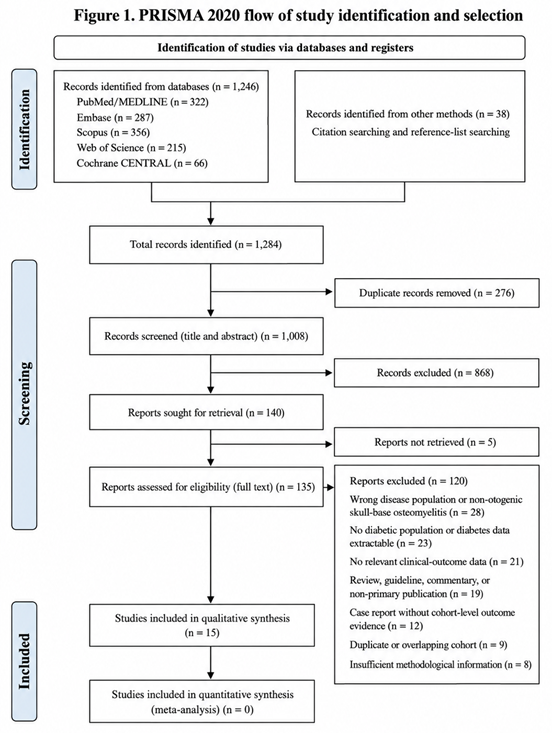
Electronic searching identified 1,246 records: PubMed/MEDLINE 322, Embase 287, Scopus 356, Web of Science 215, and Cochrane CENTRAL 66. An additional 38 reports were identified through citation and reference-list searching, giving 1,284 records in total. After removal of 276 duplicates, 1,008 unique records remained. Of these, 868 records were excluded after title and abstract screening. One hundred forty reports were sought for retrieval, five reports could not be retrieved, and 135 full-text reports were assessed for eligibility. A total of 120 reports were excluded: wrong disease population or non-otogenic skull-base osteomyelitis (28), no diabetic population or diabetes data extractable (23), no relevant clinical-outcome data (21), review/guideline/commentary or non-primary publication (19), case report without cohort-level outcome evidence (12), duplicate or overlapping cohort (9), and insufficient methodological information (8). Fifteen primary studies were included in the qualitative synthesis; no meta-analysis was undertaken.
RESULTS:
Characteristics of Included Studies
Fifteen primary studies were included in the qualitative synthesis. The studies ranged from focused single-center diabetic case series to national inpatient analyses containing several thousand episodes. Across the smaller clinically detailed cohorts, diabetes was frequently present in 70-100% of patients. The evidence demonstrated substantial variability in clinical outcome according to disease severity, neurological involvement, radiological extension, and systemic comorbidity.
Table 1. Characteristics of the 15 Included Studies
|
Study |
Population/design |
Diabetes and principal findings |
Clinical outcomes |
|
Mani et al., 2007 [8] |
23 patients; retrospective MEO cohort |
Diagnostic inclusion included diabetes and P. aeruginosa; mean age 71 years |
Cranial nerve involvement 43.5%; facial palsy less likely to recover than lower CN palsies; cranial neuropathy did not reduce survival under optimized therapy |
|
Soudry et al., 2007 [9] |
48 patients; comparative cohort |
Diabetes in 38/48; facial palsy compared with preserved facial nerve function |
Facial palsy associated with more advanced CT disease but did not independently reduce overall survival |
|
Franco-Vidal et al., 2007 [10] |
46 patients with necrotizing external otitis |
Diabetes was a major underlying predisposing condition |
Prolonged antimicrobial management generally effective; neurological and extensive disease contributed substantially to morbidity |
|
Chen et al., 2010 [11] |
26 patients; survival vs mortality analysis |
All 26 had diabetes |
Five deaths; skull-base osteomyelitis, intracranial extension, and multiple cranial nerve palsies correlated with mortality; glycemic status and diabetes duration did not |
|
Loh and Loh, 2013 [12] |
19 patients; Singapore tertiary-center cohort |
Diabetes control assessed as prognostic variable |
63.2% resolved after 6 weeks; mortality 21.1%; clival involvement predicted persistent disease; diabetic control did not significantly predict outcome |
|
Verim et al., 2014 [13] |
Retrospective NOE outcome study |
Diabetes prominent among classic NOE risk factors |
Diagnostic delay and advanced disease assessed in relation to treatment course and outcome |
|
Stevens et al., 2015 [14] |
28 patients; severity-stratification study |
Diabetic status incorporated into clinical characterization |
Severe disease required longer antimicrobial therapy and greater healthcare utilization; cranial VII palsy, fungal culture, relapse, surgery, and major imaging abnormalities marked severity |
|
Stern Shavit et al., 2016 [15] |
88 patients; historical cohort |
75% had diabetes |
Disease-specific mortality 14%; age >70, diabetes, facial palsy, and positive CT findings identified poor-risk phenotype |
|
Glikson et al., 2017 [16] |
25 NOE patients |
Metabolic/immunocompromised population typical of NOE |
80% clinically improved; cranial neuropathy and adjacent structural involvement on CT correlated with adverse outcome; resistant and fungal pathogens were frequent |
|
Sylvester et al., 2017 [17] |
8,300 inpatient MOE cases; US Nationwide Inpatient Sample |
Diabetes compared directly with non-DM group |
DM associated with greater comorbidity, LOS 5.5 vs 4.0 days, and higher costs, but not higher in-hospital mortality (0.6% vs 0.5%) |
|
Hatch et al., 2018 [18] |
786 cases across 187 US hospitals |
Diabetes present in 64.4%; chronic diabetic complications associated with longer LOS |
Mean LOS 18.6 days; ICU 9.3%; complications 4.3%; mortality 2.5%; sepsis, CHF, weight loss, and coagulopathy strongly predicted mortality |
|
Marina et al., 2019 [19] |
14 patients; Indian tertiary-center case series |
Diabetes present in all 14 patients |
Severe otalgia universal; four patients had cranial nerve involvement; two of three patients with facial palsy recovered; P. aeruginosa isolated in 50% |
|
Lau et al., 2020 [20] |
39 patients; UK NOE cohort |
Older diabetic phenotype represented major clinical group |
MRI identified disease extension not visible on CT in several patients, emphasizing prognostic importance of adequate imaging |
|
Liew et al., 2024 [21] |
31 patients with skull-base osteomyelitis |
Diabetes present in 100%; mean HbA1c 8.37% |
IHD, anemia, and nerve palsy associated with unfavorable prognosis; 25% required surgery; mean antimicrobial duration approximately 36 days |
|
Otogenic SBO cohort, 2017-2024 [22] |
17 hospitalized patients; tertiary-center retrospective study |
All patients had type 2 diabetes |
Cranial nerve palsy 70.6%; mean hospital stay 45 days; mortality 17.6%; HBOT did not significantly reduce morbidity or LOS |
Clinical Presentation in Diabetic Patients
Severe persistent otalgia remained the most characteristic presenting symptom. Pain was frequently nocturnal, deep, and disproportionate to the apparent severity of external canal inflammation. Otorrhea was also common, although its absence did not exclude disease. In the 2024 diabetic skull-base osteomyelitis cohort, 93.5% presented with otalgia and 64.5% with otorrhea. Granulation tissue was found in approximately half of the patients. [21]
Diabetes and Glycemic Control
Diabetes is one of the strongest predisposing conditions for MOE but its role in determining outcome after disease has developed is less straightforward. Several cohorts included exclusively diabetic patients, while others contained diabetic proportions of approximately 60-90%. In the Chen et al. survival study, all 26 patients had diabetes, but mortality was not statistically associated with degree of glucose intolerance or duration of diabetes. Severe anatomical and neurological complications were more important. [11] Loh and Loh similarly found diabetic control did not significantly predict outcome, whereas clival involvement strongly predicted persistence. [12]
Clinical Resolution and Treatment Success
Clinical response varied considerably between studies. Loh and Loh reported resolution in 63.2% after the initial six-week treatment course. Glikson et al. reported clinical improvement in 80% of their 25 patients. The African systematic evidence estimated an antimicrobial cure rate of approximately 76.2%. [1] “Cure” was inconsistently defined across studies, including complete symptom resolution, microbiological cure, normalization of ESR or CRP, radiological response, or absence of recurrence.
Mortality
Mortality varied greatly according to study setting, disease severity, and follow-up. Chen et al. reported five deaths among 26 diabetic patients, approximately 19%. Loh and Loh reported mortality of 21.1% in a small tertiary referral series containing advanced disease. Stern Shavit et al. reported disease-specific mortality of 14% over long-term follow-up. By contrast, Hatch et al. reported in-hospital mortality of 2.5% in 786 admissions, while Sylvester et al. reported in-hospital mortality around 0.5-0.6% in diabetic and non-diabetic hospitalized adults. [11,12,15,17,18]
Predictors of Mortality
The clearest mortality signals related to advanced anatomical disease. Chen et al. found skull-base osteomyelitis, intracranial involvement, and multiple cranial neuropathies associated with mortality. Loh and Loh found clival involvement significantly associated with persistent disease. The large UHC database study found strong mortality associations with sepsis, weight loss, coagulopathy, and congestive heart failure. [18] More recent diabetic skull-base osteomyelitis evidence identified ischemic heart disease and anemia as adverse prognostic factors. [21]
Cranial Nerve Complications
Cranial neuropathy is among the most clinically important complications of MOE. Mani et al. reported cranial nerve involvement in 10 of 23 patients (43.5%). Six had facial nerve palsy, three had lower cranial nerve deficits, and one had extensive multiple cranial nerve involvement. All patients with lower cranial nerve palsy recovered normal function, whereas facial nerve palsy was significantly less likely to resolve with medical treatment. Cranial nerve involvement did not reduce survival in that cohort. [8]
Hospitalization and Healthcare Burden
Diabetes affects healthcare utilization even when it does not independently increase mortality. The Nationwide Inpatient Sample analysis of 8,300 MOE hospitalizations found adult and elderly diabetic patients had a mean hospital stay of 5.5 days compared with 4.0 days among non-diabetic patients and higher mean charges. Mortality did not differ significantly between diabetic and non-diabetic adults: 0.6% versus 0.5%. [17] In the University HealthSystem Consortium study, mean hospitalization was 18.6 days, 9.3% required ICU care, and 3.4% were readmitted within 30 days for MOE-related reasons. [18]
Microbiological Outcomes
Pseudomonas aeruginosa remained the most frequently identified organism. Marina et al. recovered Pseudomonas in 50% of their diabetic cases. Loh and Loh similarly identified it as the principal pathogen. Increasing resistance complicates treatment: in the Singapore cohort, 33.3% of Pseudomonas isolates were multidrug resistant, and Glikson et al. reported multidrug resistance in approximately 30% of pseudomonal isolates. [12,16]
Fungal and Culture-Negative Disease
Fungal pathogens are increasingly recognized, particularly in refractory, immunocompromised, or extensively antibiotic-exposed patients. Glikson et al. reported fungal pathogens in approximately 35% of their cohort. [16] Culture-negative MOE also remains clinically challenging; prior topical or systemic antibiotics can reduce culture yield. A negative external-ear swab does not exclude osteomyelitis when clinical and radiological findings strongly support the diagnosis.
Radiological Disease and Outcome
Imaging confirms the extent of disease and identifies high-risk anatomical involvement. CT remains valuable for bone erosion and temporal-bone anatomy, while MRI better characterizes soft-tissue, skull-base, clival, intracranial, and neurovascular involvement. The 39-patient UK review emphasized that CT can appear nondiagnostic in patients whose MRI demonstrates NOE. [20] Clival involvement was strongly associated with persistent disease in the Loh cohort. [12]
Inflammatory Markers and Monitoring
ESR and CRP are nonspecific but useful longitudinal biomarkers. Loh and Loh found ESR and CRP correlated with disease activity despite not predicting prognosis at initial presentation. Marina et al. similarly incorporated ESR into treatment monitoring. Treatment cessation should therefore be based on an integrated clinical, biochemical, microbiological, and imaging assessment rather than imaging alone.
Antimicrobial Treatment
Long-course antimicrobial therapy remains the foundation of treatment. Traditional regimens include fluoroquinolones, ceftazidime, antipseudomonal penicillins, cefepime, and carbapenems depending on culture susceptibility and local resistance patterns. Treatment courses of approximately six weeks are common, but duration should be individualized. Loh and Loh evaluated outcome after a six-week regimen. The 2024 diabetic skull-base osteomyelitis cohort reported mean antimicrobial therapy of approximately 36 days. [12,21]
Surgical Treatment
The role of surgery has declined dramatically since effective antipseudomonal antibiotics became available. Surgery is now generally reserved for obtaining diagnostic tissue, drainage, debridement of necrotic tissue, management of abscess, refractory disease, or specific complications. In the UHC cohort, surgery was performed in 19.2%; Stern Shavit et al. reported surgery in 22%; and the 2024 diabetic skull-base osteomyelitis cohort required surgery in 25%. [15,18,21]
Hyperbaric Oxygen Therapy
Hyperbaric oxygen therapy has been used as an adjunct based on the theoretical benefits of increasing oxygenation of ischemic infected tissue, enhancing leukocyte function, and supporting wound healing. High-quality comparative evidence remains limited. In Stern Shavit et al., 8% of patients received HBOT. A more recent 17-patient diabetic otogenic skull-base osteomyelitis cohort administered HBOT to 52.9% but found no significant reduction in morbidity or length of hospitalization. [15,22]
Recurrence and Persistent Disease
Recurrence is an important outcome but is inconsistently reported. Persistent disease may reflect insufficient antimicrobial duration, antimicrobial resistance, fungal disease, extensive skull-base involvement, inadequate glycemic control, poor tissue perfusion, or premature interpretation of clinical improvement as cure. The Stevens stratification model considered relapse itself a marker of severe MOE, while clival involvement was significantly associated with persistence in the Singapore cohort. [12,14]
Relationship Between Diabetes and Mortality
The collective evidence supports three conclusions. First, diabetes is a dominant predisposing factor. Second, diabetes - particularly when complicated by vascular, renal, or other chronic disease - can increase treatment burden and hospitalization. Third, diabetes alone is not a consistent independent predictor of mortality once disease-severity variables are considered. Chen et al. found no mortality association with glucose tolerance or duration of diabetes; Sylvester et al. found similar inpatient mortality between diabetic and non-diabetic adults; and Loh and Loh found diabetic control did not significantly predict prognosis. [11,12,17]
Predictors of Poor Clinical Outcome
Based on the included evidence, the following adverse features appear most clinically relevant: advanced age; extensive skull-base osteomyelitis; clival involvement; intracranial extension; multiple cranial nerve palsies; sepsis; systemic cardiovascular comorbidity; malnutrition or clinically significant weight loss; coagulopathy; persistent or resistant microbiological disease; fungal infection in selected cohorts; diagnostic delay; and suboptimal treatment duration.
Factors affecting complexity more consistently than mortality include diabetes itself, poor glycemic control, facial nerve palsy in isolation, need for surgery, and elevated inflammatory markers at initial presentation. These categories are interpretive rather than a formally validated scoring system.
DISCUSSION:
This review demonstrates that malignant otitis externa in diabetic patients remains a potentially life-threatening infection despite major improvements in antimicrobial therapy and imaging. Diabetes was nearly universal in some cohorts and strongly predominant in many others. However, a central finding is that diabetes should be distinguished as a risk factor for developing disease from a predictor of outcome after disease develops.
Diabetic microvascular disease reduces tissue perfusion and oxygen delivery. Hyperglycemia impairs neutrophil chemotaxis, phagocytosis, and intracellular killing. Peripheral vascular disease further compromises antimicrobial delivery to infected tissue. Chronic renal and cardiovascular disease can constrain antibiotic choice and tolerance. These mechanisms explain why diabetes increases susceptibility and may prolong recovery even when it does not independently predict mortality.
Disease severity appears more important than diabetes alone. Chen et al. demonstrated this principle directly: all 26 patients had diabetes, yet mortality was linked to skull-base osteomyelitis, intracranial extension, and multiple cranial nerve involvement rather than duration or degree of diabetes. Similarly, the large US NIS study found diabetes increased resource utilization but not mortality.
The prognostic meaning of cranial nerve involvement depends on the pattern. Isolated facial nerve palsy is a sign of local disease progression but does not consistently increase mortality; however, facial nerve function may fail to recover fully. Multiple or lower cranial nerve involvement indicates a broader skull-base process and is more frequently associated with severe outcome. Neurological examination should therefore be repeated throughout treatment.
The traditional assumption that MOE is invariably pseudomonal is no longer adequate. P. aeruginosa remains the leading pathogen but culture-negative infection, resistant pseudomonal disease, Staphylococcus, Gram-negative bacilli, and fungal pathogens are increasingly reported. This changing microbiology supports a culture-directed strategy and argues against empirically extending the same antibiotic indefinitely when clinical improvement fails.
Disease extent is a clinically meaningful outcome predictor. CT is excellent for bone anatomy, but early disease may be primarily soft tissue. MRI better characterizes skull-base, clival, intracranial, neurovascular, and soft-tissue involvement. The combination of clinical examination, inflammatory markers, and imaging provides a more reliable picture of disease activity than any single method.
Although strong evidence demonstrating that a particular HbA1c target improves MOE survival is lacking, effective glycemic control is biologically and clinically rational. Hyperglycemia impairs host defense and wound healing. Diabetes-related microvascular and renal disease can complicate antimicrobial treatment. Management should therefore include active diabetes optimization rather than treating the ear infection independently from metabolic disease.
Suggested Clinical Management Framework
Strengths of the Review
This review focuses specifically on clinically meaningful outcomes in the diabetic population rather than simply describing the association between diabetes and disease incidence. It integrates small detailed clinical cohorts with large administrative studies. Outcome domains include mortality, treatment response, cranial nerve recovery, hospitalization, microbiology, imaging, surgical intervention, and recurrence. The review also distinguishes diabetes-related susceptibility from predictors of mortality after infection has developed.
Limitations of the Evidence
Most studies were retrospective. Diagnostic definitions of malignant and necrotizing otitis externa varied considerably. Some studies included patients with skull-base osteomyelitis extending beyond classical otogenic disease. Diabetes was universal in some cohorts but only a subgroup variable in others. Outcome definitions were heterogeneous, treatment regimens differed across decades, and changes in fluoroquinolone resistance and fungal disease limit historical comparisons. Cranial nerve recovery and recurrence were not consistently reported. Administrative datasets contain large numbers but cannot provide the clinical detail available in small tertiary-center cohorts.
Limitations of the Review Process
The review was not prospectively registered. Because of substantial methodological and clinical heterogeneity, no pooled treatment-effect estimate was calculated. Studies published in different eras were synthesized despite changes in microbiology, imaging, and antimicrobial treatment. Publication bias cannot be excluded.
Future Research
Future studies should use a standardized definition of MOE/NOE and clearly distinguish external-canal disease, temporal-bone osteomyelitis, and central skull-base extension. Prospective multicenter registries should record diabetes duration, HbA1c, diabetic vascular and renal complications, microbiological culture and susceptibility, fungal testing, cranial nerve involvement, radiological stage, inflammatory markers, antibiotic choice and duration, surgical intervention, glycemic management, recurrence, functional neurological recovery, and disease-specific survival. A validated prognostic score should integrate systemic and disease-specific factors rather than simply using diabetes as a binary variable.
CONCLUSION:
Malignant otitis externa remains a serious infectious complication among patients with diabetes. Diabetes is the dominant predisposing condition and contributes to impaired immunity, delayed healing, increased healthcare complexity, and prolonged hospitalization. However, diabetes alone does not reliably predict mortality. Poor outcomes are more consistently associated with advanced age, extensive skull-base disease, clival or intracranial extension, multiple cranial nerve involvement, sepsis, cardiovascular and nutritional comorbidity, resistant or fungal infection, diagnostic delay, and inadequate treatment. Pseudomonas aeruginosa remains the principal pathogen, but microbiological diversity and antimicrobial resistance increasingly influence therapeutic response. Prolonged culture-directed antimicrobial therapy, meticulous glycemic control, repeated cranial nerve assessment, serial ESR/CRP measurement, adequate imaging, and multidisciplinary management are essential. The most clinically useful approach is therefore not merely to identify whether a patient has diabetes but to assess the severity of diabetes-related comorbidity together with the anatomical, neurological, microbiological, and systemic extent of infection.
REFERENCES:
1. Azeez TA, Adeagbo AK. The association between malignant otitis externa and diabetes mellitus in Africa: a systematic review. Indian J Otolaryngol Head Neck Surg. 2023;75(4):3277-3287. doi:10.1007/s12070-023-03939-3.
2. Aljariri AA, Al-Qudimat AR, Hammoud R, Nashwan AJ, Larem AY, Al Darwish MB, et al. Mortality of malignant otitis externa: a prevalence meta-analysis. Qatar Med J. 2025;2025(2):53. doi:10.5339/qmj.2025.53.
3. Chandler JR. Malignant external otitis. Laryngoscope. 1968;78(8):1257-1294.
4. Cohen D, Friedman P. The diagnostic criteria of malignant external otitis. J Laryngol Otol. 1987;101(3):216-221. doi:10.1017/S0022215100101562.
5. Rubin Grandis J, Branstetter BF IV, Yu VL. The changing face of malignant (necrotising) external otitis: clinical, radiological, and anatomic correlations. Lancet Infect Dis. 2004;4(1):34-39.
6. Carfrae MJ, Kesser BW. Malignant otitis externa. Otolaryngol Clin North Am. 2008;41(3):537-549. doi:10.1016/j.otc.2008.01.004.
7. Mahdyoun P, Pulcini C, Gahide I, et al. Necrotizing otitis externa: a systematic review. Otol Neurotol. 2013;34(4):620-629.
8. Mani N, Sudhoff H, Rajagopal S, Moffat D, Axon PR. Cranial nerve involvement in malignant external otitis: implications for clinical outcome. Laryngoscope. 2007;117(5):907-910. doi:10.1097/MLG.0b013e318039b30f.
9. Soudry E, Joshua BZ, Sulkes J, Nageris BI. Characteristics and prognosis of malignant external otitis with facial paralysis. Arch Otolaryngol Head Neck Surg. 2007;133(10):1002-1004. doi:10.1001/archotol.133.10.1002.
10. Franco-Vidal V, Blanchet H, Bebear C, Dutronc H, Darrouzet V. Necrotizing external otitis: a report of 46 cases. Otol Neurotol. 2007;28(6):771-773.
11. Chen CN, Chen YS, Yeh TH, Hsu CJ, Tseng FY. Outcomes of malignant external otitis: survival vs mortality. Acta Otolaryngol. 2010;130(1):89-94. doi:10.3109/00016480902971247.
12. Loh S, Loh WS. Malignant otitis externa: an Asian perspective on treatment outcomes and prognostic factors. Otolaryngol Head Neck Surg. 2013;148(6):991-996. doi:10.1177/0194599813482107.
13. Verim A, Naiboğlu B, Karaca CT, Seneldir L, Külekçi S, Oysu C. Clinical outcome parameters for necrotizing otitis externa. Otol Neurotol. 2014;35(2):371-376. doi:10.1097/MAO.0000000000000249.
14. Stevens SM, Lambert PR, Baker AB, Meyer TA. Malignant otitis externa: a novel stratification protocol for predicting treatment outcomes. Otol Neurotol. 2015;36(9):1492-1498. doi:10.1097/MAO.0000000000000839.
15. Stern Shavit S, Soudry E, Hamzany Y, Nageris B. Malignant external otitis: factors predicting patient outcomes. Am J Otolaryngol. 2016;37(5):425-430. doi:10.1016/j.amjoto.2016.04.005.
16. Glikson E, Sagiv D, Wolf M, Shapira Y. Necrotizing otitis externa: diagnosis, treatment, and outcome in a case series. Diagn Microbiol Infect Dis. 2017;87(1):74-78. doi:10.1016/j.diagmicrobio.2016.10.017.
17. Sylvester MJ, Sanghvi S, Patel VM, Eloy JA, Ying YLM. Malignant otitis externa hospitalizations: analysis of patient characteristics. Laryngoscope. 2017;127(10):2328-2336. doi:10.1002/lary.26401.
18. Hatch JL, Bauschard MJ, Nguyen SA, Lambert PR, Meyer TA, McRackan TR. Malignant otitis externa outcomes: a study of the University HealthSystem Consortium database. Ann Otol Rhinol Laryngol. 2018;127(8):514-520. doi:10.1177/0003489418778056.
19. Marina S, Goutham MK, Rajeshwary A, Bhat V, Devika T. A retrospective review of 14 cases of malignant otitis externa. J Otol. 2019;14(2):63-66. doi:10.1016/j.joto.2019.01.003.
20. Lau K, Scotta G, Wu K, Kabuli MAK, Watson G. A review of thirty-nine patients diagnosed with necrotising otitis externa over three years: is CT imaging for diagnosis sufficient? Clin Otolaryngol. 2020;45(3):414-418. doi:10.1111/coa.13507.
21. Liew YT, Ghauth S, Ng YX, et al. Skull base osteomyelitis: a 5-year review and prognostic outcome in a single tertiary institution. OTO Open. 2024.
22. Otogenic skull base osteomyelitis: clinical presentation, diagnostic and therapeutic challenges, and long-term outcomes from a single tertiary centre. Turkish Journal of Ear Nose and Throat. 2025.
23. Joshua BZ, Sulkes J, Raveh E, Bishara J, Nageris BI. Predicting outcome of malignant external otitis. Otol Neurotol. 2008;29(3):339-343. doi:10.1097/MAO.0b013e3181661879.
24. Soudry E, Hamzany Y, Preis M, Joshua BZ, Hadar T, Nageris BI. Malignant external otitis: analysis of severe cases. Otolaryngol Head Neck Surg. 2011;144(5):758-762. doi:10.1177/0194599810396132.
25. Berenholz L, Katzenell U, Harell M. Evolving resistant pseudomonas to ciprofloxacin in malignant otitis externa. Laryngoscope. 2002;112(9):1619-1622.
26. Chawdhary G, Liow N, Democratis J, Whiteside O. Necrotising (malignant) otitis externa in the UK: a growing problem. Review of five cases and analysis of national Hospital Episode Statistics trends. J Laryngol Otol. 2015;129(6):600-603. doi:10.1017/S002221511500105X.
27. Guerrero-Espejo A, Valenciano-Moreno I, Ramirez-Llorens R, Perez-Monteagudo P. Malignant external otitis in Spain. Acta Otorrinolaringol Esp. 2017;68(1):23-28.
28. Amaro CE, Espiney R, Radu L, Guerreiro F. Malignant (necrotizing) externa otitis: the experience of a single hyperbaric centre. Eur Arch Otorhinolaryngol. 2019;276(7):1881-1887. doi:10.1007/s00405-019-05396-7.
29. Sokołowski J, Lachowska M, Karchier E, Bartoszewicz R, Niemczyk K. Skull base osteomyelitis: factors implicating clinical outcome. Acta Neurol Belg. 2019;119(3):431-437. doi:10.1007/s13760-019-01110-w.
30. Saxena A, Paul BS, Singh G, Ahluwalia A, Paul G. Predicting outcome in skull base osteomyelitis: an assessment of demographic, clinical, and pathological attributes. J Neurosci Rural Pract. 2021;12(4):751-757. doi:10.1055/s-0041-1735324.
31. Di Lullo AM, Russo C, Piroli P, Petti A, Capriglione P, Cantone E, et al. Malignant otitis external: our experience and literature review. Am J Case Rep. 2020;21:e925060. doi:10.12659/AJCR.925060.
32. Yang TH, Xirasagar S, Cheng YF, Wu CS, Kao YW, Shia BC, Lin HC. Malignant otitis externa is associated with diabetes: a population-based case-control study. Ann Otol Rhinol Laryngol. 2020;129(6):585-590. doi:10.1177/0003489419901139.
33. Peled C, El-Seid S, Bahat-Dinur A, Tzvi-Ran LR, Kraus M, Kaplan D. Necrotizing otitis externa-analysis of 83 cases: clinical findings and course of disease. Otol Neurotol. 2019;40(1):56.
34. Khan MA, Quadri SAQ, Kazmi AS, et al. A comprehensive review of skull base osteomyelitis: diagnostic and therapeutic challenges among various presentations. Asian J Neurosurg. 2018;13(4):959-970. doi:10.4103/ajns.AJNS_90_17.
35. Blyth CC, Gomes L, Sorrell TC, da Cruz M, Sud A, Chen SCA. Skull-base osteomyelitis: fungal vs bacterial infection. Clin Microbiol Infect. 2011;17(2):306-311. doi:10.1111/j.1469-0691.2010.03231.x.