Tension band wiring versus cancellous screw fixation for displaced medial malleolar fractures: a prospective comparative study.
- Nihit Baranwal , Junior Resident, Department of Orthopaedics, Bangalore Medical College and Research Institute, Bengaluru, Karnataka, India.
- Sharath Kumar P V , Professor, Department of Orthopaedics, Bangalore Medical College and Research Institute, Bengaluru, Karnataka, India.
- Mohammed Anas , Senior Resident, Department of Orthopaedics, Bangalore Medical College and Research Institute, Bengaluru, Karnataka, India.
- Kunal , Junior Resident, Department of Orthopaedics, Bangalore Medical College and Research Institute, Bengaluru, Karnataka, India.
Article Information:
Abstract:
Background: Displaced medial malleolar fractures require operative fixation to restore ankle stability and prevent post-traumatic degeneration. There are two common fixation constructs, partially threaded cancellous screws and tension band wiring (TBW) but both have clinical problems. Screws may not obtain good purchase in small fragments or osteoporotic bone, and traditional TBW constructs are often associated with soft tissue irritation and symptomatic hardware. The existing evidence comparing the two is dominated by small, heterogeneous studies. Objective: To compare radiological union, ankle function and complications after tension band wiring (TBW) versus cancellous screw fixation of displaced medial malleolar fractures. Methods: This prospective comparative study included 64 adults treated at Victoria Hospital, Bangalore Medical College and Research Institute, Bengaluru, between March 2024 and August 2025. Participants with closed, displaced medial malleolar fractures amenable to either construct were allocated 1:1 to TBW or two 4.0-mm partially threaded cancellous screws. Vertical shear, open, pathological and comminuted fractures unsuitable for standard fixation were excluded. Participants were reviewed at 2 and 6 weeks, 3 months and 6 months. The primary outcomes were time to radiological union and the Olerud- Molander Ankle Score (OMAS) at six months; complications, reoperation, range of motion and return to activity were secondary outcomes. Results: Thirty-two participants were analysed in each group. Mean time to union was shorter with TBW than with screw fixation (8.32 ± 1.61 versus 10.69 ± 3.35 weeks; p=0.008). By eight weeks, 26/32 (81%) TBW fractures and 9/32 (28%) screw-fixed fractures had united (p<0.001); no non-unions were reported. Six-month mean OMAS was 88.7 ± 8.4 after TBW and 85.2 ± 9.6 after screw fixation (p=0.12), while excellent or good outcomes occurred in 30/32 (94%) and 29/32 (91%), respectively (p=0.68). Symptomatic hardware was more frequent after TBW (7/32 [22%] versus 1/32 [3%]; p=0.02), and five TBW participants underwent elective implant removal. Overall complication rates did not differ significantly (34% versus 25%; p=0.38). Conclusion: TBW was associated with earlier radiological union but not better six-month function. Its union advantage must be balanced against greater hardware-related morbidity and implant removal. Implant selection should reflect fracture morphology, bone quality and patient preferences.
Keywords:
Article :
INTRODUCTION:
Ankle fractures are common injuries in orthopaedic practice and restoration of a congruent stable mortise is central to treatment. The medial malleolus is the medial buttress of the ankle and is the site of attachment of the deltoid ligament complex . Displacement or instability may thus impair tibiotalar mechanics and lead to persistent pain, loss of function and post traumatic degeneration. In general, operative fixation is indicated when there is displacement of the fracture, instability of the mortise or medial injury in association with an unstable bi- or trimalleolar pattern [1].
Transverse and oblique medial malleolar fractures are treated with two familiar constructs. Partially threaded cancellous screws are technically simple to utilize and provide interfragmentary compression across the fracture, but purchase may be limited in small fragment or poor quality cancellous bone. Tension band wiring (TBW) employs parallel Kirschner wires and a figure of 8 cerclage to counter distraction and sustain compression. In a small comparative study, TBW was associated with earlier union and slightly better modified Olerud-Molander outcomes, but only 20 patients were included in the sample [2].
As neither construct is free of implant related morbidity the clinical decision remains nuanced.Traditional wire tension bands may cause irritation to the thin medial soft tissue envelope and cause painful hardware or removal. In an effort to address these issues, a retrospective comparison of conventional and knotless tension-band constructions was designed and showed that lower-profile constructs may reduce treatment costs while maintaining fixation performance [3]. Screw design is also important. Compression screws have been studied with a full thread and without a head to improve purchase or reduce prominence. Clinical and biomechanical studies have suggested that different screw constructs should not be considered a single homogeneous intervention [4,5].
Direct evidence comparing conventional TBW with cancellous screws remains largely based on small heterogeneous studies. Earlier radiographic healing would be of use only if it is translated into better function or earlier activity without additional reoperation. Thus, this study compared TBW with cancellous screw fixation for displaced medial malleolar fractures. The primary objectives were to compare time to radiological union and six month ankle function, secondary objectives were to compare range of motion, complications, secondary surgery and return to activity.
MATERIALS AND METHODS:
Study design and setting
This prospective comparative study was conducted in the Department of Orthopaedics, Victoria Hospital, Bangalore Medical College and Research Institute, Bengaluru, from March 2024 to August 2025. The dissertation records 1:1 allocation using a computer-generated random-number table or sealed envelopes. Further details of sequence generation, allocation concealment and blinding were not available. Reporting was structured with reference to CONSORT principles for a two-group allocated comparison. Participant flow is summarised in Figure 1.
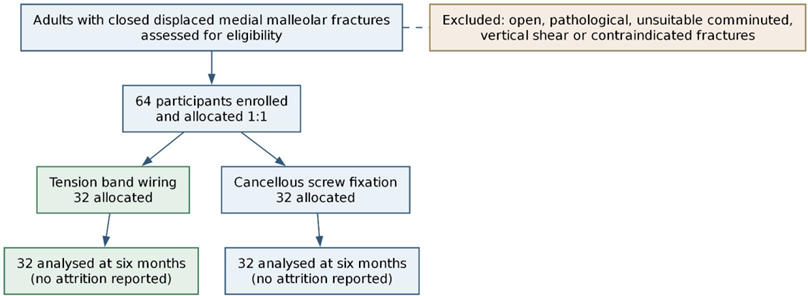
Figure 1. Participant flow from enrolment through six-month analysis. The dissertation reported outcome denominators of 32 in each group and did not report attrition.
Participants
Adults older than 18 years with a closed, displaced (>2 mm) medial malleolar fracture were eligible. Isolated Herscovici type B or C fractures and medial malleolar components of bi- or trimalleolar injuries were included when medial fixation was required. Participants had to be skeletally mature and able to provide written informed consent. Exclusion criteria were open fractures, pathological fractures, active local infection or cellulitis, neurovascular deficit or compartment syndrome, long-term steroid or immunosuppressant use, and comminution that precluded standard fixation. Supination-
adduction vertical shear fractures were excluded because their fracture geometry was considered unsuitable for TBW.
Interventions
Both procedures used spinal or epidural anaesthesia, a supine position and a thigh tourniquet. A standard anteromedial incision was used, with protection of the saphenous vein and nerve. Haematoma and interposed periosteum were cleared and reduction was obtained under direct and fluoroscopic control. In the TBW group, two parallel 1.6- or 2.0-mm Kirschner wires were advanced from the malleolar tip into the tibial metaphysis. An 18-gauge stainless-steel wire was passed through a transverse tibial tunnel 3–4 cm proximal to the fracture, crossed in a figure-of-eight configuration and tightened. Kirschner-wire ends were bent, cut and impacted, and the wire knot was buried. In the screw group, reduction was stabilised with two parallel 4.0-mm partially threaded cancellous screws inserted perpendicular to the fracture line; washers were permitted when bone quality was considered poor.
Postoperatively, participants received elevation, analgesia and antibiotics, with suture removal at 10–14 days. Non-weight-bearing mobilisation was used initially. Active ankle movement and progressive partial weight bearing were introduced after radiographic review, and full weight bearing was allowed when union was evident. Scheduled assessments occurred at 2 weeks, 6 weeks, 3 months and 6 months.
Outcomes
Radiological union was defined as bridging trabeculae across at least three cortices on standard anteroposterior and lateral radiographs. Time to union, union by 8 and 12 weeks, delayed union after 12 weeks, and non-union were recorded. Functional outcome at six months was assessed with the Olerud-Molander Ankle Score (OMAS), a 0–100 patient- reported scale covering pain, stiffness, swelling and activity. Published work supports the clinical interpretability of OMAS in unstable ankle fractures [6]. Scores were classified as excellent (91–100), good (81–90), fair (61–80) or poor (<60). Secondary outcomes included ankle dorsiflexion, plantarflexion, inversion and eversion at six months; maintenance of reduction; adverse radiological outcome; infection; wound and skin complications; hardware symptoms; fixation failure; stiffness; elective removal; hospital stay; and time to return to light activity and full duty.
Sample size and statistical analysis
The dissertation reports a single-proportion calculation using an expected favourable outcome proportion of 0.88, 12% absolute precision and 95% confidence, which yielded 28 participants. Sixty-four participants were ultimately included. Analyses were performed in IBM SPSS Statistics for Windows, version 29.0. Continuous variables were summarised as mean ± standard deviation and compared with an independent-samples Student’s t test. Categorical variables were reported as counts and percentages and compared with the chi- square or Fisher exact test, as appropriate. Statistical significance was set at two-sided p<0.05. Confidence intervals and an intention-to-treat analysis were not reported in the dissertation.
RESULTS:
Table 1. Baseline demographic, injury and operative characteristics.
|
Characteristic |
TBW (n=32) |
Screw fixation (n=32) |
p value |
|
Age, years |
41.3 ± 14.76 |
39.65 ± 15.34 |
0.71 |
|
Male sex |
20 (63%) |
21 (66%) |
0.68 |
|
Right side |
19 (59%) |
20 (63%) |
0.78 |
|
Road traffic injury |
16 (50%) |
15 (47%) |
0.84 |
|
Smoking |
6 (19%) |
13 (41%) |
0.06 |
|
Alcohol use |
13 (41%) |
4 (13%) |
0.01 |
|
Supination- external rotation |
20 (63%) |
21 (66%) |
0.75a |
|
Fracture Displacement, (in mm) |
4.2 ± 1.8 |
4.5 ± 2.1 |
0.58 |
|
Injury-to-surgery interval, days |
2.9 ± 1.2 |
3.1 ± 1.5 |
0.65 |
|
Operative duration(minutes) |
88.90 ± 15.05 |
82.75 ± 16.29 |
0.05 |
aFor the overall Lauge-Hansen classification distribution. Values are mean ± standard deviation or number (%).
Sixty-four participants were included, with 32 analysed in each group at six months. The mean age was 41.3 ± 14.76 years in the TBW group and 39.65 ± 15.34 years in the screw group. Men comprised 20/32 and 21/32 participants, respectively. Road traffic injury was the most frequent mechanism (50% versus 47%), and the supination-external rotation pattern was most common (63% versus 66%). Baseline fracture displacement and articular involvement were similar. Alcohol use was the only reported statistically significant baseline imbalance (41% versus 13%; p=0.01) (Table 1).
Table 2. Radiological, functional and safety outcomes.
|
Outcome |
TBW (n=32) |
Screw fixation (n=32) |
p value |
|
Time to union, weeks |
8.32 ± 1.61 |
10.69 ± 3.35 |
0.008 |
|
Union by 8 weeks |
26 (81%) |
9 (28%) |
<0.001 |
|
Union by 12 weeks |
31 (97%) |
29 (91%) |
0.32 |
|
Delayed union (>12 weeks) |
1 (3%) |
3 (9%) |
0.31 |
|
Non-union |
0 |
0 |
— |
|
Six-month OMAS |
88.7 ± 8.4 |
85.2 ± 9.6 |
0.12 |
|
Excellent/good OMAS |
30 (94%) |
29 (91%) |
0.68 |
|
Symptomatic hardware |
7 (22%) |
1 (3%) |
0.02 |
|
Overall complications |
11 (34%) |
8 (25%) |
0.38 |
|
Elective implant removal |
5 (16%) |
0 |
0.02 |
|
Reoperation |
5 (16%) |
1 (3%) |
0.09 |
|
Return to full duty, weeks |
14.3 ± 3.5 |
16.1 ± 4.2 |
0.08 |
OMAS, Olerud-Molander Ankle Score; TBW, tension band wiring. Values are mean ± standard deviation or number (%).
Mean radiological union occurred 2.37 weeks earlier after TBW (8.32 ± 1.61 weeks) than after screw fixation (10.69 ± 3.35 weeks; p=0.008). Union by eight weeks occurred in 26/32 (81%) and 9/32 (28%) participants, respectively (p<0.001). By 12 weeks, the corresponding proportions were 31/32 (97%) and 29/32 (91%; p=0.32). Delayed union occurred in one TBW and three screw participants; no non-unions were reported.At six months, mean OMAS was 88.7 ± 8.4 after TBW and 85.2 ± 9.6 after screw fixation (p=0.12). Excellent or good results were recorded in 30/32 (94%) and 29/32 (91%), respectively (p=0.68). Range of motion did not differ significantly in any measured plane. Anatomical reduction was reported for all participants, although two screw-treated participants had an adverse radiological outcome and one had hardware loosening (Table 2).
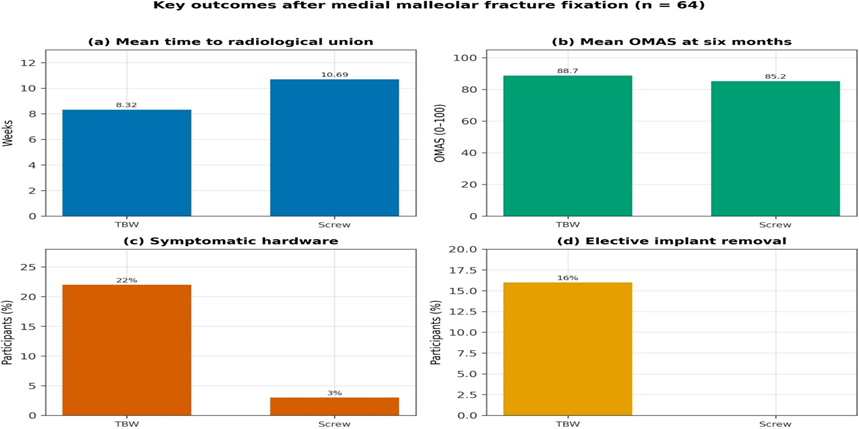
Figure 2. Key radiological, functional and hardware-related outcomes by fixation group. A lower value favours TBW for time to union and a higher value favours TBW for OMAS; lower values favour the intervention for hardware symptoms and removal.
Table 3: Comparison of Postoperative Complications, Reoperation Rates, and Recovery Timelines Between Tension Band Wiring and Screw Fixation
|
Outcome / Variable |
Tension Band Wiring (TBW) (n=32) |
Screw Fixation (n=32) |
p-value |
|
Complications & Symptoms |
|||
|
Overall complications |
11 (34%) |
8 (25%) |
0.38 |
|
Symptomatic hardware |
7 (22%) |
1 (3%) |
0.02 |
|
Superficial infection |
2 |
2 |
- |
|
Deep infection |
0 |
0 |
- |
|
K-wire migration |
0 |
0 |
- |
|
Reoperations |
|||
|
Elective implant removal |
5 |
0 |
0.02 |
|
Overall reoperation |
5 |
1 |
0.09 |
|
Recovery Timeline (weeks) |
|||
|
Return to light activity (mean ± SD) |
8.5 ± 2.1 |
9.2 ± 2.8 |
0.28 |
|
Return to full duty (mean ± SD) |
14.3 ± 3.5 |
16.1 ± 4.2 |
0.08 |
Overall complications occurred in 11/32 (34%) TBW and 8/32 (25%) screw participants (p=0.38). Superficial infection occurred in two participants per group. Symptomatic hardware was more frequent after TBW (7/32 [22%] versus 1/32 [3%]; p=0.02). Five TBW participants underwent elective implant removal for symptomatic hardware, compared with none in the screw group (p=0.02); overall reoperation occurred in 5/32 and 1/32, respectively (p=0.09). There were no deep infections or Kirschner-wire migrations.
Mean return to light activity was 8.5 ± 2.1 weeks after TBW and 9.2 ± 2.8 weeks after screw fixation (p=0.28). Return to full duty occurred at 14.3 ± 3.5 and 16.1 ± 4.2 weeks, respectively (p=0.08). Total and postoperative hospital stay were similar.
DISCUSSION:
The main finding was a shorter reported time to radiological union with TBW, and a much larger proportion united at 8 weeks. The functional benefit at six months was not significantly different attributable to this early radiographic advantage. In contrast, the most evident clinical trade-off was an increase in hardware-related morbidity following TBW: around one in five participants reported symptomatic implants and one in six required elective removal. Other than overall complications, six-month range of motion, hospital stay and return to activity were similar.The previous merging of TBW is biologically and mechanically feasible when the construct is satisfactorily applied on transverse or avulsion-type fracture.
The purpose of a figure-of-eight wire is to resist distractive forces and inhibit compression during movement of the ankle. In a comparative study involving 20 patients, Mohammed and co-workers found that mean union (9.4 weeks) with TBW and 11.8 weeks with screws was comparable. Also, 90% and 80%, respectively, had good modified Olerud-Molander (OM) scores [2] The previous research had a small sample size and used alternate allocation, so although its direction of that union difference is consistent with the findings in the paper, we will need to be careful with 1988 the interpretation 1989. Fracture morphology differences, postoperative loading feedback, and definition or frequency of radiographic assessment may significantly affect measured union time.
The average difference in OMAS for six months for the current study was 3.5 points and not statistically significant. According to the report by Penning et al, anchors-based estimates denote clinically-important OMAS change of approximately 15 points from three to six months and 9.5 points from six to twelve months [6]. Direct equivalence is not appropriate, as those values concern within-person change rather than a cross-sectional treatment contrast; still, The context they provide indicates that the noticed group difference was modest. By six months, anatomical reduction fracture consolidation and rehabilitation may dominate patient reported function more than a two week difference in radiographic union.
The performance of hardware alters the overall spectrum of benefits significantly. Conventional TBW places bentKirschner-wire ends and a twisted wire knot beneath a thin subcutaneous envelope in the fractures as shown below. According to Downey and coworkers, prolonged hardware irritation and subsequent removal of the implant are continuing troubles faced with the traditional stainless-steel tension band. In respect, they evaluated a lower-profile knotless construct. [3] We present a 22% symptomatic-hardware rate and 16% elective-removal rate in the TBW group consistent with the mechanism. Wire ends must be impacted with care, knots buried and excessive tension in the remaining soft-tissue avoided. However, these steps may not eliminate symptoms which arise from the construct.
Screw fixation is a group of reconstructions and not a single technique. The current research utilized cancellous screws that were 4.0mm in diameter and partially threaded. A study contrasting the clinical effects of a fully and partially threaded 4-mm cancellous screw found similar functional and radiographic results while emphasising relevance of purchase and screw strategy [4]. Utilizing a synthetic-bone biomechanical model, both headless compression screws and partially threaded cancellous screws had similar failure resistance. This suggests headless designs provide a possible means of decreasing prominent-hardware signs [5]. The alternatives may be relevant when classic screws are selected; however, biomechanical equivalence does not equate to comparative clinical evidence.
Implant selection depends upon fracture morphology. Transverse or avulsion patterns can best be treated with TBW, where wire loops can combat distraction. The study appropriately omitted supination-adduction vertical shear fracture, which usually requires a construct capable of resisting shear (eg, lag screws oriented perpendicular to the fracture or a buttress plate). On the contrary, a small distal fragment or bad cancellous purchase.
Could complicate screwing fixation. Therefore, the algorithm of treatment should integrate fracture-plane orientation, fragment size, bone quality and condition of the medial soft tissues rather than treating TBW and screws interchangeably across all fractures [1].
The studied groups on report had similar age, sex, side, mechanism of injury and fracture classification. Alcohol use was significantly different while smoking had a numerical imbalance. Adherence, wound healing or union can be affected by these factors, and the summary data did not allow adjusted analysis. The confidence intervals, protocol registration, allocation concealment, radiographic assessment blinding and missing data handling were also not disclosed in the dissertation. Despite maintaining a constant outcome denominator of 32 per group, ем did not report attrition. These gaps constrain the certainty of internal validity and precision of treatment effects.
From a clinical standpoint, a tension band wire may be an appealing fixation choice when an early union is desired, robust fixation of a small fragment required and the patient is willing to accept a higher chance of implant irritation or removal. In cases where the medial soft-tissue envelope may be compromised or avoidance of a second procedure is critical, standard cancellous screws may be best. The lack of a six month functional advantage suggests TBW should not be chosen to speed up radiographic union. More explicit than current technology level – machines used at point of care.
CONCLUSION:
TBW was associated with earlier radiological union than partially threaded cancellous screw fixation, but six-month OMAS and range of motion were similar. Symptomatic hardware and elective removal were more frequent after TBW. The choice of fixation should be individualised according to fracture morphology, fragment size, bone quality, soft-tissue conditions and patient preferences concerning potential secondary surgery.
REFERENCES:
1. Lampridis V, Gougoulias N, Sakellariou A. Stability in ankle fractures: diagnosis and treatment. EFORT Open Rev. 2018;3(5):294-303. doi: 10.1302/2058-5241.3.170057.
2. Mohammed AA, Abbas KA, Mawlood AS. A comparative study in fixation methods of medial malleolus fractures between tension bands wiring and screw fixation. Springerplus. 2016;5:530. doi: 10.1186/s40064-016-2155-z.
3. Downey MW, Duncan K, Kosmopoulos V, Motley TA, Carpenter BB, Ogunyankin F, et al. Comparing the knotless tension band and the traditional stainless steel wire tension band fixation for medial malleolus fractures: a retrospective clinical study. Scientifica (Cairo). 2016;2016:3201678. doi: 10.1155/2016/3201678.
4. Sayyed-Hosseinian SH, Bagheri F, Ebrahimzadeh MH, Moradi A, Golshan S. Comparison of partially threaded and fully threaded 4mm cancellous screws in fixation of
5. medial malleolar fractures. Arch Bone Jt Surg. 2020;8(6):710-715. doi: 10.22038/abjs.2020.46112.2263.
6. Corey RM, Cannada LK, Bledsoe G, Israel H. Biomechanical evaluation of medial malleolus fractures treated with headless compression screws. J Clin Orthop Trauma. 2019;10(2):310-314. doi: 10.1016/j.jcot.2018.04.010.
7. Penning D, Kleipool S, van Dieren S, Dingemans SM, RODEO Collaborator Group, Schepers T. The minimal clinically important difference of the Olerud Molander Ankle Score in patients with unstable ankle fracture. Arch Orthop Trauma Surg. 2023;143(6):3103-3110. doi: 10.1007/s00402-022-04533-y.