Comparative Study Of 0.5% Hyperbaric Levobupivacaine, 0.75% Hyperbaric Ropi-Vacaine And 0.5% Hyperbaric Bupivacaine With Add On Fentanyl In Subarachnoid Block For Lower Limb Surgeries.
- Japneet Bakhshi , Senior Resident (MD Anaesthesiology), MBBS, Department of Anaesthesiology, Dayanand Medical College & Hospital, Civil Lines, Tagore Nagar, Ludhiana, Punjab – 141001, India.
- Gurpreeti Kaur , Additional Professor (formerly Associate Professor), MBBS, MD, Department of Anaesthesiology, Dayanand Medical College & Hospital, Civil Lines, Tagore Nagar, Ludhiana, Punjab – 141001, India.
- Gurleen Kaur , Assistant Professor, MBBS, MD, Department of Anaesthesiology, JIS Medical College and Hospital, Ludhiana, Punjab 141206.
- Mirley Rupinder Kaur , Professor, MBBS, MD, Department of Anaesthesiology, Dayanand Medical College & Hospital, Civil Lines, Tagore Nagar, Ludhiana, Punjab – 141001, India.
- Arzoi Grewal , 3rd year MBBS student, SGRD Medical College, Amritsar, Punjab, India.
Article Information:
Abstract:
Introduction: Hyperbaric bupivacaine, levobupivacaine, and ropivacaine are commonly used intrathecal local anaesthetic agents for lower limb orthopaedic surgeries. Their sensory and motor block characteristics influence postoperative recovery and analgesia. Aim: Comparison of the sensory and motor block characteristics of 0.5% hyperbaric levobupivacaine with fentanyl, 0.75% hyperbaric ropivacaine with fentanyl, and 0.5% hyperbaric bupivacaine with fentanyl in orthopaedic surgeries under subarachnoid block in terms of onset, sensory level, and duration of sensory and motor block. Methods: A prospective randomized double-blind study was conducted on 195 patients undergoing lower limb orthopaedic surgeries under subarachnoid block. Patients were equally allocated into three groups B,R&L receiving 0.5% hyperbaric levobupivacaine with fentanyl, 0.75% hyperbaric ropivacaine with fentanyl, and 0.5% hyperbaric bupivacaine with fentanyl. Onset and duration of sensory and motor block, duration of analgesia, haemodynamic parameters, and adverse effects were assessed. Results: The onset of sensory block was comparable among Group B (4.86 ± 1.06 min), Group R (4.95 ± 1.42 min), and Group L (4.58 ± 1.10 min) (p=0.194). Duration of sensory block was significantly shorter in Group R (101.00 ± 10.72 min) compared to Group B (107.00 ± 12.52 min) and Group L (105.69 ± 11.07 min) (p=0.008). Duration of motor block and analgesia were also significantly shorter in Group R (p=0.001). Haemodynamic parameters and adverse effects were comparable among the groups. Conclusion: Hyperbaric ropivacaine provides earlier motor recovery with comparable haemodynamic stability and may be preferred when early postoperative mobilization is desired.
Keywords:
Article :
INTRODUCTION:
Spinal anaesthesia is widely preferred for lower limb orthopaedic surgeries because of its rapid onset, effective sensory blockade, reduced perioperative complications, and good postoperative analgesia. [1,2] Hyperbaric bupivacaine has traditionally been the most commonly used intrathecal local anaesthetic agent; however, it is associated with prolonged motor blockade and increased cardiovascular and central nervous system toxicity. [3,4-7] Levobupivacaine and ropivacaine, the pure S(-) enantiomers developed as safer alternatives, demonstrate lower cardiotoxicity and neurotoxicity while maintaining effective sensory blockade.[8,9] Levobupivacaine provides block characteristics similar to bupivacaine, whereas ropivacaine produces less intense motor blockade with faster recovery, making it useful for ambulatory and lower limb surgeries.[8,9] Addition of intrathecal fentanyl enhances sensory blockade and postoperative analgesia without significantly prolonging motor block. [2] However, limited studies have directly compared hyperbaric ropivacaine, hyperbaric levobupivacaine, and hyperbaric bupivacaine in spinal anaesthesia for lower limb surgeries. Therefore, the present study was undertaken to compare the sensory and motor block characteristics of 0.5% hyperbaric levobupivacaine with fentanyl (25 mcg), 0.75% hyperbaric ropivacaine with fentanyl (25 mcg), and 0.5% hyperbaric bupivacaine with fentanyl (25 mcg) in orthopaedic surgeries under subarachnoid block in terms of onset, highest sensory level, and duration of sensory and motor blockade.
MATERIALS AND METHODS:
Study design: Prospective, randomized, double-blind interventional study.
Study period: 12 Months
Place of study: Department of Anaesthesiology, Tertiary Care Teaching Hospital.
Study population: Adult patients aged 18–65 years, ASA physical status I–III, undergoing lower limb orthopaedic surgeries under subarachnoid anaesthesia.
Sample size: 195 patients.
Inclusion Criteria:
· Age 18–65 years.
· ASA physical status I–III.
· Scheduled for lower limb orthopaedic surgeries under subarachnoid anaesthesia.
Exclusion Criteria:
· Refusal for subarachnoid block.
· Known allergy to local anaesthetic agents.
· Coagulopathy.
· Infection at the injection site.
· Spinal deformity (e.g., scoliosis, kyphoscoliosis).
· Pre-existing neurological disease.
· Inability to comprehend sensory and motor block assessment.
· Failed subarachnoid block requiring conversion to general anaesthesia.
Study Variable:
This prospective, randomized, double-blind interventional study was conducted in the Department of Anaesthesiology of a tertiary care teaching hospital, after obtaining approval from the Institutional Ethics Committee (vide approval number IEC/2023/145, Ref no DMCH/IEC/2023/287 Dated 15 December 2023). It was done according to the principles of the declaration of Helsinki, 2013 and Good Clinical practice guidelines. A total of 195 adult patients aged 18–65 years, belonging to ASA physical status I–III and scheduled for lower limb orthopaedic surgeries under subarachnoid anaesthesia, were included in the study. Patients refusing subarachnoid block , those with known allergy to local anaesthetic agents, coagulopathy, infection at the injection site, spinal deformities (scoliosis, kyphoscoliosis or similar deformities), pre-existing neurological disease, inability to comprehend sensory and motor block assessment, and failed subarachnoid block requiring conversion to general anaesthesia were excluded from the study.
Sample size was calculated using the formula:
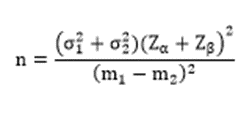
where Z_αwas taken as 1.96 at 95% confidence interval and Z_βas 0.842 for 80% power. Based on the findings of Casati et al., the calculated sample size was 59 patients per group. To account for possible dropouts and exclusions, 65 patients were included in each group, making a total sample size of 195 patients.
All patients underwent detailed pre-anaesthetic evaluation one day prior to surgery. Routine investigations including haemogram and coagulation profile were performed, and standard fasting guidelines according to ASA recommendations were followed. In the operating room, standard monitoring including non-invasive blood pressure, electrocardiography, and peripheral oxygen saturation was established and baseline parameters were recorded. Intravenous access was secured and preloading with intravenous fluids was initiated prior to administration of subarachnoid block.
Patients were randomly allocated into three groups using computer-generated randomization. Allocation concealment was done using sealed envelopes opened by an independent anaesthesiologist responsible for preparation of the study drug. Group B received 2.5 mL of 0.5% hyperbaric bupivacaine with fentanyl 25 mcg (0.5 mL), Group R received 2.5 mL of 0.75% hyperbaric ropivacaine with fentanyl 25 mcg (0.5 mL), and Group L received 2.5 mL of 0.5% hyperbaric levobupivacaine with fentanyl 25 mcg (0.5 mL) intrathecally. The total volume administered in all groups was 3 mL.
A designated anaesthesiologist prepared the study drug in a coded 5 mL syringe and handed it over to another anaesthesiologist administering the block, who remained blinded to the study medication. Under strict aseptic precautions and with the patient in sitting position, local infiltration was performed using 2 mL of 2% lignocaine. A 26-gauge Quincke spinal needle was inserted through the midline approach. After confirmation of free flow of cerebrospinal fluid, the study drug was administered intrathecally at a rate of 0.2 mL/s. Immediately after injection, patients were placed supine with the operating table maintained in a neutral position.
Haemodynamic parameters including heart rate, systolic blood pressure, diastolic blood pressure, mean arterial pressure, and peripheral oxygen saturation were recorded at baseline, 2, 4, 6, 8, 10, and 15 minutes after administration of subarachnoid block and subsequently at 15-minute intervals. Sensory block was assessed bilaterally along the midclavicular line using pinprick method with a sterile 26G needle. Surgery was commenced after attainment of sensory block up to T10 dermatome.
The onset of sensory block was defined as the time from intrathecal injection to loss of pain sensation at T10 dermatome. Duration of sensory block was defined as the time interval between intrathecal injection and regression by two dermatomes from the highest sensory level achieved. Motor block was assessed using the Modified Bromage Scale at 2, 4, 6, 8, 10, and 15 minutes and subsequently at 15-minute intervals. The onset of motor block was defined as the time from intrathecal injection to attainment of Grade 1 motor block, while duration of motor block was defined as the time from intrathecal injection until return to Grade 0. Modified Bromage Scale grading was as follows: Grade 0 – full motor function; Grade 1 – unable to raise extended leg but able to flex knee; Grade 2 – unable to flex knee with preserved ankle movement; and Grade 3 – complete motor block.
Patients were monitored intraoperatively for hypotension, bradycardia, and hypoxemia. Hypotension was defined as systolic blood pressure below 90 mmHg or a reduction greater than 20% from baseline and was managed with intravenous fluids and ephedrine 6 mg boluses. Bradycardia, defined as heart rate below 60 beats/minute, was treated using intravenous atropine 0.6 mg. Hypoxemia, defined as peripheral oxygen saturation below 90%, was managed with supplemental oxygen and ventilatory support when required.
In the post-anaesthesia care unit, haemodynamic parameters along with sensory and motor block characteristics were monitored every 15 minutes until complete regression of both blocks. Postoperative pain assessment was performed using the Numerical Rating Scale (NRS), where 0 represented no pain and 10 represented worst imaginable pain. Pain assessment was initiated immediately upon arrival in the post-anaesthesia care unit and repeated hourly for the first six postoperative hours. Intravenous tramadol 100 mg was administered when NRS score exceeded 4, and the time to first analgesic request was documented.
The primary outcomes of the study were onset of sensory block and onset of motor block. Secondary outcomes included highest level and duration of sensory block and duration of motor block.
Data were summarized using mean ± standard deviation, median, range, frequencies, and percentages as appropriate. Normality of distribution was assessed using the Kolmogorov–Smirnov test. Quantitative variables were compared using the Kruskal–Wallis test followed by post hoc Tukey’s test where applicable. Categorical variables were analysed using chi-square test or Fisher’s exact test. A p-value <0.05 was considered statistically significant. Statistical analysis was performed using SPSS version 21 (SPSS Inc., Chicago, IL, USA).
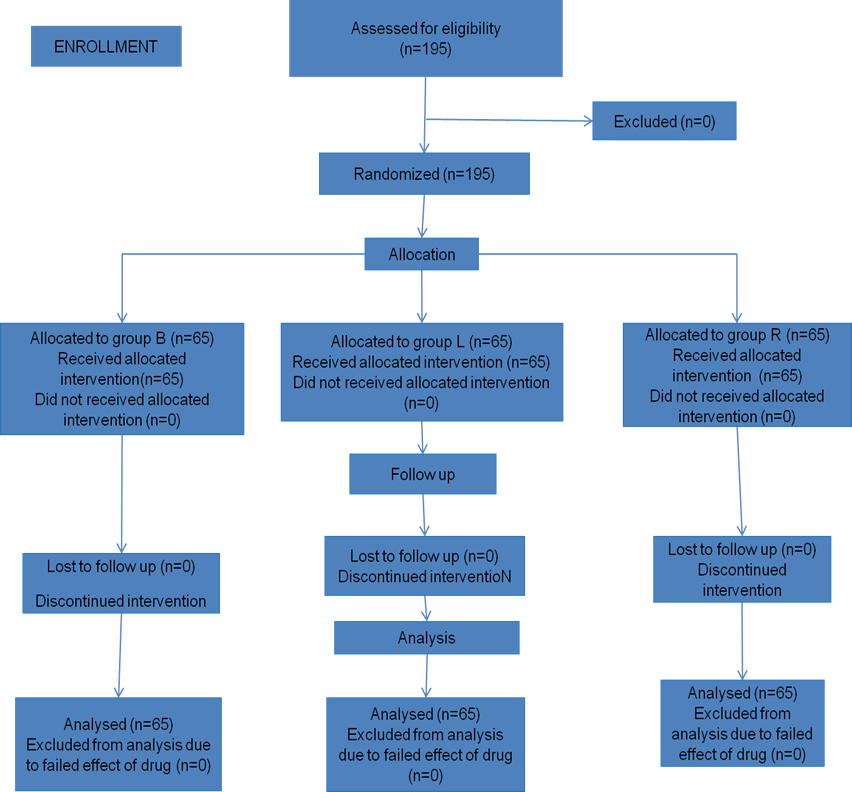
Consort Flow Chart.
RESULTS:
Table 1: Baseline characteristics of study participants
|
Parameter |
Group B |
Group R |
Group L |
p-value |
|
Age (years), mean ± SD |
42.72 ± 13.34 |
41.68 ± 12.89 |
40.02 ± 14.14 |
0.514 |
|
Male/Female |
46/19 |
44/21 |
47/18 |
0.842 |
|
BMI (kg/m²), mean |
27.20 |
27.09 |
26.88 |
>0.05 |
|
ASA I, n (%) |
25 (38.5%) |
31 (47.7%) |
24 (36.9%) |
0.372 |
|
ASA II, n (%) |
20 (30.8%) |
18 (27.7%) |
27 (41.5%) |
|
|
ASA III, n (%) |
20 (30.8%) |
16 (24.6%) |
14 (21.5%) |
|
|
Duration of surgery (min), mean ± SD |
104.62 ± 33.22 |
100.85 ± 33.84 |
111.15 ± 36.44 |
0.230 |
Table 2: Comparison of sensory block characteristics among study groups
|
Parameter |
Group B |
Group R |
Group L |
p-value |
|
Onset of sensory block (min), mean ± SD |
4.86 ± 1.06 |
4.95 ± 1.42 |
4.58 ± 1.10 |
0.194 |
|
Duration of sensory block (min), mean ± SD |
107.00 ± 12.52 |
101.00 ± 10.72 |
105.69 ± 11.07 |
0.008 |
|
Maximum sensory level T4, n (%) |
19 (29.2%) |
28 (43.1%) |
23 (35.4%) |
0.602 |
|
Maximum sensory level T6, n (%) |
45 (69.2%) |
36 (55.4%) |
41 (63.1%) |
|
|
Maximum sensory level T8, n (%) |
1 (1.5%) |
1 (1.5%) |
1 (1.5%) |
Table 3: Comparison of motor block characteristics and duration of analgesia among study groups
|
Parameter |
Group B |
Group R |
Group L |
p-value |
|
Onset of motor block (min), mean ± SD |
2.31 ± 1.07 |
2.34 ± 1.20 |
2.09 ± 0.55 |
0.301 |
|
Time to complete motor regression (min), mean ± SD |
167.77 ± 12.06 |
132.23 ± 13.75 |
166.23 ± 14.95 |
0.001 |
|
Duration of analgesia (min), mean ± SD |
191.23 ± 15.18 |
155.08 ± 14.83 |
189.15 ± 17.49 |
0.001 |
Table 4: Comparison of adverse effects among study groups
|
Adverse effect |
Group B |
Group R |
Group L |
p-value |
|
Hypotension, n (%) |
26 (40.0%) |
28 (43.1%) |
24 (36.9%) |
0.774 |
|
Bradycardia, n (%) |
0 (0.0%) |
3 (4.6%) |
1 (1.5%) |
0.168 |
|
Nausea/Vomiting, n (%) |
5 (7.7%) |
13 (20.0%) |
9 (13.8%) |
0.127 |
|
Vasopressor requirement, mean ± SD |
7.76 ± 2.77 |
6.56 ± 1.78 |
7.86 ± 3.25 |
0.101 |
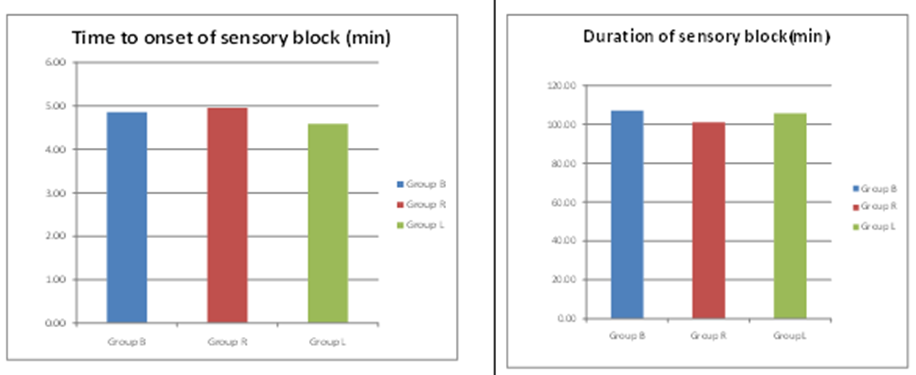
Figure 2a: Comparison of Study Groups According to Onset of Sensory Block (Minutes)
Figure 2b: Comparison of Study Groups According to Duration of Sensory Block (Minutes)
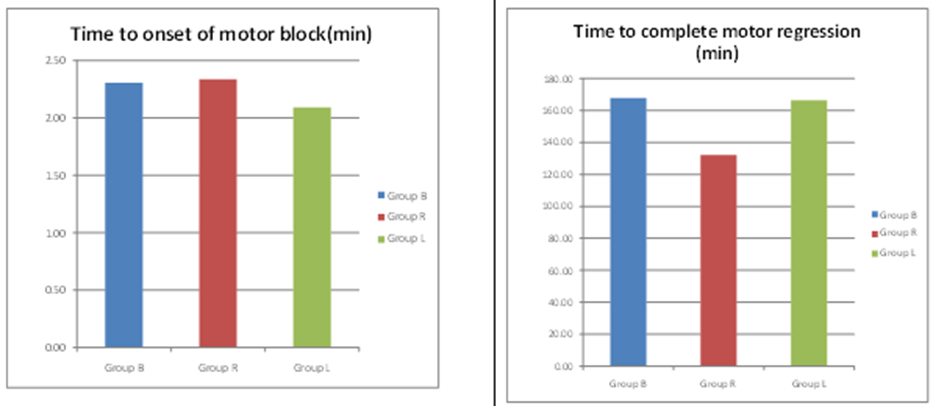
Figure 3a: Comparison of Study Groups According To Time Required For Onset of Motor Block (Minutes)
Figure 3b: Comparison of Study Groups According to Duration of Motor Block (Minutes)
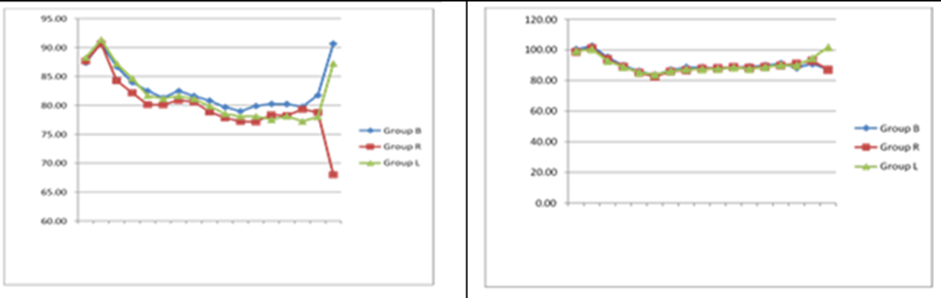
FIGURE 4a: Trends Of Intra-Operative HR Values In Three Group
Figure 4b: Trends Of Intra-Operative Mean Arterial Pressure (MAP) Values In All Three Groups
A total of 195 patients were enrolled and randomized equally into three groups: Group B (hyperbaric bupivacaine with fentanyl), Group R (hyperbaric ropivacaine with fentanyl), and Group L (hyperbaric levobupivacaine with fentanyl), with 65 patients in each group. The participant recruitment and allocation process is illustrated in Figure 1.
The baseline demographic and clinical characteristics of the study population are summarized in Table 1. The three groups were comparable with respect to demographic profile, ASA grading, BMI, and duration of surgery, with no statistically significant intergroup differences observed (p > 0.05).
Sensory block characteristics among the study groups are presented in Table 2 Fig 2. The mean onset time of sensory block was comparable among the three groups, with no statistically significant difference (p = 0.194). However, duration of sensory block differed significantly among the groups (p = 0.008). Group B demonstrated significantly longer duration of sensory block compared to Group R (p = 0.003), while no significant difference was observed between Group B and Group L (p = 0.516). T6 was the most commonly achieved sensory level in all groups, and no statistically significant difference was observed in the maximum sensory level attained (p = 0.602).
Motor block characteristics and duration of analgesia are summarized in Table 3 Fig 3 . The onset of motor block was comparable among all groups (p = 0.301). Time to complete motor regression was significantly shorter in Group R compared to Group B and Group L (p = 0.001). Similarly, duration of analgesia was significantly shorter in Group R, whereas Groups B and L demonstrated comparable duration of postoperative analgesia.
Adverse effects and haemodynamic parameters are summarized in Table 4 and Figure 4, respectively. No statistically significant intergroup differences were observed with respect to incidence of hypotension, bradycardia, nausea/vomiting, or vasopressor requirement (p > 0.05). Haemodynamic parameters including heart rate, systolic blood pressure, diastolic blood pressure, and mean arterial pressure remained comparable among the three groups throughout the intraoperative and postoperative periods.
REFERENCES:
1. Chattopadhyay A, Maitra S, Sen S, Bhattacharjee S, Layek A, Pal S, et al. A study to compare the analgesic efficacy of intrathecal bupivacaine alone with intrathecal bupivacaine midazolam combination in patients undergoing elective infraumbilical surgery. Anaesthesia Res Pract. 2013; 2013:567134.
2. Miller RD, Eriksson LI, Fleisher LA, Wiener-Kronish JP, Cohen NH, Young WL. Miller’s Anesthesia. 8th ed. Philadelphia: Elsevier Health Sciences; 2014.
3. Jagtap S, Chhabra A, Dawoodi S, Jain A. Comparison of intrathecal ropivacaine-fentanyl and bupivacaine-fentanyl for major lower limb orthopaedic surgery: A randomised double-blind study. Indian J Anaesth. 2014; 58:442–6.
4. Cappelleri G, Aldegheri G, Danelli G, Marchetti C, Nuzzi M, Iannandrea G, et al. Spinal anesthesia with hyperbaric levobupivacaine and ropivacaine for outpatient knee arthroscopy: a prospective, randomized, double-blind study. Anesth Analg. 2005; 101:77–82.
5. McLure HA, Rubin AP, Westcott M, Henderson H. A comparison of 1% ropivacaine with a mixture of 0.75% bupivacaine and 2% lignocaine for peribulbar anaesthesia. Anaesthesia. 1999; 54:1178–82.
6. Bardsley H, Gristwood R, Baker H, Watson N, Nimmo W. A comparison of the cardiovascular effects of levobupivacaine and rac-bupivacaine following intravenous administration to healthy volunteers. Br J Clin Pharmacol. 1998; 46:245–9.
7. Kuthiala G, Chaudhary G. Ropivacaine: A review of its pharmacology and clinical use. Indian J Anaesth. 2011; 55:104–10.
8. Bajwa SS, Kaur J. Clinical profile of levobupivacaine in regional anesthesia: A systematic review. J Anaesthesiol Clin Pharmacol. 2013; 29:530–9.
9. Khundongbam K, Laithangbam P, Hemjit T, Asem J, Longjam E, et al. A comparative study of spinal anesthesia with hyperbaric ropivacaine plus fentanyl and hyperbaric bupivacaine plus fentanyl in lower abdominal surgery and lower limb surgery. J Med Soc. 2016; 30:50-4.
10. Lee YY, Kee WD, Fong SY, Liu JT, Gin T, et al. The median effective dose of bupivacaine, levobupivacaine, and ropivacaine after intrathecal injection in lower limb surgery. Anesth Analg. 2009; 109:1331-4.
11. Kallio H, Snäll EV, Tuomas CA, Rosenberg PH, et al. Comparison of hyperbaric and plain ropivacaine 15 mg in spinal anaesthesia for lower limb surgery. Br J Anaesth. 2004; 93:664-9.
12. Casati A, Moizo E, Marchetti C, Vinciguerra F. A prospective, randomized, double-blind comparison of unilateral spinal anesthesia with hyperbaric bupivacaine, ropivacaine, or levobupivacaine for inguinal herniorrhaphy. Anesth Analg. 2004; 99:1387–92.
13. Luck JF, Fettes PD, Wildsmith JA, et al. Spinal anaesthesia for elective surgery: a comparison of hyperbaric solutions of racemic bupivacaine, levobupivacaine, and ropivacaine. Br J Anaesth. 2008; 101:705-10.
14. Gupta S, Yadav I, Saxena A, Kumar S, et al. Comparison of clinical efficacy of hyperbaric ropivacaine with hyperbaric bupivacaine in spinal anesthesia for transurethral resection of prostate: a randomized and double-blind study. Asian J Med Sci. 2024;15.
15. Kalbande JV, Kukanti C, Karim HM, Sandeep G, Dey S. The efficacy and safety of spinal anesthesia with hyperbaric ropivacaine 0.75% and bupivacaine 0.5% in patients undergoing infra-umbilical surgeries: a randomized, double-blind study. Cureus. 2024 Mar 26;16(3).
16. Gohil PJ, Panchal P, Panjabi GM, Gohil JJ, Thakar UH, Rathi RR, et al. Anesthetic efficacy and safety of ropivacaine 0.75% versus bupivacaine 0.5% for spinal anesthesia in patients undergoing lower limb orthopedic surgery. Asian J Med Sci. 2023; 14:9-14.
17. Garaniya RR. Comparison of the clinical effect of intrathecal hyperbaric 0.75% ropivacaine and 0.5% bupivacaine for lower abdominal surgeries in adult patients. Int J Acad Med Pharm. 2023; 5:349-53.
18. Athar M, Moied Ahmed S, Ali S, Doley K, Varshney A, Hussain Siddiqi M, et al. Levobupivacaine or ropivacaine: a randomised double blind controlled trial using equipotent doses in spinal anaesthesia. Colomb J Anestesiol. 2016; 44:97-104.