Functional Outcome of Cruciate-Retaining Versus Posterior-Stabilized Total Knee Arthroplasty: A Comparative Observational Study.
- Hariprasad K.A. , Assistant Professor, Department of Orthopaedics, Sri Chamundeshwari Medical College Hospital & Research Institute, Channapatna, karnataka, India.
- Bharath M. , Consultant Orthopaedician, Department of Health and Family Welfare, Mysuru, Karnataka, India.
- Avinash G.C. , Assistant Professor, Department of Orthopaedics, Sri Chamundeshwari Medical College Hospital & Research Institute, Channapatna, karnataka, India.
Article Information:
Abstract:
Background: Preservation or sacrifice of the posterior cruciate ligament (PCL) remains a practical design choice in primary total knee arthroplasty (TKA). Although cruciate-retaining (CR) and posterior-stabilized (PS) constructs are both widely used, the extent to which either provides superior functional recovery remains uncertain. Objective: To compare two-year functional outcomes after CR and PS total knee arthroplasty using Knee Society Scores (KSS), knee flexion, and recorded complications. Methods: This comparative observational study included 45 patients with primary osteoarthritis who underwent TKA and had complete preoperative and two-year follow-up data. Twenty-three patients were in the CR group and 22 in the PS group. KSS knee score, KSS function score, knee flexion, demographic characteristics, and complications were evaluated. Between-group comparisons were performed with appropriate parametric or non-parametric tests, while paired preoperative and postoperative changes were assessed within each group. Results: Baseline characteristics were comparable between groups. Mean KSS knee score improved from 42.91±5.95 to 87.78±4.64 in the CR group and from 41.91±5.41 to 86.82±5.05 in the PS group (both p<0.001). Mean KSS function score improved from 45.70±6.53 to 82.13±6.70 in CR and from 44.82±6.00 to 81.50±6.35 in PS (both p<0.001). Mean knee flexion increased from 94.96±8.44° to 115.96±7.95° in CR and from 94.68±8.74° to 115.18±8.67° in PS (both p<0.001). At two years, no significant difference was observed between CR and PS for KSS knee score (p=0.509), KSS function score (p=0.747), or knee flexion (p=0.756). Complications occurred in 2/23 CR patients and 1/22 PS patients (p=1.000). Conclusion: Both CR and PS total knee arthroplasty produced substantial functional improvement at two years. No statistically significant advantage of either design was identified for KSS knee score, KSS function score, flexion, or overall complication frequency.
Keywords:
Article :
INTRODUCTION:
Knee osteoarthritis is a major cause of pain, mobility restriction, and disability, particularly in older adults. The knee is the most frequently affected joint in osteoarthritis, and advanced disease may ultimately require joint replacement when symptoms remain substantial despite non-operative management.[1] Total knee arthroplasty is therefore performed with the central aim of relieving pain, restoring stable movement, and improving the ability to perform everyday activities.
Functional evaluation after TKA requires more than a radiographically satisfactory implant. The Knee Society clinical rating system separates knee-specific status from functional capacity, allowing postoperative improvement to be described in a clinically interpretable manner.[2] Range of flexion is also relevant because many routine activities, including stair negotiation and rising from a seated position, depend on adequate postoperative motion.
One long-standing technical question in primary TKA concerns the posterior cruciate ligament. In cruciate-retaining designs, the PCL is preserved and contributes to anteroposterior stability and femoral rollback. In posterior-stabilized designs, the PCL is sacrificed and stability during flexion is provided principally by the post-cam mechanism. A randomized comparison by Clark et al. demonstrated good outcomes with both approaches, without establishing a clear overall functional superiority for either construct.[3]
The practical trade-off is not merely theoretical. PCL preservation may retain more native soft-tissue function, but appropriate ligament tension and balancing are technically important. Posterior stabilization can simplify management when PCL competence is uncertain, although additional femoral box preparation and post-cam mechanics introduce their own design considerations. Tanzer et al. highlighted the importance of gap balancing when comparing CR and PS arthroplasty.[4] Maruyama et al. similarly found comparable postoperative knee scores, although improvement in range of motion favoured the posterior-stabilized group in their randomized bilateral comparison.[5]
Because clinically meaningful differences between the two approaches remain small and inconsistent across studies, evaluation in routine orthopaedic practice remains relevant. The present study compared the two-year functional outcome of CR and PS total knee arthroplasty in patients with primary osteoarthritis, focusing on KSS knee score, KSS function score, knee flexion, and recorded complications.
MATERIALS AND METHODS:
Study Design and Setting
A hospital-based comparative observational study was conducted in the Department of Orthopaedics in a Tertiary Care Hospital in South India for a period of 1 year.
Study Population
The analytic cohort comprised 45 patients with primary osteoarthritis who underwent primary total knee arthroplasty and had complete preoperative and two-year postoperative outcome measurements. Patients were classified according to the implant strategy used: cruciate-retaining (CR), in which the posterior cruciate ligament was retained, or posterior-stabilized (PS), in which the posterior cruciate ligament was sacrificed.
Eligibility for the Analysis
Patients were included when the diagnosis was primary osteoarthritis, the TKA construct could be classified as CR or PS, and preoperative as well as two-year follow-up values were available for KSS knee score, KSS function score, and knee flexion. All 45 patients in the final cohort had complete values for the study variables.
Study Groups
The CR group comprised 23 patients and the PS group 22. Patients were grouped according to the TKA construct used in routine clinical care. The comparison was observational, with no research-specific allocation or intervention. Factors governing CR/PS selection were not captured among the study variables.
Outcome Measures
The principal outcomes were Knee Society knee score, Knee Society function score, and knee flexion measured in degrees. Each outcome was recorded preoperatively and at two-year follow-up. Age, gender, body mass index (BMI), operated side, diagnosis, and recorded postoperative complications were also evaluated.
Statistical Analysis
Continuous variables were summarized as mean±standard deviation and categorical variables as frequency and percentage. Normality of continuous variables was assessed using the Shapiro-Wilk test. Normally distributed between-group variables were compared using the independent-samples t-test.
Because change-score distributions were non-normal, paired preoperative-to-postoperative comparisons were assessed using the Wilcoxon signed-rank test, and change scores between CR and PS groups were compared using the Mann-Whitney U test. Categorical comparisons were performed using Fisher's exact test where appropriate. A two-sided p-value <0.05 was considered statistically significant. Statistical analysis was carried out using standard statistical software.
Ethical Considerations
The study was conducted after obtaining approval from the Institutional Ethics Committee. Patient confidentiality and anonymity were maintained throughout the study. The study involved evaluation of routinely recorded clinical and functional outcomes, without any additional research-specific intervention.
RESULTS:
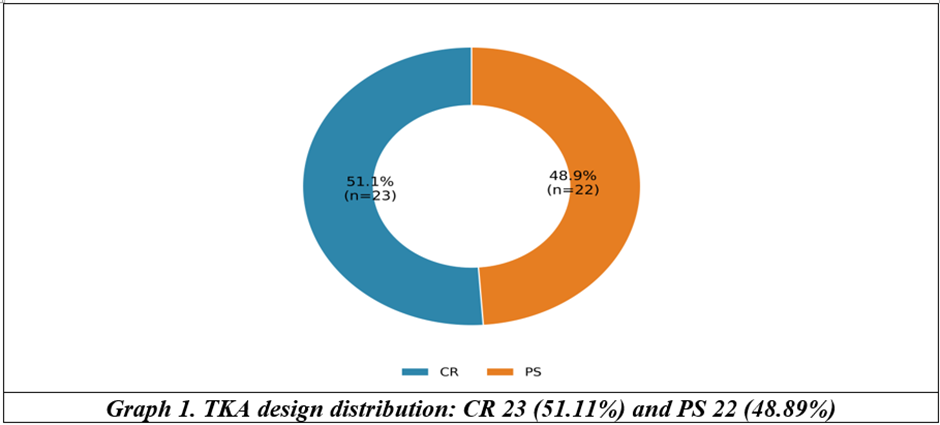
A total of 45 patients were analysed: 23 (51.11%) in the CR group and 22 (48.89%) in the PS group (Graph 1). All patients had primary osteoarthritis and complete two-year follow-up values for the specified outcome measures.
Baseline demographic and clinical characteristics were closely balanced between groups (Table 1). Mean age was 65.91±6.93 years in the CR group and 66.55±6.57 years in the PS group (p=0.755). Mean BMI was 30.62±2.49 kg/m² and 31.01±2.45 kg/m², respectively (p=0.598). Gender and operated side were also comparable. Preoperative KSS knee score, KSS function score, and knee flexion showed no statistically significant intergroup differences.
Table 1. Baseline demographic and clinical characteristics of the study groups
|
Variable |
CR (n=23) |
PS (n=22) |
p-value |
|
Age (years) |
65.91±6.93 |
66.55±6.57 |
0.755 |
|
BMI (kg/m²) |
30.62±2.49 |
31.01±2.45 |
0.598 |
|
Female, n (%) |
12 (52.17) |
11 (50.00) |
1.000 |
|
Male, n (%) |
11 (47.83) |
11 (50.00) |
|
|
Right knee, n (%) |
12 (52.17) |
12 (54.55) |
1.000 |
|
Left knee, n (%) |
11 (47.83) |
10 (45.45) |
|
|
Pre-op KSS knee |
42.91±5.95 |
41.91±5.41 |
0.557 |
|
Pre-op KSS function |
45.70±6.53 |
44.82±6.00 |
0.641 |
|
Pre-op flexion (°) |
94.96±8.44 |
94.68±8.74 |
0.915 |
|
Values are mean±SD unless otherwise stated. CR: cruciate-retaining; PS: posterior-stabilized; BMI: body mass index; KSS: Knee Society Score |
|||
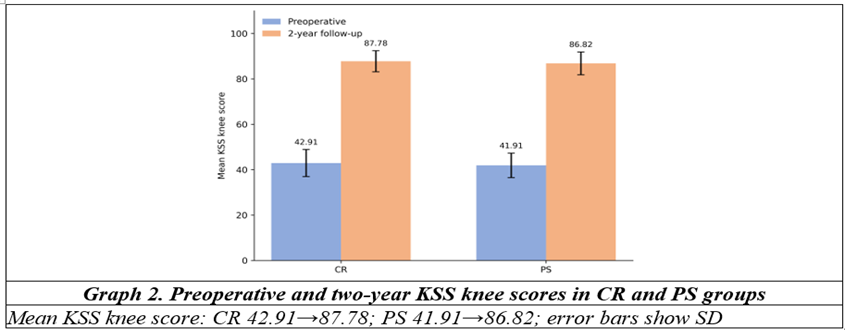
Both groups demonstrated marked improvement in knee-specific and functional scores at two-year follow-up (Table 2). Mean KSS knee score increased from 42.91±5.95 to 87.78±4.64 in CR and from 41.91±5.41 to 86.82±5.05 in PS. The preoperative-to-postoperative improvement was significant in both groups (p<0.001). The pattern of improvement is shown in Graph 2.
Table 2. Preoperative and two-year functional outcomes within each TKA group
|
Outcome |
CR pre-op |
CR 2-year |
p-value |
PS pre-op |
PS 2-year |
p-value |
|
KSS knee |
42.91±5.95 |
87.78±4.64 |
<0.001 |
41.91±5.41 |
86.82±5.05 |
<0.001 |
|
KSS function |
45.70±6.53 |
82.13±6.70 |
<0.001 |
44.82±6.00 |
81.50±6.35 |
<0.001 |
|
Flexion (°) |
94.96±8.44 |
115.96±7.95 |
<0.001 |
94.68±8.74 |
115.18±8.67 |
<0.001 |
|
Within-group p-values were obtained using the Wilcoxon signed-rank test |
||||||
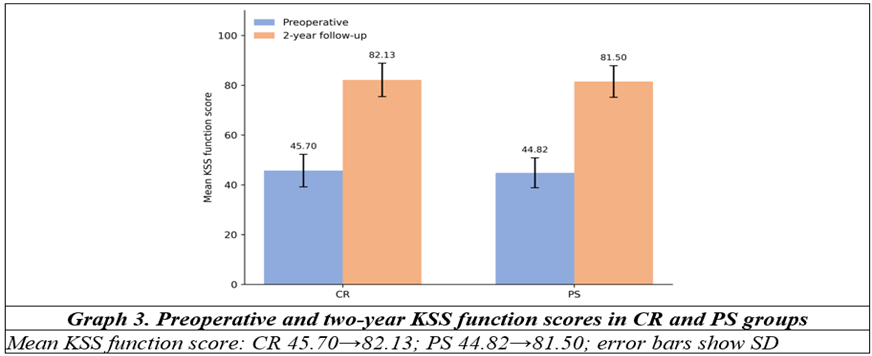
Mean KSS function score improved from 45.70±6.53 to 82.13±6.70 in the CR group and from 44.82±6.00 to 81.50±6.35 in the PS group, again with significant within-group improvement (p<0.001 for each group). Graph 3 illustrates the magnitude of functional recovery.
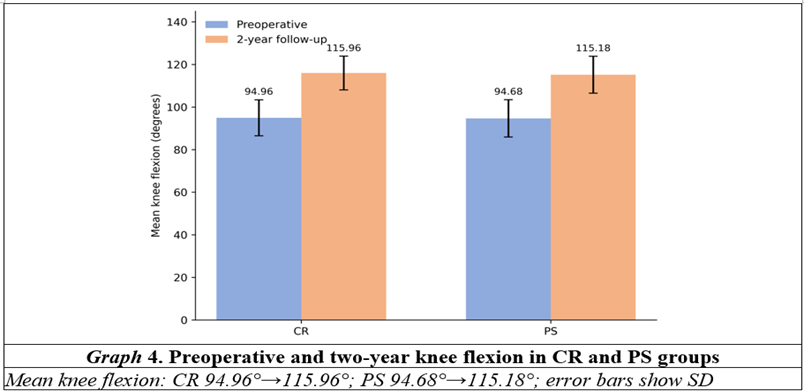
Knee flexion improved from 94.96±8.44° preoperatively to 115.96±7.95° at two years in the CR group. In the PS group, mean flexion increased from 94.68±8.74° to 115.18±8.67°. Both changes were statistically significant (p<0.001), as shown in Graph 4.
Direct comparison of two-year outcomes did not identify a significant advantage for either design (Table 3). The between-group p-values were 0.509 for postoperative KSS knee score, 0.747 for postoperative KSS function score, and 0.756 for postoperative flexion. Likewise, the magnitude of improvement from baseline was similar between CR and PS groups for KSS knee score (p=0.899), KSS function score (p=0.534), and flexion (p=0.841).
Table 3. Comparison of two-year outcomes and magnitude of improvement between CR and PS groups
|
Outcome |
CR (n=23) |
PS (n=22) |
p-value |
|
2-year KSS knee |
87.78±4.64 |
86.82±5.05 |
0.509 |
|
Change in KSS knee |
44.87±2.14 |
44.91±1.15 |
0.899 |
|
2-year KSS function |
82.13±6.70 |
81.50±6.35 |
0.747 |
|
Change in KSS function |
36.43±1.41 |
36.68±0.84 |
0.534 |
|
2-year flexion (°) |
115.96±7.95 |
115.18±8.67 |
0.756 |
|
Change in flexion (°) |
21.00±3.91 |
20.50±1.10 |
0.841 |
|
Two-year continuous outcomes were compared using independent-samples t-tests. Change scores were compared using the Mann-Whitney U test |
|||
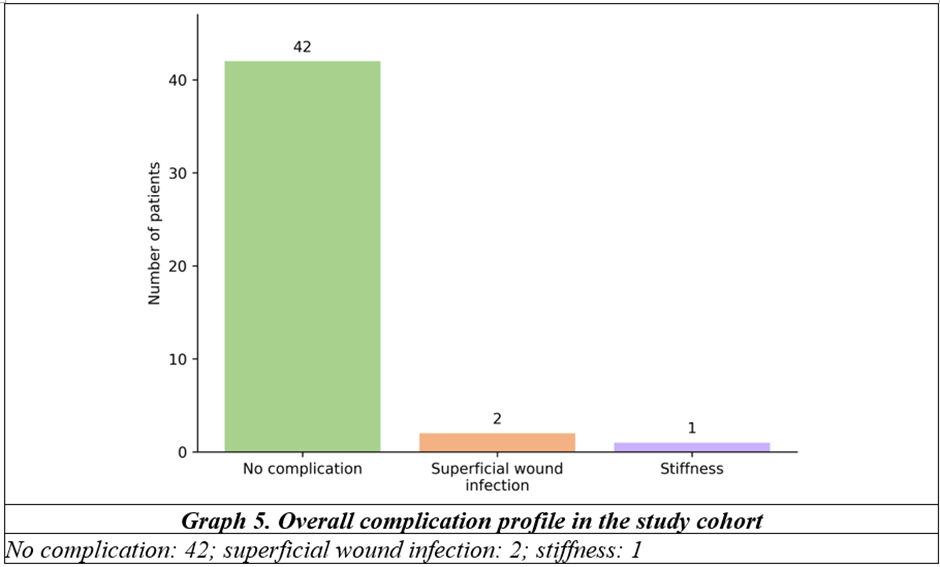
Three patients had recorded complications (Table 4 and Graph 5). In the CR group, one superficial wound infection resolved and one patient developed stiffness requiring manipulation under anaesthesia. In the PS group, one superficial wound infection resolved. Overall complication frequency did not differ significantly between groups (8.70% versus 4.55%; p=1.000).
Table 4. Recorded postoperative complications according to TKA design
|
Complication |
CR (n=23) |
PS (n=22) |
Total (n=45) |
|
None |
21 (91.30%) |
21 (95.45%) |
42 (93.33%) |
|
Superficial wound infection, resolved |
1 (4.35%) |
1 (4.55%) |
2 (4.44%) |
|
Stiffness requiring manipulation under anaesthesia |
1 (4.35%) |
0 |
1 (2.22%) |
|
Any complication |
2 (8.70%) |
1 (4.55%) |
3 (6.67%) |
|
Fisher's exact test for any complication: p=1.000 |
|||
DISCUSSION:
The principal finding of this study is straightforward: both cruciate-retaining and posterior-stabilized total knee arthroplasty produced substantial clinical improvement over two years, while the difference between the two constructs remained small. KSS knee score, KSS function score, and knee flexion improved significantly within both groups, but none of the two-year comparisons reached statistical significance. The change from baseline was also comparable. These findings suggest that, within the characteristics represented in this cohort, successful functional recovery was not dependent on PCL retention or sacrifice alone.
This pattern is consistent with several controlled comparisons. Harato et al., in a multicentre prospective randomized trial, found satisfactory midterm outcomes with both posterior cruciate-retaining and substituting designs, without a consistent functional advantage that would justify routine preference for one construct.[6] Kim et al. similarly compared high-flexion cruciate-retaining and cruciate-substituting prostheses and reported broadly similar functional and radiographic results at short-term follow-up.[7] The present data fit this general pattern, particularly because baseline KSS and flexion were nearly identical between groups.
Short-term studies have occasionally suggested modest differences in specific domains rather than a broad superiority of one design. Kolisek et al. reported favourable outcomes with both posterior-stabilized and PCL-retaining TKA, with differences in recovery characteristics that did not translate into a uniform overall advantage.[8] Kawakami et al., using the newer Knee Society scoring framework at intermediate follow-up, likewise found no statistically significant difference across major clinical outcome domains between CR and PS groups.[9] This reinforces the view that implant design should not be judged by a single numerical outcome in isolation.
One theoretical argument for PCL retention is preservation of more physiologic soft-tissue function and potentially improved extensor mechanics. Yet objective evidence does not consistently demonstrate a functional benefit. Cho et al. found that CR TKA did not produce better quadriceps recovery than PS TKA during early follow-up, and clinical scores and range of motion were comparable.[10] The current study extends that practical observation to two years: KSS function scores were almost identical, with mean values of 82.13 in CR and 81.50 in PS.
The mechanics of PCL sacrifice nevertheless remain important during surgery. Kayani et al. demonstrated that resection of the PCL alters flexion-extension gaps and mediolateral laxity, emphasizing that soft-tissue balance can change substantially when the ligament is sacrificed.[11] This is clinically relevant because a technically well-balanced CR knee and a well-balanced PS knee may both function well, whereas inappropriate tensioning, gap mismatch, malrotation, or instability can compromise either design. Thus, the absence of a functional difference in the present cohort should not be interpreted to mean that PCL management is unimportant. Rather, it suggests that implant selection and balancing should be individualized to ligament quality, deformity, intraoperative stability, and surgical judgement.
Indian evidence is also relevant. Rajgopal et al. evaluated long-term CR and PS knee replacements in patients younger than 55 years and reported excellent survivorship with both constructs. Their CR cohort showed numerically better long-term outcomes and survivorship, but the difference was not statistically significant.[12] Although the age profile in the present study was older, both studies support a pragmatic conclusion: durable and satisfactory outcomes can be achieved with either construct when appropriately selected and implanted.
More recent randomized evidence continues to show the same broad theme. Rehman et al. reported similar pain, function, satisfaction, and general health across cruciate-retaining and posterior-stabilized designs at two years, although maximal flexion was greater in the PS group.[13] In the present cohort, PS flexion was not higher at two years; mean values were 115.18° in PS and 115.96° in CR. This difference across studies may relate to implant geometry, baseline motion, surgical balancing, rehabilitation, or patient characteristics. Importantly, the current between-group difference was less than one degree and was not statistically significant.
Longer-term evidence further reduces the likelihood that a large functional difference exists between the two strategies. Kersten et al., reporting 12-year follow-up from a double-blind randomized trial, found good survival and no significant differences in major clinical or radiological outcomes between posterior cruciate-retaining and posterior-stabilized designs.[14] Tille et al. more recently demonstrated better flexion with PS TKA in a randomized trial but no corresponding improvement in patient satisfaction, underscoring that a statistically greater range of motion does not automatically translate into a clinically superior overall result.[15]
The complication profile in the present study was low and comparable. Two complications occurred in the CR group and one in the PS group. The numbers are too small for a meaningful complication-specific comparison, but there was no signal of a large difference in overall adverse events. The isolated stiffness requiring manipulation occurred in a CR patient, whereas superficial wound infection occurred once in each group and resolved.
From a clinical standpoint, the findings favour a balanced selection strategy rather than routine preference for one implant philosophy. A competent PCL with achievable soft-tissue balance may support a CR construct, while a PS design remains useful when the PCL is insufficient or when predictable balancing requires sacrifice. The functional endpoint appears to depend on the total quality of reconstruction, including alignment, balancing, rehabilitation, and patient factors, rather than on the CR-versus-PS distinction alone.
Limitations
The study has limitations. The sample size was modest, with 23 CR and 22 PS patients, which limits the ability to detect small between-group differences and uncommon complications. The observational design also means that unmeasured factors influencing implant selection could have affected outcomes, and the specific clinical basis for choosing CR or PS was not captured among the study variables. Radiographic alignment, implant manufacturer and geometry, patellar management, detailed deformity, PCL quality, and rehabilitation variables were not evaluated as study outcomes. The analysis relied on KSS and flexion, without additional patient-reported measures such as KOOS, WOMAC, or Oxford Knee Score. Finally, follow-up was limited to two years, so the study cannot address long-term survivorship or revision risk. Despite these constraints, the groups were well balanced at baseline and complete two-year data were available for all 45 patients, allowing a direct comparison of functional recovery. Larger, adequately powered comparative studies incorporating patient-reported and radiographic outcomes would help determine whether smaller design-specific differences exist.
CONCLUSION:
Cruciate-retaining and posterior-stabilized total knee arthroplasty both produced significant improvement in KSS knee score, KSS function score, and knee flexion at two-year follow-up. No statistically significant difference was identified between the two groups in postoperative functional scores, flexion, magnitude of improvement, or overall complication frequency. The findings support individualized selection of CR or PS design according to ligament competence, deformity, intraoperative balancing, and surgeon judgement rather than an expectation of inherent functional superiority of one design.
REFERENCES:
1. World Health Organization. Osteoarthritis [Internet]. Geneva: World Health Organization; 2023 Jul 14 [cited 2026 Aug 8]. Available from: https://www.who.int/news-room/fact-sheets/detail/osteoarthritis.
2. Insall JN, Dorr LD, Scott RD, Scott WN. Rationale of the Knee Society clinical rating system. Clin Orthop Relat Res. 1989;(248):13-4.
3. Clark CR, Rorabeck CH, MacDonald S, MacDonald D, Swafford J, Cleland D. Posterior-stabilized and cruciate-retaining total knee replacement: a randomized study. Clin Orthop Relat Res 2001;(392):208-12.
4. Tanzer M, Smith K, Burnett S. Posterior-stabilized versus cruciate-retaining total knee arthroplasty: balancing the gap. J Arthroplasty 2002;17(7):813-9. doi:10.1054/arth.2002.34814.
5. Maruyama S, Yoshiya S, Matsui N, Kuroda R, Kurosaka M. Functional comparison of posterior cruciate-retaining versus posterior stabilized total knee arthroplasty. J Arthroplasty 2004;19(3):349-53. doi:10.1016/j.arth.2003.09.010.
6. Harato K, Bourne RB, Victor J, Snyder M, Hart J, Ries MD. Midterm comparison of posterior cruciate-retaining versus -substituting total knee arthroplasty using the Genesis II prosthesis: a multicenter prospective randomized clinical trial. Knee 2008;15(3):217-21. doi:10.1016/j.knee.2007.12.007.
7. Kim YH, Choi Y, Kwon OR, Kim JS. Functional outcome and range of motion of high-flexion posterior cruciate-retaining and high-flexion posterior cruciate-substituting total knee prostheses: a prospective, randomized study. J Bone Joint Surg Am 2009;91(4):753-60. doi:10.2106/JBJS.H.00805.
8. Kolisek FR, McGrath MS, Marker DR, Jessup N, Seyler TM, Mont MA, et al. Posterior-stabilized versus posterior cruciate ligament-retaining total knee arthroplasty. Iowa Orthop J 2009;29:23-7.
9. Kawakami Y, Matsumoto T, Takayama K, Ishida K, Nakano N, Matsushita T, et al. Intermediate-term comparison of posterior cruciate-retaining versus posterior-stabilized total knee arthroplasty using the new Knee Scoring System. Orthopedics 2015;38(12):e1127-32. doi:10.3928/01477447-20151123-03.
10. Cho KY, Kim KI, Song SJ, Bae DK. Does cruciate-retaining total knee arthroplasty show better quadriceps recovery than posterior-stabilized total knee arthroplasty? Objective measurement with a dynamometer in 102 knees. Clin Orthop Surg 2016;8(4):379-85. doi:10.4055/cios.2016.8.4.379.
11. Kayani B, Konan S, Horriat S, Ibrahim MS, Haddad FS. Posterior cruciate ligament resection in total knee arthroplasty: the effect on flexion-extension gaps, mediolateral laxity, and fixed flexion deformity. Bone Joint J 2019;101-B(10):1230-7. doi:10.1302/0301-620X.101B10.BJJ-2018-1428.R2.
12. Rajgopal A, Kumar S, Aggarwal K. Evaluating long term outcomes and survivorship of cruciate retaining and sacrificing knee replacements done for degenerative arthritis in patients under 55 years. Indian J Orthop 2021;55(5):1180-5. doi:10.1007/s43465-021-00460-z.
13. Rehman Y, Korsvold AM, Lerdal A, Aamodt A. No difference in patient-reported outcomes with cruciate-retaining, anterior-stabilized, and posterior-stabilized total knee arthroplasty designs. Bone Joint J 2023;105-B(12):1271-8. doi:10.1302/0301-620X.105B12.BJJ-2023-0064.R3.
14. Kersten RFMR, de Vries AJ, van Raaij JJAM, Brouwer RW. 12-year clinical and radiological results of a double-blind randomized controlled trial comparing posterior cruciate-retaining versus posterior-stabilized total knee arthroplasty. Knee 2023;45:110-6. doi:10.1016/j.knee.2023.10.006.
15. Tille E, Beyer F, Lützner C, Postler A, Lützner J. Better flexion but unaffected satisfaction after treatment with posterior stabilized versus cruciate retaining total knee arthroplasty: 2-year results of a prospective, randomized trial. J Arthroplasty 2024;39(2):368-73. doi:10.1016/j.arth.2023.08.044.