A Comparative Study Assessing the Efficacy and Outcomes of Submuscular Plating and Elastic Stable Intramedullary Nailing (ESIN) in Paediatric Diaphyseal Femoral Fractures.
- Avinash G.C. , Assistant Professor, Department of Orthopaedics, Sri Chamundeshwari Medical College Hospital & Research Institute, Channapatna, karnataka, India.
- Bharath M. , Consultant Orthopaedician, Department of Health and Family Welfare, Mysuru, Karnataka, India.
- Madhusudan B. , Senior Consultant, Department of Orthopedics, Syrus Hospital, Kushalnagar, Kodagu, Karnataka, India.
Article Information:
Abstract:
Background: Operative stabilisation of paediatric diaphyseal femoral fractures is commonly achieved with elastic stable intramedullary nailing (ESIN) or submuscular plating. The choice between these methods depends on patient and fracture characteristics, while comparative clinical outcomes remain relevant in routine orthopaedic practice. Objective: To compare perioperative and short-term outcomes of submuscular plating and ESIN in children with diaphyseal femoral fractures. Methods: This comparative observational study included 45 children with diaphyseal femoral fractures and a minimum follow-up of six months. Twenty-two children were managed with submuscular plating and 23 with ESIN. Age, weight, gender, side, fracture pattern, surgery time, time to union, complications, and six-month Flynn grading were analysed. Results: Baseline age, weight, gender, side, and fracture-pattern distributions were comparable between groups. Mean surgery time was 89.77±8.45 minutes with submuscular plating and 58.70±7.16 minutes with ESIN (p<0.001). Mean time to union was 8.64±1.18 weeks and 7.30±0.88 weeks, respectively (p<0.001). At six months, excellent Flynn grading was observed in 18/22 (81.82%) children after plating and 21/23 (91.30%) after ESIN; the difference was not statistically significant (p=0.414). Complications were recorded in 3/22 (13.64%) and 2/23 (8.70%) children, respectively (p=0.665). Conclusion: Both submuscular plating and ESIN produced favourable six-month outcomes in paediatric diaphyseal femoral fractures. ESIN was associated with shorter surgery time and earlier union in this cohort, while Flynn grading and overall complication frequency were comparable between groups.
Keywords:
Article :
INTRODUCTION:
Femoral shaft fractures are important paediatric injuries because they can impose substantial pain, immobility, disruption of schooling, and a considerable caregiving burden on families. Their epidemiology varies with age and mechanism of injury, with falls and road-traffic trauma representing common causes in children.[1] Treatment has evolved from prolonged traction and spica casting toward operative stabilisation in selected school-aged children, particularly when early mobilisation and maintenance of alignment are priorities.[2]
Elastic stable intramedullary nailing changed the operative management of childhood femoral shaft fractures by providing relative stability through a minimally invasive intramedullary construct. The technique is designed to preserve fracture biology and permits early functional recovery in appropriately selected patients.[3] Early multicentre experience with titanium elastic nails demonstrated a high proportion of excellent or satisfactory outcomes, although implant prominence and soft-tissue irritation were recognised complications.[4]
Submuscular plating developed as another biologically respectful strategy, particularly useful when fracture morphology, patient size, or stability requirements make flexible nailing less attractive. By bridging the fracture through limited incisions, the technique aims to maintain length and alignment without extensive exposure of the fracture site. Kanlic et al. reported predictable healing and favourable clinical results with submuscular bridge plating in complex paediatric femoral fractures.[5]
The practical question is therefore not whether either method can work, but which trade-offs matter for a particular child. ESIN may reduce surgical exposure and operative duration, whereas plating may provide stronger control in selected unstable patterns. Both require implant-specific vigilance during follow-up. The present study compared submuscular plating and ESIN in children with diaphyseal femoral fractures, focusing on surgery time, time to union, complications, and functional outcome according to Flynn grading at six months.
MATERIALS AND METHODS:
Study Design and Setting
A hospital-based comparative observational study was conducted in the Department of Orthopaedics in a Tertiary Care Hospital, South India for a period of one year.
Study Population
The study included 45 children with diaphyseal femoral fractures who were managed surgically and had outcome data available for a minimum follow-up of six months.
Study Groups
Patients were classified according to the fixation method used. The submuscular plating group comprised 22 children, while the ESIN group comprised 23 children.
Outcome Measures
Recorded variables included age, gender, body weight, affected side, fracture pattern, duration of surgery, time to union, postoperative complications, and Flynn grading at six months. Fracture patterns were categorised as transverse, oblique, spiral, or comminuted. Flynn grading was reported as excellent or satisfactory in the study cohort.
Statistical Analysis
Continuous variables were summarised as mean±standard deviation and categorical variables as frequency and percentage. Normality was assessed using the Shapiro-Wilk test. Age, weight, and surgery time were compared using the independent-samples t-test. Because time-to-union values were non-normally distributed, the Mann-Whitney U test was used for between-group comparison. Gender, side, fracture pattern, Flynn grading, and overall complication frequency were compared using Fisher exact testing. A two-sided p-value <0.05 was considered statistically significant. Statistical analysis was performed using standard statistical software.
Ethical Considerations
The study was conducted after obtaining approval from the Institutional Ethics Committee. Written informed consent was obtained from the parents or legal guardians of all participating children. Patient confidentiality and anonymity were maintained throughout the study.
RESULTS:
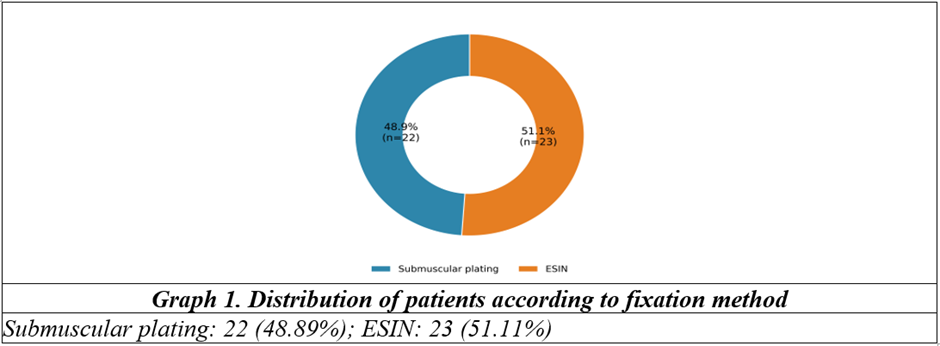
A total of 45 children were analysed, including 22 (48.89%) treated with submuscular plating and 23 (51.11%) treated with ESIN (Graph 1).
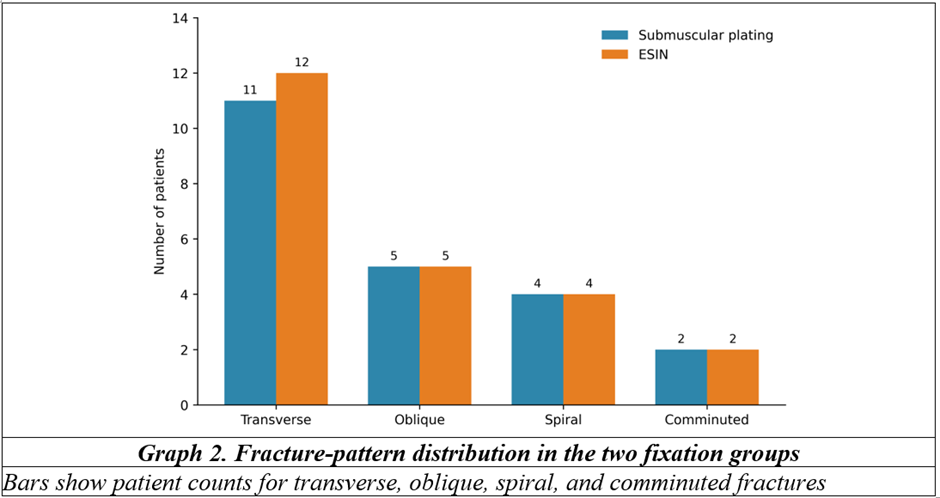
Baseline demographic and fracture characteristics were comparable between groups (Table 1). Mean age was 9.50±2.20 years in the plating group and 8.83±2.21 years in the ESIN group (p=0.311). Mean weight was 32.82±8.43 kg and 29.91±8.18 kg, respectively (p=0.248). Gender and affected side were evenly distributed. Transverse fractures were the commonest pattern in both groups, and the overall fracture-pattern distribution did not differ significantly (p=1.000). Graph 2 shows the fracture-pattern distribution.
Table 1. Baseline demographic and fracture characteristics of the study groups
|
Variable |
Submuscular plating (n=22) |
ESIN (n=23) |
p-value |
|
Age (years) |
9.50±2.20 |
8.83±2.21 |
0.311 |
|
Weight (kg) |
32.82±8.43 |
29.91±8.18 |
0.248 |
|
Male, n (%) |
11 (50.00) |
12 (52.17) |
1.000 |
|
Female, n (%) |
11 (50.00) |
11 (47.83) |
|
|
Right side, n (%) |
11 (50.00) |
12 (52.17) |
1.000 |
|
Left side, n (%) |
11 (50.00) |
11 (47.83) |
|
|
Transverse fracture, n (%) |
11 (50.00) |
12 (52.17) |
1.000 |
|
Oblique fracture, n (%) |
5 (22.73) |
5 (21.74) |
|
|
Spiral fracture, n (%) |
4 (18.18) |
4 (17.39) |
|
|
Comminuted fracture, n (%) |
2 (9.09) |
2 (8.70) |
|
|
Values are mean±SD unless otherwise stated. Fisher exact testing was used for categorical comparisons |
|||
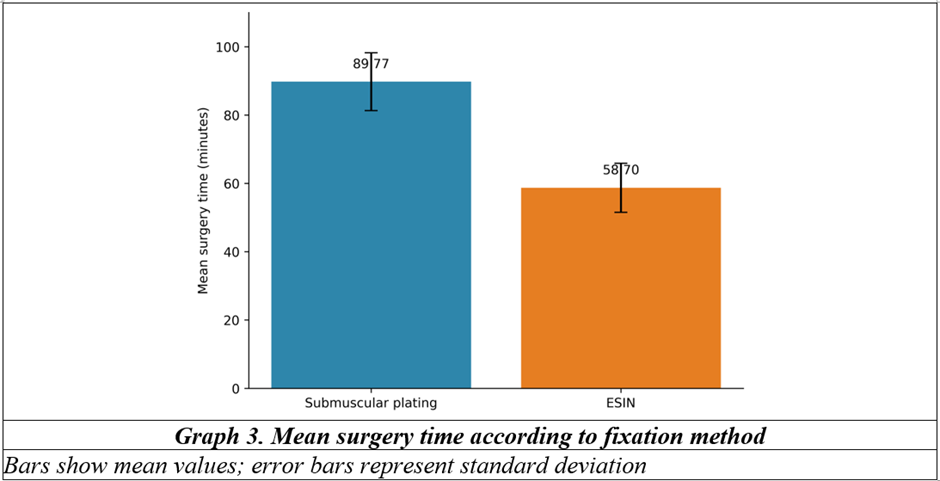
Operative duration was substantially shorter in the ESIN group (Table 2). Mean surgery time was 89.77±8.45 minutes with submuscular plating compared with 58.70±7.16 minutes with ESIN (p<0.001). The difference is illustrated in Graph 3.
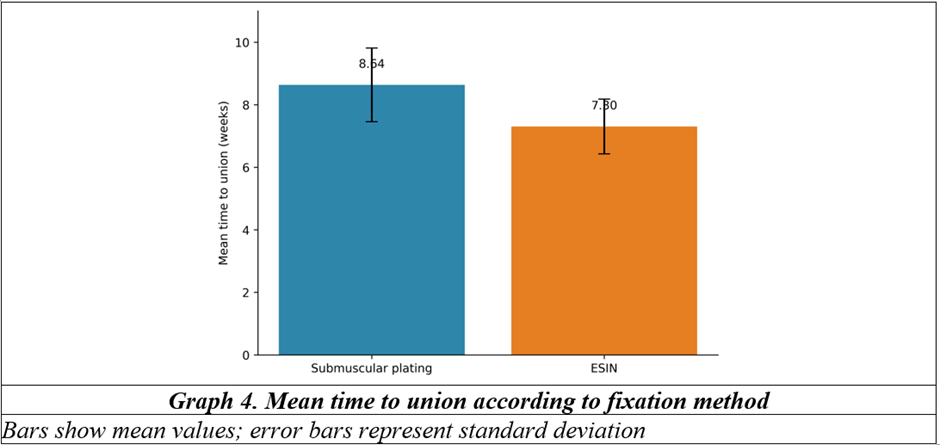
Table 2. Comparison of surgery time and time to union between fixation methods
|
Outcome |
Submuscular plating (n=22) |
ESIN (n=23) |
p-value |
|
Surgery time (min) |
89.77±8.45 |
58.70±7.16 |
<0.001 |
|
Surgery time range (min) |
76-108 |
46-72 |
|
|
Time to union (weeks) |
8.64±1.18 |
7.30±0.88 |
<0.001 |
|
Union-time range (weeks) |
7-11 |
6-9 |
|
|
Surgery time was compared using an independent-samples t-test; time to union was compared using the Mann-Whitney U test |
|||
Time to union was also shorter in the ESIN group. Mean union time was 8.64±1.18 weeks after submuscular plating and 7.30±0.88 weeks after ESIN (p<0.001) (Table 2 and Graph 4). All 45 children had a recorded time to union.
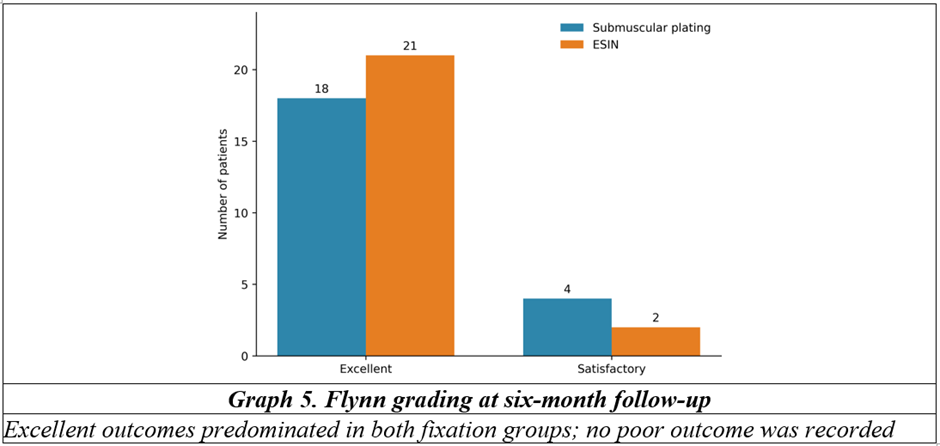
At six months, Flynn grading was excellent in 18/22 (81.82%) children in the submuscular plating group and 21/23 (91.30%) in the ESIN group. Four children (18.18%) after plating and two (8.70%) after ESIN had satisfactory outcomes. No poor Flynn grade was recorded. The difference in grading distribution was not statistically significant (p=0.414) (Table 3 and Graph 5).
Table 3. Six-month functional outcome according to Flynn grading
|
Flynn grade at 6 months |
Submuscular plating (n=22) |
ESIN (n=23) |
p-value |
|
Excellent |
18 (81.82%) |
21 (91.30%) |
0.414 |
|
Satisfactory |
4 (18.18%) |
2 (8.70%) |
|
|
Poor |
0 |
0 |
|
|
Fisher exact test was used for the excellent-versus-satisfactory distribution |
|||
Postoperative complications were infrequent and predominantly minor (Table 4). The plating group had one superficial wound irritation, one hypertrophic scar, and one superficial infection that resolved. In the ESIN group, one child developed entry-site skin irritation and one developed entry-site bursitis. Overall complication frequency was 13.64% with submuscular plating and 8.70% with ESIN (p=0.665).
Table 4. Recorded postoperative complications according to fixation method
|
Complication |
Submuscular plating (n=22) |
ESIN (n=23) |
Total (n=45) |
|
None |
19 (86.36%) |
21 (91.30%) |
40 (88.89%) |
|
Superficial wound irritation |
1 (4.55%) |
0 |
1 (2.22%) |
|
Hypertrophic scar |
1 (4.55%) |
0 |
1 (2.22%) |
|
Superficial infection, resolved |
1 (4.55%) |
0 |
1 (2.22%) |
|
Entry-site skin irritation |
0 |
1 (4.35%) |
1 (2.22%) |
|
Entry-site bursitis |
0 |
1 (4.35%) |
1 (2.22%) |
|
Any complication |
3 (13.64%) |
2 (8.70%) |
5 (11.11%) |
|
Fisher exact test for any complication: p=0.665 |
|||
DISCUSSION:
The principal finding of this comparative study was that both fixation methods produced favourable six-month outcomes, but ESIN was associated with a markedly shorter operative duration and a shorter observed time to union. Functional grading remained high in both groups, and the difference in excellent Flynn outcomes was not statistically significant. Complications were uncommon and mostly minor. Taken together, these findings suggest that the major distinction in this cohort was perioperative efficiency and speed of union rather than a clear separation in short-term functional outcome.
The shorter operative time with ESIN is consistent with earlier comparative literature. Caglar et al. reported significantly shorter operation time with flexible intramedullary nailing than with plate fixation while maintaining a high union rate.[6] Allen et al. similarly found longer operative time and greater resource utilisation with plating, while patient outcomes remained broadly equivalent between techniques.[7] In the present cohort, the difference was substantial, approximately 31 minutes on average, which can be clinically relevant in busy trauma operating lists and resource-constrained settings.
Sutphen et al. compared submuscular plating with intramedullary fixation in a large paediatric cohort and highlighted that outcomes differ according to the specific fixation strategy and complication profile.[8] Flexible nailing was associated with hardware irritation and malunion in their series, while submuscular plating permitted rapid progression to weight bearing and union. That pattern contrasts partly with the present finding of earlier union after ESIN. The discrepancy is plausible because time to union is influenced by fracture stability, age, body size, postoperative protection, and the criteria used to define union. These variables were not sufficiently detailed in the present cohort to attribute the union difference to implant choice alone.
Chen et al. also demonstrated shorter operative time with flexible nails compared with submuscular plates, along with less estimated blood loss and a shorter postoperative stay.[9] Their complication profile was mixed: surgical-site infection occurred with both constructs, while implant irritation was more common with flexible nails. In the current study, entry-site irritation and bursitis occurred only in the ESIN group, whereas wound irritation, hypertrophic scarring, and superficial infection occurred in the plating group. The event numbers were small, and the overall complication rates were statistically comparable.
An especially relevant comparison comes from South India. James et al. randomised children with diaphyseal femoral fractures to ESIN or submuscular plating and concluded that both were safe, viable, and effective; however, the need for additional implant-removal procedures influenced treatment preference in their resource-limited setting.[10] The present observational findings similarly support the clinical acceptability of both constructs. They do not, however, evaluate implant-removal burden or cost, and therefore cannot establish an economic advantage.
Fracture stability remains an important determinant of interpretation. Li et al. studied length-unstable femoral shaft fractures in school-aged children and found comparable clinical outcomes with ESIN and submuscular plating, with ESIN offering shorter operative time, lower estimated blood loss, and shorter hospital stay.[11] Their work shows that ESIN can perform well even in selected unstable patterns, although additional postoperative protection may be required. In the present study, the fracture-pattern distribution was nearly identical between groups, including two comminuted fractures in each group, but fracture length stability was not separately recorded.
El-Adly et al. compared flexible intramedullary nails and submuscular locked plating in children and again reported longer operative and radiation times with plating.[12] Their study, however, described some clinical advantages with plating in parameters such as range of motion and alignment. This reinforces an important point: shorter surgery does not automatically mean a universally superior fixation method. Mechanical control, fracture geometry, soft-tissue handling, patient weight, and the surgeon's ability to obtain stable fixation remain central.
Indian data using both techniques are broadly consistent with favourable outcomes. Venkataraman et al. reported predominantly excellent results with both locking compression plating and titanium elastic nailing in paediatric diaphyseal fractures.[13] Govindasamy et al., in an Indian ESIN series, reported excellent Flynn outcomes in 83% and satisfactory outcomes in 17%, with soft-tissue discomfort at the nail end being a common problem.[14] In the present study, the ESIN excellent-outcome proportion was 91.30%, with only two minor entry-site complications.
The relationship between child size and flexible-nail outcome also deserves attention. Moroz et al. demonstrated that increasing age and weight were associated with poorer outcomes after titanium elastic nailing, particularly in heavier children.[15] Mean weight in the present ESIN group was approximately 30 kg, and the highest recorded weight was 44 kg. Because allocation criteria were not available, the current results should not be extrapolated to substantially heavier adolescents or to fractures requiring greater mechanical stability.
From a practical standpoint, both techniques remain useful rather than mutually exclusive. ESIN may be attractive when a minimally invasive construct with shorter theatre time is desirable and fracture geometry is suitable. Submuscular plating remains valuable when stronger length and rotational control is needed. In Indian centres, where theatre availability, follow-up access, implant cost, and the burden of a second procedure can influence family decision-making, implant choice should remain individualised rather than based on a single outcome measure.
Limitations
This study has several limitations. The sample size was modest, with 22 children in the submuscular plating group and 23 in the ESIN group, limiting the ability to detect small differences in functional outcomes and uncommon complications. The observational design does not eliminate selection bias, and the clinical basis for choosing one fixation method over the other was not recorded. Follow-up was reported only as a minimum of six months, so long-term alignment, limb-length discrepancy, refracture, implant-removal morbidity, and late functional outcomes could not be assessed. Important perioperative variables such as blood loss, fluoroscopy exposure, hospital stay, time to full weight bearing, and implant cost were also unavailable. In addition, detailed radiographic parameters, including residual angulation and shortening, were not part of the recorded outcome set. Larger comparative studies with longer follow-up and standardised radiographic and patient-centred outcome measures would strengthen the evidence.
CONCLUSION:
Both submuscular plating and ESIN achieved favourable six-month outcomes in children with diaphyseal femoral fractures. ESIN was associated with significantly shorter surgery time and earlier union in this cohort, while Flynn grading and overall complication frequency were comparable between groups. The findings support the use of either method according to fracture characteristics, child size, fixation requirements, available resources, and surgeon judgement rather than assuming universal superiority of one construct.
REFERENCES:
1. Loder RT, O'Donnell PW, Feinberg JR. Epidemiology and mechanisms of femur fractures in children. J Pediatr Orthop 2006;26(5):561-566. doi:10.1097/01.bpo.0000230335.19029.ab.
2. Hunter JB. Femoral shaft fractures in children. Injury 2005;36 Suppl 1:A86-A93. doi:10.1016/j.injury.2004.12.018.
3. Ligier JN, Metaizeau JP, Prevot J, Lascombes P. Elastic stable intramedullary nailing of femoral shaft fractures in children. J Bone Joint Surg Br 1988;70(1):74-77. doi:10.1302/0301-620X.70B1.3339064.
4. Flynn JM, Hresko T, Reynolds RA, Blasier RD, Davidson R, Kasser J. Titanium elastic nails for pediatric femur fractures: a multicenter study of early results with analysis of complications. J Pediatr Orthop 2001;21(1):4-8. doi:10.1097/00004694-200101000-00003.
5. Kanlic EM, Anglen JO, Smith DG, Morgan SJ, Pesantez RF. Advantages of submuscular bridge plating for complex pediatric femur fractures. Clin Orthop Relat Res 2004;(426):244-251. doi:10.1097/01.blo.0000138961.34810.af.
6. Caglar O, Aksoy MC, Yazici M, Surat A. Comparison of compression plate and flexible intramedullary nail fixation in pediatric femoral shaft fractures. J Pediatr Orthop B 2006;15(3):210-214. doi:10.1097/01.bpb.0000186642.91944.68.
7. Allen JD, Murr K, Albitar F, Jacobs C, Moghadamian ES, Muchow R. Titanium elastic nailing has superior value to plate fixation of midshaft femur fractures in children 5 to 11 years. J Pediatr Orthop 2018;38(3):e111-e117. doi:10.1097/BPO.0000000000001129.
8. Sutphen SA, Mendoza JD, Mundy AC, Yang JG, Beebe AC, Samora WP 3rd, et al. Pediatric diaphyseal femur fractures: submuscular plating compared with intramedullary nailing. Orthopedics 2016;39(6):353-358. doi:10.3928/01477447-20160719-03.
9. Chen LK, Sullivan BT, Sponseller PD. Submuscular plates versus flexible nails in preadolescent diaphyseal femur fractures. J Child Orthop 2018;12(5):488-492. doi:10.1302/1863-2548.12.180036.
10. James D, Martin D, Kumar A, Krishnan S, Gahukamble A, Madhuri V, et al. Elastic stable intramedullary nailing versus submuscular plating in pediatric diaphyseal femur fractures: a randomized controlled trial among children in South India. J Pediatr Orthop B 2022;31(2):e122-e129. doi:10.1097/BPB.0000000000000933.
11. Li J, Rai S, Ze R, Tang X, Liu R, Hong P. The optimal choice for length unstable femoral shaft fracture in school-aged children: a comparative study of elastic stable intramedullary nail and submuscular plate. Medicine (Baltimore) 2020;99(25):e20796. doi:10.1097/MD.0000000000020796.
12. El-Adly W, El-Gafary K, Khashaba M, Abubeih H. Flexible intramedullary nail versus submuscular locked plate with the cluster technique in pediatric femoral shaft fractures fixation. Indian J Orthop 2022;56(4):580-586. doi:10.1007/s43465-021-00571-7.
13. Venkataraman S, Ethiraj P, Shanthappa AH, Vellingiri K. Treatment of diaphyseal fractures of the femur in paediatric age group: a comparative study of locking compression plate versus titanium elastic nailing system (TENS). Cureus 2022;14(9):e28924. doi:10.7759/cureus.28924.
14. Govindasamy R, Gnanasundaram R, Kasirajan S, Ibrahim S, Melepuram JJ. Elastic stable intramedullary nailing of femoral shaft fracture-experience in 48 children. Arch Bone Jt Surg 2018;6(1):39-46.
15. Moroz LA, Launay F, Kocher MS, Newton PO, Frick SL, Sponseller PD, et al. Titanium elastic nailing of fractures of the femur in children: predictors of complications and poor outcome. J Bone Joint Surg Br 2006;88(10):1361-1366. doi:10.1302/0301-620X.88B10.17517.