Effectiveness Of Single-Stage Transperineal Dorsolateral Buccal Mucosal Graft Urethroplasty For Treatment Of Long Segment Anterior Urethral Strictures.
- Vipin Kumar , Department of General Surgery, NCR Institute of Medical Sciences, Meerut, UP.
- Nitesh Chhikara , Department of Dentistry, SHKM Government Medical College and Hospital, Nuh, Haryana
Article Information:
Abstract:
Objectives: To evaluate the effectiveness of single-stage buccal mucosal graft (BMG) urethroplasty and to evaluate donor- and recipient-site complications following single-stage BMG urethroplasty in long segment anterior urethral strictures. Methods: This prospective study included 38 patients with long segment anterior urethral strictures (>4 cm) from July 2022 to July 2024, operated using Kulkarni’s single-stage transperineal dorsolateral onlay BMG urethroplasty. Patients were followed up for 12–18 months. Postoperative complications were categorized as mild, moderate and severe. Patients requiring redo surgery/redo urethroplasty were considered treatment failures. Results: Out of 38 patients, 7 (18.4%) developed postoperative complications. Only 1 (2.6%) patient developed postoperative recurrent panurethral stricture due to recurrent BXO and was considered as treatment failure. The remaining 6 patients with postoperative complications were managed conservatively. The failure case had postoperative Qmax<10 ml/s with PVR >200 ml. Two patients with moderate complications had postoperative Qmax>10 ml/s with PVR ~50 ml. The remaining 31 patients had postoperative Qmax>15 ml/s with PVR <20 ml. Overall success rate was 97.4% (37/38). Conclusion: Single-stage dorsolateral onlay urethroplasty using buccal mucosal graft (BMG) via unilateral urethral mobilization is an effective and safe technique for long segment anterior urethral strictures with good functional outcomes and minimal impact on sexual function.
Keywords:
Article :
INTRODUCTION:
Urethral stricture disease is a common and challenging condition encountered in urological practice, characterized by narrowing of the urethral lumen due to fibrosis of the corpus spongiosum. It affects approximately 200–300 per 100,000 men and contributes significantly to lower urinary tract symptoms (LUTS), urinary retention, recurrent urinary tract infections, bladder dysfunction, and renal impairment if left untreated [1,2]. The condition imposes considerable morbidity and healthcare burden, particularly in developing countries where infectious and inflammatory etiologies remain prevalent. Management options for urethral strictures include urethral dilatation, direct vision internal urethrotomy (DVIU), and open urethral reconstruction (urethroplasty). While dilatation and DVIU may provide temporary relief, their long-term success is limited, particularly in strictures longer than 1–2 cm, dense fibrosis, or recurrent disease [3-6]. Repeated endoscopic interventions often exacerbate spongiofibrosis and reduce the success of future reconstructive surgery. Consequently, urethroplasty has emerged as the definitive treatment modality for long segment anterior urethral strictures [7].
Urethroplasty techniques are broadly classified into excision and primary anastomosis (EPA) and substitution urethroplasty. EPA is suitable for short bulbar strictures (<2 cm), whereas long segment strictures require tissue substitution using grafts or flaps [8]. Among various graft materials used historically—including penile skin, scrotal skin, and bladder mucosa—buccal mucosal graft (BMG) has become the gold standard due to its favorable biological characteristics [9].
Single-stage transperineal dorsolateral BMG urethroplasty has gained widespread acceptance for management of long segment anterior urethral strictures, offering high success rates, reduced donor site morbidity, and preservation of sexual function [10-12]. However, outcomes may vary depending on stricture length, etiology, prior interventions, and presence of lichen sclerosus. Long-term follow-up data remain essential to evaluate durability and recurrence patterns.
Given the increasing incidence of long segment anterior urethral strictures and evolving reconstructive techniques, the present study was undertaken to evaluate the effectiveness and safety of single-stage transperineal dorsolateral buccal mucosal graft urethroplasty (Kulkarni technique) in patients with long segment anterior urethral strictures, with particular emphasis on functional outcomes and donor- and recipient-site complications.
MATERIALS AND METHODS :
This prospective study was conducted at the Urology Department, Optima Multispeciality Hospital, Meerut and NCRIMS, Meerut from July 2022 to July 2024, with follow-up of 12–18 months. A sample size of 38 patients was evaluated regarding the effectiveness of single-stage BMG urethroplasty in long segment anterior urethral strictures and complications at donor and recipient sites following single-stage BMG urethroplasty.
Inclusion and Exclusion Criteria
The study included adult male patients aged ≥18 years with long-segment anterior urethral strictures measuring >4 cm, involving the bulbar urethra, penile urethra, or the entire anterior urethra (panurethral stricture). Patients with idiopathic, post-traumatic (>4 weeks after injury), post-infective, or lichen sclerosus-associated strictures (balanitis xerotica obliterans [BXO]) were eligible for inclusion, provided they were fit for surgery and willing to provide informed written consent. Patients who were unwilling to undergo surgical intervention, had a history of failed urethroplasty, urethral abscess or urethrocutaneous fistula, active urinary tract infection at the time of surgery, poor oral hygiene or active oral infection precluding buccal mucosal graft harvesting, severe comorbid illness rendering them unfit for anesthesia, neurogenic bladder dysfunction, or radiation-induced urethral strictures were excluded.
Preoperative evaluation comprised a detailed history and physical examination, uroflowmetry with assessment of maximum urinary flow rate (Qmax), ultrasonographic measurement of post-void residual (PVR) urine volume, retrograde urethrography (RGU), and voiding cystourethrography (VCUG)/micturating cystourethrography (MCU), along with other investigations as clinically indicated. A suprapubic catheter was placed preoperatively in patients presenting with acute urinary retention or deranged renal function parameters.
Outcome Measures
Treatment success was defined as freedom from the need for redo urethroplasty during the follow-up period. Treatment failure was defined as recurrence or persistence of stricture requiring redo urethroplasty. Complications were graded according to the severity of intervention required: mild complications were those managed with medical treatment alone, moderate complications required non-operative interventions such as urethral dilatation or self-catheterization, and severe complications required operative intervention. The need for redo urethroplasty was considered a treatment failure.
Surgical technique (Kulkarni’s procedure)
Surgery was performed under general anesthesia with nasal intubation. Patients were positioned in exaggerated dorsal lithotomy with padding of pressure points. Two teams worked simultaneously—one at donor site (Figure 1, 2) and one at recipient site (Figure 3, 4). A midline perineal incision was made to expose bulbar urethra while preserving the central tendon of the perineum and bulbospongiosus muscle. The urethra was mobilized from corpora cavernosa on the left side only, preserving blood supply from the right. The penis was invaginated into the perineal incision and the urethra dissected along the same side. The urethra was rotated partially and a dorsolateral urethrotomy performed, extending 1 cm beyond the stricture proximally and distally. In strictures extending to the meatus, dorsal meatotomy was performed and connected to the distal urethrotomy.
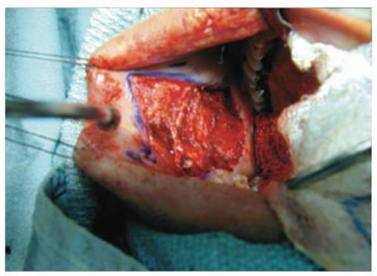
Figure 1: Buccal mucosa harvest site making and dissection
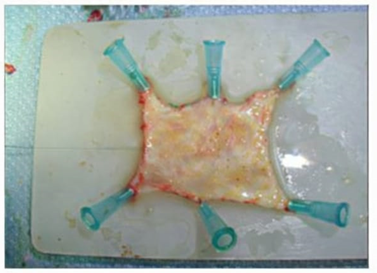
Figure 2: Harvested buccal mucosal graft
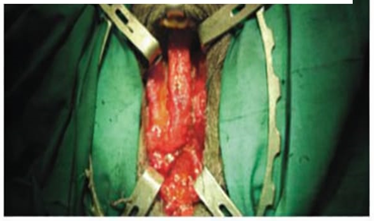
Figure 3: Dorsolateral urethrotomy
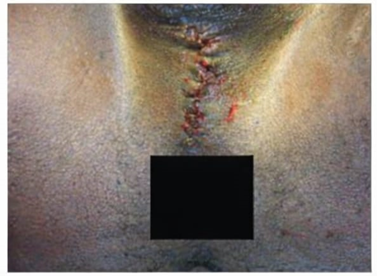
Figure 4: Sutured perineal incision at the end of surgery
Buccal mucosal graft was harvested from inner cheek away from Stensen’s duct and mucocutaneous junction. Depending on graft length, one or both cheeks were used. The donor site was left open for re-epithelialization. The graft was tailored and fixed over corpora, and edges sutured to urethral margins using 4-0 polyglactin over a 14 Fr silicone Foley catheter. Wound closure was performed in layers. Catheter was kept for 3–4 weeks.
RESULTS:
A total of 38 patients with anterior urethral stricture disease underwent dorsal onlay buccal mucosal graft urethroplasty. The age of the patients ranged from 18 to 57 years. The stricture length varied from 4 to 12 cm, with a mean length of 7 cm. Preoperatively, all patients had significant bladder outlet obstruction, with a maximum urinary flow rate (Qmax) <10 ml/s and post-void residual urine (PVR) >200 ml. The majority of patients had panurethral strictures (76.3%), followed by long-segment bulbar strictures (13.2%) and long-segment penile strictures (10.5%) (Table 1).
Table 1: Distribution of Stricture Site (n=38)
|
Stricture site |
No. of patients |
Percentage (%) |
|
Long segment bulbar |
5 |
13.2 |
|
Long segment penile |
4 |
10.5 |
|
Panurethral |
29 |
76.3 |
|
Total |
38 |
100 |
The most common etiology was balanitis xerotica obliterans (BXO)/lichen sclerosus (39.5%), followed by idiopathic strictures (28.9%). Trauma, catheter-related injury, and post-TURP strictures accounted for 13.2%, 10.5%, and 7.9% of cases, respectively (Table 2).
Table 2: Etiology Distribution (n=38)
|
Etiology |
No. of patients |
Percentage (%) |
|
Idiopathic |
11 |
28.9 |
|
BXO (lichen sclerosus) |
15 |
39.5 |
|
Trauma |
5 |
13.2 |
|
Catheter related |
4 |
10.5 |
|
Post-surgery (TURP) |
3 |
7.9 |
|
Total |
38 |
100 |
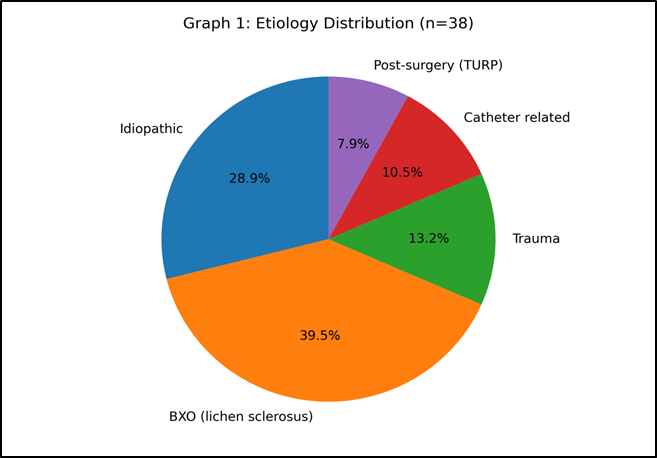
Graph 1 shows etiological distribution. Only 1 patient (2.6%) developed postoperative recurrent panurethral stricture due to recurrent BXO and was considered a treatment failure requiring redo urethroplasty. The remaining 6 patients with postoperative complications were managed conservatively. Postoperative functional outcomes showed that the failure case had Qmax<10 ml/s with PVR >200 ml. Two patients with moderate complications had postoperative Qmax>10 ml/s with PVR ~50 ml, while the remaining 31 patients had postoperative Qmax>15 ml/s with PVR <20 ml. Overall success rate: 97.4% (37/38).
Overall, 7 of 38 patients (18.4%) developed postoperative complications. Mild complications included buccal donor-site discomfort in one patient (2.6%) and wound infection in three patients (7.9%), all of which were managed conservatively with analgesics or antibiotics. Two patients (5.3%) developed graft contracture/partial recurrent stricture, both of whom maintained satisfactory urinary flow (Qmax >10 ml/s) and were successfully managed with sequential urethral dilatation and clean intermittent self-catheterization. One patient (2.6%) with recurrent BXO experienced graft failure with recurrent panurethral stricture, characterized by persistent obstructive urinary parameters (Qmax <10 ml/s and PVR >200 ml), and subsequently underwent redo urethroplasty. Except for this single failure, all patients demonstrated satisfactory postoperative functional outcomes, with Qmax >15 ml/s and PVR <20 ml. (Table 3).
Table 3: Postoperative Complications (n=38)
|
Grade |
Complication |
No. of patients |
Etiology |
Post-op Qmax |
Post-op PVR |
Management |
|
Mild |
Buccal discomfort |
1 |
Idiopathic |
>15 ml/s |
<20 ml |
Analgesics |
|
Mild |
Wound infection |
3 |
BXO-2; Catheter related-1 |
>15 ml/s |
<20 ml |
Antibiotics |
|
Moderate |
Graft contracture / partial stricture |
2 |
BXO-1; Trauma-1 |
>10 ml/s |
~50 ml |
Sequential dilatation + self catheterisation |
|
Severe |
Graft failure / recurrent panurethral stricture |
1 |
Recurrent BXO |
<10 ml/s |
>200 ml |
Redo urethroplasty (failure) |
DISCUSSION :
Long segment anterior urethral strictures represent one of the most complex scenarios in reconstructive urology. Increasing stricture length, multifocal disease, lichen sclerosus (BXO), and prior instrumentation significantly increase recurrence risk and technical difficulty. Over the past three decades, substitution urethroplasty using buccal mucosal graft (BMG) has become the gold standard for reconstruction of long anterior urethral strictures due to its favorable biological characteristics and durable long-term outcomes [13].
Barbagli popularized the dorsal onlay BMG urethroplasty technique in 1996, demonstrating superior graft support and durable outcomes [1]. Subsequent refinements included the one-sided urethral mobilization technique described by Kulkarni et al., which preserves contralateral vascular supply and minimizes disruption of bulbospongiosus muscle and neurovascular bundles [3]. This modification is particularly valuable in panurethral strictures where extensive mobilization may compromise urethral blood supply [14].
The Kulkarni technique incorporates several reconstructive principles, including unilateral urethral mobilization, preservation of the central tendon of the perineum, dorsolateral placement of the graft, and minimal circumferential urethral dissection. These technical refinements are intended to minimize disruption of the urethral blood supply, preserve erectile function, and promote optimal graft vascularization and survival [15].
Comparison with Published Literature
In the present study, the overall success rate was 97.4% (37/38) over a follow-up period of 12–18 months. This outcome compares favorably with large published series of dorsal BMG urethroplasty, where success rates typically range from 85% to 95% depending on follow-up duration and etiology [7].
Kulkarni et al. reported long-term success rates of approximately 83–90% in panurethral strictures with follow-up exceeding five years [3]. Similarly, contemporary systematic reviews and meta-analyses have shown pooled success rates of 88–92% for dorsal BMG urethroplasty in long anterior urethral strictures [8]. The slightly higher success rate in the present study may reflect shorter follow-up duration, meticulous patient selection, and adherence to standardized technique.
Impact of Stricture Etiology
In this study, BXO (lichen sclerosus) was the most common etiology (39.5%), followed by idiopathic causes (28.9%). Lichen sclerosus is widely recognized as a progressive inflammatory condition associated with higher recurrence rates after urethroplasty due to ongoing fibrosis and involvement of penile skin and urethral plate [9]. The only failure in this series occurred in a patient with recurrent BXO, resulting in graft failure and recurrent panurethral stricture. This finding is consistent with existing literature, which identifies lichen sclerosus as an independent predictor of recurrence [8, 9]. Long-term surveillance is particularly important in this subgroup because recurrence may occur several years after reconstruction. Traumatic and catheter-related strictures, in contrast, typically demonstrate better outcomes due to localized fibrosis and absence of ongoing inflammatory pathology [16].
Functional Outcomes
Preoperatively, all patients had Qmax<10 ml/s and PVR >200 ml, reflecting significant obstruction. Postoperatively, 81.6% of patients achieved Qmax>15 ml/s with minimal residual urine (<20 ml), indicating excellent functional restoration. Two patients with moderate complications maintained Qmax>10 ml/s and were successfully managed with sequential dilatation and self-catheterization. Objective uroflowmetry improvement is a widely accepted surrogate marker for functional success. According to contemporary guidelines, a Qmax>15 ml/s with absence of obstructive symptoms is considered satisfactory after urethroplasty [10, 11]. The findings in this study align with these standards.
CONCLUSION:
Single-stage dorsolateral onlay urethroplasty using buccal mucosal graft (BMG) via unilateral urethral mobilization is an effective and safe technique for long segment anterior urethral strictures with good functional outcomes and minimal impact on sexual function.
REFERENCES:
1. Santucci RA, Joyce GF, Wise M. Male urethral stricture disease. J Urol. 2007; 177:1667–1674.
2. Anger JT, Buckley JC, Santucci RA, Elliott SP, Saigal CS. Trends in stricture management among male Medicare beneficiaries. Urology. 2011; 77:481–485.
3. Barbagli G, Palminteri E, Lazzeri M, Guazzoni G. Anterior urethral strictures. BJU Int. 2003; 92:497–505.
4. Mundy AR, Andrich DE. Urethral strictures. BJU Int. 2011; 107:6–26.
5. Depasquale I, Park AJ, Bracka A. The treatment of balanitisxerotica obliterans. BJU Int. 2000; 86:459–465.
6. Steenkamp JW, Heyns CF, de Kock ML. Internal urethrotomy versus dilatation as treatment for male urethral strictures. J Urol. 1997; 157:98–101.
7. Mangera A, Chapple CR. Management of anterior urethral stricture: an evidence-based approach. CurrOpin Urol. 2010; 20:453–458.
8. Andrich DE, Mundy AR. What is the best technique for urethroplasty? Eur Urol. 2008; 54:1031–1041.
9. Andrich DE, Mundy AR. Substitution urethroplasty with buccal mucosal free grafts. J Urol. 2001; 165:1131–1133.
10. Humby G. A one-stage operation for hypospadias. Br J Surg. 1941; 29:84–92.
11. Markiewicz MR, DeSantis JL, Margarone JE, Pogrel MA, Chuang SK. Morbidity associated with oral mucosa harvest for urethral reconstruction: a systematic review. J Urol. 2007; 178:1170–1176.
12. Barbagli G, Selli C, Tosto A, Palminteri E. Dorsal free graft urethroplasty. J Urol. 1996; 155:123–126.
13. Kulkarni SB, Barbagli G, Sansalone S, Lazzeri M. One-sided anterior urethroplasty: a new dorsal onlay graft technique. BJU Int. 2009; 104:1150–1155.
14. European Association of Urology (EAU). EAU Guidelines on Urethral Strictures. 2023 edition.
15. Palminteri E, Lazzeri M, Guazzoni G, Turini D, Barbagli G. New 2-stage buccal mucosal graft urethroplasty. J Urol. 2002; 167:130–132.
16. Blaschko SD, Sanford MT, Cinman NM, McAninch JW, Breyer BN. De novo erectile dysfunction after anterior urethroplasty: a systematic review. J Urol. 2013; 189:1727–1732.