Thrombocytopenia in End-Stage Renal Disease: A Comparative Study of Patients on Maintenance Haemodialysis and Those Not Yet on Maintenance Haemodialysis.
- Sangappa , Assistant Professor, Department of General Medicine, Ballari Medical College and Research Centre Ballari, Karnataka, India.
- Tejaswini T.S. , Assistant Professor, Department of General Medicine, Ballari Medical College and Research Centre Ballari, Karnataka, India.
- Arunkumar , Resident, Department of General Medicine, Ballari Medical College and Research Centre Ballari, Karnataka, India.
- Hally Karibasappa , Professor, Department of General Medicine, Ballari Medical College and Research Centre Ballari, Karnataka, India.
Article Information:
Abstract:
Background: End-stage renal disease (ESRD) is accompanied by several haematological abnormalities, including disturbances of platelet number and function. Haemodialysis can modify uraemia-related haemostasis, while extracorporeal circulation, dialysis membranes and anticoagulant exposure may also influence platelet behaviour. Aim: To compare platelet counts and the frequency of thrombocytopenia among patients with ESRD receiving maintenance haemodialysis and those not yet on maintenance haemodialysis. Methods: This hospital-based comparative observational study included 80 adults with established ESRD, divided equally into a maintenance haemodialysis (MHD) group (n=40) and a non-MHD group (n=40). Platelet count, haemoglobin, serum urea, serum creatinine, bleeding manifestations, antiplatelet exposure and recognised alternative causes of thrombocytopenia were recorded. In the MHD group, dialysis duration, weekly session frequency, dialyser membrane, anticoagulation regimen, Kt/V and blood-sampling timing were documented; all analysed samples were obtained pre-dialysis. Thrombocytopenia was defined as platelet count <150×10³/µL. A sensitivity analysis excluded patients with recognised alternative causes of thrombocytopenia. Results: Mean platelet count was lower in the MHD group than in the non-MHD group (123.88±24.29 vs 130.75±21.71×10³/µL), but the difference was not statistically significant (p=0.186). Thrombocytopenia occurred in 34/40 (85.0%) and 31/40 (77.5%) patients, respectively (p=0.568). Bleeding manifestations were recorded in 13 (32.5%) and 14 (35.0%) patients (p=1.000). Five patients in each group had a recognised alternative cause of thrombocytopenia. Antiplatelet exposure was present in 24 (60.0%) MHD patients and 22 (55.0%) non-MHD patients (p=0.821). The sensitivity analysis excluding these 10 patients yielded a similar platelet-count comparison (128.51±22.21 vs 135.11±19.37×10³/µL; p=0.190). Conclusion: Thrombocytopenia was common in patients with ESRD irrespective of maintenance haemodialysis status. Although the MHD group had a numerically lower mean platelet count and a higher prevalence of thrombocytopenia, neither difference was statistically significant, and the finding remained unchanged after exclusion of patients with recognised alternative causes.
Keywords:
Article :
INTRODUCTION:
Chronic kidney disease (CKD) is defined by persistent abnormalities of kidney structure or function with implications for health, and its advanced stages are accompanied by substantial metabolic, cardiovascular and haematological morbidity.[1] When kidney failure becomes established, patients may require kidney replacement therapy, most commonly haemodialysis in many tertiary-care settings. Alongside anaemia, disturbances of haemostasis are an important clinical concern because individuals with severe kidney dysfunction can show both bleeding and thrombotic tendencies.
The haemostatic disturbance of uraemia is not explained by platelet number alone. Defects in platelet adhesion, aggregation and interaction with the vessel wall have long been recognised. Mild thrombocytopenia may nevertheless accompany chronic renal failure. Gafter et al. reported reduced platelet counts in patients with chronic renal failure and noted that mild thrombocytopenia was frequent in both patients receiving maintenance haemodialysis and those not yet treated with dialysis.[2]
Haemodialysis can alter platelet behaviour in several directions. Contact between blood and the extracorporeal circuit may promote complement activation, platelet adhesion and transient sequestration. Hakim and Schafer demonstrated marked platelet activation with transient thrombocytopenia during dialysis using a complement-activating membrane.[3] Earlier observations by Levin et al. similarly documented changes in circulating platelet count and function during haemodialysis.[4] Changes in platelet membrane glycoprotein expression during dialysis further indicate that the effect is qualitative as well as quantitative.[5]
At the same time, removal of uraemic solutes may improve platelet function in selected patients. An Indian prospective study of CKD G5 patients initiating haemodialysis found that improvement in platelet-function testing was most apparent among those who already had abnormal function at baseline.[6] Broader haemostatic studies in ESRD have also shown a mixed pattern of platelet dysfunction, altered thrombin generation and fibrinolytic abnormalities, reinforcing the idea that haemostasis in kidney failure cannot be reduced to a single laboratory marker.[7]
Platelet count remains inexpensive, widely available and readily interpretable, which makes it useful in routine clinical practice. The present study was undertaken to compare platelet counts and the frequency of thrombocytopenia between ESRD patients on maintenance haemodialysis and those not yet established on maintenance haemodialysis in a tertiary health care setting.
MATERIALS AND METHODS:
Study Design and Setting
A hospital-based comparative observational study was conducted in the Department of General Medicine, Ballary Medical College and Research Centre for a period of 18 months.
Study Population and Eligibility
The analysed cohort comprised 80 adult patients with an established clinical diagnosis of end-stage renal disease who were admitted to the tertiary health care setting and had a documented platelet count and maintenance haemodialysis status. Patients without an established diagnosis of ESRD or without the essential variables required for the primary comparison were not part of the analysed cohort. Recognised alternative causes of thrombocytopenia and antiplatelet exposure were not used as exclusion criteria because these variables were present in routine clinical practice; instead, they were recorded explicitly, and a sensitivity analysis was planned after excluding patients with a recognised alternative cause.
Study Groups
The cohort was divided into two equal groups. Group I comprised 40 patients receiving maintenance haemodialysis, while Group II comprised 40 patients with ESRD who had not yet been initiated on maintenance haemodialysis. For patients in Group I, the recorded duration of haemodialysis and the number of sessions per week were additionally analysed.
Clinical and Laboratory Assessment
Age, sex, underlying aetiology of ESRD, platelet count, haemoglobin concentration, serum urea, serum creatinine, bleeding manifestations, antiplatelet exposure and the presence of another recognised cause of thrombocytopenia were recorded. Bleeding manifestation was treated as a binary clinical variable indicating any documented bleeding episode or sign recorded at the time of assessment; the anatomical site and severity of bleeding were not available as separate variables. When another recognised cause of thrombocytopenia was present, the specific recorded cause was also documented.
For the MHD group, the analysed laboratory sample was documented as pre-dialysis in all 40 patients. Dialysis duration, number of haemodialysis sessions per week, dialyser membrane, anticoagulation regimen and dialysis adequacy expressed as Kt/V were also recorded. This standardised pre-dialysis sampling reduced variability from transient within-session platelet changes, although paired post-dialysis platelet counts were not available.
Outcome Measures
The primary outcome was the difference in platelet count between the MHD and non-MHD groups. Secondary outcomes included the frequency of thrombocytopenia, distribution of platelet-count categories, bleeding manifestations and the relationship between maintenance-haemodialysis duration and platelet count. Dialysis treatment characteristics and antiplatelet exposure were described to improve clinical interpretation. A prespecified sensitivity analysis repeated the principal platelet comparisons after excluding patients with a recognised alternative cause of thrombocytopenia.
Definition of Thrombocytopenia
For the present analysis, thrombocytopenia was defined as a platelet count <150×10³/µL. For descriptive comparison, platelet counts were further grouped as <100×10³/µL, 100–149×10³/µL and ≥150×10³/µL.
Ethical Considerations
The study protocol was reviewed and approved by the Institutional Ethics Committee before commencement. The work was conducted in accordance with institutional ethical requirements and accepted principles for research involving human participants. Patient confidentiality was maintained throughout, only de-identified information was analysed, and requirements for informed consent were followed in accordance with the approved institutional protocol.
Statistical Analysis
Continuous variables were summarised as mean±standard deviation, while categorical variables were expressed as frequency and percentage. Distributional normality was assessed using the Shapiro-Wilk test; the principal continuous variables in both groups showed no significant departure from normality. Continuous variables were therefore compared using the independent-samples t-test. Categorical comparisons used the chi-square test or Fisher exact test as appropriate. Because the ESRD-aetiology table contained sparse cells, the Fisher-Freeman-Halton exact test was used for the overall comparison. Spearman rank correlation assessed the relationship between maintenance-haemodialysis duration and platelet count. A two-sided p-value <0.05 was considered statistically significant. Statistical calculations were performed using standard statistical software.
RESULTS:
A total of 80 patients with ESRD were analysed, including 40 patients receiving maintenance haemodialysis and 40 who had not yet been initiated on maintenance haemodialysis. The mean age was 59.03±9.31 years in the MHD group and 58.85±9.13 years in the non-MHD group (p=0.933).
Each group contained 23 males (57.5%) and 17 females (42.5%). Haemoglobin concentrations were comparable, whereas serum urea and serum creatinine were significantly lower in the MHD group (p=0.001 and p=0.028, respectively). Any antiplatelet exposure was recorded in 24 (60.0%) MHD patients and 22 (55.0%) non-MHD patients (p=0.821) (Table 1).
Table 1. Baseline demographic and laboratory characteristics of the study groups
|
Parameter |
MHD group (n=40) |
Non-MHD group (n=40) |
p-value |
|
Age, years |
59.03±9.31 |
58.85±9.13 |
0.933 |
|
Male sex, n (%) |
23 (57.5) |
23 (57.5) |
1.000 |
|
Female sex, n (%) |
17 (42.5) |
17 (42.5) |
1.000 |
|
Haemoglobin, g/dL |
8.05±0.92 |
7.90±0.84 |
0.462 |
|
Serum urea, mg/dL |
117.73±20.56 |
134.58±24.79 |
0.001 |
|
Serum creatinine, mg/dL |
10.13±1.64 |
11.06±2.06 |
0.028 |
|
Other recognised cause of thrombocytopenia, n (%) |
5 (12.5) |
5 (12.5) |
1.000 |
|
Any antiplatelet exposure, n (%) |
24 (60.0) |
22 (55.0) |
0.821 |
|
Values are expressed as mean±SD or n (%), as appropriate. Any antiplatelet exposure includes aspirin, clopidogrel or dual aspirin-clopidogrel therapy. MHD: maintenance haemodialysis |
|||
Five patients in each group had a recognised potential alternative cause of thrombocytopenia. In the MHD group these were chronic liver disease with hypersplenism (n=1), drug-induced thrombocytopenia related to heparin exposure (n=1), heparin-induced thrombocytopenia (n=1), chronic liver disease (n=1) and active sepsis (n=1). In the non-MHD group they were myelodysplastic syndrome (n=1), drug-induced thrombocytopenia (n=1), systemic lupus erythematosus with immune thrombocytopenia (n=1), chronic liver disease with hypersplenism (n=1) and active sepsis (n=1). These patients were retained in the primary pragmatic analysis, with a separate sensitivity analysis performed after their exclusion.
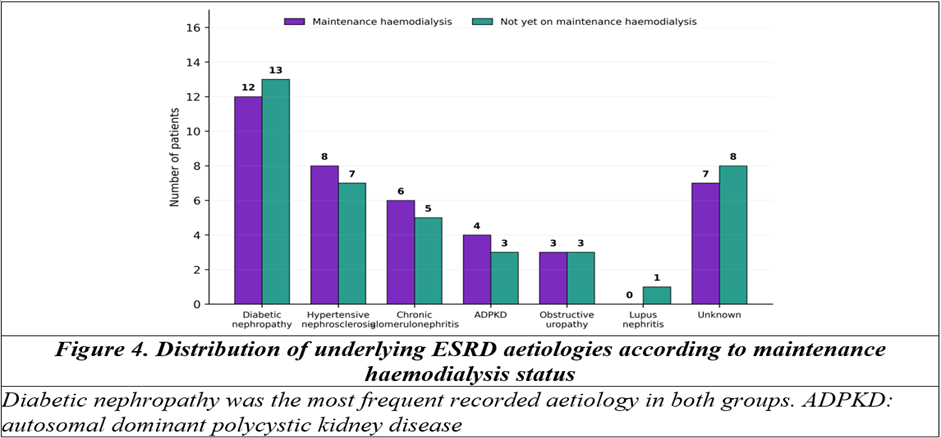
The distribution of the underlying renal disease was broadly comparable between groups (Table 2). Diabetic nephropathy was the most frequent recorded aetiology, accounting for 12 (30.0%) patients in the MHD group and 13 (32.5%) in the non-MHD group.
Hypertensive nephrosclerosis and chronic glomerulonephritis were the next most frequent causes. The overall aetiological distribution did not differ significantly (Fisher-Freeman-Halton exact p=1.000). Antiplatelet exposure was also similar between groups: aspirin alone was recorded in 19 patients in each group, clopidogrel alone in four MHD and three non-MHD patients, dual aspirin-clopidogrel therapy in one MHD patient, and no antiplatelet exposure in 16 and 18 patients, respectively.
Table 2. Distribution of the underlying aetiology of end-stage renal disease
|
ESRD Aetiology |
MHD Group, n (%) |
Non-MHD Group, n (%) |
|
Diabetic nephropathy |
12 (30.0) |
13 (32.5) |
|
Hypertensive nephrosclerosis |
8 (20.0) |
7 (17.5) |
|
Chronic glomerulonephritis |
6 (15.0) |
5 (12.5) |
|
ADPKD |
4 (10.0) |
3 (7.5) |
|
Obstructive uropathy |
3 (7.5) |
3 (7.5) |
|
Lupus nephritis |
0 |
1 (2.5) |
|
Unknown |
7 (17.5) |
8 (20.0) |
|
Total |
40 (100) |
40 (100) |
|
|
||
|
Overall comparison: Fisher-Freeman-Halton exact test, p=1.000. ADPKD: autosomal dominant polycystic kidney disease; MHD: maintenance haemodialysis |
||
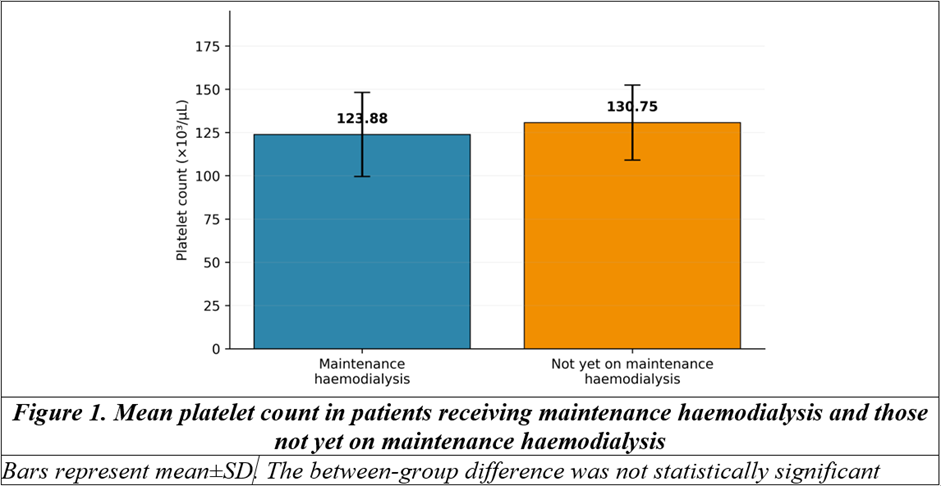
The principal platelet findings are summarised in Table 3. Mean platelet count was 123.88±24.29×10³/µL in the MHD group and 130.75±21.71×10³/µL in the non-MHD group. The mean difference was -6.88×10³/µL (95% CI -17.13 to 3.38), and the between-group difference was not statistically significant (p=0.186). The comparison is illustrated in Figure 1.
Table 3. Comparison of platelet-related findings between the study groups
|
Platelet-related variable |
MHD group (n=40) |
Non-MHD group (n=40) |
p-value |
|
Platelet count, ×10³/µL |
123.88±24.29 |
130.75±21.71 |
0.186 |
|
Thrombocytopenia (<150×10³/µL), n (%) |
34 (85.0) |
31 (77.5) |
0.568 |
|
Platelet count <100×10³/µL, n (%) |
7 (17.5) |
3 (7.5) |
|
|
Platelet count 100–149×10³/µL, n (%) |
27 (67.5) |
28 (70.0) |
|
|
Platelet count ≥150×10³/µL, n (%) |
6 (15.0) |
9 (22.5) |
|
|
Bleeding manifestation, n (%) |
13 (32.5) |
14 (35.0) |
1.000 |
|
Overall comparison of the three platelet-count categories: χ²=2.218, p=0.330. MHD: maintenance haemodialysis |
|||
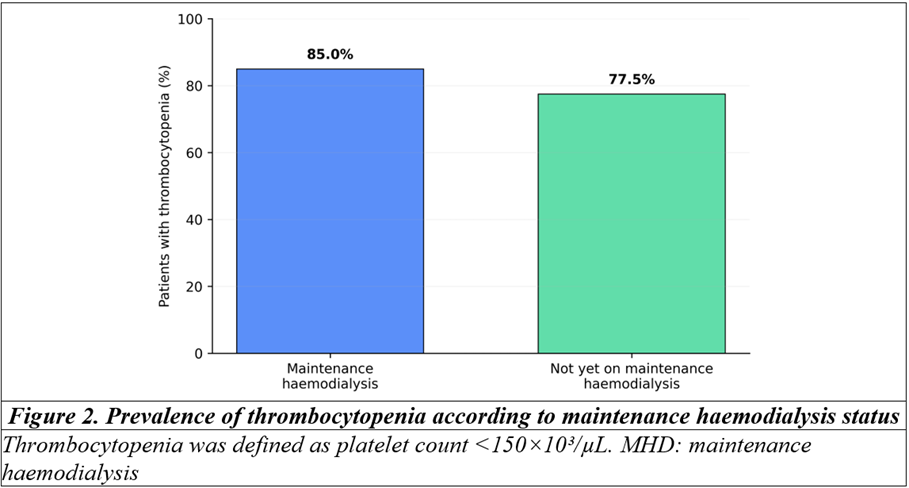
Thrombocytopenia was present in 34 of 40 patients (85.0%) receiving MHD and 31 of 40 patients (77.5%) not yet receiving MHD. The difference was not statistically significant (Fisher exact p=0.568), as illustrated in Figure 2. Overall, 65 of the 80 patients (81.25%) fulfilled the platelet-count criterion for thrombocytopenia.
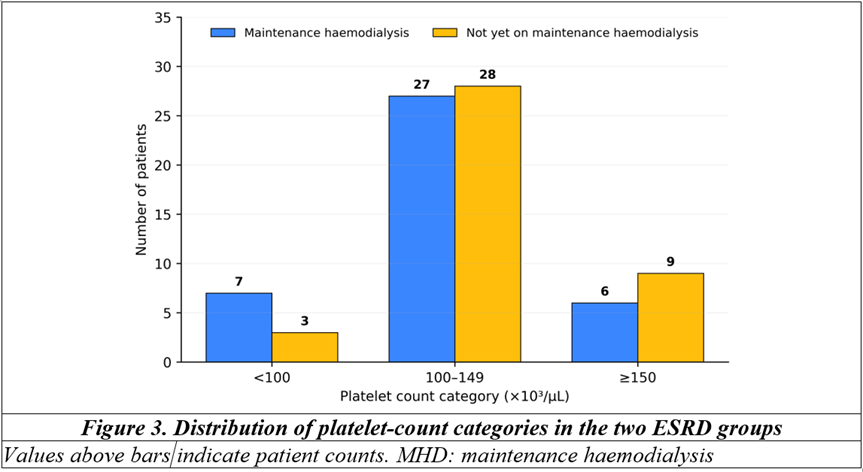
Platelet counts below 100×10³/µL occurred in 7 (17.5%) patients in the MHD group and 3 (7.5%) in the non-MHD group. Counts of 100–149×10³/µL were observed in 27 (67.5%) and 28 (70.0%) patients, respectively. The overall distribution of the three platelet-count categories was not statistically different between groups (χ²=2.218, p=0.330). Figure 3 depicts this distribution.
Bleeding manifestations were recorded in 27 of 80 patients (33.75%). Thirteen patients (32.5%) in the MHD group and 14 (35.0%) in the non-MHD group had a documented bleeding manifestation, with no significant between-group difference (p=1.000). All 27 patients with bleeding manifestations met the platelet-count definition of thrombocytopenia. In the overall cohort, thrombocytopenia was significantly associated with recorded bleeding manifestations (Fisher exact p=0.0016); however, this association should not be interpreted as evidence that platelet count alone accounted for bleeding, particularly because antiplatelet exposure and other haemostatic factors were present.
Among patients receiving maintenance haemodialysis, mean dialysis duration was 36.50±21.31 months (range 6-96 months). Twenty-five patients (62.5%) underwent two sessions per week and 15 (37.5%) underwent three sessions per week. Polysulfone was used in 25 (62.5%) patients, polyethersulfone in 9 (22.5%) and cellulose triacetate in 6 (15.0%). Anticoagulation consisted of unfractionated heparin in 25 (62.5%), low-molecular-weight heparin in 12 (30.0%) and heparin-free dialysis in 3 (7.5%). Mean recorded Kt/V was 1.38±0.08 (range 1.25-1.55), and all analysed blood samples were obtained pre-dialysis. Dialysis duration did not correlate significantly with platelet count (Spearman ρ=-0.079, p=0.630) (Table 4).
Table 4. Maintenance haemodialysis treatment characteristics (n=40)
|
Characteristic |
MHD group |
|
MHD duration, months |
36.50±21.31 (range 6-96) |
|
HD sessions/week: 2 sessions, n (%) |
25 (62.5) |
|
HD sessions/week: 3 sessions, n (%) |
15 (37.5) |
|
Dialysis membrane: Polysulfone, n (%) |
25 (62.5) |
|
Dialysis membrane: Polyethersulfone, n (%) |
9 (22.5) |
|
Dialysis membrane: Cellulose triacetate, n (%) |
6 (15.0) |
|
Anticoagulation: Unfractionated heparin, n (%) |
25 (62.5) |
|
Anticoagulation: Low-molecular-weight heparin, n (%) |
12 (30.0) |
|
Anticoagulation: Heparin-free, n (%) |
3 (7.5) |
|
Kt/V |
1.38±0.08 (range 1.25-1.55) |
|
Pre-dialysis sampling, n (%) |
40 (100) |
|
MHD: maintenance haemodialysis; HD: haemodialysis. All analysed MHD laboratory samples were obtained pre-dialysis |
|
A sensitivity analysis excluded the 10 patients with a recognised alternative cause of thrombocytopenia, leaving 35 patients in each group. Mean platelet count remained lower in the MHD group (128.51±22.21 vs 135.11±19.37×10³/µL), but the difference remained non-significant (p=0.190). Thrombocytopenia occurred in 29/35 (82.9%) MHD patients and 26/35 (74.3%) non-MHD patients (p=0.561), while bleeding manifestations were recorded in 8 (22.9%) and 9 (25.7%) patients, respectively (p=1.000) (Table 5).
Table 5. Sensitivity analysis excluding patients with another recognised potential cause of thrombocytopenia
|
Variable |
MHD group (n=35) |
Non-MHD group (n=35) |
p-value |
|
Platelet count, ×10³/µL |
128.51±22.21 |
135.11±19.37 |
0.190 |
|
Thrombocytopenia (<150×10³/µL), n (%) |
29 (82.9) |
26 (74.3) |
0.561 |
|
Bleeding manifestation, n (%) |
8 (22.9) |
9 (25.7) |
1.000 |
|
Sensitivity analysis excludes the 10 patients with a recognised alternative cause of thrombocytopenia. MHD: maintenance haemodialysis |
|||
DISCUSSION:
The present study compared platelet counts in two clinically distinct groups of patients with ESRD. Thrombocytopenia was common in both groups. Patients receiving maintenance haemodialysis had a lower mean platelet count and a numerically greater prevalence of thrombocytopenia, but neither difference was statistically significant. Importantly, the same pattern persisted after excluding the 10 patients with a recognised alternative cause of thrombocytopenia. The findings therefore support a cautious interpretation: platelet-count abnormalities are common in advanced renal failure, while maintenance haemodialysis status alone does not appear to be the dominant determinant.
A useful historical comparison is the study by Gafter et al., who found reduced platelet counts and frequent mild thrombocytopenia among patients with chronic renal failure, with similar mean platelet counts in patients receiving maintenance haemodialysis and those who had not yet started dialysis.[2] The direction of the present findings is comparable. The frequency of thrombocytopenia in this cohort was high, however, which may reflect differences in case mix, illness severity and the tertiary-care population studied.
The haemodialysis procedure can itself influence circulating platelets. Hakim and Schafer demonstrated transient thrombocytopenia together with platelet activation during dialysis using complement-activating membranes.[3] Levin et al. also documented dynamic changes in platelet function during haemodialysis.[4] Sloand and Sloand subsequently showed transient changes in platelet membrane glycoprotein expression during dialysis, supporting the concept that extracorporeal exposure can produce qualitative as well as quantitative platelet effects.[5] These observations provide a biologically plausible explanation for a lower platelet count in some dialysis patients, even when the overall between-group difference is modest.
Dialysis may also improve selected uraemia-related platelet abnormalities. Bilgin et al. reported shortening of prolonged PFA-100 closure times after haemodialysis.[8] Mekawy et al. similarly observed partial correction of platelet dysfunction following haemodialysis among Egyptian patients with ESRD.[9] Yet the response is not uniform. In an Indian prospective study, Murakonda et al. found that improvement after initial haemodialysis sessions was mainly confined to the subgroup with abnormal platelet-function testing at baseline.[6] Thus, initiation of haemodialysis should not be expected to normalise every component of primary haemostasis.
More comprehensive haemostatic investigations further emphasise this complexity. Gäckler et al. demonstrated platelet dysfunction in patients with ESRD together with alterations in thrombin generation and fibrinolysis.[7] Knehtl et al., comparing several anticoagulation strategies during haemodialysis, found that platelet-related haemostasis could remain abnormal before and after dialysis.[10] Mitic et al. also demonstrated impaired platelet-dependent thrombus formation in ESRD using a flow-based total thrombus-formation analysis system.[11] Such findings explain why bleeding risk in ESRD is not determined by platelet count in isolation.
In the current cohort, bleeding manifestations occurred in approximately one-third of patients and were almost equally distributed between the MHD and non-MHD groups. Every recorded bleeding manifestation occurred in a patient whose platelet count was below 150×10³/µL, producing a significant association between thrombocytopenia and bleeding in the overall cohort. Nevertheless, bleeding in ESRD is multifactorial. Antiplatelet exposure was common and similarly distributed between groups, occurring in 60.0% of MHD patients and 55.0% of non-MHD patients. Anaemia, uraemic platelet dysfunction, vascular abnormalities and other coexisting factors may also influence bleeding risk, so the observed association cannot be attributed to platelet count alone.
The lack of a significant relationship between dialysis duration and platelet count is also noteworthy. Araújo and Suassuna observed lower platelet counts among haemodialysis patients than controls in a study that examined spleen size and inflammatory associations, while dialysis vintage was not a major determinant of spleen size.[12] Toyoda et al. later showed that even relatively mild thrombocytopenia among maintenance-haemodialysis patients may have prognostic relevance and should not automatically be regarded as an innocuous laboratory finding.[13] The present cross-sectional comparison was not designed to assess prognosis, but it reinforces the value of monitoring platelet trends rather than interpreting a single low count in isolation.
Five patients in each study group had a recognised alternative contributor to thrombocytopenia. The MHD group included chronic liver disease or hypersplenism, heparin-related drug-induced thrombocytopenia, documented heparin-induced thrombocytopenia and active sepsis. The non-MHD group included myelodysplastic syndrome, drug-induced thrombocytopenia, systemic lupus erythematosus with immune thrombocytopenia, chronic liver disease with hypersplenism and active sepsis. Their equal numerical distribution reduced gross between-group imbalance, but these conditions could still influence absolute platelet levels. Reassuringly, exclusion of all 10 patients in a sensitivity analysis did not materially alter the principal comparison.[14]
Dialysis technology may also influence platelet behaviour. Chen et al. reported differences in platelet aggregation according to dialyser characteristics.[15] In the present MHD cohort, polysulfone membranes predominated, followed by polyethersulfone and cellulose triacetate, while anticoagulation was most commonly provided with unfractionated heparin. Three patients underwent heparin-free dialysis. These treatment characteristics were documented rather than pooled as unknown confounders, although the study was not powered for reliable membrane- or anticoagulant-specific subgroup comparisons.
Serum urea and creatinine were significantly lower in patients receiving maintenance haemodialysis. All laboratory samples used for the MHD comparison were obtained pre-dialysis, which provides a consistent sampling point and reduces distortion from transient intradialytic platelet sequestration. The mean recorded Kt/V was 1.38±0.08. These dialysis data improve interpretation of the MHD group, although the study did not include paired pre- and post-dialysis platelet measurements and therefore cannot quantify acute within-session platelet changes.
From a practical standpoint, the principal finding is the absence of a statistically significant difference in platelet count or thrombocytopenia prevalence between patients established on maintenance haemodialysis and those not yet on maintenance haemodialysis. A low platelet count in a dialysis patient should therefore not be attributed automatically to dialysis, while thrombocytopenia may already be present before maintenance dialysis is initiated. Clinical review for medications, infection, liver disease, hypersplenism, immune causes and other acquired causes remains important when the severity or trajectory of thrombocytopenia is unexpected.
Limitations
The study was performed in a single tertiary health care setting with a modest sample size of 80 patients, which limits generalisability. The comparison was observational and cannot establish that maintenance haemodialysis caused, prevented or corrected thrombocytopenia. Although recognised alternative causes of thrombocytopenia and antiplatelet exposure were documented, detailed medication duration, bleeding-site classification and platelet-function testing were not available. The sensitivity analysis reduced concern about the 10 patients with recognised alternative causes but cannot remove residual confounding.
All MHD platelet measurements used in the analysis were obtained pre-dialysis, but paired post-dialysis counts were unavailable; therefore, acute intradialytic platelet changes could not be assessed. Dialyser membrane, anticoagulation regimen and Kt/V were recorded, yet the sample size was insufficient for adequately powered subgroup analyses across these treatment characteristics. Longitudinal platelet trends and formal platelet-function assays were also not available.
CONCLUSION:
Thrombocytopenia was highly prevalent among patients with end-stage renal disease in both study groups. Patients receiving maintenance haemodialysis had a lower mean platelet count and a greater numerical prevalence of thrombocytopenia than patients not yet receiving maintenance haemodialysis, but the differences were not statistically significant. The conclusion remained unchanged after exclusion of patients with recognised alternative causes of thrombocytopenia. Because all MHD samples were obtained pre-dialysis and dialysis treatment characteristics were documented, the comparison provides a consistent snapshot of platelet status in routine tertiary-care practice. Platelet abnormalities in ESRD should therefore be interpreted in relation to the broader clinical and haemostatic picture rather than attributed to maintenance haemodialysis alone.
REFERENCES:
1. Kidney Disease: Improving Global Outcomes (KDIGO) CKD Work Group. KDIGO 2024 Clinical Practice Guideline for the Evaluation and Management of Chronic Kidney Disease. Kidney Int 2024;105(4S):S117-314.
2. Gafter U, Bessler H, Malachi T, et al. Platelet count and thrombopoietic activity in patients with chronic renal failure. Nephron 1987;45(3):207-10.
3. Hakim RM, Schafer AI. Hemodialysis-associated platelet activation and thrombocytopenia. Am J Med 1985;78(4):575-80.
4. Levin RD, Kwaan HC, Ivanovich P. Changes in platelet function during hemodialysis. J Lab Clin Med 1978;92(5):779-86.
5. Sloand JA, Sloand EM. Studies on platelet membrane glycoproteins and platelet function during hemodialysis. J Am Soc Nephrol 1997;8(5):799-803.
6. Murakonda VB, Mohapatra A, Geevar T, et al. Does hemodialysis need to be initiated to improve platelet function in CKD G5 patients? A pilot prospective, observational cohort study. Indian J Nephrol 2021;31(1):43-9.
7. Gäckler A, Rohn H, Lisman T, et al. Evaluation of hemostasis in patients with end-stage renal disease. PLoS One 2019;14(2):e0212237.
8. Bilgin AU, Karadogan I, Artac M, et al. Hemodialysis shortens long in vitro closure times as measured by the PFA-100. Med Sci Monit 2007;13(3):CR141-5.
9. Mekawy MA, Habashy DM, Abd El-Mohsen WA. Effect of hemodialysis on platelet function in end-stage renal disease Egyptian patients using in vitro closure time test (PFA-100 analyzer). Platelets 2015;26(5):443-7.
10. Knehtl M, Ponikvar R, Buturovic-Ponikvar J. Platelet-related hemostasis before and after hemodialysis with five different anticoagulation methods. Int J Artif Organs 2013;36(10):717-24.
11. Mitic BP, Dimitrijevic ZM, Hosokawa K, et al. Platelet thrombus formation in patients with end-stage renal disease before and after hemodialysis as measured by the total thrombus-formation analysis system. Int Urol Nephrol 2022;54(10):2695-702.
12. Araújo NC, Suassuna JHR. The spleen size in patients undergoing hemodialysis. J Bras Nefrol 2021;43(1):61-7.
13. Toyoda Y, Tateno K, Takeda Y, et al. Significance of mild thrombocytopenia in maintenance hemodialysis patients; a retrospective cohort study. Platelets 2022;33(5):735-42.
14. Sivaprakasam Y, Chadha S, Kotwal J, et al. Heparin-induced thrombocytopenia in hemodialysis patients-the first study from India. Indian J Nephrol 2023;33(6):459-63.
15. Chen CY, Liou HH, Chang MY, et al. The use of a low-flux hemo-dialyzer is associated with impaired platelet aggregation in patients undergoing chronic hemodialysis. Medicine (Baltimore) 2022;101(43):e31623.