The Association of High-Sensitivity C-Reactive Protein and Other Biomarkers with Cardiovascular Disease in Patients Living with HIV.
- Alia Anzoom N. , Resident, Department of General Medicine, Ballari Medical College and Research Centre, Ballari, Karnataka, India.
- Sangappa , Assistant Professor, Department of General Medicine, Ballari Medical College and Research Centre Ballari, Karnataka, India.
- Tejaswini T.S , Assistant Professor, Department of General Medicine, Ballari Medical College and Research Centre Ballari, Karnataka, India.
- N. Kotresh , Professor & HOD, Department of General Medicine, Ballari Medical College and Research Centre, Ballari, Karnataka, India.
Article Information:
Abstract:
Background: Cardiovascular disease has become an important long-term comorbidity among people living with HIV. Persistent immune activation, inflammatory signalling and coagulation abnormalities may contribute to vascular risk even during antiretroviral therapy. High-sensitivity C-reactive protein (hs-CRP), interleukin-6 (IL-6) and D-dimer are clinically measurable biomarkers that may reflect these pathways.Aim:To examine the association of hs-CRP and other inflammatory, coagulation, immunological and metabolic biomarkers with cardiovascular disease among patients living with HIV.Methods:This comparative observational analysis included 80 adults living with HIV, of whom 32 had documented cardiovascular disease (CVD) and 48 had no documented CVD. The CVD group comprised mutually exclusive primary recorded phenotypes of myocardial infarction, ischemic stroke, coronary artery disease or peripheral arterial disease. Recorded variables included demographic characteristics, HIV duration, current antiretroviral regimen, CD4 count, HIV viral load, hs-CRP, IL-6, D-dimer, lipid parameters, fasting glucose, diabetes, hypertension, smoking, body mass index and statin use. Continuous variables were compared using the Mann-Whitney U test, categorical variables using chi-square or Fisher exact tests, and selected associations with CVD status using Spearman rank correlation. Because statin use was confined to the CVD group, an exploratory sensitivity analysis repeated the biomarker comparisons after excluding statin users.Results:CVD was documented in 32/80 (40.0%) participants. Median hs-CRP was higher among those with CVD than among those without CVD (6.85 [5.33-8.95] vs 2.20 [1.28-3.03] mg/L; p<0.001). IL-6 (7.15 [5.68-9.25] vs 2.80 [1.98-3.63] pg/mL; p<0.001) and D-dimer (515.0 [432.5-667.5] vs 247.5 [183.8-317.5] ng/mL; p<0.001) were also higher. CVD status correlated positively with hs-CRP (rho=0.837), IL-6 (rho=0.817) and D-dimer (rho=0.787), while CD4 count showed an inverse correlation (rho=-0.496); all p<0.001. In the sensitivity analysis excluding 17 statin users, hs-CRP, IL-6 and D-dimer remained significantly higher in the CVD group (all p<0.001).Conclusion:Established cardiovascular disease among people living with HIV was associated with higher hs-CRP, IL-6 and D-dimer concentrations together with a less favourable metabolic and immunological profile. The biomarker differences persisted after exclusion of statin users, but the findings remain unadjusted and cannot establish temporal or independent predictive effects. These markers may complement, rather than replace, conventional cardiovascular risk assessment.
Keywords:
Article :
INTRODUCTION:
The clinical course of human immunodeficiency virus (HIV) infection has changed substantially with effective antiretroviral therapy (ART). Longer survival, however, has brought chronic non-AIDS comorbidities into the centre of routine care. Cardiovascular disease (CVD) is particularly important because its occurrence in people living with HIV reflects the combined effects of conventional cardiometabolic risk factors, HIV-related immune dysregulation, chronic inflammation and treatment-related metabolic changes.[1].
Large observational cohorts have demonstrated higher rates of acute myocardial infarction among people living with HIV than among HIV-negative populations, even after conventional risk factors are considered.[2,3] The excess risk is not uniform. Age, smoking, diabetes, hypertension and dyslipidaemia remain important, while longer exposure to HIV, periods of viraemia, impaired immune recovery and persistent inflammatory activation may further modify vascular risk.
Inflammation and coagulation pathways have therefore attracted considerable interest as potential links between HIV and atherosclerotic disease. In the SMART study, higher concentrations of high-sensitivity C-reactive protein (hs-CRP), interleukin-6 (IL-6) and D-dimer were associated with adverse outcomes, including mortality.[4] Subsequent analyses demonstrated that these markers also track with cardiovascular events, supporting a biologically plausible relationship between persistent inflammation, thrombosis and vascular injury in treated HIV infection.[5].
Among available biomarkers, hs-CRP is attractive because it is inexpensive, standardised and widely accessible. Importantly, a nested case-control study in treated HIV infection found higher hs-CRP to be associated with cardiovascular events independently of several conventional risk factors, while IL-6 also showed an association with CVD.[6] D-dimer provides complementary information by reflecting ongoing coagulation and fibrinolytic activity, and elevated IL-6 and D-dimer have remained associated with serious non-AIDS morbidity even in individuals receiving suppressive ART.[7].
For tertiary hospitals in India, the practical question is not whether inflammation exists in chronic HIV infection, but whether routinely obtainable markers can help identify a phenotype that deserves closer cardiovascular assessment. Evidence from low- and middle-income settings remains less extensive than that from high-income cohorts. The present study therefore evaluated the association of hs-CRP and other biomarkers with documented cardiovascular disease among people living with HIV, while also examining traditional cardiometabolic and HIV-related characteristics.
MATERIALS AND METHODS:
Study Design and Setting
A hospital-based comparative observational analysis was undertaken in the Department of General Medicine, Ballary Medical College and Research Centre for a period of one year. Eighty adults living with HIV who had the clinical and laboratory variables required for the planned comparison were included.
Eligibility Criteria
Adults aged 18 years or older with a documented diagnosis of HIV infection and available records for cardiovascular disease status, hs-CRP, IL-6, D-dimer, CD4 count, HIV viral load, lipid profile, fasting glucose and the conventional cardiovascular risk variables used in the analysis were eligible. Records lacking one or more variables required for the principal comparison were not included. Dedicated variables describing acute opportunistic or other intercurrent infection, active tuberculosis, chronic inflammatory disorders, malignancy, pregnancy, end-stage renal disease or liver cirrhosis were not available in the study records; these conditions therefore cannot be stated as formal exclusions and were considered potential sources of residual confounding.
Study Population and Cardiovascular Disease Definition
Participants were classified according to cardiovascular disease documented in the clinical record at the time of study assessment. The CVD group comprised patients with a recorded history of myocardial infarction, ischemic stroke, coronary artery disease or peripheral arterial disease; those without any of these diagnoses formed the non-CVD comparison group. Each of the 32 affected participants was assigned to one primary recorded CVD phenotype, so the phenotype categories were mutually exclusive and individuals were not double-counted. The exact interval between the index cardiovascular event and biomarker measurement, and the specific diagnostic investigations used to establish the historical CVD diagnosis, were not available as separate study variables.
Variables Assessed
The recorded variables were age, sex, duration of HIV infection, current ART regimen, CD4 count, HIV viral load, hs-CRP, IL-6, D-dimer, total cholesterol, low-density lipoprotein (LDL) cholesterol, high-density lipoprotein (HDL) cholesterol, triglycerides, fasting glucose, diabetes, hypertension, smoking status, body mass index (BMI), statin use and cardiovascular disease phenotype. HIV viral load below 200 copies/mL was used as the operational threshold for virologic suppression in the comparative analysis. The available ART variable represented the current regimen; duration on the current regimen, previous ART switches, adherence measures and duration of virologic suppression were not separately recorded.
Outcome Measures
The primary comparison was the difference in hs-CRP between patients with and without documented CVD. Secondary comparisons included IL-6, D-dimer, CD4 count, lipid parameters, fasting glucose and conventional cardiovascular risk factors. The strength and direction of unadjusted associations between selected biomarkers and CVD status were explored using rank correlation.
Statistical Analysis
Data were analysed using standard statistical software. Normality of continuous variables was assessed using the Shapiro-Wilk test. Because several continuous measures showed non-normal distributions and the group sizes were unequal, continuous variables were summarised using median and interquartile range (IQR) and compared with the Mann-Whitney U test. Categorical variables were expressed as frequencies and percentages and compared using the chi-square test or Fisher exact test, as appropriate. Spearman rank correlation was used to quantify unadjusted associations between selected continuous variables and binary CVD status. An exploratory sensitivity analysis excluded participants receiving statins and repeated the hs-CRP, IL-6 and D-dimer comparisons, thereby comparing 15 CVD participants not receiving statins with all 48 non-CVD participants. All tests were two-sided, and p<0.05 was considered statistically significant. The analyses were associative and exploratory; no causal inference was made.
Ethical Considerations
The study was conducted in accordance with institutional ethical requirements for clinical research following review and approval through the appropriate Institutional Ethics Committee process. Requirements for participant consent were handled in accordance with the approved institutional protocol. Confidentiality was maintained throughout, and no patient-identifying information is presented in the manuscript.
RESULTS:
Table 1. Demographic, HIV-related and conventional cardiovascular characteristic
|
Variable |
CVD Present (n=32) |
No CVD (n=48) |
P-Value |
|
Age, years |
59.0 (53.8-64.3) |
52.0 (44.8-58.3) |
<0.001 |
|
Male sex, n (%) |
21 (65.6) |
26 (54.2) |
0.359 |
|
HIV duration, years |
13.5 (9.8-17.3) |
10.0 (5.0-14.0) |
0.006 |
|
CD4 count, cells/µL |
321.5 (260.0-393.5) |
471.5 (371.5-573.0) |
<0.001 |
|
Viral load <200 copies/mL, n (%) |
18 (56.3) |
44 (91.7) |
<0.001 |
|
BMI, kg/m² |
27.2 (25.2-28.8) |
25.0 (23.3-27.4) |
0.006 |
|
Diabetes, n (%) |
18 (56.3) |
7 (14.6) |
<0.001 |
|
Hypertension, n (%) |
24 (75.0) |
18 (37.5) |
0.001 |
|
Smoking, n (%) |
19 (59.4) |
6 (12.5) |
<0.001 |
|
TDF/3TC/DTG, n (%) |
13 (40.6) |
21 (43.8) |
|
|
TDF/FTC/EFV, n (%) |
8 (25.0) |
10 (20.8) |
|
|
ABC/3TC/DTG, n (%) |
6 (18.8) |
10 (20.8) |
|
|
AZT/3TC/ATV/r, n (%) |
5 (15.6) |
7 (14.6) |
0.970 |
|
Statin use, n (%) |
17 (53.1) |
0 (0) |
Not tested* |
|
Values are median (IQR) or n (%). *Statin use was described but not tested as a risk factor because treatment may follow a cardiovascular diagnosis (indication/secondary-prevention bias). TDF: tenofovir disoproxil fumarate; 3TC: lamivudine; DTG: dolutegravir; FTC: emtricitabine; EFV: efavirenz; ABC: abacavir; AZT: zidovudine; ATV/r: ritonavir-boosted atazanavir |
|||
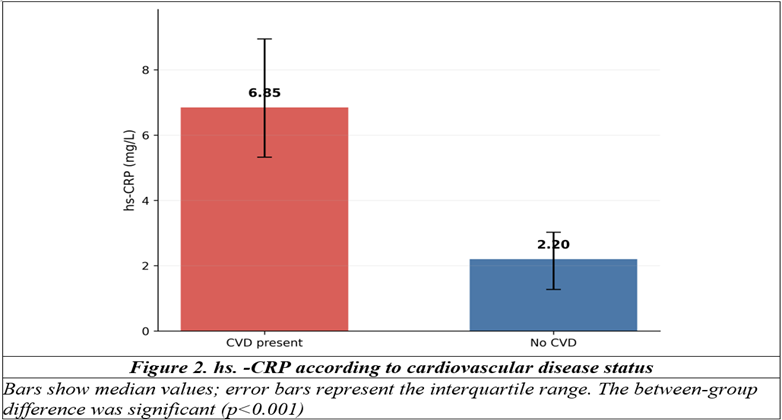
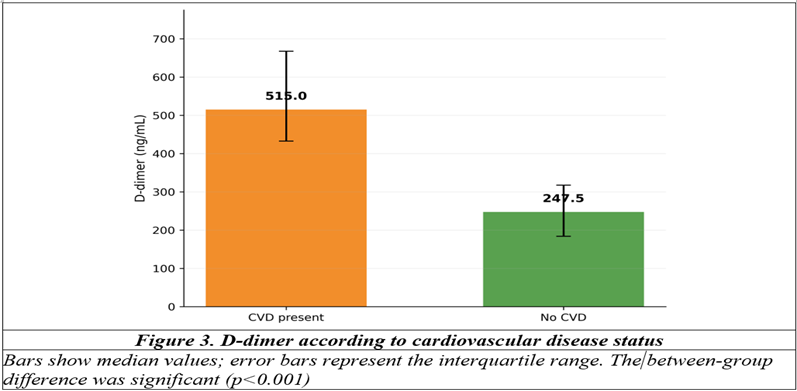
When the biomarkers were examined as continuous variables against binary CVD status, hs-CRP demonstrated the strongest rank correlation (rho=0.837), followed by IL-6 (rho=0.817) and D-dimer (rho=0.787). LDL cholesterol and triglycerides were positively associated with CVD status, whereas CD4 count and HDL cholesterol showed inverse associations (Table 3). These correlations are unadjusted and should be interpreted as measures of association rather than independent predictive effects.
Table 3. Spearman rank correlations of selected biomarkers with cardiovascular disease status
|
Variable |
Spearman RHO |
P-Value |
|
hs-CRP, mg/L |
0.837 |
<0.001 |
|
IL-6, pg/mL |
0.817 |
<0.001 |
|
D-dimer, ng/mL |
0.787 |
<0.001 |
|
CD4 count, cells/µL |
-0.496 |
<0.001 |
|
LDL cholesterol, mg/dL |
0.593 |
<0.001 |
|
HDL cholesterol, mg/dL |
-0.489 |
<0.001 |
|
Triglycerides, mg/dL |
0.538 |
<0.001 |
|
CVD status was coded as 1=present and 0=absent. Positive rho values indicate higher values among participants with CVD; negative values indicate lower values among participants with CVD |
||
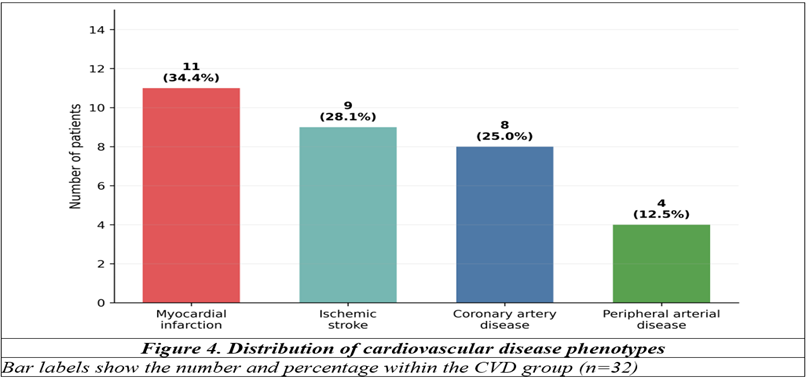
Among the 32 patients with CVD, myocardial infarction was the most frequent recorded phenotype (34.4%), followed by ischemic stroke (28.1%), coronary artery disease (25.0%) and peripheral arterial disease (12.5%) (Table 4 and Figure 4).
Table 4. Distribution of cardiovascular disease phenotypes among affected participants
|
CVD Phenotype |
n |
% of CVD Group |
|
Myocardial infarction |
11 |
34.4 |
|
Ischemic stroke |
9 |
28.1 |
|
Coronary artery disease |
8 |
25.0 |
|
Peripheral arterial disease |
4 |
12.5 |
|
|
||
|
Percentages use the 32 participants with documented cardiovascular disease as the denominator |
||
An exploratory sensitivity analysis was performed because statin exposure was confined to the CVD group. After excluding all 17 statin users, 15 participants with CVD and 48 without CVD remained. The between-group biomarker pattern persisted: median hs-CRP was 5.10 mg/L (IQR 4.30-5.85) versus 2.20 mg/L (IQR 1.28-3.03), IL-6 was 5.30 pg/mL (IQR 4.55-6.15) versus 2.80 pg/mL (IQR 1.98-3.63), and D-dimer was 410 ng/mL (IQR 370-465) versus 247.5 ng/mL (IQR 183.8-317.5); all comparisons remained significant at p<0.001 (Table 5).
Table 5. Sensitivity analysis of inflammatory and coagulation biomarkers after exclusion of statin users
|
Parameter |
CVD Present, No Statin (n=15) |
No CVD (n=48) |
P-Value |
|
hs-CRP, mg/L |
5.10 (4.30-5.85) |
2.20 (1.28-3.03) |
<0.001 |
|
IL-6, pg/mL |
5.30 (4.55-6.15) |
2.80 (1.98-3.63) |
<0.001 |
|
D-dimer, ng/mL |
410 (370-465) |
247.5 (183.8-317.5) |
<0.001 |
|
|
|||
|
Values are median (IQR). Group comparisons were performed using the Mann-Whitney U test. Statin users were excluded from both groups; no non-CVD participant was receiving a statin |
|||
DISCUSSION:
The principal finding of this study was a clear separation in inflammatory and coagulation biomarker profiles between people living with HIV who had established cardiovascular disease and those without documented CVD. hs-CRP showed the strongest unadjusted association with CVD status, while IL-6 and D-dimer were also markedly higher. At the same time, the CVD group had a heavier conventional risk-factor burden, lower CD4 counts and less frequent virologic suppression. The pattern therefore supports a multifactorial cardiovascular phenotype rather than a biomarker-only explanation.
The hs-CRP difference is consistent with earlier clinical observations. Triant et al. reported that elevated C-reactive protein and HIV infection were independently associated with acute myocardial infarction.[8] More directly comparable is the nested case-control study by De Luca et al., in which high hs-CRP was independently associated with cardiovascular events among treated patients with HIV, while IL-6 also contributed additional information.[6] The present analysis cannot establish independence from conventional risk factors, but the magnitude and direction of the hs-CRP difference reinforce the relevance of systemic inflammatory activity in patients with established CVD.
IL-6 behaved similarly. In large HIV cohorts, Borges et al. found IL-6 to be strongly associated with clinical events, including cardiovascular outcomes.[9] IL-6 occupies an upstream position in inflammatory signalling and stimulates hepatic acute-phase responses, including CRP production. Persistently elevated IL-6 despite ART may therefore reflect ongoing immune activation, endothelial stress and inflammatory signalling that is not fully captured by viral load alone.
D-dimer was also substantially higher in the CVD group. This fits the broader evidence linking coagulation activation to non-AIDS morbidity in HIV. Grund et al. demonstrated graded associations of IL-6 and D-dimer with serious non-AIDS events or death even in adults receiving suppressive ART.[7] Duprez et al. similarly linked inflammation and coagulation biomarkers with cardiovascular disease in HIV.[5] In the current cohort, the strong positive correlation between D-dimer and CVD status should be read as a marker of a prothrombotic/inflammatory phenotype, not as evidence that D-dimer is specific for atherosclerotic disease.
A second important observation was that the inflammatory phenotype coexisted with dyslipidaemia and traditional cardiovascular risk factors. LDL cholesterol and triglycerides were higher, HDL cholesterol was lower, and diabetes, hypertension and smoking were substantially more common among participants with CVD. Work in virologically suppressed populations has shown that inflammatory burden can track with adverse lipid patterns, suggesting interaction rather than strict separation between metabolic and immune pathways.[10] More recent biomarker-profile studies likewise indicate that individuals with greater immune and inflammatory activation cluster into higher cardiovascular-risk phenotypes.[11].
The current evidence base has also become more clinically consequential. A 2026 systematic review and meta-analysis found a positive association between hs-CRP and future major adverse cardiovascular events in people living with HIV, while IL-6 and D-dimer showed consistent positive associations across multiple studies, although methodological heterogeneity remains substantial.[12] This broader evidence supports the biological relevance of these markers but does not yet justify replacing established cardiovascular risk assessment with a biomarker-only strategy.
The CVD group in this study also had lower CD4 counts and a lower proportion with HIV RNA below 200 copies/mL. These findings are compatible with the concept that prolonged or incompletely controlled HIV-related immune activation may add to traditional vascular risk. They should not be interpreted as proof that low CD4 count or viraemia caused the cardiovascular events, because the analysis was cross-sectional with respect to biomarker measurement and established CVD status.
The longer recorded duration of HIV infection among participants with CVD also merits attention. Median HIV duration was 3.5 years longer in the CVD group. Biologically, longer exposure could reflect cumulative periods of immune activation, treatment-related metabolic effects or a greater opportunity for conventional vascular risk factors to accumulate. Yet the CVD group was also older, and the present sample was not suited to stable multivariable modelling of age, HIV duration and the correlated inflammatory biomarkers simultaneously. HIV duration should therefore be regarded as an associated characteristic in this cohort rather than an independent cardiovascular determinant.
Statin use deserves separate consideration. More than half of participants with CVD were receiving a statin, while no statin use was recorded in the non-CVD group. This distribution is compatible with secondary-prevention practice after a cardiovascular diagnosis, but it also complicates interpretation because statins can modify LDL cholesterol and inflammatory markers. For this reason, statin use was not analysed as a causal risk factor. Importantly, after exclusion of all statin users, hs-CRP, IL-6 and D-dimer remained significantly higher among participants with CVD, indicating that the principal biomarker pattern was not solely attributable to statin exposure. The REPRIEVE trial demonstrated that pitavastatin reduced major adverse cardiovascular events among people with HIV at low-to-moderate predicted cardiovascular risk.[13] Mechanistic analyses from REPRIEVE also demonstrated reductions in non-calcified coronary plaque progression and selected inflammatory or lipid-oxidation pathways with pitavastatin.[14] Current HIV cardiovascular guidance consequently places increasing emphasis on structured ASCVD prevention and appropriate statin use while accounting for drug-drug interactions with ART.[15].
The findings have practical relevance for Indian HIV services, where long-term follow-up increasingly includes management of diabetes, hypertension, obesity and dyslipidaemia alongside viral suppression. Contemporary data from southern India have documented clinically meaningful lipid changes after initiation of dolutegravir-based ART, underscoring the need for metabolic surveillance as treated populations age.[16] hs-CRP is attractive because it is more accessible than many experimental inflammatory markers. Nevertheless, a single elevated hs-CRP value is nonspecific and may be influenced by intercurrent infection, obesity, smoking or other inflammatory states. Its role is therefore best considered complementary to, rather than a substitute for, conventional risk-factor assessment.
Limitations
Several limitations require emphasis. First, this was a relatively small single-setting observational analysis, so the results may not represent the wider population of people living with HIV. Second, cardiovascular disease was already established when participants were classified; the exact interval from the index cardiovascular event to biomarker sampling was not recorded, and the analysis therefore cannot determine whether elevated biomarkers preceded the event. Third, the CVD and non-CVD groups differed substantially in age, HIV duration, diabetes, hypertension, smoking and metabolic variables. The sample size, strong intercorrelation among hs-CRP, IL-6 and D-dimer, and marked separation of biomarker distributions limited stable multivariable modelling. Accordingly, the reported biomarker associations are unadjusted and should not be interpreted as independent predictive effects.
Dedicated information on acute opportunistic or other intercurrent infections, active tuberculosis, chronic inflammatory disorders, malignancy, pregnancy, advanced renal dysfunction and liver cirrhosis was not available as separate study variables; residual confounding from conditions capable of altering hs-CRP, IL-6 or D-dimer therefore remains possible. Biomarkers were represented by single recorded measurements and cannot capture biological variability over time. The precise investigations used to confirm historical CVD diagnoses were not separately recorded. Current ART regimen was available, but duration on that regimen, previous treatment switches, adherence and duration of virologic suppression were not. Statin exposure was strongly linked to established CVD and secondary prevention; although the non-statin sensitivity analysis preserved the biomarker differences, treatment-related and indication-related bias cannot be completely excluded.
CONCLUSION:
Among patients living with HIV, documented cardiovascular disease was associated with substantially higher hs-CRP, IL-6 and D-dimer concentrations, a more adverse lipid and glycaemic profile, greater prevalence of conventional cardiovascular risk factors and lower CD4 counts. hs-CRP showed the strongest unadjusted association with CVD status, and the inflammatory/coagulation biomarker differences persisted in an exploratory analysis excluding statin users. These findings support integrated cardiovascular assessment in HIV care, combining conventional risk-factor control with awareness of persistent inflammatory and coagulation activity. Prospective, adequately powered studies with event-timed biomarker measurement and multivariable adjustment are required before these markers can be considered independent predictors or incorporated into routine risk algorithms.
REFERENCES:
1. Feinstein MJ, Hsue PY, Benjamin LA, et al. Characteristics, prevention, and management of cardiovascular disease in people living with HIV: a scientific statement from the American Heart Association. Circulation 2019;140(2):e98-e124.
2. Triant VA, Lee H, Hadigan C, et al. Increased acute myocardial infarction rates and cardiovascular risk factors among patients with human immunodeficiency virus disease. J Clin Endocrinol Metab 2007;92(7):2506-12.
3. Freiberg MS, Chang CCH, Kuller LH, et al. HIV infection and the risk of acute myocardial infarction. JAMA Intern Med 2013;173(8):614-22.
4. Kuller LH, Tracy R, Belloso W, et al. Inflammatory and coagulation biomarkers and mortality in patients with HIV infection. PLoS Med 2008;5(10):e203.
5. Duprez DA, Neuhaus J, Kuller LH, et al. Inflammation, coagulation and cardiovascular disease in HIV-infected individuals. PLoS One 2012;7(9):e44454.
6. De Luca A, de Gaetano Donati K, Colafigli M, et al. The association of high-sensitivity C-reactive protein and other biomarkers with cardiovascular disease in patients treated for HIV: a nested case-control study. BMC Infect Dis 2013;13:414.
7. [7] Grund B, Baker JV, Deeks SG, et al. Relevance of interleukin-6 and D-dimer for serious non-AIDS morbidity and death among HIV-positive adults on suppressive antiretroviral therapy. PLoS One 2016;11(5):e0155100.
8. Triant VA, Meigs JB, Grinspoon SK. Association of C-reactive protein and HIV infection with acute myocardial infarction. J Acquir Immune Defic Syndr 2009;51(3):268-73.
9. Borges AH, O'Connor JL, Phillips AN, et al. Interleukin 6 is a stronger predictor of clinical events than high-sensitivity C-reactive protein or D-dimer during HIV infection. J Infect Dis 2016;214(3):408-16.
10. Višković K, Židovec Lepej S, Gorenec A, et al. Cardiovascular markers of inflammation and serum lipid levels in HIV-infected patients with undetectable viremia. Sci Rep 2018;8:6113.
11. Sukumaran L, Kunisaki KM, Bakewell N, et al. Association between inflammatory biomarker profiles and cardiovascular risk in individuals with and without HIV. AIDS 2023;37(4):595-603.
12. Murray A, Louwman N, Luk A, et al. Inflammatory biomarkers predicting major adverse cardiovascular events in people living with HIV: a systematic review and meta-analysis. J Int AIDS Soc 2026;29(4):e70101.
13. Grinspoon SK, Fitch KV, Zanni MV, et al. Pitavastatin to prevent cardiovascular disease in HIV infection. N Engl J Med 2023;389(8):687-99.
14. Lu MT, Ribaudo H, Foldyna B, et al. Effects of pitavastatin on coronary artery disease and inflammatory biomarkers in HIV: mechanistic sub study of the REPRIEVE randomized clinical trial. JAMA Cardiol 2024;9(4):323-34.
15. Panel for the Use of Antiretroviral Agents in Adults and Adolescents With HIV. Update on statin therapy in people with HIV. ClinicalInfo.HIV.gov. Updated May 27, 2026.
16. Sebastian SA, Devasia C, Selvam S, et al. Dolutegravir-associated dyslipidemia and atherogenic lipid changes among treatment-naive people living with HIV: a 12-month prospective cohort study from Southern India. Cureus 2026;18(7):e111987.