Effectiveness of Toy-Augmented Neurodevelopmental Therapy in Supporting Motor and Cognitive Milestone Attainment in High-Risk Infants.
- Dhanashree Vishal Deshmukh , Consultant Physiotherapist, Chaitanya Balrugnalay, Karad, Maharashtra, India.
- Jai Santosh Kadam , Assistant professor, Department of Cardiopulmonary sciences, Manavsadan College of Physiotherapy, Kudal, Sindhudurg, Maharashtra, India.
Article Information:
Abstract:
Background: High-risk infants, especially those born preterm or with perinatal complications, are vulnerable to neurodevelopmental impairments such as cerebral palsy (CP). Early physiotherapeutic intervention, particularly Neurodevelopmental Treatment (NDT), can improve motor outcomes. Recent approaches suggest that integrating interactive toys into therapy may further enhance engagement, neuroplasticity, and functional gains. Objective: To evaluate the efficacy of conventional NDT augmented with interactive toys in improving gross motor function among infants at high risk for CP, compared to conventional NDT alone. Methods: A prospective, randomized controlled trial was conducted from January 2024 to March 2025 at Krishna Hospital and Cottage Hospital. Thirty high-risk infants aged 6–12 months were randomized equally into two groups: (1) NDT with interactive toys and (2) NDT alone. The intervention was delivered thrice weekly over 12 weeks. Gross motor function was assessed using the Gross Motor Function Measure-66 (GMFM-66) at baseline and post-intervention. Statistical analysis included repeated measures ANOVA with a significance threshold of p < 0.05. Results: Baseline characteristics were comparable between groups. After 12 weeks, both groups showed significant improvement in GMFM-66 scores. However, the NDT with interactive toys group exhibited greater gains (mean score: 36.19 ± 6.36) compared to the NDT-only group (mean score: 34.09 ± 5.28), with a statistically significant difference (p < 0.0001). Conclusion: The addition of interactive toys to conventional NDT significantly enhances gross motor function in high-risk infants. This play-integrated approach appears to promote multisensory engagement and motor learning, suggesting that early enriched interventions may offer superior developmental outcomes. These findings support the inclusion of interactive toy-based stimulation in early rehabilitation programs for infants at risk of CP.
Keywords:
Article :
INTRODUCTION:
High-risk infants, particularly those born preterm, with low birth weight, or who have experienced perinatal complications, are at an elevated risk of developing neurodevelopmental impairments, including cerebral palsy, delayed motor milestones, and cognitive deficits.1–4 Early identification and timely intervention are critical in optimizing their developmental trajectories and minimizing long-term disability.[1,2]
Neurodevelopmental Treatment (NDT), also known as the Bobath concept, is a widely used physiotherapeutic approach that emphasizes facilitation of normal movement patterns, inhibition of abnormal tone, and enhancement of functional motor abilities through hands-on techniques.[3-5] In high-risk infants, NDT has shown promise in improving postural control, gross and fine motor skills, and overall developmental outcomes, particularly when initiated during the critical early months of neuroplasticity.[6-8]
To further enhance the effectiveness of NDT, recent therapeutic strategies have explored the integration of interactive toys during therapy sessions. Interactive toys-those that respond with sound, light, or motion-offer multisensory stimulation and encourage goal-directed behaviors, visual-motor coordination, and active participation.[9,10] The incorporation of such toys aligns with principles of motor learning and play-based therapy, which have been recognized as essential components of infant neurodevelopmental rehabilitation.[11-13] Play not only facilitates motor and cognitive skill acquisition but also fosters engagement and motivation, which are essential for learning in early childhood.[14,15-17]
Despite theoretical support, there is limited empirical evidence from randomized controlled trials assessing the combined impact of NDT with interactive toy integration in high-risk infant populations. Therefore, this study aims to evaluate the efficacy of a structured NDT-based intervention program augmented with interactive toys, in comparison to conventional NDT alone, on motor and functional outcomes in high-risk infants. The findings could contribute significantly to evidence-based pediatric physiotherapy by identifying more engaging and effective approaches to early intervention.
MATERIALS AND METHODS:
This study was designed as a prospective, parallel-group, randomized controlled trial to evaluate the effectiveness of neurodevelopmental therapy (NDT) with and without the use of interactive toys in infants at high risk for cerebral palsy. The research was conducted between January 2024 and March 2025 at Krishna Hospital and Cottage Hospital. Ethical clearance for the study was obtained from the Krishna Vishwa Ethics Committee, and informed written consent was collected from the parents or legal guardians of all participating infants prior to enrollment.
Participants were infants diagnosed with a high risk of cerebral palsy by a pediatrician. Eligibility was based on the presence of motor dysfunction, including decreased motor quality, abnormal neurological signs, delayed achievement of motor milestones, and atypical motor patterns. Additional diagnostic support included cranial imaging findings such as periventricular leukomalacia, hemorrhagic infarction, and lesions in the cortical and deep grey matter. Infants were also included if they had a history of high-risk factors for cerebral palsy, including adverse events before pregnancy (such as stillbirth, abortion, and assisted reproduction), during pregnancy (including genetic disorders, congenital anomalies, and multiple births), and in the postpartum period (such as ischemic-hypoxic encephalopathy, intracranial hemorrhage, and significant neonatal jaundice). Eligible infants were between 6 months and 1 year of age, had not received any prior rehabilitation related to cerebral palsy, and had caregivers with adequate literacy and communication skills to participate in and adhere to the intervention protocol.
Infants were excluded if they were diagnosed with severe epilepsy, trisomy 21 syndrome, metachromatic leukodystrophy, serious comorbid conditions involving major organ systems, or any other disorder associated with abnormal muscle tone. Eligible participants were randomly assigned in a 1:1 ratio to either the experimental or control group using a computer-generated randomization sequence. Allocation was concealed through the use of sequentially numbered, opaque, sealed envelopes. There was no stratification based on gestational age or the severity of brain injury. The primary investigator managed the randomization process and communicated the group assignments to the parents.
Once enrolled, participants received the assigned intervention until reaching 12 months of corrected age. The total duration of the intervention therefore varied based on the infant’s age at enrollment. Infants in the experimental group received conventional neurodevelopmental therapy supplemented with interactive toy-based stimulation for 15 to 30 minutes per day, three times per week, over a 12-week period. The control group received only conventional NDT for the same frequency and duration.
The primary outcome measure for this study was gross motor function, assessed using the Gross Motor Function Measure-66 (GMFM-66), a validated tool widely used to evaluate motor performance in children with cerebral palsy.[18] Assessments were conducted before the initiation of therapy and again after the completion of the 12-week intervention. All assessments were performed by qualified physical therapists who were blinded to group allocation and had no involvement in the delivery of the interventions. The GMFM scores before and after the intervention were compared within and between groups.
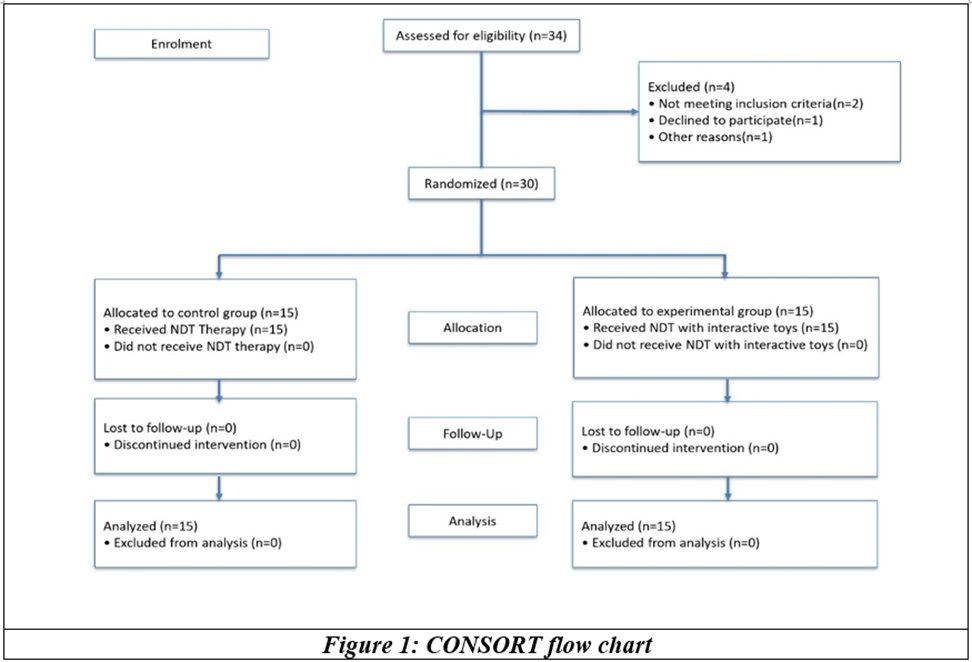
Due to the exploratory nature of the trial and practical limitations, the study was designed as a pilot randomized controlled trial. A total of 30 infants were included, with 15 participants assigned to each group. This sample size was considered sufficient to provide preliminary data on the efficacy of the intervention and to inform future, larger-scale studies.
Statistical Analysis
Statistical analysis was conducted using SPSS-K version 20.0 (IBM Corporation, Armonk, NY, USA). Descriptive statistics were used to summarize participant characteristics. Repeated measures analysis of variance (ANOVA) was used to evaluate within-group changes over time and between-group differences in GMFM scores. A p-value of less than 0.05 was considered statistically significant, and all statistical tests were conducted with a 95% confidence interval.
RESULTS:
Table 1: Baseline characteristics of participants
|
Infant Characteristics |
NDT with Interactive Toys |
NDT only |
|
|
Age |
Enrolment corrected age(weeks) mean (SD) |
15.73(4.76) |
20.07(5.08) |
|
Sex |
Male, n (%) Female n (%) |
9(60) 6(40) |
8(53) 7(47) |
|
Cp risk factor |
Birth weight(kg), mean (SD) |
2.31(1.02) |
2.65(1.12) |
|
Multiple births, n (%) |
2(13) |
2(13) |
|
|
Hypoxic ischaemic encephalopathy n (%) |
4(27) |
2(13) |
|
|
Birth gestational age(weeks), mean (SD) |
34.27(5.27) |
35.27(5.09) |
|
|
• 28 Weeks, n (%) |
1(6) |
1(6) |
|
|
• 28 -31 Weeks, n (%) |
3(20) |
4(28) |
|
|
• 32-36 Weeks, n (%) |
2(14) |
2(13) |
|
|
• > 36Weeks, n (%) |
9(60) |
8(53) |
Table 2: Outcome measure at baseline and 12 weeks after intervention
|
Infant Motor Function |
Measure |
NDT with Interactive Toys Mean (SD) |
NDT only Mean (SD) |
P value |
|
Baseline |
GMFM-66 |
21.76(3.55) |
22.09(2.91) |
< 0.0001 |
|
12 weeks |
GMFM-66 |
36.19(6.36) |
34.09(5.28) |
A total of 30 high-risk infants for cerebral palsy were enrolled in the study and randomly allocated into two equal groups: the NDT with interactive toys group (n = 15) and the NDT-only group (n = 15). Baseline demographic and clinical characteristics were comparable between the groups. The mean corrected age at enrollment was 15.73 weeks (SD 4.76) in the interactive toys group and 20.07 weeks (SD 5.08) in the NDT-only group. Male infants constituted 60% of the interactive toys group and 53% of the NDT-only group. The mean birth weight was marginally lower in the interactive toys group [2.31 kg (SD 1.02)] compared to the NDT-only group [2.65 kg (SD 1.12)]. Both groups had an equal proportion of multiple births (13%). A greater proportion of infants in the interactive toys group had a history of hypoxic-ischemic encephalopathy (27% vs. 13%). The mean gestational age at birth was 34.27 weeks (SD 5.27) in the interactive toys group and 35.27 weeks (SD 5.09) in the NDT-only group.
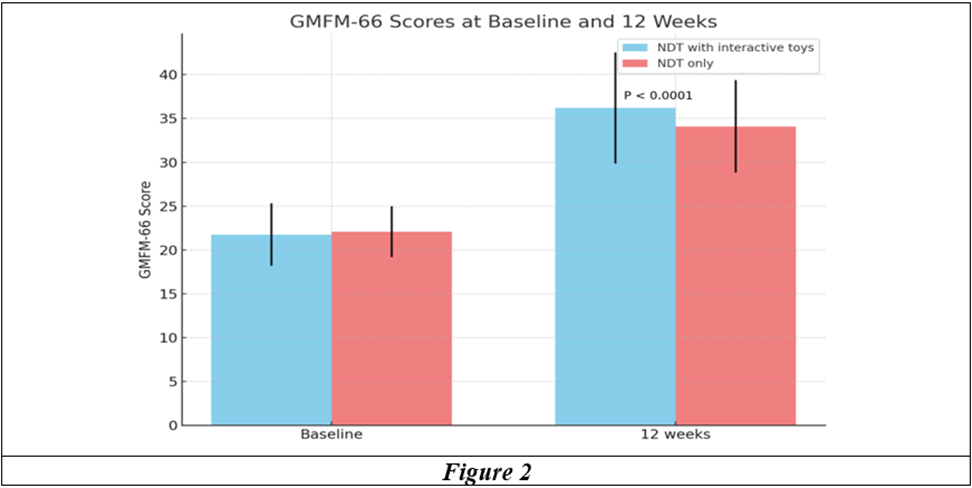
At baseline, motor function as assessed by the Gross Motor Function Measure-66 (GMFM-66) was similar between the two groups, with mean scores of 21.76 (SD 3.55) in the interactive toys group and 22.09 (SD 2.91) in the NDT-only group. Following 12 weeks of intervention, the interactive toys group demonstrated a significantly greater improvement in motor function, with a mean GMFM-66 score of 36.19 (SD 6.36) compared to 34.09 (SD 5.28) in the NDT-only group (p < 0.0001). These findings suggest that the incorporation of interactive toys into NDT-based intervention may result in enhanced motor outcomes in high-risk infants.
DISCUSSION:
The present randomized controlled trial demonstrates that the incorporation of interactive toys into neurodevelopmental therapy (NDT) results in significantly greater improvements in gross motor function among infants at high risk of cerebral palsy (CP) compared to standard NDT alone. The statistically significant increase in GMFM-66 scores in the experimental group (mean: 36.19 ± 6.36) versus the control group (mean: 34.09 ± 5.28; p < 0.0001) supports the efficacy of an enriched therapeutic environment in enhancing motor outcomes during a critical neurodevelopmental window.
These findings are consistent with those reported by Lee et al. (2017),[19] who evaluated the effects of intensive NDT on children with developmental delay (DD), with and without CP. In their cohort, intensive NDT (three sessions per week for three months) led to statistically significant improvements in GMFM scores, and these gains were sustained following a subsequent period of conventional NDT.[19] Notably, their study did not find differential efficacy between children with CP and those without, suggesting broad applicability of the intervention across neurodevelopmental spectra. While our study targeted a younger age group (corrected age: 15.73–20.07 weeks), the results corroborate the assertion that increased therapeutic intensity is associated with superior functional outcomes.
Further supporting the present findings, Li et al. (2023)[20] examined the effect of ultra-early NDT intervention-initiated within the first week of life-on neurodevelopmental outcomes in high-risk infants. Their longitudinal analysis demonstrated significantly better developmental quotient (DQ) scores across all functional domains, along with reduced rates of progression to cerebral palsy and global developmental delay, in comparison to infants who received delayed intervention at three to five months of age. This reinforces the neurobiological premise that earlier intervention aligns with periods of heightened neuroplasticity and synaptic organization, optimizing therapeutic responsiveness. Although the onset of intervention in our study was later than that in Li et al.[20] the observed improvement in GMFM-66 scores within a 12-week period underscores the value of early and enriched motor stimulation even within the first five postnatal months.
The integration of interactive toys into the NDT paradigm likely contributed to the superior outcomes observed in our experimental group. Interactive toys facilitate multisensory stimulation, promote exploratory behaviors, and encourage voluntary, goal-directed movements all of which are known to enhance motor learning and cortical reorganization.[10,21-24] These elements align with contemporary neurorehabilitation principles emphasizing active engagement, environmental enrichment, and child-led activity. Similar strategies were highlighted in Li et al.’s study, wherein environmental diversity and task-specific training using toys and familiar household objects were integral to the intervention protocol. Moreover, the emphasis on therapist-guided parental education and structured home-based tasks in their study reflects a growing consensus around family-centered care models, which may further reinforce treatment efficacy and continuity beyond clinical settings.[16,25]
Despite these promising outcomes, several limitations must be acknowledged. The sample size was relatively small, and the follow-up period was limited to 12 weeks, precluding inferences about the long-term sustainability of motor gains. In contrast, Lee et al.[19] demonstrated maintenance of GMFM improvements over a six-month duration, and Li et al.[20] reported developmental benefits sustained up to 24 months of age. Future investigations should incorporate extended follow-up periods to evaluate the durability of treatment effects and the potential translation of early motor gains into functional independence and participation in daily life. Additionally, while our study employed the GMFM-66 as the primary outcome measure, future research could benefit from including neurodevelopmental and cognitive assessments, as well as caregiver-reported outcome measures, to provide a more holistic evaluation of functional progress.
In conclusion, the findings of this study add to the growing body of evidence advocating for early, enriched, and developmentally appropriate interventions in infants at high risk of CP. The use of interactive toys within the NDT framework appears to enhance therapeutic efficacy, likely by promoting sensory-motor integration and active participation. These results, in conjunction with prior studies, underscore the critical importance of early neurorehabilitation in optimizing motor outcomes and mitigating long-term disability in high-risk pediatric populations.
CONCLUSION:
Conventional NDT with interactive toys showed significantly improved gross motor function than conventional NDT only. Additionally, all the improvements were maintained by the intervention. Combination of NDT with interactive toys is a promising new early intervention for infants. Thus, we recommend inclusion of interactive toys along with conventional NDT program by day-hospital centers for children with CP.
REFERENCES:
1. Blauw-Hospers CH, Hadders-Algra M. A systematic review of the effects of early intervention on motor development. Dev Med Child Neurol 2005;47(6):421-32.
2. Hadders-Algra M. Early diagnosis and early intervention in cerebral palsy. Front Neurol 2014;5:185.
3. Panteliadis CP, Hagel C, Karch D, et al. Cerebral palsy: a lifelong challenge asks for early intervention. Open Neurol J 2015;9(1):45-52.
4. Aita M, DeClifford Faugère G, Lavallée A, et al. Effectiveness of interventions on early neurodevelopment of preterm infants: a systematic review and meta-analysis. BMC Pediatr 2021;21(1):210.
5. Allen MC. Neurodevelopmental outcomes of preterm infants. Curr Opin Neurol 2008;21(2):123-8.
6. Valvano J. Activity-Focused Motor Interventions for Children with Neurological Conditions. Phys Occup Ther Pediatr 2004;24(1-2):79-107.
7. Sakzewski L, Ziviani J, Boyd RN. Efficacy of upper limb therapies for unilateral cerebral palsy: a meta-analysis. Pediatrics 2014;133(1):e175-204.
8. Harbourne RT, Willett S, Kyvelidou A, et al. A Comparison of interventions for children with cerebral palsy to improve sitting postural control: a clinical trial. Phys Ther 2010;90(12):1881-98.
9. Lobo MA, Harbourne RT, Dusing SC, et al. Grounding Early Intervention: Physical Therapy Cannot Just Be About Motor Skills Anymore. Phys Ther 2013;93(1):94-103.
10. Hakon J, Quattromani MJ, Sjölund C, et al. Multisensory stimulation improves functional recovery and resting-state functional connectivity in the mouse brain after stroke. Neuro Image Clin 2018;17:717-30.
11. Adolph KE, Franchak JM. The development of motor behavior. WIREs Cogn Sci 2017;8(1-2):10.1002/wcs.1430.
12. Bhat AN, Galloway JC. Toy-oriented changes during early arm movements: Hand kinematics. Infant Behav Dev 2006;29(3):358-72.
13. Bhat A, Heathcock J, Galloway JC. Toy-oriented changes in hand and joint kinematics during the emergence of purposeful reaching. Infant Behav Dev 2005;28(4):445-65.
14. Gadre M, Deshpande V. Impact of early exposure to play materials on motor development in high risk infants: a randomized controlled trial. J Mother Child Med Wieku Rozw 2023;27(1):64-71.
15. Case-Smith J. Systematic reviews of the effectiveness of interventions used in occupational therapy early childhood services. Am J Occup Ther 2013;67(4):379-82.
16. Abessa TG, Worku BN, Wondafrash M, et al. Effect of play-based family-centered psychomotor/psychosocial stimulation on the development of severely acutely malnourished children under six in a low-income setting: a randomized controlled trial. BMC Pediatr 2019;19(1):336.
17. Dusing SC, Tripathi T, Marcinowski EC, et al. Supporting play exploration and early developmental intervention versus usual care to enhance development outcomes during the transition from the neonatal intensive care unit to home: a pilot randomized controlled trial. BMC Pediatr 2018;18(1):46.
18. Russell DJ, Avery LM, Rosenbaum PL, et al. Improved scaling of the gross motor function measure for children with cerebral palsy: evidence of reliability and validity. Phys Ther 2000;80(9):873-85.
19. Lee KH, Park JW, Lee HJ, et al. Efficacy of intensive neurodevelopmental treatment for children with developmental delay, with or without cerebral palsy. Ann Rehabil Med 2017;41(1):90-6.
20. Li M, Wang L, Yu S, et al. Effect of ultra-early intervention of NDT therapy on nerve and motor development in infants at high risk of cerebral palsy. Folia Neuropathol 2023;61(4):419-25.
21. Sale A, Berardi N, Maffei L. Environment and Brain Plasticity: Towards an Endogenous Pharmacotherapy. Physiol Rev 2014;94(1):189-234.
22. Gordon AM, Charles J, Wolf SL. Efficacy of constraint-induced movement therapy on involved upper-extremity use in children with hemiplegic cerebral palsy is not age-dependent. Pediatrics 2006;117(3):e363-73.
23. Ruffino C, Papaxanthis C, Lebon F. Neural plasticity during motor learning with motor imagery practice: Review and perspectives. Neuroscience 2017;341:61-78.
24. Kolb B, Gibb R. Brain plasticity and behaviour in the developing brain. J Can Acad Child Adolesc Psychiatry J Acad Can Psychiatr Enfant Adolesc 2011;20(4):265-76.
25. King G, Chiarello L. Family-centered care for children with cerebral palsy: conceptual and practical considerations to advance care and practice. J Child Neurol 2014;29(8):1046-54.