Cyberchondria among Medical, Nursing and Pharmacy Undergraduate Students of Wayanad District, Kerala - A Cross-Sectional Study.
- Aparna Mohandas , Assistant Professor, Department of Community Medicine, Dr. Moopen’s Medical College, Wayanad, Kerala, India.
- Ashid Salim , Biostatistician, Department of Community Medicine, Dr. Moopen’s Medical College, Wayanad, Kerala, India.
- Lyla Mehreen , Final year MBBS Student, Dr. Moopen’s Medical College, Wayanad, Kerala, India.
- Krishnapriya V.T , Final year MBBS Student, Dr. Moopen’s Medical College, Wayanad, Kerala, India.
- Jithin Krishna , Final year MBBS Student, Dr. Moopen’s Medical College, Wayanad, Kerala, India.
- Jibin , Final year MBBS Student, Dr. Moopen’s Medical College, Wayanad, Kerala, India.
- Jyothika Gopi , Final year MBBS Student, Dr. Moopen’s Medical College, Wayanad, Kerala, India.
- Krishnaprasad K.R , Final year MBBS Student, Dr. Moopen’s Medical College, Wayanad, Kerala, India.
Article Information:
Abstract:
Background: Cyberchondria is defined as extreme anxiety and distress related to compulsive health related searches online. Medical and paramedical students are not an exception to this problem as their universal access to smartphones make them rely upon faster online resources. This study aims to evaluate the severity of cyberchondria among medical and paramedical students in Wayanad, Kerala. Methods: This cross-sectional study was conducted from July to December 2025, among undergraduate Medical, Nursing and Pharmacy students. Ethical clearance was obtained from the Institute and informed consent was taken from the participants. CSS-15 was used to measure the severity of cyberchondria and a sociodemographic data sheet was used. Data were analysed using R software (version 4.3.2). Categorical variables were summarized as frequencies and percentages, while continuous variables were summarized as mean, standard deviation, median, and interquartile range (Q1, Q3). Associations were examined using Mann-Whitney U and Kruskal-Wallis tests. Results: 452 participants completed the questionnaire. The mean age was 20.46 ± 1.41 years and 81.64% of participants were females. The total scores ranged from 8 to 48, with a mean of 23.09 ± 6.44. 50% scored between 19 and 28, indicating a moderate level of cyberchondria. Distress domain emerged as the most severely affected, with 37.62% of participants falling into the severely affected category. In Excessiveness domain, 31.42% of participants were severely affected. Conclusion: Cyberchondria represents a significant and emerging concern among healthcare students, warranting institutional attention to digital behaviour, mental health, and medical education practices.
Keywords:
Article :
INTRODUCTION:
Globally, 74% of the world population in 2025 had access to internet with a projected annual growth rate of at least 3%.1 The internet has transformed how individuals access health related information, offering instant, affordable, and anonymous knowledge at a click. Approximately 72% of internet users access medical information worldwide and the proportion reaches as high as 88% in recent studies from India.2,3 However, this accessibility presents significant challenges such as an "infodemic"- an overwhelming surge of both accurate and misleading health information. Rapidly evolving information during public health emergencies, particularly the COVID-19 pandemic, has heightened public scepticism regarding online source credibility while placing additional burdens on already strained healthcare systems.3,4
In this context, an emerging problem related to online health related searches is Cyberchondria. The term originates from cyber (internet) and hypochondriasis (excessive health anxiety) and was popularized in the 2000s. It refers to extreme anxiety and distress related to compulsive health related searches online.5,6 Measured using the Cyberchondria Severity Scale (CSS-15), it encompasses five constructs/dimensions: prolonged or repetitive online searches for health information (excessiveness), interference in daily life as a result of uncontrollable urge to seek medical information (compulsiveness), increased negative affect like anxiety triggered by search results (distress), repeated attempts to seek reassurance from various resources (reassurance) and doubts regarding the diagnosis by medical professionals based on the information acquired during online searches (mistrust).7
Physiologically and behaviourally, health-anxiety-driven searching often operates on an endless loop: initial searching may yield brief reassurance, but repeated attempts to confirm the diagnoses may heighten anxiety, thereby entrenching a vicious cycle.8 In low- and middle-income countries (LMICs), like India the intersection of expanding internet access, poor medical knowledge, limited health infrastructure, and shortage of medical personnel threatens to amplify this phenomenon into a substantial public health burden.9
Healthcare students-including medical, nursing, and pharmacy undergraduates-represent a particularly vulnerable demographic. High academic demands, coupled with peer and personal stressors, elevate their susceptibility to mental distress. Furthermore, universal access to gadgets like smartphones and tablets make them rely upon faster online resources over traditional textbooks or formal clinical consultations, particularly when living away from parental support systems.5 Studies from Saudi Arabia and Pakistan showed moderate to high prevalence of cyberchondria among medical students.9,10 A study conducted among dental students in Bengaluru reported that 98% of subjects were affected by at least one construct of cyberchondria.4 The consequences of cyberchondria especially among these students extend beyond mental health and can cause functional impairment and reduced academic performance.8,11 As future frontline healthcare providers, medical, nursing, and pharmacy students must cultivate strong digital health literacy and balanced online information-seeking behaviors to safeguard both personal well-being and professional competency. Given the rising prevalence and psychological implications of cyberchondria among healthcare students, particularly in India, this study aims to evaluate the severity of cyberchondria among medical, nursing, and pharmacy undergraduates in Wayanad district, Kerala. Identifying the extent and patterns of cyberchondria across disciplines will help in designing targeted interventions to reduce health-related anxiety, promote responsible online health information use, and strengthen the digital resilience of future healthcare professionals.
MATERIALS AND METHODS:
This cross-sectional study was conducted over a six-month period, from July to December 2025, at Dr. Moopen’s Medical, Pharmacy, and Nursing Colleges in Wayanad, Kerala. The study targeted undergraduate students enrolled in the first and second years of Medical (MBBS), Pharmacy (B.Pharm), and Nursing (B.Sc. Nursing) programs. Universal sampling was used to ensure maximum coverage. Third- and final-year MBBS students were excluded, as their clinical exposure was assumed to provide superior medical reasoning and health-related understanding. Inclusion was extended to all students who were present during the data collection period and consented to participate.
Prior to initiation, clearance was obtained from the Institutional Ethics Committee (IEC/DMMC/SEPT/2025-10) and informed consent was obtained from all participants before data collection. Data were collected using a structured, self-administered Google Form comprising two sections: The demographic data sheet captured baseline characteristics such as age, gender, academic course alongside patterns of daily internet utility and the frequency of online health-related searches. The 15-item Cyberchondria Severity Scale (CSS-15) derived from the original 33 item questionnaire provides a quicker, reliable evaluation while maintaining the 5 subscales.12 The five distinct dimensions(subscales) is measured using a 5-point scale (0 = Never to 4 = Always). Each subscale consists of three items: Excessiveness (items 1, 2, 13), Distress (items 6, 9, 14), Compulsion (items 3, 4, 7), Reassurance-Seeking (items 8, 10, 11), and Mistrust (items 5, 12, 15). Domains are scored as: score 0-not affected,1-6-moderately affected, score 7-12- severely affected. This scoring was reversed for mistrust domain. Maximum possible score is 60, with higher scores predicting cyberchondria.
Data were analysed using R software (version 4.3.2). Descriptive statistics were computed for all variables. Categorical variables were summarized as frequencies and percentages, while continuous variables were summarized as mean, standard deviation, median, and interquartile range (Q1, Q3). Normality was assessed using Shapiro-Wilk test, and since data were non-normally distributed, non-parametric tests were employed. Associations were examined using Mann-Whitney U tests for binary variables and Kruskal-Wallis tests for multi-category variables. Spearman's correlation coefficient was used to examine relationships between domains. Cronbach's alpha was calculated to assess internal consistency. A p-value < 0.05 was considered statistically significant.
RESULTS:
A total of 452 healthcare students completed the questionnaire fully and were considered for analysis. The mean age of participants was 20.46 ± 1.41 years (range: 17-26 years). Majority of participants were females (81.64%, n=369), while males constituted 18.36% (n=83). Regarding academic discipline, B.Pharm students comprised the largest group (41.15%, n=186), followed by MBBS (30.97%, n=140) and B.Sc. Nursing (27.88%, n=126). The demographic characteristics of the participants are presented in table 1.
Table 1: Demographic Characteristics of Participants (N=452)
|
Variable |
Category |
n (%) |
|
Gender |
Female |
369 (81.64) |
|
Male |
83 (18.36) |
|
|
Course |
B. Pharm |
186 (41.15) |
|
B. Sc Nursing |
126 (27.88) |
|
|
MBBS |
140 (30.97) |
|
|
Residence |
Rural |
284 (62.83) |
|
Urban |
168 (37.17) |
|
|
Socioeconomic Status (Modified B G Prasad scale) |
Upper Class(I) |
8 (1.77) |
|
Upper Middle Class (II) |
92 (20.35) |
|
|
Middle Class (III) |
326 (72.12) |
|
|
Lower Middle Class (IV) |
25 (5.53) |
|
|
Lower Class (V) |
1 (0.22) |
Regarding Internet usage, 53.10% (n=240) reported using the Internet for less than 3 hours daily, while 28.10% (n=127) used it for 3-5 hours, and 18.81% (n=85) used it for more than 5 hours. The majority of participants (78.76%, n=356) reported ‘No’ for searching health information daily, while 21.24% (n=96) reported ‘yes’. 11.28% (n=51) of participants reported a history of psychiatric illness.
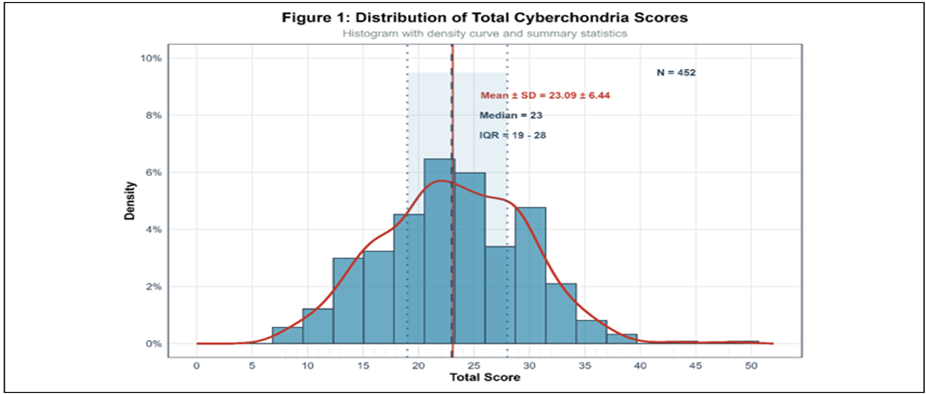
Figure 1 displays the distribution of total CSS-15 scores among the 452 healthcare students. The scores ranged from 8 to 48, with a mean of 23.09 ± 6.44 and a median of 23 (Q1=19, Q3=28). The majority of participants (50%) scored between 19 and 28, indicating a moderate level of cyberchondria. The peak frequency was observed around scores of 22–24, with progressively fewer participants at the extremes (below 12 or above 38), suggesting that severe cyberchondria was uncommon. The density curve overlaid on the histogram highlights the unimodal pattern, confirming that most students clustered around the moderate range.
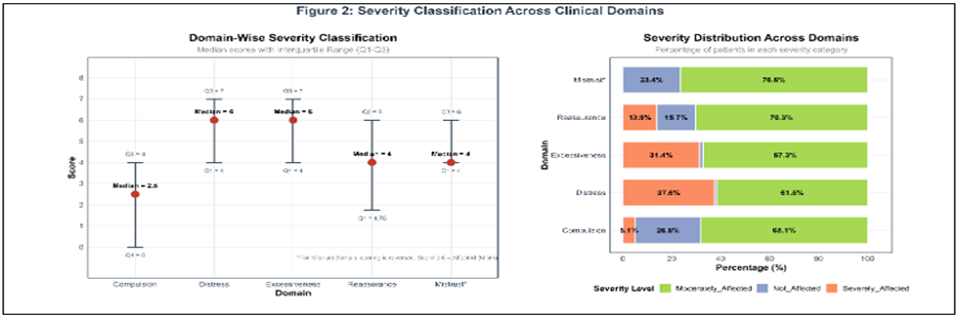
Figure 2 represents the classification of participants based on the severity of each CSS-15 domain. The Distress domain emerged as the most severely affected, with 37.62% (n=170) of participants falling into the severely affected category, while 61.50% (n=278) were moderately affected. The median score for Distress was 6 (Q1=4, Q3=7). Excessiveness domain showed that 31.42% (n=142) of participants were severely affected, with 67.26% (n=304) moderately affected and only 1.33% (n=6) not affected. The median score was 6 (Q1=4, Q3=7). In the reassurance domain,13.94% (n=63) were severely affected, 70.35% (n=318) moderately affected, and 15.71% (n=71) not affected. The median score was 4 (Q1=1.75, Q3=6). The Compulsion domain showed the lowest severity, with only 5.09% (n=23) severely affected, 68.14% (n=308) moderately affected, and 26.77% (n=121) not affected. The median score was 2.5 (Q1=0, Q3=4). For the Mistrust domain, which uses reverse scoring, 76.55% (n=346) were classified as affected (Score 1-6), while 23.45% (n=106) were not affected (Score 7-12). The median score was 4 (Q1=4, Q3=6).
The association between independent variables and CSS-15 domain scores was examined using Mann-Whitney U tests for binary variables and Kruskal-Wallis tests for multi-category variables. Table 2 presents the median (Q1, Q3) values and association for each domain across all independent variables.
Table 2: Domain wise median (Q1, Q3) and association analysis
|
Variable |
Category |
n |
Total Score Median (Q1, Q3) |
Compulsion Median (Q1, Q3) |
Distress Median (Q1, Q3) |
Excessiveness Median (Q1, Q3) |
Reassurance Median (Q1, Q3) |
Mistrust Median (Q1, Q3) |
|
Gender |
Female |
369 |
23 (19, 28) |
2 (0, 4) |
6 (5, 7) |
6 (4, 7) |
4 (1, 6) |
4 (4, 6) |
|
Male |
83 |
23 (19, 28) |
3 (1, 5) |
6 (4, 7) |
6 (4, 6) |
4 (2, 6) |
5 (4, 7) |
|
|
p-value |
0.9118 |
0.0439* |
0.0409* |
0.1474 |
0.7797 |
0.0550 |
||
|
Course |
B. Pharm |
186 |
24 (19, 28) |
3 (1, 5) |
6 (4, 7) |
5 (4, 6) |
4 (1, 6) |
6 (4, 8) |
|
B. Sc Nursing |
126 |
22.5 (18.25, 27) |
2 (0, 4) |
6 (4, 7) |
6 (4.25, 7) |
4 (1, 6) |
4 (4, 6) |
|
|
MBBS |
140 |
23 (18, 28) |
2 (0.75, 4) |
6 (5, 7) |
6 (5, 7) |
4 (2, 6) |
4 (4, 6) |
|
|
p-value |
0.3870 |
0.0545 |
0.5936 |
0.0369* |
0.9886 |
<0.001*** |
||
|
Residence |
Rural |
284 |
23 (19, 28) |
3 (0, 5) |
6 (4, 7) |
6 (4, 7) |
4 (2, 6) |
5 (4, 7) |
|
Urban |
168 |
23 (18, 28) |
2 (0, 4) |
6 (4, 7) |
6 (5, 7) |
4 (1, 6) |
4 (4, 6) |
|
|
p-value |
0.7909 |
0.1709 |
0.1728 |
0.7387 |
0.2689 |
0.0132* |
||
|
Internet Usage |
>5 hours |
85 |
24 (19, 28) |
3 (1, 4) |
6 (4, 7) |
6 (5, 7) |
4 (2, 5) |
4 (4, 6) |
|
3-5 hours |
127 |
23 (18, 28) |
2 (0, 4) |
6 (5, 7) |
6 (4, 7) |
4 (1, 6) |
4 (4, 6) |
|
|
<3 hours |
240 |
23 (19, 28) |
3 (0, 5) |
6 (4, 7) |
6 (4, 7) |
4 (2, 6) |
4 (4, 7) |
|
|
p-value |
0.8358 |
0.1949 |
0.3425 |
0.0691 |
0.5793 |
0.0817 |
||
|
Search for health information daily |
Yes |
96 |
23.5 (17, 27) |
2 (0, 4) |
6 (5, 7) |
6 (5, 7) |
4 (1, 6) |
4 (4, 5) |
|
No |
356 |
23 (19, 28) |
3 (0, 4) |
6 (4, 7) |
6 (4, 7) |
4 (2, 6) |
4 (4, 7) |
|
|
p-value |
0.5460 |
0.3796 |
0.5566 |
0.0993 |
0.5826 |
0.0017** |
||
|
History of psychiatric illness |
No |
401 |
23 (18, 28) |
2 (0, 4) |
6 (4, 7) |
6 (4, 7) |
4 (1, 6) |
4 (4, 6) |
|
Yes |
51 |
25 (20.5,31) |
3 (1, 5) |
6 (4, 7) |
6 (5, 7) |
4 (2, 6.5) |
5 (4, 7) |
|
|
p-value |
0.0236* |
0.1315 |
0.4255 |
0.0834 |
0.2517 |
0.0576 |
||
|
*p < 0.05 is statistically significant |
||||||||
Significant gender differences were observed for the Compulsion (p=0.0439) and Distress (p=0.0409) domains. Male participants showed higher Compulsion scores [Median=3 (1, 5)] compared to females [Median=2 (0, 4)].
The course of study showed highly significant associations with Mistrust (p<0.001) and Excessiveness (p=0.0369). B.Sc Nursing [Median=4 (4, 6)] and MBBS [Median=4 (4, 6)] students had higher mistrust compared to the B. Pharm students [Median=6 (4, 8)]. For Excessiveness, MBBS students [Median=6 (5, 7)] and B.Sc Nursing [Median=6 (4.25, 7)] students showed higher scores compared to B.Pharm [Median=5 (4, 6)] students.
There was a significant association between Mistrust and place of residence (p=0.0132). Urban students exhibited higher Mistrust scores [Median=4 (4, 6)] compared to rural students [Median=5 (4, 7)].
Searching for Health-related information on a daily basis showed a significant association with Mistrust (p=0.0017). Students who search health information on a daily basis exhibited higher Mistrust scores [Median=4 (4, 5)] compared to those who did not [Median=4 (4, 7)]. Meaning, students who less frequently searched for health information online showed least mistrust toward medical professionals.
Spearman's correlation analysis was conducted to examine the relationships between the CSS-15 domains (Table 3). All four domains-Compulsion, Distress, Excessiveness, and Reassurance-showed significant positive correlations with each other (all p<0.001).
The strongest correlation was observed between Compulsion and Reassurance (r=0.389, p<0.001).
Distress showed moderate positive correlations with Reassurance (r=0.336, p<0.001) and Excessiveness (r=0.268, p<0.001). Compulsion showed positive correlations with Excessiveness (r=0.254, p<0.001) and Distress (r=0.250, p<0.001).
Excessiveness showed a weaker but significant correlation with Reassurance (r=0.223, p<0.001).
Table 3: Correlation Matrix Between CSS-15 Domains (Spearman)
|
Domain |
Compulsion |
Distress |
Excessiveness |
Reassurance |
|
Compulsion |
1.000 |
0.250* |
0.254* |
0.389* |
|
Distress |
0.250* |
1.000 |
0.268* |
0.336* |
|
Excessiveness |
0.254* |
0.268* |
1.000 |
0.223* |
|
Reassurance |
0.389* |
0.336* |
0.223* |
1.000 |
|
All correlations with p < 0.001 are marked with * |
||||
DISCUSSION:
This cross-sectional study investigated the severity and correlates of cyberchondria among 452 undergraduate healthcare students (Medical, Nursing, and Pharmacy) in Wayanad District, Kerala. Because healthcare students represent a unique intersection of future medical professionals and active internet users, evaluating cyberchondria in this cohort provides critical insights into how health-related education interacts with online health-seeking behaviour and health anxiety.
In the present study, the majority of participants were females (81.64%), which is consistent with the findings of Patanapu et al. and Shailaja et al., who investigated cyberchondria among dental students in Telangana and Maharashtra, respectively. Similarly, Gandla et al., in their study among medical students in Andhra Pradesh, reported a predominance of female participants (54%). The increasing proportion of female students enrolling in medical and paramedical courses over the years may explain the higher representation of females observed in the present study.4,5,11 Although access to smartphones and the internet is nearly universal, 53% of participants in the present study reported spending less than three hours online, and only 21.24% reported searching for health-related information on the internet on a daily basis. This proportion was slightly lower than that reported by Abdulrahman et al. in a study conducted in Saudi Arabia, where 24.5% of participants reported daily health-related internet searches.10
This study indicated majority of participants (50%) scored between 19 and 28, highlighting a moderate level of cyberchondria across the cohort. The peak frequency observed around scores of 22–24, coupled with a lack of extreme clustering at the upper tails, indicates that severe cyberchondria is relatively uncommon among these undergraduate students. Studies in Saudi Arabia and Pakistan by Abdulrahman et al and Sabir et al, respectively reported moderate to severe cyberchondria among the medical undergraduate students. Gandla et al reported 66% of the participants (medical undergraduates and interns) had moderate cyberchondria, which was slightly higher in comparison to our study.5,9,10 These findings align with existing literature indicating that while online symptom checking is widespread in modern academic settings, pathological cyberchondria remains less frequent, owing to their foundational medical knowledge which acts as a buffer against extreme tails of severe cyberchondria.
The study revealed that, across the four constructs/domains, the majority of participants were moderately affected. Similarly, studies conducted among medical, dental, and engineering students across India have consistently reported moderate levels of impact across all domains.4,13,14 Distress domain was the most affected with nearly 38% of the participants being in the severe category followed by the Excessiveness domain, in which 31% were severely affected. Slightly in contrast to this finding, studies from Saudi Arabi and across India (Shailaja et al, Santi et al) reported excessiveness as the most affected domain, followed by distress.4,10,14 This demonstrated that even among students trained in healthcare, online searches frequently trigger distress, anxiety, and repetitive information-seeking behaviour. In the Reassurance and compulsion domain 14% and 5% participants belonged to the severe category, respectively. This suggests that while students experience anxiety and excessiveness, their web-searching habits are rarely compulsive enough to severely disrupt their daily academic and personal routines. Majority (77%) of the participants were affected by Mistrust, meaning they trusted the online resources over consulting doctors.
In our study, gender was significantly associated with the compulsion and distress domains, with males exhibiting higher compulsion scores and females reporting higher distress scores. These findings are consistent with those of Patanapu et al. and Shailaja et al., who similarly reported higher distress scores among females than males. However, our findings contrast with a study from Saudi Arabia, which observed minimal gender differences across all CSS domains. Although anxiety disorders are generally more prevalent among females, existing evidence suggests that health anxiety does not demonstrate a consistent gender difference.4,10,11,15 Suggesting that regional and cultural factors influence how health anxiety is manifested and reported. There was significant difference between academic discipline and excessiveness domain, with MBBS students exhibiting higher excessiveness score, probably driven by heightened drive to deeply research clinical presentations online. B.Sc Nursing and MBBS students exhibited significantly higher mistrust scores compared to B.Pharm students. However, no previous studies were identified that directly support or validate this finding. There was a significant association between Mistrust and place of residence (p=0.0132), with students from urban setting exhibiting higher Mistrust scores. Other studies suggest that individuals living in urban settings have greater internet use and may consequently exhibit higher cyberchondria scores; however, there is currently no direct evidence establishing an association between mistrust and place of residence.16 Searching for Health-related information on a daily basis showed a significant association with Mistrust (p=0.0017); students who less frequently searched for health information online showed least mistrust toward medical professionals. Even though there are no direct studies to confirm this finding, many studies demonstrate a positive, association between the frequency of online health-information searching and overall cyberchondria severity.17
All four domains-Compulsion, Distress, Excessiveness, and Reassurance-showed significant positive correlations with each other, indicating that these constructs form an interconnected network of cyberchondria symptoms. The strongest correlation was observed between Compulsion and Reassurance, suggesting that students who experienced greater disruption to their daily activities from online health searches were also more likely to seek reassurance. Distress showed positive correlations with Reassurance and Excessiveness, indicating that anxiety and panic were associated with both help-seeking behaviour and repetitive searching.
CONCLUSION:
Among the 452 participants (MBBS, B.Sc. Nursing and B. Pharm students), majority of the participants scored between 19 and 28, indicating a moderate level of cyberchondria. The Distress domain emerged as the most severely affected, with 37.62% of participants falling into the severely affected category, while 61.50% were moderately affected. Excessiveness domain showed that 31.42% of participants were severely affected, with 67.26% being moderately affected. For the Mistrust domain, which uses reverse scoring, 76.55% were affected. All four domains-Compulsion, Distress, Excessiveness, and Reassurance-showed significant positive correlations with each other, indicating that these constructs form an interconnected network of cyberchondria symptoms.
These findings highlight the need for targeted educational strategies focusing on digital health literacy, critical appraisal of online information, and awareness of health anxiety. Incorporating structured sessions on safe internet use and symptom searching into undergraduate curricula may help mitigate cyberchondria. In conclusion, cyberchondria represents a significant and emerging concern among healthcare students, warranting institutional attention to digital behavior, mental health, and medical education practices.
REFERENCES:
1. International Telecommunication Union. Internet use [Internet]. Geneva: International Telecommunication Union; 2025 Oct 15 [cited 2026 Aug 13]. Available from: https://www.itu.int/itu-d/reports/statistics/2025/10/15/ff25-internet-use/
2. Miezah D, Adzakpa R, Bani EM, et al. Prevalence and Associated Factors of Cyberchondria: A Scoping Review. The Scientific World Journal 2026;2026(1):9950027.
3. Srivastava, P., Srivastava, M. Patterns and predictors of online health information seeking and credibility assessment among youths in India. Discov Public Health 2026;23:534. https://doi.org/10.1186/s12982-026-01749-w
4. Shailaja B, Shetty V, Chaudhury S, et al. Exploring cyberchondria and its associations in dental students amid COVID-19 infodemic. Ind Psychiatry J 2020;29:257-6.
5. Gandla SD, Dayala PP, Kadiyala PK. Cyberchondria: an emerging form of health anxiety. Arch Ment Health 2021;22:148-52.
6. Starcevic V, Berle D, Arnáez S. Recent insights into cyberchondria. Current Psychiatry Reports 2020;22(11):56.
7. Dagar D, Kakodkar P, Shetiya SH. Evaluating the cyberchondria construct among computer engineering students in Pune (India) Using Cyberchondria Severity Scale (CSS-15). Indian J Occup Environ Med 2019;23:117-20.
8. Mathes BM, Norr AM, Allan NP, et al. Cyberchondria: Overlap with health anxiety and unique relations with impairment, quality of life, and service utilization. Psychiatry Research 2018;261:204-11.
9. Sabir S, Naqvi I. Prevalence of cyberchondria among university students: an emerging challenge of the 21st century. The Journal of the Pakistan Medical Association 2023;73(8):1634-9.
10. Bin Abdulrahman KA, AL Musfir SK, Alforaih AS, et al. The prevalence of cyberchondria and the impact of skepticism on medical decisions among Imam Mohammed Ibn Saud Islamic University students, Riyadh, Saudi Arabia. J Family Med Prim Care 2024;13:5334-40
11. Patanapu SK, Sreeja CS, Veeraboina N, et al. Prevalence and effect of cyberchondria on academic performance among undergraduate dental students: an institutional based study. Ind Psychiatry J 2022;31:228-34.
12. Barke A, Bleichhardt G, Rief W, et al. The Cyberchondria Severity Scale (CSS): German validation and development of a short form. International Journal of Behavioral Medicine 2016;23(5):595-605.
13. Dagar D, Kakodkar P, Shetiya SH. Evaluating the cyberchondria construct among computer engineering students in Pune (India) Using Cyberchondria Severity Scale (CSS-15). Indian J Occup Environ Med 2019;23:117-20.
14. Santi NS, Sahoo JP. Cyberchondria in medical students: an observational study. Natl J Physiol Pharm Pharmacol 2023;13(01):82-84.
15. Kikas K, Werner-Seidler A, Upton E, et al. Illness anxiety disorder: a review of the current research and future directions. Current Psychiatry Reports 2024 Jul;26(7):331-9.
16. Kurcer MA, Erdogan Z, Cakir Kardes V. The effect of the COVID‐19 pandemic on health anxiety and cyberchondria levels of university students. Perspectives in Psychiatric Care 2022;58(1):132-40.
17. Kanganolli SR, Kumar NP. A cross sectional study on prevalence of cyberchondria and factors influencing it among undergraduate students. Int J Med Sci Public Health 2020;9(4):263-6.