Association of polycystic ovarian syndrome with mental stress in women of reproductive age group.
- Rehana Yasmin , Chief Consultant, DHQ Teaching Hospital, Mianwali.
- Nazima Naureen Niazi , Consultant Gynaecologist, DHQ Teaching Hospital, Mianwali.
- Afia Rafique , Consultant Gynaecologist, DHQ Teaching Hospital, Mianwali.
- Raheela Azam , Senior Registrar, Gynae, Muhammad Teaching Hospital, Peshawar.
- Kiran Nasir , Consultant Gynaecologist, DHQ Teaching Hospital, Mianwali.
- Soma Zafar , House Officer, PIMS, Islamabad.
Article Information:
Abstract:
Background: Objective: “To determine the association of polycystic ovarian syndrome with stress in women of reproductive age group” Study design: Case control study Study place and duration: Department of Obstetrics & Gynecology, DHQ Hospital, Mianwali for 6 months ( 01 January 2026 to 30 June 2026). Methodology: Five hundred and thirty women were included and divided in two groups. Cases were those who were diagnosed with PCOS and controls were those who did not have PCOS. Then women were examined for perceived stress score and if score If >13, then stress was labeled. Data was collected in a proforma while later on analysed in SPSSv.25. Results: In this study, the mean age of women in case group was 30.30 ± 8.57 years and in control group was 31.26 ± 8.80 years. The stress was observed in 175 (66.0%) women in case group while in 82 (30.9%) women in control groups with the OR = 4.339 (95% CI: 3.016, 6.245). Conclusion: There is significant association of stress with PCOS among women of reproductive age group.
Keywords:
Article :
INTRODUCTION:
The most common endocrinological condition affecting women of reproductive age is polycystic ovarian syndrome (PCOS), which causes changes in body composition and metabolic abnormalities.1, 2 The most common endocrinological condition affecting women of reproductive age is polycystic ovarian syndrome (PCOS), which causes metabolic problems and changes in body composition.3, 4
Women of reproductive age have a 5%–10% higher prevalence of PCOS than the overall population worldwide, and 40% of PCOS-afflicted women, especially young girls, suffer from depression. It is uncertain what specifically causes PCOS. Stress is an imperceptible element influencing contemporary life and is closely linked to the etiology of several diseases, including PCOS in women.1, 5
The WHO study states that the prevalence of anxiety and depression among women worldwide is 4.6% and 5.1%, respectively. Additionally, according to WHO statistics, the prevalence of anxiety and depression in women between the ages of 20 and 40 varies from 5 to 6% and 6 to 7%, respectively.6, 7 In a different research, the prevalence of depression-like and anxiety-like behavior increased to 52.0% and 26.1%, respectively, among all PCOS patients aged 20 to 40, and to 32.56 and 36.36%, respectively, in the fertile group.8 Compared to the healthy women, the PCOS-afflicted women had higher degrees of anxiety and sadness as well as worse ego-resiliency. Compared to the healthy women, the PCOS-afflicted women employed passive stress-coping techniques far more frequently. Anxiety levels were raised by being childless, living in a remote region, and having less education.9, 10
Finding out whether stress and PCOS are connected in women of reproductive age was the aim of this investigation. For women in the reproductive age range, PCOS is the main cause of irregular menstruation and infertility, which can result in poor mental health and a worse quality of life. In women of reproductive age, stress has been identified as a contributing factor to the development of PCOS. It has been observed that stress and PCOS have close relationship. However, proper evidence lack and very few studies have been done before. In addition, no local data on this topic is available so far. Therefore, we conducted this study to get local evidence and implement the result in local setting.
METHODOLOGY:
This Case Control study was carried out in the Department of Obstetrics & Gynecology, DHQ Hospital, Mianwali for 6 months ( 01 January 2026 to 30 June 2026). Sample size of 530 women (265 in each group) was estimated by keeping 80% power of study, 5% significance level, and percentage of stress as50% among cases and 39.2% among controls.11 All the women who fulfilled following criteria were enrolled in the study by applying non-probability, consecutive sampling.
Inclusion: Women who fall in age range 16-45 years (reproductive age group) were enrolled in the study. Women were screened for PCOS. Cases were those women who were diagnosed to have PCOS. PCOS was defined as presence of LH/FSH ratio>1 with oligomerrorhea (<9 cycles/year), presence of >11 large sized cysts (detected on on ultrasound), hirsutism and acne (any 3 or more). Controls were those women, who did not diagnose with PCOS and normal ovarian function.
Exclusion: Women with PCOS in pregnancy, chronic diabetes (OGTT>200 mg/dl), thyroid disorder or known psychiatric disorder (schizophrenia) were excluded from the study.
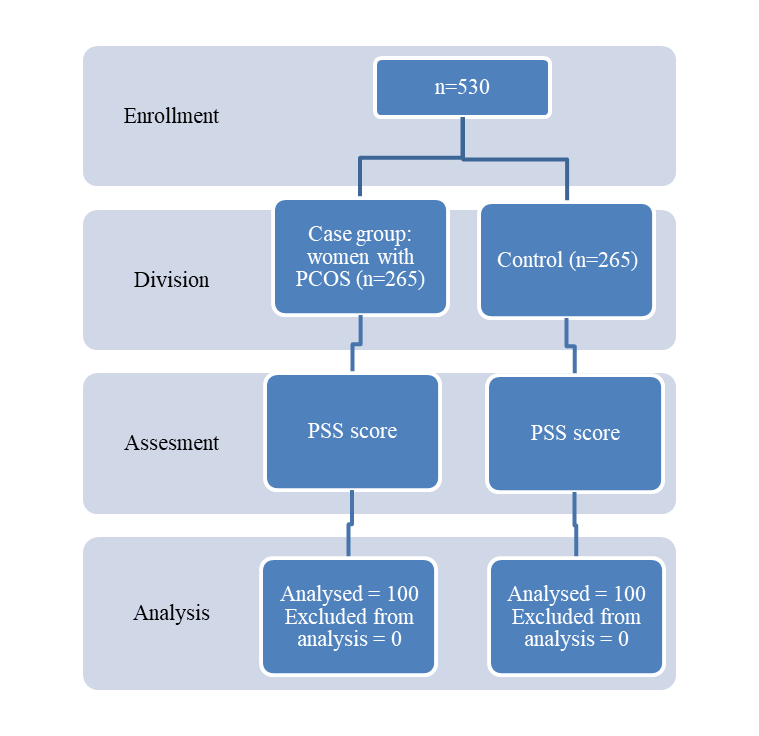
Figure-1: Patient Flow Diagram (n= 200)
Women were included from OPD and informed consent was taken to enroll them in the study and using their personal data for research purpose. Demographic details were also documented. The women were divided in two groups i.e. cases with PCOS and controls without PCOS. Then women were examined for perceived stress score by a consultant psychiatrist having at least 4 years’ experience in relevant field. If female scored >13, then stress was labeled. Women with stress along with PCOS were managed as per standard guidelines. Data was collected in a proforma while later on analysed in SPSSv.25. Odds ratio was calculated by using 2x2 contingency table to determine the association between PCOS and stress OR>1 was kept as significant.
RESULTS:
In this study, the mean age of women in case group was 30.30 ± 8.57 years and in control group was 31.26 ± 8.80 years. The mean BMI of women in case group was 27.57 ± 6.87 kg/m2 and in control group was 26.89 ± 6.87 kg/m2. In case group, there were 189 (71.3%) married while 76 (28.7%) unmarried women. In control group, there were 193 (72.8%) married while 72 (27.2%) unmarried women. In case group, there were 92 (34.7%) nulliparous women (unmarried and women with infertility complaint), 58 (21.9%) were primiparous and 115 (43.4%) were multiparous. In control group, there were 87 (32.8%) nulliparous women, 63 (23.8%) were primiparous and 115 (43.4%) were multiparous. In case group, there were 94 (35.5%) women of low socioeconomic class, 81 (30.6%) were middle class and 90 (34.0%) were high class. In control group, there were 91 (34.3%) women of low socioeconomic class, 78 (29.4%) were middle class and 96 (36.2%) were high class. In case group, the mean duration of symptoms was 13.44 ± 6.12 months. Table-I
In case group, mean perceived stress score was 24.10 ± 11.28 that was significantly higher than control group (10.34 ± 7.68, p<0.0001). Thus, stress was observed in 175 (66.0%) women in case group while in 82 (30.9%) women in control groups. The risk of developing stress is four times higher among women with PCOS as compared to women without PCOS i.e. OR = 4.339 (95% CI: 3.016, 6.245, p-value <0.0001). Table-II
We stratified data in different effect modifiers and observed significant association of stress with PCOS in each stratified group. In women of age 16-30 years, the risk of association was 3.661 (95% CI: 2.211, 6.063), but risk increases with age above 31 years (5.189 (95% CI: 3.063, 8.791). But risk of association is almost similar with respect to BMI i.e. 4-6 times risk, but in obese women, risk of developing stress is two times higher only. Marital status also showed that among married women, the risk of stress was four times higher in women with PCOS than non-PCOS women. But in unmarried women, risk of stress was three times higher in women with PCOS than non-PCOS women. Stress is three times higher among nulliparous women, but five times higher in primiparous women. Women belong to low socioeconomic class, risk of stress was 5.5 time higher in women with PCOS than non-PCOS women. But risk of stress was three times higher in women belong to middle or high class. Table-III
Table-I: Basic demographic details of enrolled women (n = 530)
|
|
Group |
|
|
|
Case |
Control |
|
n |
265 |
265 |
|
Age (in years) |
30.30 ± 8.57 |
31.26 ± 8.80 |
|
BMI (kg/m2) |
27.57 ± 6.87 |
26.89 ± 6.87 |
|
Marital status |
|
|
|
Married |
189 (71.3%) |
193 (72.8%) |
|
Unmarried |
76 (28.7%) |
72 (27.2%) |
|
Parity |
|
|
|
Nulliparous |
92 (34.7%) |
87 (32.8%) |
|
Primiparous |
58 (21.9%) |
63 (23.8%) |
|
Multiparous |
115 (43.4%) |
115 (43.4%) |
|
Socioeconomic status |
|
|
|
Low |
94 (35.5%) |
91 (34.3%) |
|
Middle |
81 (30.6%) |
78 (29.4%) |
|
High |
90 (34.0%) |
96 (36.2%) |
|
Duration of PCOS symptoms |
13.44 ± 6.12 |
NA |
Table-II: Association of stress with PCOS (n = 530)
|
|
Group |
P-value |
|
|
|
Case |
Control |
|
|
n |
265 |
265 |
|
|
Perceived stress score |
24.10 ± 11.28 |
10.34 ± 7.68 |
<0.0001 |
|
Stress |
|
|
|
|
Yes |
175 (66.0%) |
82 (30.9%) |
<0.0001 |
|
No |
90 (34.0%) |
183 (69.1%) |
|
OR = 4.339 (95% CI: 3.016, 6.245).
Table-III: Association of stress with PCOS with respect to effect modifiers
|
|
Group |
Odds ratio (95% CI) |
|
|
Case |
Control |
||
|
Age 16-30 years |
89 (65.4%) |
45 (34.1%) |
3.661 (2.211, 6.063) |
|
Age 31-45 years |
86 (66.7%) |
37 (27.8%) |
5.189 (3.063, 8.791) |
|
BMI |
|
|
|
|
Underweight |
23 (71.9%) |
12 (30.0%) |
5.963 (2.139, 16.624) |
|
Normal |
46 (68.7%) |
19 (31.1%) |
4.842 (2.291, 10.234) |
|
Overweight |
40 (67.8%) |
17 (24.6%) |
6.440 (2.972, 13.955) |
|
Obese |
66 (61.7%) |
34 (35.8%) |
2.888 (1.629, 5.120)) |
|
Marital status |
|
|
|
|
Married |
127 (67.2%) |
58 (30.1%) |
4.768 (3.094, 7.346) |
|
Unmarried |
48 (63.2%) |
24 (33.3%) |
3.429 (1.743, 6.742) |
|
Parity |
|
|
|
|
Nulliparous |
57 (62.0%) |
27 (31.0%) |
3.619 (1.948, 6.722) |
|
Primiparous |
40 (69.0%) |
19 (30.2%) |
5.146 (2.373, 11.158) |
|
Multiparous |
78 (67.8%) |
36 (31.3%) |
4.626 (2.655, 8.061) |
|
Socioeconomic status |
|
|
|
|
Low |
68 (72.3%) |
29 (31.9%) |
5.592 (2.974, 10.513) |
|
Middle |
56 (69.1%) |
29 (37.2%) |
3.785 (1.960, 7.309) |
|
High |
51 (56.7%) |
24 (25.0%) |
3.923 (2.106, 7.309) |
DISCUSSION:
In our investigation, we found that the case group's mean perceived stress score was 24.10 ± 11.28, which was substantially greater than that of the control group (10.34 ± 7.68, p<0.0001). Accordingly, stress was noted in 82 (30.9%) women in the control groups and 175 (66.0%) women in the case group. According to the computed OR of 4.339 (95% CI: 3.016, 6.245, p-value <0.0001), women with PCOS are four times more likely than those without PCOS to feel stress. Stress is one of the elements that contribute to the pathophysiology of the illness. It has been proposed that stress is a significant factor in regulating the many clinical symptoms that PCOS patients experience.12
Stress is an invisible factor that affects modern life and is directly related to the causes of a number of illnesses, such as female polycystic ovarian syndrome (PCOS). PCOS is the most prevalent endocrinological disorder affecting women who are of reproductive age.
Stress is an invisible factor that affects modern life and is directly related to the causes of a number of illnesses, such as female polycystic ovarian syndrome (PCOS). PCOS is the most prevalent endocrinological disorder affecting women who are of reproductive age, which causes changes in body composition and metabolic abnormalities. Two important stress mediators that have been linked to PCOS are salivary amylase and cortisol. However, it is yet unknown how they affect body composition in PCOS.13
Damone et al,.11 showed that women with PCOS were more likely than those without PCOS to experience anxiety symptoms (50% vs. 39.2%), sadness (27.3 vs. 18.8%), and a higher perceived stress score (1.01± 0.03 vs. 0.88± 0.01).11 Similarly, Benjami et al., conducted a case control study and observed that mean perceived stress score was 19.74 ±5.54 which was significantly higher in women with PCOS than women without PCOS
16.56 ±6.04, p-value <0.001. They came to the conclusion that there was a substantial difference in the stress hormone levels between the two groups. Stress-reduction strategies for these women can significantly lessen the intensity of their current symptoms and the likelihood of developing dangerous consequences. 14
Altaf et al., We out a cross-sectional study in Rawalpindi and discovered that: According to the study, women with PCOS had considerably more stress (22.93 ± 6.46 versus 19.56 ± 4.45), with a p-value of 0.003. Stress and PCOS were positively correlated (r = 0.60, p <.001), according to regression analysis. The results showed a strong correlation between young women's PCOS and high stress levels. This implies that stress management techniques should be included in PCOS prevention and therapy.15
Divya and Ranganathan presented a case of Girishma that helped16 should realize that PCOS is a lifestyle issue with several contributing elements, rather than just a medical problem. Therefore, treating PCOS with medication and concentrating solely on its physical symptoms is insufficient. Reducing the patient's stress levels through additional supporting services is also crucial.16
This is consistent with other research, like Khafagy et al., which discovered a noteworthy differential in PSS scores between teenagers with and without PCOS.17 Additionally, the majority of the subscales in our study revealed substantial variations in health-related quality of life between physical and emotional health using the SF-36, with PCOS women exhibiting lower scores, hence indicating a reduced quality of life. Similarly, a recent case-control research found that PCOS and healthy control patients differed significantly in a number of short form health survey-36 topics.18 Similar findings have been reported before, and our results support the general consensus that women with PCOS are more likely to experience emotional discomfort and a worse quality of life.19, 20 According to a new systematic review and meta-analysis by Yin et al., women with PCOS have a worse quality of life and are more likely to experience anxiety and depression, supporting the well-known and shown impact of PCOS on general health and quality of life.21, 22.
CONCLUSION:
There is significant association of stress with PCOS among women of reproductive age group. Now in future, we will implement a practice to screen PCOS women for their psychological and social life in order to screen out the stress and anxiety level in women and counsel them to improve their quality of life.
CONFLICT OF INTEREST
None.
REFERENCES:
1. Basu BR, Chowdhury O, Saha SK. Possible link between stress-related factors and altered body composition in women with polycystic ovarian syndrome. J Human Reprod Sci 2018;11(1):10-8. http://doi.org/.4103/jhrs.JHRS_78_17.
2. Parker J, O’brien C, Hawrelak J, Gersh FL. Polycystic ovary syndrome: an evolutionary adaptation to lifestyle and the environment. Int J Environ Res Public Health 2022;19(3):1336. http://doi.org/10.3390/ijerph19031336.
3. Chaudhari AP, Mazumdar K, Mehta PD. Anxiety, depression, and quality of life in women with polycystic ovarian syndrome. Indian J Psychol Med 2018;40(3):239-46. http://doi.org/10.4103/IJPSYM.IJPSYM_561_17.
4. Thannickal A, Brutocao C, Alsawas M, Morrow A, Zaiem F, Murad MH, et al. Eating, sleeping and sexual function disorders in women with polycystic ovary syndrome (PCOS): A systematic review and meta‐analysis. Clin Endocrinol 2020;92(4):338-49. http://doi.org/10.1111/cen.14153.
5. Sadeeqa S, Mustafa T, Latif S. Polycystic ovarian syndrome–related depression in adolescent girls: a review. J Pharm Bioallied Sci 2018;10(2):55-9. http://doi.org/10.4103/JPBS.JPBS_1_18.
6. Kolhe JV, Chhipa AS, Butani S, Chavda V, Patel SS. PCOS and depression: common links and potential targets. Reprod Sci 2022;29:3106–23. https://doi.org/10.1007/s43032-021-00765-2.
7. Alamri AS, Alhomrani M, Alsanie WF, Almuqbil M, Alqarni KM, Alshehri SM, et al. Role of polycystic ovarian syndrome in developing psychological burden in Saudi Arabian females: A case control study. Front Public Health 2022;10:999813. https://doi.org/10.3389/fpubh.2022.
8. Lin H, Liu M, Zhong D, Ng EHY, Liu J, Li J, et al. The prevalence and factors associated with anxiety-like and depression-like behaviors in women with polycystic ovary syndrome. Front Psychiatry 2021;12:709674. http://doi.org/10.3389/fpsyt.2021.
9. Dybciak P, Humeniuk E, Raczkiewicz D, Krakowiak J, Wdowiak A, Bojar I. Anxiety and Depression in Women with Polycystic Ovary Syndrome. Medicina 2022;58(7):942. https://doi.org/10.3390/medicina58070942.
10. Kite C, Atkinson L, McGregor G, Clark CCT, Brown JE, Kyrou I, et al. Sleep Disruption and Depression, Stress and Anxiety Levels in Women With Polycystic Ovary Syndrome (PCOS) During the Lockdown Measures for COVID-19 in the UK. Front Glob Women Health 2021;2:649104. https://doi.org/10.3389/fgwh.2021.
11. Damone AL, Joham AE, Loxton D, Earnest A, Teede HJ, Moran LJ. Depression, anxiety and perceived stress in women with and without PCOS: a community-based study. Psychol Med 2019;49(9):1510-20. http://doi.org/10.017/S0033291718002076.
12. Salari N, Babajani F, Hosseinian-Far A, Hasheminezhad R, Abdoli N, Haydarisharaf P, et al. Global prevalence of major depressive disorder, generalized anxiety, stress, and depression among infertile women: a systematic review and meta-analysis. Arch Gynecol Obstet 2024;309(5):1833-46. https://doi.org/10.007/s00404-024-7444-y.
13. Basu BR, Chowdhury O, Saha SK. Possible Link Between Stress-related Factors and Altered Body Composition in Women with Polycystic Ovarian Syndrome. Journal of human reproductive sciences 2018;11(1):10-8. http://doi.org/.4103/jhrs.JHRS_78_17.
14. Benjamin JJ, MaheshKumar K, Radha V, Rajamani K, Puttaswamy N, Koshy T, et al. Stress and polycystic ovarian syndrome-a case control study among Indian women. Clin Epidemiol Glob Health 2023;22:101326. https://doi.org/10.1016/j.cegh.2023.
15. Altaf K, Mehreen K, Khatoon B, Tariq M. Role of Stress in Onset of Polycystic Ovarian Syndrome (PCOS). J Health Rehab Res 2023;3(2):1122-7. https://doi.org/10.61919/jhrr.v3i2.276.
16. Divya M, Ranganathan S. "PCOS is Like having a Disease": The Everyday Stress of Living with Polycystic Ovarian Syndrome (PCOS). Indian journal of community medicine : official publication of Indian Association of Preventive & Social Medicine 2022;47(4):622-3. http://doi.org/10.4103/ijcm.ijcm_1374_21.
17. Khafagy G, El Sayed I, Abbas S, Soliman S. Perceived Stress Scale Among Adolescents with Polycystic Ovary Syndrome. International journal of women's health 2020;12:1253-8. http://doi.org/10.2147/ijwh.s279245.
18. Tabassum F, Jyoti C, Sinha HH, Dhar K, Akhtar MS. Impact of polycystic ovary syndrome on quality of life of women in correlation to age, basal metabolic index, education and marriage. PloS one 2021;16(3):e0247486. https://doi.org/10.1371/journal.pone.
19. Benjamin JJ, Kuppusamy M, Koshy T, Kalburgi Narayana M, Ramaswamy P. Cortisol and polycystic ovarian syndrome - a systematic search and meta-analysis of case-control studies. Gynecological endocrinology : the official journal of the International Society of Gynecological Endocrinology 2021;37(11):961-7. https://doi.org/10.1080/09513590.2021.1908254.
20. Marschalek M-L, Marculescu R, Schneeberger C, Marschalek J, Dewailly D, Ott J. A case-control study about markers of stress in normal-/overweight women with polycystic ovary syndrome and in controls. Front Endocrinol 2023;14:1173422. https://doi.org/10.3389/fendo.2023.
21. Aversa A, La Vignera S, Rago R, Gambineri A, Nappi RE, Calogero AE, et al. Fundamental Concepts and Novel Aspects of Polycystic Ovarian Syndrome: Expert Consensus Resolutions. Frontiers in endocrinology 2020;11:516. https://doi.org/10.3389/fendo.2020.00516.
22. Yin X, Ji Y, Chan CLW, Chan CHY. The mental health of women with polycystic ovary syndrome: a systematic review and meta-analysis. Archives of women's mental health 2021;24(1):11-27. https://doi.org/10.1007/s00737-020-1043-x.