Cardiac Manifestations of Aluminium Phosphide Poisoning and Utility of Troponin T and CK-MB in Assessing Severity of Poisoning: A Prospective Observational Study.
- Akhil Murali Nair , Junior Resident, Department of General Medicine, Mysore Medical College and Research Institute, Mysore, Karnataka, India.
- Harshavardhan L. , Professor, Department of General Medicine, Mysore Medical College and Research Institute, Mysore, Karnataka, India.
- Sanjay N. , Junior Resident, Department of General Medicine, Mysore Medical College and Research Institute, Mysore, Karnataka, India.
- Deepak Ramesh , Junior Resident, Department of General Medicine, Mysore Medical College and Research Institute, Mysore, Karnataka, India.
Article Information:
Abstract:
Background: Aluminium phosphide (AlP) poisoning is a leading cause of fatal self-poisoning in India, with mortality driven principally by phosphine-induced myocardial toxicity. Cardiac troponin T (cTnT) and creatine kinase-MB (CK-MB) may help identify early myocardial injury and stratify severity. This study assessed the cardiac manifestations of AlP poisoning and evaluated the utility of cTnT and CK-MB in assessing severity and predicting outcome. Methods: A hospital-based prospective observational study was conducted on 64 adult patients with acute AlP poisoning admitted to a tertiary-care centre over 18 months. Clinical profile, electrocardiographic findings, PGI severity score, and serum cTnT and CK-MB at admission were recorded and correlated with severity and in-hospital outcome. Statistical analysis was performed using the Chi-square/Fisher's exact test, binary logistic regression, and receiver-operating-characteristic (ROC) curve analysis (SPSS v28.0; p<0.05 significant). Results: Hypotension (54.7%), tachycardia (35.9%) and abnormal ECG (81.3%) were common. cTnT was positive in 42.2% and CK-MB elevated in 28.1% of patients; both correlated significantly with PGI severity (p<0.0001 and p=0.008, respectively). Overall mortality was 40.6%. On logistic regression, the PGI score (OR 6.14) and CK-MB (OR 11.35, p=0.036) independently predicted mortality, whereas cTnT did not (p=0.109). PGI combined with CK-MB gave the highest AUC (0.935) for predicting death. Conclusion: Cardiac involvement is near-universal in AlP poisoning and strongly predicts outcome. Unlike cTnT, CK-MB independently predicts mortality, and combining it with the PGI score improves early risk stratification.
Keywords:
Article :
INTRODUCTION:
Aluminium phosphide (AlP) poisoning remains one of the most lethal toxicological emergencies encountered in clinical practice, particularly in agrarian regions where it is used as a grain fumigant.[1,2] Despite its simple chemistry, ingestion unleashes profound systemic derangement, with the heart emerging as the organ most responsible for the disproportionately high mortality associated with this poison. In India, AlP (sold as "Celphos" or "rice tablets") has become a leading cause of fatal self-poisoning because of its ready availability and lack of regulatory restriction, with intentional ingestion accounting for over 90% of cases. A recent meta-analysis of Indian studies involving 3,449 patients reported a pooled mortality of nearly 54%, despite optimal supportive care.[3]
On exposure to moisture and gastric acid, AlP liberates phosphine gas, a potent inhibitor of mitochondrial cytochrome-c oxidase that arrests oxidative phosphorylation and generates excessive reactive oxygen species.[4] Because cardiomyocytes possess the highest mitochondrial density and metabolic turnover of any cell type, the heart is disproportionately affected, and cardiac involvement is therefore central rather than incidental to the clinical course.[5]
At the cellular level, this oxidative stress causes lipid peroxidation of myocardial membranes, disruption of calcium homeostasis, and direct myocyte necrosis, producing a picture resembling acute toxic myocarditis on histopathology, so that cardiogenic shock and life-threatening arrhythmias can develop even in patients without any pre-existing cardiac disease.[5] Patients may appear deceptively stable before deteriorating abruptly into refractory hypotension, malignant arrhythmias, and cardiogenic shock that responds poorly to conventional fluids and vasopressors.[6,7]
The clinical course of AlP poisoning is consequently often unpredictable - some patients succumb within hours, while others survive with aggressive supportive care.[6]. Because clinical signs and haemodynamic parameters alone may not capture the full extent of early myocardial injury, biochemical cardiac markers have attracted increasing interest as objective tools for risk stratification.[8]
Cardiac troponin T (cTnT) is a highly sensitive and specific marker of myocyte injury, and in AlP poisoning its elevation reflects direct toxic damage to the contractile apparatus rather than coronary ischaemia. Creatine kinase-MB (CK-MB), though less specific, has long been used as an ancillary marker of myocardial necrosis, and rising or persistently elevated levels have been linked to worsening haemodynamic status and mortality. Composite clinical severity scores such as the PGI score, based on arterial pH, Glasgow Coma Scale and systolic blood pressure at admission, have also been validated as simple bedside predictors of outcome in AlP poisoning.[9]
In resource-limited settings, where advanced cardiac imaging such as echocardiography may not be immediately available, accessible biomarkers such as cTnT and CK-MB, interpreted alongside a validated clinical severity score, offer a practical means of risk assessment, anticipating complications, and guiding the intensity of monitoring and critical-care resource allocation.[8,9]
Despite the well-recognised cardiotoxicity of AlP, Indian data correlating cTnT and CK-MB with clinical severity and outcome remain limited, and the incremental value of these biomarkers over existing clinical severity scores is not well established.[3,8]
This study was therefore undertaken to characterise the spectrum of cardiac manifestations of acute AlP poisoning and to evaluate the utility of cTnT and CK-MB, alone and in combination with the PGI score, in assessing severity and predicting outcome. The specific objectives were (i) to study the cardiac manifestations of AlP poisoning, and (ii) to correlate the severity of poisoning with serum cTnT and CK-MB levels.
MATERIALS AND METHODS:
Study Design and Setting
This hospital-based prospective observational study was conducted in the inpatient wards and intensive care unit of the Department of General Medicine, K.R. Hospital, attached to Mysore Medical College and Research Institute (MMCRI), Mysuru, Karnataka - a tertiary-care referral centre for poisoning cases. The study was carried out over 18 months (April 2024 to September 2025) after approval from the Institutional Ethics Committee and was conducted in accordance with the Declaration of Helsinki. Written informed consent was obtained from participants, or from a legally acceptable representative where sensorium was impaired, with assent sought subsequently on recovery.
Participants
Adult patients (18 years or older) with a confirmed history of AlP ingestion - corroborated by the brought-in tablet or strip, a credible witness history, or a characteristic clinical presentation - who presented within 24 hours of ingestion were screened consecutively. Patients with pre-existing structural or ischaemic heart disease, chronic kidney disease (eGFR <45 ml/min/1.73m2), pregnancy, sepsis unrelated to the poisoning, recent chest trauma, or co-ingestion of another cardiotoxic poison were excluded. A purposive consecutive sampling technique was used. The sample size was calculated from a reported AlP-poisoning prevalence of 20.9% among pesticide-poisoning admissions,[10] using the single-proportion formula (Z=1.96, absolute precision 10%), which yielded a minimum requirement of 64 participants, all of whom were enrolled.
Data Collection
A structured proforma was used to record demographic details, time and quantity of ingestion, presenting symptoms, vital parameters, Glasgow Coma Scale, and detailed cardiac examination findings. A 12-lead ECG and blood samples for serum cTnT, CK-MB, arterial blood gas, complete blood count, and renal and liver function tests were obtained at admission as part of routine care.
Severity was graded using the PGI score (one point each for arterial pH <7.25, GCS <13, and systolic blood pressure <87 mmHg; grade 0 = mild, 1 = moderate, 2 = severe, 3 = very severe).9 Patients were followed through their hospital stay for the requirement of inotropic support and mechanical ventilation, and for final in-hospital outcome (survival or death).
Study Procedure and Ethical Considerations
Following stabilisation, eligible patients (or their legally acceptable representative in cases of altered sensorium) were counselled regarding the study using a participant information sheet in the local language, and written informed consent was obtained before enrolment. A detailed history and clinical examination were performed and recorded on the structured proforma by the investigator.
All patients received standard institutional management for AlP poisoning, including gastric decontamination, fluid resuscitation, vasopressor and inotropic support, correction of acidosis and electrolyte disturbances, and intensive-care monitoring as clinically indicated; the investigators did not alter or influence standard therapeutic management for study purposes, and the required investigations were part of routine clinical care rather than additional research-related risk.
Data were anonymised using a unique identification number for each participant and stored in a secure, access-controlled database, in accordance with approval granted by the Institutional Ethics Committee.
Statistical Analysis
· Data were analysed using IBM SPSS for Windows, version 28.0.
· Continuous variables were expressed as mean plus or minus SD; categorical variables were expressed as frequencies and percentages.
· Association between categorical variables (biomarker status, PGI severity grade, and outcome) was tested using the Chi-square test, or Fisher's exact test where cell counts were small.
· Binary logistic regression was used to identify independent predictors of in-hospital mortality, with results expressed as odds ratio (OR) and 95% confidence interval (CI).
· Receiver-operating-characteristic (ROC) curves were constructed and the area under the curve (AUC) was compared for the PGI score alone, PGI plus cTnT, and PGI plus CK-MB, in predicting mortality.
· A two-tailed p-value of less than 0.05 was considered statistically significant for all tests.
RESULTS:
A total of 64 patients with acute AlP poisoning were enrolled during the study period (Table 1). Most patients belonged to the third and fourth decades of life - 31 to 40 years (40.6%) and 21 to 30 years (28.1%) - with a male preponderance (56.3% versus 43.8% females). Nearly all patients (95.3%) had consumed the tablet formulation, most commonly two or three tablets (34.4% and 37.5% respectively), and all cases (100%) were suicidal in intent. Most patients (64.1%) presented within 3 to 4 hours of ingestion.
Table 1: Baseline demographic and clinical profile of study participants (n=64)
|
Parameter |
Category |
n |
% |
|
Age group (years) |
≤20 |
6 |
9.4 |
|
|
21–30 |
18 |
28.1 |
|
|
31–40 |
26 |
40.6 |
|
|
41–50 |
11 |
17.2 |
|
|
>50 |
3 |
4.7 |
|
Sex |
Male |
36 |
56.3 |
|
|
Female |
28 |
43.8 |
|
Form consumed |
Tablet |
61 |
95.3 |
|
|
Powder |
3 |
4.7 |
|
No. of tablets |
1 |
18 |
28.1 |
|
|
2 |
22 |
34.4 |
|
|
3 |
24 |
37.5 |
|
Time since ingestion (h) |
2–4 |
44 |
68.8 |
|
|
5–6 |
20 |
31.3 |
|
Mode of consumption |
Suicidal |
64 |
100.0 |
Gastrointestinal and cardiopulmonary symptoms dominated the clinical picture (Table 2): nausea (46.9%), chest discomfort (42.2%), vomiting and altered sensorium (40.6% each), generalised weakness (37.5%), abdominal pain (32.8%), and breathlessness (29.7%). On examination, hypotension (systolic BP <90 mmHg) was the single most common cardiac manifestation, present in 54.7% of patients, followed by tachycardia and weak peripheral pulses (35.9% each) and irregular pulse (31.3%); bradycardia was noted in 26.6%. Severe metabolic acidosis (pH <7.2) was present in 45.3% of patients, and 21.9% had a GCS below 8 at admission. Based on the PGI score, 40.6% of patients had very severe poisoning and an equal proportion had mild poisoning, while 54.7% required inotropic support and 40.6% required mechanical ventilation.
Table 2: Clinical presentation and cardiac manifestations among study participants
|
Parameter |
n |
% |
|
Nausea |
30 |
46.9 |
|
Chest discomfort |
27 |
42.2 |
|
Vomiting |
26 |
40.6 |
|
Altered sensorium |
26 |
40.6 |
|
Generalised weakness |
24 |
37.5 |
|
Abdominal pain |
21 |
32.8 |
|
Breathlessness |
19 |
29.7 |
|
Hypotension (SBP <90 mmHg) |
35 |
54.7 |
|
Tachycardia |
23 |
35.9 |
|
Weak peripheral pulses |
23 |
35.9 |
|
Irregular pulse |
20 |
31.3 |
|
Bradycardia |
17 |
26.6 |
|
Severe metabolic acidosis (pH <7.2) |
29 |
45.3 |
|
GCS <8 |
14 |
21.9 |
|
Very severe poisoning (PGI grade 3) |
26 |
40.6 |
|
Inotrope requirement |
35 |
54.7 |
|
Mechanical ventilation |
26 |
40.6 |
Electrocardiographic abnormalities were seen in 81.3% of patients (Table 3), the commonest being bradyarrhythmia (21.9%), followed by sinus tachycardia and atrial fibrillation (14.1% each), ventricular premature complexes (9.4%), and ventricular tachycardia (4.7%). QTc prolongation was present in 31.3%, ST-segment elevation in 9.4%, and right bundle branch block pattern in 9.4% of patients.
Table 3: Electrocardiographic findings among study participants
|
ECG Parameter |
Category |
n |
% |
|
Rhythm |
Normal |
23 |
35.9 |
|
|
Bradyarrhythmia |
14 |
21.9 |
|
|
Sinus tachycardia |
9 |
14.1 |
|
|
Atrial fibrillation |
9 |
14.1 |
|
|
Sinus rhythm with VPCs |
6 |
9.4 |
|
|
Ventricular tachycardia |
3 |
4.7 |
|
ST segment |
Elevation |
6 |
9.4 |
|
QTc interval |
Prolonged |
20 |
31.3 |
|
BBB pattern |
RBBB / incomplete RBBB |
9 |
14.1 |
|
Overall ECG status |
Abnormal |
52 |
81.3 |
Cardiac biomarkers reflected a substantial burden of myocardial injury (Table 4): cTnT was positive in 42.2% and CK-MB was elevated in 28.1% of patients. Isolated cTnT positivity was seen in 23.4%, isolated CK-MB elevation in 9.4%, and both markers were elevated together in 18.8% of patients; the two markers were significantly associated with each other (p=0.013).
Table 4: Distribution and cross-tabulation of cardiac biomarkers
|
Troponin T status |
CK-MB elevated, n (%) |
CK-MB normal, n (%) |
Total |
|
Positive |
12 (44.4) |
15 (55.6) |
27 |
|
Negative |
6 (16.2) |
31 (83.8) |
37 |
|
Total |
18 |
46 |
64 |
|
Troponin T positive: 27 (42.2%); CK-MB elevated: 18 (28.1%); χ2 test, p = 0.013 |
|||
Both biomarkers correlated strongly with clinical severity (Table 5). All cTnT-positive patients belonged to the severe (22.2%) or very severe (77.8%) PGI categories, with none in the mild or moderate groups (p<0.0001). CK-MB elevation likewise increased with severity, being highest in the very severe group (50.0%), though the gradient was less steep than for cTnT (p=0.008).
Table 5: Association of Troponin T and CK-MB status with severity of poisoning (PGI grade)
|
Biomarker status |
Mild, n (%) |
Moderate, n (%) |
Severe, n (%) |
Very severe, n (%) |
P value |
|
Troponin T negative (n=37) |
26 (70.3) |
3 (8.1) |
3 (8.1) |
5 (13.5) |
<0.0001 |
|
Troponin T positive (n=27) |
0 (0.0) |
0 (0.0) |
6 (22.2) |
21 (77.8) |
|
|
CK-MB normal (n=46) |
23 (50.0) |
0 (0.0) |
6 (13.0) |
17 (37.0) |
0.0079 |
|
CK-MB elevated (n=18) |
3 (16.7) |
3 (16.7) |
3 (16.7) |
9 (50.0) |
|
In-hospital outcome showed an equally strong gradient (Table 6). Overall mortality was 40.6% (26 of 64), reflecting the high fatality historically reported with this poisoning.
Mortality rose sharply with PGI grade - from 0% in scores 0 to 1, to 66.7% in score 2, and 76.9% in score 3 (p<0.0001) - and was strongly associated with the requirement for inotropic support (74.3% mortality versus 0% without, p<0.0001), mechanical ventilation (88.5% versus 7.9%, p<0.0001), and abnormal ECG (50.0% mortality versus 0% with a normal ECG, p=0.0015).
Table 6: Association of clinical and biomarker parameters with in-hospital outcome
|
Parameter |
Death, n (%) |
Survival, n (%) |
P value |
|
PGI score 0–1 (n=29) |
0 (0.0) |
29 (100.0) |
<0.0001 |
|
PGI score 2–3 (n=35) |
26 (74.3) |
9 (25.7) |
|
|
No inotrope required (n=29) |
0 (0.0) |
29 (100.0) |
<0.0001 |
|
Inotrope required (n=35) |
26 (74.3) |
9 (25.7) |
|
|
No mechanical ventilation (n=38) |
3 (7.9) |
35 (92.1) |
<0.0001 |
|
Mechanical ventilation (n=26) |
23 (88.5) |
3 (11.5) |
|
|
Normal ECG (n=12) |
0 (0.0) |
12 (100.0) |
0.0015 |
|
Abnormal ECG (n=52) |
26 (50.0) |
26 (50.0) |
|
|
Overall (n=64) |
26 (40.6) |
38 (59.4) |
— |
On binary logistic regression (Table 7), the PGI score was an independent predictor of mortality in all models (OR 6.14, 95% CI 2.85-13.21 alone; OR 12.17 with cTnT added; OR 9.12 with CK-MB added; p<0.001 in all models).
CK-MB retained independent significance after adjustment for the PGI score (OR 11.35, 95% CI 1.18-109.2; p=0.036), whereas cTnT did not (OR 0.12, 95% CI 0.01-1.43; p=0.109).
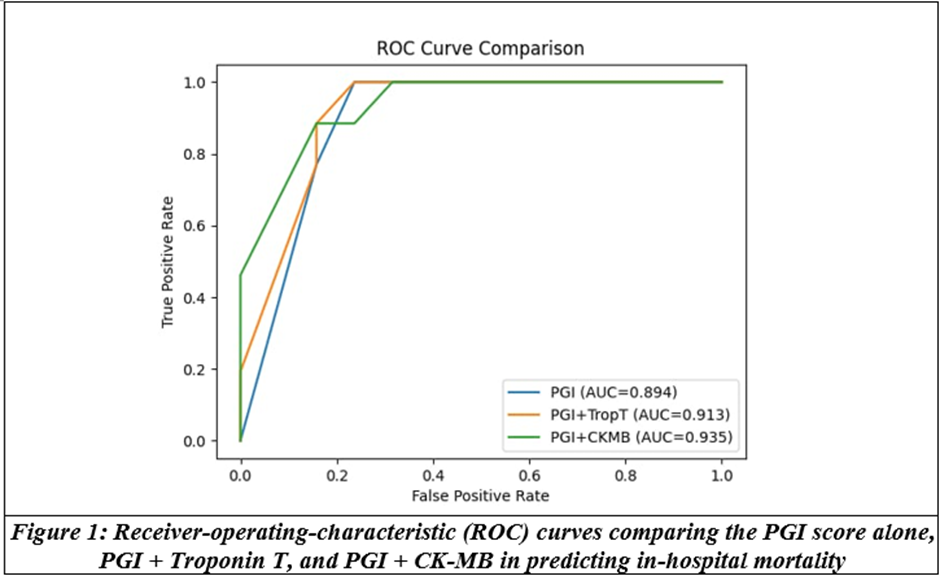
On ROC analysis (Figure 1), the AUC for predicting mortality was 0.894 for the PGI score alone, improving to 0.913 with the addition of cTnT, and to 0.935 with the addition of CK-MB - indicating that CK-MB added the greatest incremental discriminative value to the PGI score.
Table 7: Binary logistic regression – predictors of in-hospital mortality
|
Model |
Variable |
OR (95% CI) |
P value |
AUC |
|
PGI score alone |
PGI score |
6.14 (2.85–13.21) |
<0.001 |
0.894 |
|
PGI + Troponin T |
PGI score |
12.17 (3.85–38.45) |
<0.001 |
0.913 |
|
|
Troponin T |
0.12 (0.01–1.43) |
0.109 |
|
|
PGI + CK-MB |
PGI score |
9.12 (3.01–27.65) |
<0.001 |
0.935 |
|
|
CK-MB |
11.35 (1.18–109.2) |
0.036 |
|
Central nervous system examination further supported the systemic nature of the poisoning: 45.3% of patients were fully alert, 37.5% responded only to pain, 9.4% responded to verbal commands, and 7.8% were unresponsive at presentation, broadly paralleling the severity of hypoxaemia and acidosis observed. Respiratory system examination was normal in 73.4% of patients, with crepitations noted in the remainder; no patient had rhonchi. These findings, taken together with the biomarker and PGI-score gradients described above, indicate that cardiac, neurological and metabolic derangements evolved in parallel as overall severity increased, reinforcing the concept of AlP poisoning as a multisystem toxic insult in which cardiac injury represents the final common pathway most closely linked to mortality.
DISCUSSION:
In this prospective study of 64 patients with acute AlP poisoning, cardiac involvement was near-universal and closely tracked both severity and outcome, reaffirming the heart as the principal determinant of prognosis in this poisoning.[1,2,5]
The demographic profile - a predominance of young, economically productive adults with a mild male preponderance - mirrors earlier Indian and Iranian cohorts.[11,12] Similarly, the exclusively suicidal mode of ingestion (100%) observed here is consistent with reports of 94 to 95% intentional exposure from other series,[13] underscoring that AlP poisoning is chiefly a manifestation of the psychosocial burden of self-harm rather than occupational or accidental exposure, and highlighting the need for stricter point-of-sale regulation and mental-health support.
Cardiovascular compromise was the dominant clinical feature, with hypotension in 54.7% of patients - intermediate between the 69% reported by Pannu et al[9] and 42.6% reported by Louriz et al[13] - while tachycardia (35.9%) and irregular pulse (31.3%) were broadly comparable to the 32% and 24% reported by Beyranvand et al[11] and Kalawat et al[14] respectively. ECG abnormalities were seen in 81.3% of our patients, somewhat higher than the 57 to 68% reported by Louriz et al[13] and Shadnia et al[12] possibly reflecting a greater proportion of severe cases in this cohort; bradyarrhythmia was the predominant rhythm disturbance, consistent with the progressive conduction slowing described as poisoning advances from an early sympathetic-driven tachyarrhythmic phase to terminal bradyarrhythmia and asystole.[1,6]
Severe metabolic acidosis (pH <7.2 in 45.3%) was similarly prominent, in keeping with the profound impairment of oxidative phosphorylation that is central to phosphine toxicity,4 and parallels the high acidosis burden reported by Pannu et al[9] and the comparably low mean arterial pH reported by Jaiswal et al[15] and Erfantalab et al.[16]
The central finding of this study was the strong, graded relationship between cardiac biomarkers and both severity and outcome. cTnT positivity (42.2%) tracked severity almost perfectly, being confined entirely to the severe or very-severe PGI categories - consistent with its role as a highly specific marker of myocardial structural injury following phosphine-induced ATP depletion and calcium overload. CK-MB elevation (28.1%), while less prevalent and less tightly graded than cTnT, was comparable to the 28% reported by Kumar et al[17] and remained significantly associated with severity.
Notably, despite its superior sensitivity for detecting myocardial injury, cTnT did not emerge as an independent predictor of mortality on multivariate analysis (p=0.109), whereas CK-MB did (OR 11.35, p=0.036), and the addition of CK-MB rather than cTnT produced the greater incremental improvement in AUC over the PGI score alone (0.935 versus 0.913).
This dissociation between diagnostic sensitivity and independent prognostic value likely reflects the fact that troponin elevation, once present, was almost uniformly associated with very severe poisoning and therefore correlated too closely with the PGI score itself to add independent predictive information - a phenomenon of collinearity rather than a lack of biological relevance. CK-MB, being a less specific but dynamically responsive marker of ongoing myocardial stress, may better capture the evolving haemodynamic insult that drives mortality. A comparable search for reliable biochemical mortality predictors in AlP poisoning has also led to interest in markers such as NT-pro-B-type natriuretic peptide.[18]
The strong performance of the PGI score itself (AUC 0.894; mortality rising from 0% at scores 0 to 1, to 76.9% at score 3) reaffirms its value as a simple, reproducible bedside tool, corroborating the original validation cohort of Pannu et al, in which mortality reached 96% at the highest score.[9] The requirement for inotropic support and mechanical ventilation were, unsurprisingly, powerful correlates of death, reflecting the refractory shock and cardiorespiratory failure that characterise fatal AlP poisoning.[6,7]
Taken together, these findings suggest that while both cTnT and CK-MB are valuable qualitative markers of myocardial injury, CK-MB offers greater incremental prognostic value when combined with a validated clinical severity score, supporting its incorporation into routine risk-stratification protocols for AlP poisoning, particularly in resource-limited settings where echocardiography may not be immediately available.[8]
From a clinical standpoint, these observations carry practical implications for triage in centres managing AlP poisoning. Since cTnT positivity was almost entirely confined to patients already classified as severe or very severe by the PGI score, its principal value may lie in confirming and objectively quantifying myocardial involvement in a patient already recognised as high-risk, rather than in reclassifying risk on its own. CK-MB, by contrast, appeared to carry information not fully captured by clinical severity alone, and its routine estimation alongside the PGI score at admission may help identify patients who would benefit from earlier escalation of monitoring, inotropic readiness, and intensive-care bed allocation - decisions that are often time-critical in a poisoning notorious for its abrupt haemodynamic deterioration.[1,6,7]
The absence of ST-segment elevation in the majority of patients despite widespread biomarker positivity further reinforces that myocardial injury in AlP poisoning is predominantly a diffuse toxic-metabolic process rather than one driven by focal coronary occlusion, and that ECG changes alone should not be relied upon to exclude significant cardiac involvement.[1,6]
This study has certain limitations: it was a single-centre study with a modest sample size (n=64), lacked serial biomarker measurements to track the trajectory of myocardial injury, and did not include long-term post-discharge follow-up to assess for residual cardiac dysfunction. The cross-sectional, single-time-point measurement of cTnT and CK-MB may also have underestimated their true discriminative value, since peak biomarker levels can occur later in the clinical course. Larger, multicentric studies with serial biomarker sampling and echocardiographic correlation are needed to validate these findings and refine combined clinical-biochemical prognostic models for routine use.
CONCLUSION:
Cardiac involvement is a near-universal and clinically dominant feature of acute aluminium phosphide poisoning, encompassing hypotension, rhythm disturbances, and biochemical evidence of myocardial injury, and it correlates strongly with both severity and in-hospital mortality. Cardiac troponin T is a highly sensitive marker of myocardial injury and tracks severity closely, but it did not independently predict mortality once the PGI score was accounted for. In contrast, CK-MB was an independent predictor of death, and its addition to the PGI score yielded the highest discriminative accuracy (AUC 0.935) for mortality among the models tested. These findings suggest that combining the PGI score with CK-MB provides a simple, accessible, and reliable tool for early risk stratification in aluminium phosphide poisoning, which may aid triage and resource allocation, particularly in settings with limited access to advanced cardiac imaging.
REFERENCES:
1. Siwach SB, Singh H, Jagdish, et al. Cardiac arrhythmias in aluminium phosphide poisoning studied by continuous Holter and cardioscopic monitoring. J Assoc Physicians India 1998;46(7):598-601.
2. Chugh SN, Jaggal KL, Sharma A, et al. Magnesium levels in acute cardiotoxicity due to aluminium phosphide poisoning. Indian J Med Res 1991;94:437-9.
3. Kumar S, Pannu AK, James RI, et al. Meta-analysis of mortality burden due to aluminum phosphide poisoning in India: a call for strong policy and decision making. Dialogues Health 2025;7:100247.
4. Hosseini S, Forouzesh M, Maleknia M, et al. The molecular mechanism of aluminum phosphide poisoning in cardiovascular disease: pathophysiology and diagnostic approach. Cardiovasc Toxicol 2020;20:1-10.
5. Anand R, Kumari P, Kaushal A, et al. Effect of acute aluminum phosphide exposure on rats: a biochemical and histological correlation. Toxicol Lett 2012;215(1):62-9.
6. Gurjar M, Baronia AK, Azim A, et al. Managing aluminum phosphide poisonings. J Emerg Trauma Shock 2011;4(3):378-84.
7. Bogle RG, Theron P, Brooks P, et al. Aluminium phosphide poisoning. Emerg Med J 2006;23(1):e3.
8. Dorooshi G, Mirzae M, Fard NT, et al. Investigating the outcomes of aluminum phosphide poisoning in Khorshid referral hospital, Isfahan, Iran: a retrospective study. J Res Pharm Pract 2022;10(4):166-73.
9. Pannu AK, Bhalla A. A simple tool predicts mortality in aluminum phosphide self-poisoning. Indian J Crit Care Med 2020;24(9):755.
10. Kumar DP, Rangaswamy, Anjum S. To study the in-hospital mortality of aluminium phosphide poisoning in relation to total leucocyte count. Int J Adv Res 2023;11(5):65-70.
11. Beyranvand MR, Farrokhi S, Peyvandi H, et al. The effects of amiodarone prophylaxis on cardiac dysrhythmia in acute aluminium phosphide poisoning. Arh Hig Rada Toksikol 2019;70(1):49-53.
12. Shadnia S, Sasanian G, Allami P, et al. A retrospective 7-years study of aluminum phosphide poisoning in Tehran: opportunities for prevention. Hum Exp Toxicol 2009;28(4):209-13.
13. Louriz M, Dendane T, Abidi K, et al. Prognostic factors of acute aluminum phosphide poisoning. Indian J Med Sci 2009;63(6):227-34.
14. Kalawat S, Thakur V, Thakur A, et al. Cardiovascular profile of aluminium phosphide poisoning and its clinical significance. Int J Adv Med 2016;3(4):859-64.
15. Jaiswal S, Verma RK, Tewari N. Aluminum phosphide poisoning: effect of correction of severe metabolic acidosis on patient outcome. Indian J Crit Care Med 2009;13(1):21-4.
16. Erfantalab P, Soltaninejad K, Shadnia S, et al. Trend of blood lactate level in acute aluminum phosphide poisoning. World J Emerg Med 2017;8(2):116-20.
17. Kumar R. Incidence of myocarditis following aluminium phosphide poisoning, Bihar, India 2025.
18. Elsayed EA, Eweda SA, El-Morsy SA. Assessment of the role of N-terminal pro-B-type natriuretic peptide as a predictive biomarker of mortality in acute aluminum phosphide poisoning. Biomarkers 2024;29(6):376-83.