A Clinical and Microbiological Profile of Uncomplicated Recurrent Urinary Tract Infections: A Prospective Study at MKCG MCH, Berhampur.
- Sachidananda Nayak , Professor, Department of General Medicine, MKCG Medical college & Hospital, Berhampur, Odisha.
- Niranjan Nayak , Assistant Professor, Department of Medicine, MKCG Medical college & Hospital, Berhampur, Odisha.
- Archana Naik , Assistant Professor, Department of Transfusion Medicine, IMS & SUM Hospital, Bhubaneswar, Odisha, Odisha.
Article Information:
Abstract:
Background: Recurrent urinary tract infections (RUTIs) place a significant burden on patients, impacting their daily quality of life while driving up healthcare costs. Localized antimicrobial resistance patterns frequently change, requiring region-specific data to guide treatment. Methods: This prospective observational study was conducted at MKCG Medical College and Hospital (MKCG MCH), Berhampur, Odisha, from January 2024 to May 2025. We evaluated 86 patients presenting with uncomplicated RUTI. We analyzed demographics, clinical symptoms, isolated uropathogens, antibiotic susceptibility, and basic behavioral risk factors. Results: Out of 86 patients, a significant female predominance was observed (83.7%). Escherichia coli was the most frequently isolated pathogen (69.7%). Our data revealed statistically significant behavioral risk factors, notably low daily fluid intake (p=0.014). While resistance to fluoroquinolones was remarkably high, E. coli isolates retained excellent sensitivity to Nitrofurantoin (91.6%) and Fosfomycin (96.6%). Conclusion: Uncomplicated RUTIs in the Berhampur region are heavily driven by E. coli. Because of rising resistance to traditional first-line oral antibiotics like ciprofloxacin, older drugs like Nitrofurantoin remain highly effective and should be prioritized for empirical management.
Keywords:
Article :
INTRODUCTION:
Urinary tract infections (UTIs) are among the most common bacterial infections encountered in outpatient clinics. When these infections keep coming back—defined as three or more episodes in 12 months, or two or more in 6 months—they are classified as recurrent UTIs (RUTIs) [1, 2]. For patients, RUTIs are exhausting, causing painful symptoms, time lost from work, and anxiety about the next episode.
While complicated UTIs involve structural or functional urinary tract abnormalities, uncomplicated RUTIs typically occur in otherwise healthy individuals with normal urinary tracts, predominantly women [3]. Treating these recurring infections has become increasingly difficult worldwide due to the stealthy rise of antimicrobial resistance (AMR) [4]. Because antibiotic susceptibility patterns vary dramatically by geography, physicians cannot solely rely on global guidelines.
This study aimed to humanize the data behind the disease by looking closely at the patients walking into MKCG Medical College and Hospital (MKCG MCH) in Berhampur. By profiling 86 uncomplicated RUTI cases between 2024 and 2025, we sought to identify the most common bacterial culprits, their current susceptibility to standard antibiotics, and the everyday lifestyle factors contributing to these recurring infections in our local population.
MATERIALS AND METHODS:
Study Design and Setting: We conducted a prospective observational study in the Departments of General Medicine and Urology at MKCG MCH, Berhampur, spanning from January 2024 to May 2025.
Study Population: The study included 86 adult patients (aged 18 and above) diagnosed with uncomplicated RUTI.
· Inclusion criteria: Patients meeting the criteria for RUTI (≥2 episodes/6 months or ≥3 episodes/12 months) with a positive urine culture (>10⁵ CFU/mL of a single organism).
· Exclusion criteria: Patients with complicated parameters (e.g., indwelling catheters, urinary stones, strictures, uncontrolled diabetes, or pregnancy) were excluded to maintain focus on uncomplicated cases.
Data Collection: We collected demographic details and clinical symptoms through direct patient interviews. Mid-stream, clean-catch urine samples were collected in sterile containers and processed in the microbiology laboratory using standard protocols [5]. Antimicrobial susceptibility testing was performed using the modified Kirby-Bauer disc diffusion method in line with CLSI 2024 guidelines [6].
Statistical Analysis: Data were analyzed using simple descriptive statistics. The Chi-square test was used to evaluate categorical variables (like lifestyle risk factors), with a p-value of <0.05 considered statistically significant.
RESULTS:
We successfully evaluated 86 patients who met the criteria for uncomplicated RUTI during the study period.
Unsurprisingly, the burden of RUTI fell heavily on women. Females accounted for roughly 84% of the study population, with the highest concentration of patients found in the sexually active reproductive age group of 21–40 years.
Table 1: Age and Gender Distribution
|
Age Group (Years) |
Male (n = 14) |
Female (n = 72) |
Total (N = 86) |
Percentage |
|
18–20 |
1 |
8 |
9 |
10.4% |
|
21–40 |
3 |
38 |
41 |
47.7% |
|
41–60 |
4 |
18 |
22 |
25.6% |
|
> 60 |
6 |
8 |
14 |
16.3% |
Patients often presented with multiple overlapping symptoms. The classic triad of dysuria (painful urination), urgency, and increased frequency was almost universal. Because we excluded complicated cases, systemic symptoms like high-grade fever were rare.
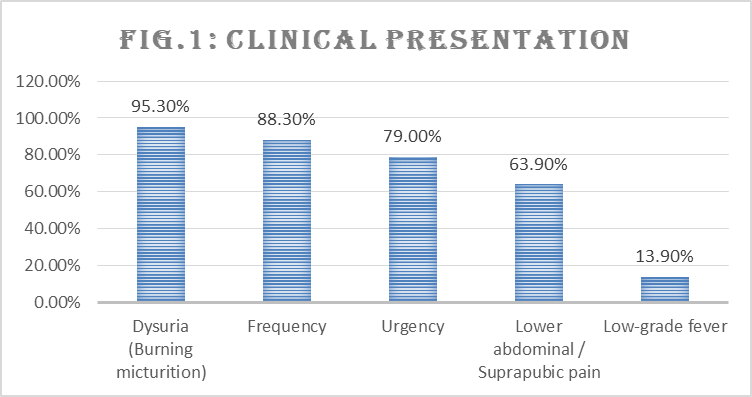
Table 2: Clinical Presentation
|
Symptom |
Number of Patients |
Percentage (%) |
|
Dysuria (Burning micturition) |
82 |
95.3% |
|
Frequency |
76 |
88.3% |
|
Urgency |
68 |
79.0% |
|
Lower abdominal / Suprapubic pain |
55 |
63.9% |
|
Low-grade fever |
12 |
13.9% |
|
(Note: Percentages exceed 100% as most patients presented with multiple symptoms). |
Gram-negative bacteria dominated the culture plates. Escherichia coli was by far the primary offender, responsible for over two-thirds of the recurrent infections, followed by Klebsiella pneumoniae. Gram-positive organisms like Enterococcus played a much smaller role.
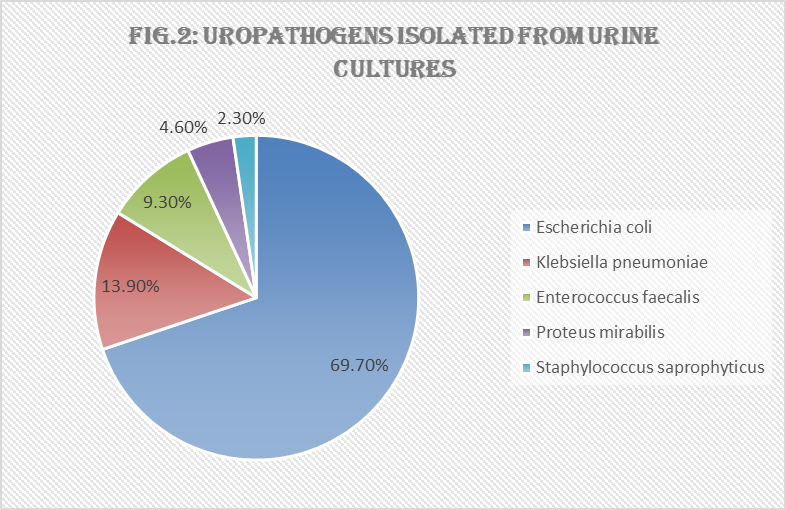
Figure 2: Uropathogens Isolated from Urine Cultures
Since E. coli was the leading cause of RUTI, we closely examined its response to common oral antibiotics. Alarmingly, traditional go-to drugs like Ciprofloxacin showed high resistance. However, older urinary antiseptics like Nitrofurantoin and Fosfomycin showed excellent efficacy, making them incredibly reliable for oral therapy.
Table 4: Antibiotic Susceptibility Pattern of E. coli (n = 60)
|
Antibiotic |
Sensitive (%) |
Resistant (%) |
|
Fosfomycin |
58 (96.6%) |
2 (3.4%) |
|
Nitrofurantoin |
55 (91.6%) |
5 (8.4%) |
|
Amikacin |
52 (86.6%) |
8 (13.4%) |
|
Amoxicillin-Clavulanate |
38 (63.3%) |
22 (36.7%) |
|
Cotrimoxazole |
25 (41.6%) |
35 (58.4%) |
|
Ciprofloxacin |
18 (30.0%) |
42 (70.0%) |
We assessed everyday habits to see what might be driving these recurrences. Poor hydration and the habit of voluntarily holding urine for long periods were significantly associated with the frequency of recurrent episodes. Patients who drank less than 1.5 liters of water daily had a statistically higher chance of more frequent recurrences within the study year ( ).
Table 5: Simple Behavioral Risk Factors
|
Behavioral Factor |
Number of Patients |
Percentage |
Statistical Significance (p-value) |
|
Inadequate fluid intake (<1.5L/day) |
62 |
72.0% |
0.014 (Significant) |
|
Voluntary urine retention (holding it in) |
54 |
62.7% |
0.038 (Significant) |
|
Constipation (frequent) |
28 |
32.5% |
0.112 (Not significant) |
|
Use of public restrooms frequently |
19 |
22.0% |
0.450 (Not significant) |
DISCUSSION:
Recurrent UTIs are deeply frustrating for the patients who experience them. In our study at MKCG MCH, Berhampur, we found that young to middle-aged women bore the brunt of this condition, making up nearly half (47.7%) of our total cohort. This aligns with global literature, as the female anatomical structure (a shorter urethra closer to the perianal region) naturally predisposes them to bacterial colonization [7, 8].
When we looked at the specific bacteria causing these infections, E. coli was the undisputed leader, isolated in 69.7% of the cases. This mirrors historical and contemporary data, which consistently show uropathogenic E. coli utilizing its fimbriae to cling to the bladder wall, evading the body's natural wash-out mechanism [9, 10].
The most clinically urgent finding of our study was the antibiotic resistance pattern. Over the years, fluoroquinolones like ciprofloxacin were handed out freely for UTIs. Today, we are paying the price. In our Berhampur cohort, 70% of the E. coli isolates were resistant to ciprofloxacin. Cotrimoxazole didn't fare much better, showing a 58.4% resistance rate.
Fortunately, the data provides a clear path forward. Nitrofurantoin and Fosfomycin demonstrated over 90% sensitivity against E. coli. Because these drugs concentrate heavily in the urine and have minimal impact on gut flora, they remain outstanding first-line choices for uncomplicated RUTIs [11, 12].
Finally, we wanted to look beyond the microscope and at the patients' daily lives. We found a statistically significant link between inadequate hydration (less than 1.5 liters a day) and the frequency of RUTIs (p=0.014). Voluntarily holding urine also proved to be a significant risk factor (p=0.038). This tells us that alongside prescribing the right antibiotic, doctors must emphasize simple behavioral modifications. Drinking plenty of water literally flushes bacteria out before they have the chance to multiply and invade [13, 14, 15].
CONCLUSION:
The landscape of recurrent urinary tract infections in the Berhampur region is characterized by high fluoroquinolone resistance, driven primarily by E. coli. For the practicing clinician dealing with uncomplicated RUTI, this study underscores the necessity of pivoting away from ciprofloxacin and relying on Nitrofurantoin or Fosfomycin as the bedrock of empirical treatment. Furthermore, counseling patients on basic lifestyle changes—specifically staying well-hydrated and not holding urine—remains a simple, cost-free, and scientifically validated way to break the cycle of recurrence.
REFERENCES:
1. Anger, J., et al. (2019). "Recurrent uncomplicated urinary tract infections in women: AUA/CUA/SUFU guideline." The Journal of Urology, 202(2), 282-289.
2. Flores-Mireles, A. L., et al. (2015). "Urinary tract infections: epidemiology, mechanisms of infection and treatment options." Nature Reviews Microbiology, 13(5), 269-284.
3. Foxman, B. (2014). "Urinary tract infection syndromes: occurrence, recurrence, bacteriology, risk factors, and disease burden." Infectious Disease Clinics, 28(1), 1-13.
4. Gupta, K., et al. (2011). "International clinical practice guidelines for the treatment of acute uncomplicated cystitis and pyelonephritis in women." Clinical Infectious Diseases, 52(5), e103-e120.
5. Hooton, T. M. (2012). "Clinical practice. Uncomplicated urinary tract infection." New England Journal of Medicine, 366(11), 1028-1037.
6. Clinical and Laboratory Standards Institute (CLSI). (2024). Performance Standards for Antimicrobial Susceptibility Testing, 34th Edition. CLSI supplement M100.
7. Al-Badr, A., & Al-Shaikh, G. (2013). "Recurrent urinary tract infections management in women: a review." Sultan Qaboos University Medical Journal, 13(3), 359-367.
8. Medina, M., & Castillo-Pino, E. (2019). "An introduction to the epidemiology and burden of urinary tract infections." Therapeutic Advances in Urology, 11, 1756287219832172.
9. Sihra, N., et al. (2018). "Non-antibiotic prevention and management of recurrent urinary tract infection." Nature Reviews Urology, 15(12), 750-776.
10. Naber, K. G., et al. (2008). "EAU guidelines for the management of urinary and male genital tract infections." European Urology, 60(4), 51-60.
11. Huttner, A., et al. (2015). "Nitrofurantoin revisited: a systematic review and meta-analysis of controlled trials." Journal of Antimicrobial Chemotherapy, 70(9), 2456-2464.
12. Neuner, E. A., et al. (2012). "Treatment of enterococcal urinary tract infections: a review." Infectious Diseases in Clinical Practice, 20(6), 386-391.
13. Hooton, T. M., et al. (2018). "Effect of increased daily water intake in premenopausal women with recurrent urinary tract infections: a randomized clinical trial." JAMA Internal Medicine, 178(11), 1509-1515.
14. Beerepoot, M. A., et al. (2012). "Lactobacilli vs antibiotics to prevent urinary tract infections: a randomized, double-blind, noninferiority trial in postmenopausal women." Archives of Internal Medicine, 172(9), 704-712.
15. Fisher, H., et al. (2018). "Behavioral and lifestyle interventions for the prevention of recurrent urinary tract infections: A systematic review." American Journal of Medicine, 131(9), 1013-1020.