Effect of Functional Endoscopic Sinus Surgery on Asthmatic Patients with Chronic Rhinosinusitis: A Prospective Study.
- Rajesh Kar , Assistant Professor, Department of ENT, SLN Medical College & Hospital, Koraput, Odisha, India.
- Gopal Krushna Sahu , Assistant Professor, Department of TB & Chest Diseases, SLN Medical College & Hospital, Koraput, Odisha, India.
- Medimi Nageswar , Assistant Professor, Department of General Medicine, SLN Medical College & Hospital, Koraput, Odisha, India.
Article Information:
Abstract:
Background: Chronic rhinosinusitis and bronchial asthma are closely associated inflammatory disorders of the respiratory tract, often described under the concept of “united airway disease.” Persistent sinonasal inflammation may aggravate lower airway symptoms, resulting in poor asthma control, increased medication requirements, and reduced quality of life. Although FESS (Functional Endoscopic Sinus Surgery) is largely acknowledged as a successful treatment for medically resistant CRS, its effects on asthma outcomes are still being studied. In patients with both CRS and bronchial asthma, the current study was conducted to assess the impact of FESS on asthma symptom severity, medication use, healthcare utilisation, and pulmonary function. Methods: This prospective observational study was conducted at Department of ENT in collaboration with Department of TB & Chest Diseases & Department of General Medicine, at SLN Medical College, Koraput, Odisha from May 2023 to May 2026. Thirty-four adult patients diagnosed with bronchial asthma and medically refractory CRS were included. All patients underwent FESS using the Messerklinger technique after failure of adequate medical management. The assessment of asthma severity scores, the frequency of hospital admissions and ER visits, the need for anti-asthmatic drugs, and pulmonary function parameters such as forced expiratory volume in one second (FEV₁) and forced expiratory flow 25–75% (FEF25–75) were all part of the clinical evaluation. After surgery, patients were monitored for six months. SPSS version 32 was used for the statistical analysis, and a p-value of less than 0.05 was deemed statistically significant. Results: Among the 34 study participants, 24 (70.6%) were males and 10 (29.4%) were females, with a mean age of 34.15 ± 12.2 years. Following FESS, there was a significant reduction in the mean asthma severity score from 2.62 to 1.62. The frequency of hospital admissions and emergency department visits due to asthma exacerbations showed a marked decline during the postoperative period. A substantial reduction in the use of bronchodilators and other anti-asthmatic medications was also observed. Pulmonary function tests demonstrated significant improvement, with increases in both FEV₁ and FEF25–75 values after surgery. Overall, patients experienced better asthma control and symptomatic relief following surgical management of CRS. Conclusion: Functional endoscopic sinus surgery significantly improves asthma control in patients with coexisting chronic rhinosinusitis and bronchial asthma. The procedure is associated with reduced symptom severity, decreased medication requirements, fewer hospital visits, and improved pulmonary function. These findings support the role of effective management of upper airway disease as an important component in the comprehensive treatment of bronchial asthma.
Keywords:
Article :
INTRODUCTION:
Chronic rhinosinusitis and bronchial asthma are among the most common chronic respiratory disorders worldwide, with a high prevalence and significant impact on quality of life. The coexistence of these two conditions has been recognized for centuries. Although the association between sinus disease and bronchial asthma was first described by Galen in the second century AD, it was not until 1925 that a causal relationship between the two conditions was proposed. Since then, numerous studies have demonstrated that chronic rhinosinusitis and asthma not only coexist frequently but are also closely linked through shared inflammatory and pathological mechanisms.
The connection between upper and lower respiratory disorders has been explained by a number of ideas. One of the earliest concepts is the nasobronchial reflex, in which inflammatory stimuli originating in the nose and paranasal sinuses trigger bronchial responses. Another proposed mechanism involves the postnasal drainage of infectious or inflammatory secretions into the lower respiratory tract, contributing to airway inflammation. Systemic dissemination of inflammatory mediators released from the upper airway may also influence bronchial inflammation. Nasal obstruction can also encourage mouth breathing, which can exacerbate bronchial hyperresponsiveness by causing the inhalation of cold, dry, and unfiltered air. Other suggested mechanisms include reduced responsiveness to beta-agonist therapy during sinus infection and stimulation of extrathoracic airway receptors by sinus secretions, resulting in increased lower airway irritability.
The concept of “united airway disease” provides the rationale for treating sinonasal inflammation in patients with asthma. According to this concept, the upper and lower airways function as a single inflammatory unit, and effective management of nasal disease can positively influence asthma control. Intranasal corticosteroids have been shown to improve symptoms of both rhinosinusitis and asthma, supporting this integrated approach.
When medication fails to cure chronic rhinosinusitis, FESS (Functional Endoscopic Sinus Surgery) has emerged as the preferred surgical procedure. By restoring physiological sinus ventilation and drainage, FESS offers minimal invasiveness, reduced morbidity, and improved postoperative healing compared with conventional surgical approaches. The goal of the current study is to compare asthma-related emergency visits or hospital admissions prior to and during FESS, as well as changes in asthma symptoms, medication needs, and pulmonary function test values.
Aims and Objectives
The study aimed to evaluate the impact of FESS on bronchial asthma control in patients with chronic rhinosinusitis and bronchial asthma. The objectives are to assess the improvement in asthma control following FESS, compare asthma medication requirements before and after surgery, evaluate changes in PFT (Pulmonary Function Test) parameters pre- and postoperatively, and compare the rates of hospital admissions and emergency department visits for acute asthma exacerbations before and after FESS.
MATERIALS AND METHODS:
Study Design
This was a prospective observational study was conducted at Department of ENT in collaboration with Department of TB & Chest Diseases & Department of General Medicine, over period of three years from May 2023 to May 2026. A total of 34 patients with coexisting chronic rhinosinusitis and bronchial asthma who presented during the study period and fulfilled the eligibility criteria were enrolled and evaluated.
Ethics and Consent
The study was approved by the Institutional Ethics Committee and Written informed consent was obtained from all participants prior to their enrolment in the study.
Inclusion and Exclusion Criteria
The study included patients aged 18 years and above who had coexisting chronic rhinosinusitis and bronchial asthma and were diagnosed with medically refractory chronic rhinosinusitis requiring FESS. Patients were excluded if they were below 18 years of age, had a history of previous surgery involving the nose, paranasal sinuses, or throat, or had underlying conditions such as immunodeficiency disorders, cystic fibrosis, or sinonasal neoplasia, as these conditions could influence disease progression and treatment outcomes.
Data Collection Procedure
Data were collected prospectively from patients with coexisting chronic rhinosinusitis and bronchial asthma who fulfilled both clinical and radiological diagnostic criteria for chronic rhinosinusitis and the American Thoracic Society (1995) criteria for bronchial asthma. Before enrollment, all patients had received at least 12 weeks of medical treatment for chronic rhinosinusitis without satisfactory improvement. A detailed clinical assessment, including examination of the nose, paranasal sinuses, and respiratory system, was performed using a standardized proforma, and informed consent was obtained.
Baseline evaluation included asthma severity grading, assessment of subjective symptoms (dyspnea, cough, and wheezing), medication requirements, history of emergency department visits and hospital admissions for asthma exacerbations during the previous six months, and (PFT). All patients subsequently underwent FESS under general anesthesia using the Messerklinger technique, with the extent of surgery tailored according to nasal endoscopy and CT scan findings. Standard postoperative care included antibiotics, saline nasal irrigation, and intranasal fluticasone, followed by regular ENT endoscopic follow-up for six months alongside continued asthma management in the Department of TB & CD. At the end of the six-month follow-up, the same clinical symptoms, medication use, hospital visits, and PFT parameters were reassessed to evaluate changes in asthma outcomes after FESS.
Statistical Analysis
Before being loaded into SPSS version 32 for statistical analysis, all gathered data was first organised using Microsoft Excel. The paired t-test was used to compare quantitative variables, which were represented as mean ± standard deviation (SD). The chi-square test was used to analyse the qualitative variables, which were displayed as percentages and frequencies. For every analysis, a p-value of less than 0.05 was deemed statistically significant.
RESULTS:
Table 1: Demographic Profile of the Study Population
|
Parameter |
N |
% |
|
Male |
24 |
70.6% |
|
Female |
10 |
29.4% |
|
Total |
34 |
100.0% |
|
Mean Age (years) ± SD |
34.15 ± 12.2 (range 19–65) |
|
Table 1 illustrates the demographic profile of the study group. Of the 34 patients studied, 24 (70.6%) were male and 10 (29.4%) were female, giving a clear male preponderance. The age of patients ranged from 19 to 65 years, with a mean age of 34.15 ± 12.2 years.
Table 2: Distribution of Asthma Severity Score (Pre- vs. Post-operative)
|
Asthma Score |
Pre-op N |
Pre-op % |
Post-op N |
Post-op % |
|
1 |
2 |
5.9% |
21 |
61.8% |
|
2 |
12 |
35.3% |
7 |
20.6% |
|
3 |
17 |
50.0% |
4 |
11.8% |
|
4 |
3 |
8.8% |
2 |
5.9% |
|
Total |
34 |
100.0% |
34 |
100.0% |
Table 2 observes a marked improvement in asthma severity grading after surgery. Pre-operatively, the majority of patients (17, 50.0%) were graded 3, followed by grade 2 (12, 35.3%), grade 4 (3, 8.8%) and grade 1 (2, 5.9%). Post-operatively this distribution shifted favourably, with 21 patients (61.8%) now at grade 1, 7 (20.6%) at grade 2, 4 (11.8%) at grade 3 and only 2 (5.9%) remaining at grade 4, indicating an overall reduction in asthma severity following treatment.
Table 3: Severity of asthma
|
|
Intermittent Grade 1 |
Mild persistent Grade 2 |
Moderate persistent Grade 3 |
Severe persistent Grade 4 |
|
Day symptoms |
< once a week |
>once a week <once a day |
Daily |
Daily |
|
Night symptoms |
<twice a month |
>twice a month |
>once a week |
Frequent with limitation of daily activities |
Table 3 depicts the classification of asthma severity into four grades based on the frequency of daytime and nocturnal symptoms. Patients with Grade 1 (Intermittent asthma) experience daytime symptoms less than once a week and night-time symptoms fewer than two times per month. Grade 2 (Mild persistent asthma) includes patients with daytime symptoms occurring more than once a week but less than once daily, with night-time symptoms occurring more than twice per month. Grade 3 (Moderate persistent asthma) comprises patients with daily daytime symptoms and night-time symptoms occurring more than once a week. Grade 4 (Severe persistent asthma) represents the most severe category, characterized by daily symptoms, frequent night-time symptoms, and limitation of daily activities. Thus, all study cases were categorized into these four grades according to the severity of their clinical symptoms.
Table 4: Mean Asthma Score and Grade-Wise Shift (Pre vs. Post)
|
Asthma Score |
Mean |
N |
SD |
p-value |
||||
|
Pre |
2.62 |
34 |
0.74 |
< 0.05 |
||||
|
Post |
1.62 |
34 |
0.92 |
|||||
|
Grade-Wise Movement from Pre- to Post-Operative Asthma Score: |
||||||||
|
Pre \ Post |
1 |
2 |
3 |
4 |
Total |
|||
|
1 |
2 |
0 |
0 |
0 |
2 |
|||
|
2 |
11 |
1 |
0 |
0 |
12 |
|||
|
3 |
8 |
6 |
3 |
0 |
17 |
|||
|
4 |
0 |
0 |
1 |
2 |
3 |
|||
|
Total |
21 |
7 |
4 |
2 |
34 |
|||
|
p-value < 0.05 |
||||||||
Table 4 depicts the mean asthma score, which improved significantly from 2.62 ± 0.74 pre-operatively to 1.62 ± 0.92 post-operatively (p < 0.05). The grade-wise shift table shows this improvement at an individual level: of the 3 patients with grade 4 disease, 1 improved to grade 3 while 2 remained unchanged; of 17 patients with grade 3 disease, 8 improved to grade 1 and 6 improved to grade 2, while 3 showed no change; of 12 patients with grade 2 disease, 11 improved to grade 1; and both patients with grade 1 disease remained stable, confirming a consistent trend of improvement across severity grades.
Table 5: Hospital Admissions and Emergency Department (ED) Visits (Pre vs. Post)
|
Hospital Admission (last 6 months) |
|
Pre |
Post |
||||||
|
No |
N |
21 |
29 |
||||||
|
|
% |
61.8% |
85.3% |
||||||
|
Yes |
N |
13 |
5 |
||||||
|
|
% |
38.2% |
14.7% |
||||||
|
Total |
N |
34 |
34 |
||||||
|
p-value < 0.05 |
|
|
|
||||||
|
ED Visits (last 6 months) |
|
Pre |
Post |
||||||
|
No |
N |
5 |
22 |
||||||
|
|
% |
14.7% |
64.7% |
||||||
|
Yes |
N |
29 |
12 |
||||||
|
|
% |
85.3% |
35.3% |
||||||
|
Total |
N |
34 |
34 |
||||||
|
p-value < 0.01 |
|
|
|
||||||
|
Total visits summary (hospital admissions & ED visits, last 6 months): |
|||||||||
|
Variable |
|
N |
Total Visits |
Mean |
SD |
Median (IQR) |
p-value* |
||
|
Hospital Admissions |
Pre |
34 |
19 |
0.56 |
0.78 |
0 (0–1) |
< 0.05 |
||
|
Post |
34 |
7 |
0.21 |
0.54 |
2 (3–5.25) |
||||
|
ED Visits |
Pre |
34 |
114 |
3.35 |
2.48 |
0 (0–0) |
< 0.05 |
||
|
Post |
34 |
35 |
1.03 |
1.90 |
0 (0–1) |
||||
|
*Wilcoxon Signed-Rank test applied, as data failed the test of normality. IQR shown as 25th–75th percentile. |
|||||||||
Table 5 combines hospital admissions and emergency department (ED) visits due to bronchial asthma over the preceding 6 months, before and after surgery. Repeated hospital admissions fell from 13/34 (38.2%) patients pre-operatively to 5/34 (14.7%) post-operatively (p < 0.05), while ED visits fell from 29/34 (85.3%) to 12/34 (35.3%) (p < 0.01). Correspondingly, the total number of hospitalisations reduced from 19 to 7, and total ED visits reduced from 114 to 35, over the respective 6-month periods, reflecting a substantial reduction in acute healthcare utilisation after surgery.
Table 6: Number of Medications Required to Control Bronchial Asthma (Pre vs. Post)
|
No. of Medications |
Pre |
Post |
|
1 |
1 |
6 |
|
2 |
0 |
10 |
|
3 |
14 |
13 |
|
4 |
12 |
2 |
|
5 |
7 |
3 |
|
Total |
34 |
34 |
|
p-value < 0.05 |
|
|
Table 6 illustrates the number of asthma medications (out of 5 drug classes commonly used - inhalational β2-agonists, inhalational corticosteroids, leukotriene antagonists, theophylline and oral steroids) required by each patient. Pre-operatively, only 1 patient was on a single medication, while 14 required three, 12 required four and 7 required all five medications. Post-operatively, medication burden fell markedly: 6 patients required only a single medication, 10 required two, 13 required three, and only 2 and 3 patients respectively required four or five medications (p < 0.05), indicating a reduced overall drug requirement after surgery.
Table 7: Dosage Pattern of Individual Medications (Pre vs. Post)
|
Medication |
Category |
Pre N (%) |
Post N (%) |
p-value |
|
Inhalational β2-Agonists |
Low |
6 (17.6%) |
23 (67.6%) |
< 0.05 |
|
Medium |
15 (44.1%) |
7 (20.6%) |
||
|
High |
13 (38.2%) |
4 (11.8%) |
||
|
Inhalational Corticosteroids |
No |
1 (2.9%) |
9 (26.5%) |
< 0.05 |
|
Low |
5 (14.7%) |
12 (35.3%) |
||
|
Medium |
13 (38.2%) |
8 (23.5%) |
||
|
High |
15 (44.1%) |
5 (14.7%) |
||
|
Leukotriene Inhibitors |
No |
15 (44.1%) |
29 (85.3%) |
< 0.05 |
|
Yes |
19 (55.9%) |
5 (14.7%) |
||
|
Theophylline SR |
None |
1 (2.9%) |
14 (41.2%) |
< 0.05 |
|
Low |
21 (61.8%) |
14 (41.2%) |
||
|
High |
12 (35.3%) |
6 (17.6%) |
||
|
Oral Steroids |
No |
26 (76.5%) |
31 (91.2%) |
0.18 |
|
Yes |
8 (23.5%) |
3 (8.8%) |
Table 7 observes the dosage pattern of each of the five individual medication classes before and after surgery. For inhalational β2-agonists, high/medium dose requirements fell from 82.3% pre-operatively to 32.4% post-operatively, with more patients shifting to low dose (67.6% post vs 17.6% pre, p < 0.05). Inhalational corticosteroid requirement also decreased, with patients requiring no steroid rising from 2.9% to 26.5% (p < 0.05). Leukotriene inhibitor use fell from 55.9% to 14.7% of patients (p < 0.05), and theophylline SR use fell correspondingly, with 41.2% of patients needing none post-operatively versus only 2.9% pre-operatively (p < 0.05). Oral steroid use also declined, from 23.5% to 8.8% of patients, though this change did not reach statistical significance (p = 0.18).
Table 8: Pulmonary Function Test (PFT) Parameters (Pre vs Post)
|
PFT Parameter |
|
Mean |
N |
SD |
p-value |
|
FEV1 (% predicted) |
Pre |
79.79 |
34 |
9.88 |
< 0.05 |
|
Post |
88.15 |
34 |
10.53 |
||
|
FEF 25–75 (% predicted) |
Pre |
82.29 |
34 |
12.22 |
< 0.05 |
|
Post |
89.79 |
34 |
10.89 |
Table 8 depicts the pulmonary function test parameters before and after surgery. The mean FEV1 (% predicted) improved from 79.79 ± 9.88 pre-operatively to 88.15 ± 10.53 post-operatively (p < 0.05). Similarly, mean FEF 25–75 (% predicted) improved from 82.29 ± 12.22 to 89.79 ± 10.89 (p < 0.05), both changes being statistically significant and indicating objective improvement in small and large airway function following surgical treatment.
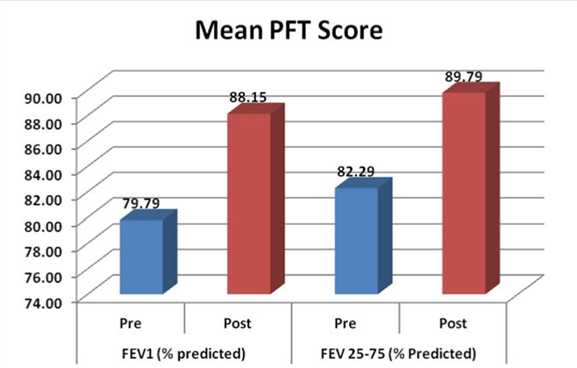
Graph 1
DISCUSSION:
Epidemiological and clinical evidence has long suggested a link between chronic sinusitis and bronchial asthma, although the exact mechanism by which upper airway disease exacerbates lower airway disease remains unclear. Several mechanisms have been proposed: (A) the sino-nasal bronchial reflex, which causes bronchoconstriction through a vagal efferent pathway after stimulation of neural receptors in the sinuses and nose activates trigeminal afferent pathways;[1] (B) bronchial hyperresponsiveness caused by inflammatory mediators directly entering the lungs by postnasal drip from the sinuses;[2] (C) persistent mouth breathing, which bypasses the warming and filtering function of the nasal passages;[3] (D) release of chemotactic chemicals and cytokines from inflammatory sinus tissue into the bloodstream, which encourages eosinophil recruitment and inflammation throughout the upper and lower respiratory tracts;[4] and (E) a shared eosinophilic inflammatory process, with epithelial damage and basement membrane thickening common to both chronic sinusitis and asthma.[5] Additional proposed mechanisms include (F) reduced beta-agonist responsiveness due to sinus infection, and (G) stimulation of extrathoracic airway receptors by sinus secretions, provoking lower airway irritability. It is conceivable that treating the upper airway might benefit the lower airway given this link; nevertheless, it is still debatable whether FESS positively affects the clinical course of bronchial asthma in individuals with chronic sinusitis. Therefore, this study looked at how FESS affected bronchial asthma in patients who also had chronic sinusitis.
In our study, majority of patients-27 of 34 (79.4%)-showed improvement in the severity of asthma symptoms following surgery (Table 5.4). The mean asthma score improved from 2.62 pre-operatively to 1.62 post-operatively, a statistically significant change (p < 0.05). This result is in line with a research by K. Dejima et al.[6] wherein 28 patients with coexisting sinusitis and bronchial asthma reported better asthma symptoms following FESS.
On grade-wise analysis, of the 3 patients with grade 4 symptoms, 1 improved to grade 3 while 2 remained unchanged. One of these was a patient with Samter's triad and extensive nasal polyposis whose symptoms and polyps recurred within 6 months, necessitating revision sinus surgery; the other, who showed no improvement, was not compliant with regular post-operative endoscopic cleaning and developed synechiae in the nasal cavity. Of the 17 patients with grade 3 symptoms, 8 improved to grade 1 and 6 improved to grade 2, while 3 showed no improvement. Similarly, of the 12 patients with grade 2 symptoms, 11 improved to grade 1, while 1 remained at grade 2. Both patients with grade 1 symptoms remained stable, with their asthma attacks well controlled. These findings are comparable to those of Brent A.S. et al.[7] who reported a reduction in asthma attacks in 20 of 27 (74%) bronchial asthma patients following FESS for chronic sinusitis.
Regarding medication requirements pre-operatively only 1 of 34 patients was on a single medication, 14 were on triple medications, 12 were on four medications, and 7 were on all five medications. Post-operatively, this shifted favourably: 6 patients required a single medication, 10 required double medications, 13 required triple medications, only 2 required four medications, and 3 required all five. This reduction in medication burden correlates with findings from Brent A.S. et al. [7] and K. Ikeda et al.[8] both of whom reported a reduced requirement of asthma medications, including oral steroids, following FESS in the majority of patients.
Emergency room and casualty visits during disease exacerbations are a marker of poor asthma control and often necessitate intensive care. In a retrospective case study, Goldstein et al. showed that these occurrences decreased following FESS.[5] In a similar vein, we saw a significant decrease in our patients' post-operative ER visits. The total number of hospitalisations for acute exacerbations of asthma fell from 19 (mean = 0.56) in the 6 months preceding surgery to 7 (mean = 0.21) in the 6 months following surgery. Likewise, total Emergency Department visits for controlling acute asthma symptoms fell from 114 (mean = 3.35) pre-operatively to 35 (mean = 1.03) post-operatively. The three patients who persisted in experiencing exacerbations had significant nasal polyposis with recurrence prior to surgery; one of these patients, who had extensive polyposis and Samter's triad (ASA triad), experienced recurrent acute exacerbations that necessitated intensive care and hospitalisation.
With respect to pulmonary function tests, the mean FEV1 (% predicted) improved from 79.79 pre-operatively to 88.15 post-operatively (p < 0.05), and mean FEF25-75 (% predicted) improved from 82.29 to 89.79 (p < 0.05), both changes being statistically significant. These results are consistent with those of Dejima et al., who reported improvement in PFTs and subjective complaints in 75% of asthma patients following FESS.[6]
Nakamura H. et al. have reported subjective worsening of asthma or precipitation of an asthma episode following sinus surgery [9], but our investigation did not find any such deterioration. Poor adherence to post-operative treatment may be the cause of the two patients' lack of progress and subsequent return of nasal polyposis. While one patient's chronic sinusitis symptoms slightly improved, two patients who acquired synechiae during long-term follow-up exhibited no improvement in bronchial asthma symptoms.
Mucociliary clearance is known to be mechanistically disrupted by septal deviation, and it returns to normal following septoplasty.[10–12] Because the evacuation of mucus, debris, and infectious or irritating material depends on mucociliary clearance, its disturbance can lead to the buildup of toxic chemicals in the upper airways, which can have negative consequences on the lower airways through both local and systemic pathways. Concha bullosa and septal deviation may therefore increase the risk of recurrent sinusitis through these pathways. Treatment for these conditions also prevents bronchospasm through the nasobronchial reflex, which could otherwise be caused by increased vagal stimulation as a result of infection and obstruction, as well as the transport of inflammatory mediators and infectious material to the lower airways via postnasal drip.[13]
Favourable effects of FESS on asthma in individuals with chronic inflammatory sinonasal illness have been shown in a number of trials.[14–17] Batra et al. discovered positive objective and subjective effects of FESS in individuals without aspirin sensitivity in their study of 17 patients with asthma and nasal polyposis, including 9 with aspirin sensitivity.[18] In 30 bronchial asthma patients with chronic sinonasal illness, including 12 with nasal polyposis, Senior et al. observed a decrease in asthma severity and steroid demand at 1.1 years post-FESS.[7] Similarly, 80% of 56 asthma patients, 73% of whom had nasal polyposis, showed improvement with FESS, according to Park et al.[19] Following FESS, 75% of asthma patients showed improvements in PFTs and subjective symptoms, according to Dejima et al.[6] After comparing three groups-patients with nasal polyposis alone, asthma with nasal polyposis, and Samter's syndrome-Dufour et al. discovered improvement in sinonasal symptoms at a 4-year follow-up, although there was no statistically significant difference between the three groups; 24 out of 31 asthma patients showed significant clinical improvement and a decrease in the dosage of their asthma medication.[20] However, some research comes to different findings. Uri et al. discovered that while FESS improves quality of life, it did not actually improve asthma.[21] In contrast, Goldstein et al.'s analysis of 13 instances revealed no statistically significant improvement in PFTs.[22] However, FEV1 and FEF25-75 both shown statistically significant improvement in our study.
The severity of asthma and medication dosages were reduced in most patients in our study, changes that meaningfully improve quality of life and help reduce steroid-related side effects such as osteoporosis, cataracts, hypertension, weight gain, and psychological effects. Notably, all patients with poor surgical outcomes in our study showed no improvement in bronchial asthma symptoms, a finding consistent with the study by K. Dejima et al.[6] in which patients with good FESS outcomes showed the greatest improvement in asthma among their 28 patients.
Limitation
The study was conducted at a single centre with a relatively small sample of 34 patients and without a parallel control group. The before-and-after design therefore demonstrates temporal association but cannot establish that the observed changes were caused solely by FESS. Changes in asthama treatment and treatment adherence during follow-up may also have influenced outcomes. The six-month follow-up limits assessment of longer-term outcomes.
CONCLUSION:
The findings of this study support the concept of the "united airways," demonstrating that effective management of chronic rhinosinusitis through FESS can lead to significant improvement in both sinonasal and asthma symptoms. Appropriate medical and surgical treatment not only enhances symptom control but may also reduce healthcare utilization and the need for asthma medications, thereby improving the overall quality of life of asthmatic patients with chronic rhinosinusitis.
REFERENCES:
1. MacFadden ER. Nasal sinus pulmonary reflexes and bronchial asthma. J Allergy Clin Immunol 1987;78:1-3.
2. Ozcan M, Ortapamuk H, Naldoken S, et al. Pulmonary aspiration of nasal secretions in patients with chronic sinusitis and asthma. Archives of Otolaryngology–Head & Neck Surgery 2003;129(9):1006-9.
3. Griffin MP, McFadden ER, Ingram RH. Airway cooling in asthmatic and nonasthmatic subjects during nasal and oral breathing. J Allergy Clin Immunol1982; 69:354-9.
4. Slavin RG, Spector SL, Bernstein IL, et al. The diagnosis and management of sinusitis: a practice parameter update. The Journal of allergy and clinical immunology 2005;116(6 Suppl):S13-47.
5. Ponikau JU, Sherris DA, Kephart GM, et al. Features of airway remodelling and eosinophillic inflammation in chronic rhinosinusitis: is the histopathology similar to asthma? J Allergy Clin Immunol 2003;112:877-82.
6. Dejima K, Hama T, Miyazaki M. A clinical study of endoscopic sinus surgery for sinusitis in patients with bronchial asthma. International Archives of Allergy and Immunology 2005;138;97-104.
7. Senior BA, Kennedy DW, Tanabodee J, et al. Long term impact of functional endoscopic sinus surgery on asthma. Otolaryngology Head and Neck Surgery 1999;121(1):66-8.
8. Ikeda K, Tanno N, Tamura G, et al. Endoscopic Sinus Surgery improves pulmonary function in patients with asthma associated with chronic sinusitis. Ann Otol Rhinol Laryngol 1999;108(4):355-9.
9. Nakamura H, Kawasaki M, Higuchi Y, et al. Effects of sinus surgery on asthma in aspirin triad patients. Acta Otolaryngol 1999;119(5):592-8.
10. Ulusoy B, Arbag H, Sari O, et al. Evaluation of the effects of nasal septal deviation and its surgery on nasal mucociliary clearance in both nasal cavities. Am J Rhinol 2007;21:180-3.
11. Uslu H, Uslu C, Varoglu E, et al. Effects of septoplasty and septal deviation on nasal mucociliary clearance. Int J Clin Pract 2004;58:1108-11.
12. Jang YJ, Myong NH, Park KH, et al. Mucociliary transport and histologic characteristics of the mucosa of deviated nasal septum. Arch Otolaryngol Head Neck Surg 2002;128:421-4.
13. Ferguson B, Powell-Davis A. The link between upper and lower respiratory disease. Curr Opin Otolaryngol Head Neck Surg 2003;11:192-5.
14. Dhong HJ, Jung YS, Chung SK, et al. Effect of endoscopic sinus surgery on asthmatic patients with chronic rhinosinusitis. Otolaryngol Head Neck Surg 2001;124:99-104.
15. Nishioka GJ, Cook PR, Davis WE, et al. Functional endoscopic sinus surgery in patients with chronic sinusitis and asthma. Otolaryngol Head Neck Surg 1994;110:494-500.
16. Özel HE, Gür ÖE, Arikan S, et al. Objective and subjective effects of surgical treatment of nasal obstructions in patients with asthma. Turk J Med Sci 2011;41(3):435-41.
17. Senior BA, Kennedy DW. Management of sinusitis in the asthmatic patient. Ann Allergy Asthma Immunol 1996;77:6-15.
18. Batra PS, Kern RC, Tripathi A, et al. Outcome analysis of endoscopic sinus surgery in patients with nasal polyps and asthma. Laryngoscope 2003;113:1703-6.
19. Park AH, Lau J, Stankiewicz J, et al. The role of functional endoscopic sinus surgery in asthmatic patients. J Otolaryngol 1998;27:275-80.
20. Dufour X, Bedier A, Ferrie JC, et al. Diff use nasal polyposis and endonasal endoscopic surgery: long-term results, a 65-case study. Laryngoscope 2004;114:1982-7.
21. Uri N, Cohen-Kerem R, Barzilai G, et al. Functional endoscopic sinus surgery in the treatment of massive polyposis in asthmatic patients. J Laryngol Otol 2002;116:185-9.
22. Goldstein MF, Grundfast SK, Dunsky EH, et al. Effect of functional endoscopic sinus surgery on bronchial asthma outcomes. Arch Otolaryngol Head Neck Surg 1999;125:314-9.