Association Of Carotid Intima-Media Thickness With Cardiovascular Risk Factors In Patients With Type 2 Diabetes Mellitus.
- D. Krishna Sumanth , Associate professor, Department of General Medicine, Mamata Medical College, Khammam
- D. Manojna Devi , Assistant Professor, Department of Radiodiagnosis, Mamata Medical College, Khammam
- E. Praveen , Associate Professor, Department of Radiodiagnosis, Mamata Medical College, Khammam.
Article Information:
Abstract:
oduction: Type 2 diabetes mellitus (T2DM) is associated with accelerated atherosclerosis and increased cardiovascular morbidity. Carotid intima-media thickness (CIMT), measured by ultrasonography, is a useful non-invasive marker of subclinical atherosclerosis. This study assessed the association of CIMT with cardiovascular risk factors in patients with T2DM. Materials and Methods: A hospital-based cross-sectional study was conducted in the Department of Radiodiagnosis in collaboration with General Medicine, Mamata Medical College and General Hospital, Khammam. Seventy-five patients with T2DM were evaluated for demographic, clinical, glycaemic, lipid, and anthropometric parameters. Bilateral CIMT was measured using high-resolution B-mode ultrasonography. Correlation and multivariable regression analyses were performed. Results: The mean CIMT was 0.77 ± 0.11 mm, and 45.3% of patients had increased CIMT. CIMT showed significant positive correlations with age, duration of diabetes, BMI, systolic blood pressure, fasting glucose, HbA1c, total cholesterol, triglycerides, and LDL-C, while HDL-C showed an inverse correlation. On multivariable analysis, HbA1c, LDL-C, age, systolic blood pressure, and HDL-C remained independently associated with CIMT. Conclusion: Increased CIMT is common in patients with T2DM and is significantly associated with multiple cardiovascular risk factors. Carotid ultrasonography may aid early identification of subclinical atherosclerosis and cardiovascular risk stratification.
Keywords:
Article :
INTRODUCTION:
Type 2 diabetes mellitus (T2DM) is a major chronic metabolic disorder and an important independent risk factor for cardiovascular disease (CVD). Cardiovascular complications, particularly coronary artery disease, cerebrovascular disease, and peripheral arterial disease, remain major causes of morbidity and mortality among patients with T2DM. The excess cardiovascular risk associated with diabetes is multifactorial and results from the interaction of chronic hyperglycaemia, insulin resistance, dyslipidaemia, hypertension, obesity, oxidative stress, and endothelial dysfunction, all of which contribute to accelerated atherosclerosis [1]. Importantly, atherosclerotic vascular changes may develop long before the appearance of clinically evident cardiovascular events.
Therefore, identification of subclinical vascular disease at an early stage may provide an opportunity for timely risk-factor modification and prevention of future cardiovascular complications.
Carotid intima-media thickness (CIMT), measured using high-resolution B-mode ultrasonography, represents the combined thickness of the intimal and medial layers of the carotid arterial wall and is widely used as a non-invasive marker of subclinical atherosclerosis. Increased CIMT has been associated with subsequent stroke, myocardial infarction, and overall cardiovascular events, although the strength of these associations varies according to the carotid segment and measurement protocol used [2].
A recent systematic review and meta-analysis involving 12,102 patients with diabetes demonstrated that increased common carotid artery IMT was associated with both microvascular and macrovascular diabetic complications, including cardiovascular events [3]. Thus, carotid ultrasonography provides a simple, non-invasive method of assessing structural vascular changes before the development of overt symptomatic disease.
Several recent studies have evaluated CIMT and carotid atherosclerosis among patients with diabetes. In the Corinthia study, Theofilis et al. observed that individuals with diabetes had significantly greater mean and maximum CIMT, greater carotid plaque burden, and increased arterial stiffness compared with individuals without diabetes [4]. Klimontov et al., in a study involving 389 patients with T2DM, identified age, sex, body mass index, glycaemic variability, renal function, and duration of diabetes among the factors associated with carotid atherosclerosis or carotid stenosis [5].
Guo et al. demonstrated that fasting plasma glucose, HbA1c, triglycerides, total cholesterol, and low-density lipoprotein cholesterol were positively correlated with CIMT, whereas high-density lipoprotein cholesterol showed an inverse association [6]. Similarly, Chen et al. reported that greater long-term HbA1c variability was independently associated with increased CIMT and carotid plaque, indicating that fluctuations in glycaemic control may contribute to subclinical atherosclerosis beyond the effect of mean HbA1c alone [7]. More recently, a meta-analysis of 57 studies involving 29,502 participants confirmed significantly greater CIMT in patients with T2DM and demonstrated important associations with dyslipidaemia, increasing age, body mass index, and hypertension [8].
Despite this growing evidence, important gaps remain. Previous studies have differed substantially in the populations studied, carotid segments examined, CIMT measurement techniques, and cardiovascular risk variables included. Several investigations have concentrated on individual metabolic markers, selected high-risk populations, or comparisons between diabetic and non-diabetic participants, rather than comprehensively examining the relationship between routinely encountered cardiovascular risk factors and CIMT within a defined T2DM population.
Such variability may limit direct application of available evidence across different clinical settings. Evaluation of demographic, anthropometric, glycaemic, blood-pressure, lipid, and lifestyle-related factors together with CIMT may therefore provide clinically useful information for identifying diabetic patients with a greater burden of subclinical atherosclerosis. Hence, the present study aims to assess the association of carotid intima-media thickness with cardiovascular risk factors in patients with type 2 diabetes mellitus, with particular emphasis on identifying clinical and biochemical factors associated with increased CIMT and facilitating early cardiovascular risk stratification.
MATERIALS AND METHODS:
This hospital-based cross-sectional observational study was conducted in the Department of Radiodiagnosis in collaboration with the Department of General Medicine, Mamata Medical College and General Hospital, Khammam. A total of 75 patients with type 2 diabetes mellitus who attended the General Medicine outpatient department or were admitted to the hospital during the study period were included.
Patients fulfilling the predefined eligibility criteria were enrolled after obtaining informed consent. Relevant demographic, clinical, anthropometric, and biochemical parameters were recorded, following which carotid ultrasonography was performed to assess carotid intima-media thickness (CIMT). The study was carried out after obtaining approval from the Institutional Ethics Committee.
Inclusion Criteria
• Patients aged 18 years and above with a confirmed diagnosis of type 2 diabetes mellitus.
• Patients attending the General Medicine outpatient department or admitted to the hospital during the study period.
• Patients willing to undergo carotid ultrasonography and participate in the study.
• Patients for whom relevant clinical and laboratory data were available.
Exclusion Criteria
• Patients with type 1 diabetes mellitus.
• Patients with previously diagnosed significant carotid artery disease or history of carotid artery surgery/intervention.
• Patients with a previous history of major cardiovascular or cerebrovascular events, where applicable according to the study protocol.
• Patients with severe systemic illness, active infection, or other conditions likely to significantly alter the vascular parameters.
• Pregnant women.
• Patients in whom adequate carotid ultrasonographic assessment could not be performed.
• Patients unwilling to provide informed consent.
Study Tool
• A structured proforma was used to record demographic details, duration of diabetes, smoking history, alcohol consumption, treatment history, and relevant cardiovascular risk factors.
• Blood pressure, height, weight, and body mass index (BMI) were recorded using standard methods.
• Laboratory parameters included fasting blood glucose, postprandial blood glucose, glycated haemoglobin (HbA1c), total cholesterol, triglycerides, low-density lipoprotein cholesterol, and high-density lipoprotein cholesterol, wherever available.
• Carotid intima-media thickness was assessed using a high-resolution B-mode ultrasonography machine with a high-frequency linear-array transducer.
• Both right and left common carotid arteries were examined, and CIMT was measured at the far wall of the distal common carotid artery, approximately 1 cm proximal to the carotid bifurcation.
• Measurements were obtained from both sides, and the mean CIMT was calculated for statistical analysis.
Data Collection
• Eligible patients with type 2 diabetes mellitus were identified from the General Medicine department.
• Written informed consent was obtained before enrolment.
• Demographic details including age and sex were documented.
• Duration of diabetes, treatment history, smoking status, alcohol use, hypertension, and other cardiovascular risk factors were recorded.
• Anthropometric measurements, including height, weight, and BMI, were obtained.
• Blood pressure was measured using a standard sphygmomanometer after adequate rest.
• Recent biochemical investigations, including blood glucose, HbA1c, and lipid profile, were recorded from the patients' clinical records or obtained as part of routine evaluation.
• All enrolled patients underwent bilateral carotid ultrasonography in the Department of Radiodiagnosis.
• CIMT measurements were recorded and subsequently correlated with demographic, clinical, and biochemical cardiovascular risk factors.
Statistical Analysis
The collected data were entered into a spreadsheet and analysed using appropriate statistical software. Continuous variables were expressed as mean ± standard deviation, while categorical variables were presented as frequency and percentage. The relationship between CIMT and continuous cardiovascular risk factors was assessed using Pearson's or Spearman's correlation coefficient, depending on the distribution of the data.
Differences in mean CIMT between categorical risk-factor groups were analysed using the independent Student's t-test or one-way ANOVA, as appropriate. Multivariable regression analysis could be performed to identify independent predictors of increased CIMT. A p value <0.05 was considered statistically significant.
RESULTS:
Table 1. Demographic, clinical and anthropometric characteristics of patients with type 2 diabetes mellitus
|
Parameter |
Result |
|
Total patients |
75 |
|
Age (years), Mean ± SD |
55.08 ± 8.01 |
|
Male, n (%) |
48 (64.0) |
|
Female, n (%) |
27 (36.0) |
|
Duration of diabetes (years), Mean ± SD |
8.18 ± 3.42 |
|
BMI (kg/m²), Mean ± SD |
27.88 ± 3.62 |
|
Systolic BP (mmHg), Mean ± SD |
125.90 ± 9.49 |
|
Diastolic BP (mmHg), Mean ± SD |
78.55 ± 6.88 |
|
Hypertension, n (%) |
26 (34.7) |
|
Smoking, n (%) |
17 (22.7) |
|
Alcohol consumption, n (%) |
12 (16.0) |
A total of 75 patients with type 2 diabetes mellitus were included in the study, with a mean age of 55.08 ± 8.01 years. Males constituted nearly two-thirds of the study population.
The mean duration of diabetes was 8.18 ± 3.42 years, indicating that most patients had established diabetes rather than newly diagnosed disease.
The mean BMI of 27.88 ± 3.62 kg/m² indicated a substantial burden of overweight and obesity. Hypertension was present in 34.7% of patients, while 22.7% were smokers. Overall, the study population demonstrated several conventional cardiovascular risk factors that could potentially influence carotid atherosclerosis.
Table 2. Glycaemic and lipid profile of the study participants
|
Parameter |
Mean ± SD |
Range |
|
Fasting blood glucose (mg/dL) |
185.22 ± 20.54 |
139.48–224.97 |
|
Postprandial blood glucose (mg/dL) |
256.37 ± 30.64 |
177.29–329.08 |
|
HbA1c (%) |
7.84 ± 0.88 |
5.90–10.41 |
|
Total cholesterol (mg/dL) |
181.21 ± 28.23 |
120.00–250.43 |
|
Triglycerides (mg/dL) |
167.47 ± 50.21 |
60.00–281.96 |
|
LDL-C (mg/dL) |
103.11 ± 23.89 |
45.00–161.13 |
|
HDL-C (mg/dL) |
44.05 ± 8.42 |
28.00–63.15 |
The mean HbA1c was 7.84 ± 0.88%, suggesting that a considerable proportion of patients had suboptimal long-term glycaemic control. Mean fasting and postprandial glucose levels were also elevated. With respect to lipid parameters, mean triglycerides were 167.47 ± 50.21 mg/dL, while mean LDL-C was 103.11 ± 23.89 mg/dL. Mean HDL-C was relatively low at 44.05 ± 8.42 mg/dL. These findings demonstrate the coexistence of poor glycaemic control and dyslipidaemia, both of which may contribute to accelerated atherosclerotic changes in patients with T2DM.
Table 3. Carotid intima-media thickness among patients with type 2 diabetes mellitus
|
CIMT parameter |
Mean ± SD (mm) |
Range (mm) |
|
Right CIMT |
0.77 ± 0.11 |
0.502–1.021 |
|
Left CIMT |
0.77 ± 0.11 |
0.522–1.043 |
|
Mean CIMT |
0.77 ± 0.11 |
0.512–1.032 |
Distribution according to CIMT category
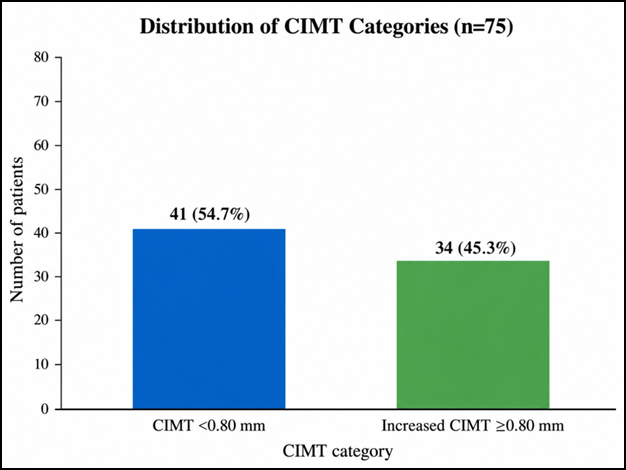
The mean carotid intima-media thickness of the study population was 0.77 ± 0.11 mm. There was no appreciable difference between the mean right and left CIMT measurements. Using an illustrative cut-off of ≥0.80 mm, increased CIMT was observed in 34 (45.3%) patients, whereas 41 (54.7%) had CIMT below this level. Thus, nearly half of the patients demonstrated evidence of increased carotid arterial wall thickness. This finding indicates a considerable burden of subclinical atherosclerotic vascular changes among patients with T2DM even in the absence of clinically established cardiovascular disease.
Table 4. Association of increased carotid intima-media thickness with cardiovascular risk factors
|
Risk factor |
n |
CIMT <0.80 mm n (%) |
CIMT ≥0.80 mm n (%) |
p value |
|
Age <50 years |
18 |
18 (100.0) |
0 (0.0) |
<0.001* |
|
Age ≥50 years |
57 |
23 (40.4) |
34 (59.6) |
|
|
Male |
48 |
24 (50.0) |
24 (50.0) |
0.338 |
|
Female |
27 |
17 (63.0) |
10 (37.0) |
|
|
BMI <25 kg/m² |
14 |
9 (64.3) |
5 (35.7) |
0.555 |
|
BMI ≥25 kg/m² |
61 |
32 (52.5) |
29 (47.5) |
|
|
Hypertension present |
26 |
12 (46.2) |
14 (53.8) |
0.334 |
|
Hypertension absent |
49 |
29 (59.2) |
20 (40.8) |
|
|
Smoker |
17 |
6 (35.3) |
11 (64.7) |
0.097 |
|
Non-smoker |
58 |
35 (60.3) |
23 (39.7) |
|
|
Diabetes duration <5 years |
13 |
11 (84.6) |
2 (15.4) |
0.029* |
|
Diabetes duration ≥5 years |
62 |
30 (48.4) |
32 (51.6) |
|
|
HbA1c <7% |
11 |
10 (90.9) |
1 (9.1) |
0.010* |
|
HbA1c ≥7% |
64 |
31 (48.4) |
33 (51.6) |
|
|
Dyslipidaemia present |
66 |
33 (50.0) |
33 (50.0) |
0.035* |
|
Dyslipidaemia absent |
9 |
8 (88.9) |
1 (11.1) |
*Statistically significant at p <0.05.
The proportion of patients with increased CIMT was significantly greater among patients aged ≥50 years compared with younger patients (p<0.001). Increased CIMT was also significantly associated with a diabetes duration of ≥5 years (p=0.029), HbA1c ≥7% (p=0.010), and the presence of dyslipidaemia (p=0.035). Smokers demonstrated a higher proportion of increased CIMT than non-smokers, although the difference did not reach statistical significance (p=0.097). Similarly, hypertension and BMI ≥25 kg/m² were associated with numerically greater proportions of increased CIMT without statistically significant categorical associations. These findings suggest that ageing, prolonged diabetes, poor glycaemic control, and dyslipidaemia may contribute importantly to subclinical carotid atherosclerosis.
Table 5. Correlation of mean carotid intima-media thickness with clinical and glycaemic parameters
|
Parameter |
Pearson correlation coefficient (r) |
p value |
|
Age |
0.526 |
<0.001* |
|
Duration of diabetes |
0.398 |
<0.001* |
|
BMI |
0.334 |
0.003* |
|
Systolic BP |
0.477 |
<0.001* |
|
Diastolic BP |
0.022 |
0.850 |
|
Fasting blood glucose |
0.331 |
0.004* |
|
Postprandial blood glucose |
0.194 |
0.096 |
|
HbA1c |
0.489 |
<0.001* |
*Statistically significant at p <0.05.
A significant positive correlation was observed between CIMT and age (r=0.526, p<0.001), representing one of the strongest associations identified in the study. CIMT also showed significant positive correlations with duration of diabetes, BMI, systolic blood pressure, fasting glucose, and HbA1c. HbA1c demonstrated a moderately strong positive correlation with CIMT (r=0.489, p<0.001), suggesting greater carotid arterial thickness among patients with poorer long-term glycaemic control. Systolic blood pressure was similarly associated with increasing CIMT (r=0.477, p<0.001). No significant correlations were observed with diastolic blood pressure or postprandial blood glucose.
Table 6. Correlation of mean carotid intima-media thickness with lipid parameters
|
Lipid parameter |
Pearson correlation coefficient (r) |
p value |
|
Total cholesterol |
0.370 |
0.001* |
|
Triglycerides |
0.304 |
0.008* |
|
LDL-C |
0.308 |
0.007* |
|
HDL-C |
−0.285 |
0.013* |
*Statistically significant at p <0.05.
Mean CIMT demonstrated significant positive correlations with total cholesterol, triglycerides, and LDL-C. Total cholesterol showed the strongest lipid-related association (r=0.370, p=0.001), followed by LDL-C and triglycerides. In contrast, HDL-C demonstrated a significant inverse relationship with CIMT (r=−0.285, p=0.013), indicating that patients with lower HDL-C tended to have greater carotid arterial wall thickness. These findings support an important relationship between an adverse lipid profile and subclinical carotid atherosclerosis in T2DM. Similar associations of CIMT with LDL-C and triglyceride levels have been reported in recent diabetic populations.
Table 7. Multiple linear regression analysis of factors associated with mean carotid intima-media thickness
|
Variable |
Unstandardized B |
Standardized β |
p value |
|
Age |
0.0043 |
0.309 |
<0.001* |
|
Duration of diabetes |
0.0044 |
0.134 |
0.098 |
|
Systolic BP |
0.0033 |
0.281 |
<0.001* |
|
HbA1c |
0.0537 |
0.423 |
<0.001* |
|
LDL-C |
0.0015 |
0.315 |
<0.001* |
|
Triglycerides |
0.0003 |
0.136 |
0.051 |
|
HDL-C |
−0.0019 |
−0.143 |
0.032* |
Model R² = 0.736; Adjusted R² = 0.708; overall model p <0.001.
*Statistically significant at p <0.05.
Multiple linear regression was performed to identify factors independently associated with mean CIMT after simultaneous adjustment for major cardiovascular risk variables. The model explained approximately 73.6% of the variability in CIMT. HbA1c demonstrated the strongest standardized association with CIMT (β=0.423, p<0.001), followed by LDL-C, age, and systolic blood pressure. HDL-C remained independently and inversely associated with CIMT (p=0.032). Although duration of diabetes and triglycerides showed positive associations in the unadjusted analysis, they did not retain conventional statistical significance after adjustment. These findings suggest that poor glycaemic control, elevated LDL-C, increasing age, elevated systolic blood pressure, and reduced HDL-C may independently contribute to increased carotid arterial thickness in patients with T2DM.
DISCUSSION:
Type 2 diabetes mellitus is associated with accelerated atherosclerosis resulting from the combined effects of chronic hyperglycaemia, dyslipidaemia, hypertension, obesity, insulin resistance, oxidative stress, and endothelial dysfunction. Carotid intima-media thickness (CIMT), assessed using high-resolution ultrasonography, provides a convenient non-invasive method for identifying early structural changes in the arterial wall. In the present study, the mean CIMT among 75 patients with T2DM was 0.77 ± 0.11 mm, and 34 (45.3%) patients had increased CIMT of ≥0.80 mm. These findings indicate a substantial burden of subclinical atherosclerosis in the diabetic population studied. Santos-Neto et al. in 2021 demonstrated that traditional cardiovascular risk factors, including hypertension, hypercholesterolaemia, smoking, and diabetes, were independently associated with increasing common carotid artery IMT. Diabetes itself was associated with an approximately 0.024-mm increase in CCA-IMT after multivariable adjustment [9]. The present findings similarly suggest that CIMT reflects the cumulative influence of multiple cardiovascular risk factors rather than a single metabolic abnormality.
The mean CIMT observed in the present study is comparable to the findings of Taya et al., who studied 600 patients with T2DM and reported a mean CIMT of 0.76 ± 0.15 mm [10]. Their patients with IMT thickening also had higher systolic blood pressure, supporting the present finding of a significant positive correlation between systolic BP and CIMT (r=0.477, p<0.001). Interestingly, Taya et al. found that short-term glucose variability measured by continuous glucose monitoring was not independently associated with CIMT, suggesting that arterial structural changes may reflect long-term cumulative metabolic exposure rather than short-term fluctuations in glucose. Naguib et al. also demonstrated a significantly increased atherosclerotic burden among patients with T2DM and reported significant relationships between CIMT and lipid-related metabolic abnormalities [11]. These observations support the concept that CIMT represents the integrated vascular consequence of prolonged metabolic and cardiovascular risk exposure.
Kayastha et al. reported a mean CIMT of 0.86 ± 0.13 mm among 64 patients with T2DM, which was somewhat higher than the value observed in the present study [12]. Differences in CIMT between studies may be related to variations in age distribution, duration of diabetes, cardiovascular risk burden, treatment status, ultrasonographic technique, carotid segment examined, and criteria used for defining abnormal CIMT. In the present study, increasing age showed the strongest clinical correlation with CIMT (r=0.526, p<0.001), and patients aged ≥50 years had a markedly greater prevalence of increased CIMT. Age also remained an independent predictor in multivariable analysis (β=0.309, p<0.001). This is biologically plausible because progressive arterial wall remodelling and cumulative exposure to atherogenic factors occur with advancing age.
Duration of diabetes was also significantly associated with increased CIMT. Patients with diabetes for ≥5 years showed a higher prevalence of increased CIMT, and duration of diabetes correlated positively with mean CIMT (r=0.398, p<0.001). However, this association was attenuated after multivariable adjustment (p=0.098), suggesting that part of the effect of diabetes duration may be mediated or confounded by age, glycaemic exposure, blood pressure, and lipid abnormalities. Güneş et al. demonstrated significantly higher CIMT among patients with T2DM compared with controls and found both age and duration of diabetes to be independently associated with CIMT in their regression analysis [13]. Their findings further support the importance of cumulative diabetic exposure in the development of subclinical vascular disease.
Glycaemic control emerged as another important determinant in the present study. Patients with HbA1c ≥7% had significantly more frequent increased CIMT than those with HbA1c <7% (p=0.010). HbA1c also showed a moderately strong positive correlation with mean CIMT (r=0.489, p<0.001) and remained the strongest standardized predictor in the multivariable model (β=0.423, p<0.001). Fasting blood glucose was positively correlated with CIMT, whereas postprandial glucose did not reach statistical significance. These findings suggest that chronic glycaemic burden may be more closely related to structural arterial changes than an isolated glucose measurement. Martins et al., studying individuals with T2DM, observed higher CIMT among patients with coronary artery calcification, although their analysis suggested that isolated carotid intimal thickness may have a stronger relationship with coronary calcification than conventional CIMT [14]. This finding highlights that CIMT is a useful marker of vascular injury but should be interpreted together with the overall cardiovascular risk profile.
The lipid profile demonstrated important associations with CIMT in the present study. Total cholesterol (r=0.370, p=0.001), triglycerides (r=0.304, p=0.008), and LDL-C (r=0.308, p=0.007) showed significant positive correlations, whereas HDL-C demonstrated an inverse correlation (r=-0.285, p=0.013). LDL-C remained independently associated with CIMT in multivariable analysis (β=0.315, p<0.001), while HDL-C retained a significant inverse association. These observations are consistent with the established role of an atherogenic lipid profile in vascular wall injury. Weerarathna et al. evaluated 300 patients with T2DM and found significant associations between CIMT and cardiometabolic risk-factor control, particularly triglyceride status, while also emphasizing the generally inadequate simultaneous control of glycaemia, lipids, and blood pressure among diabetic patients [15]. Their findings closely support the present observation that dyslipidaemia is an important contributor to increased CIMT.
BMI showed a modest but significant positive correlation with CIMT (r=0.334, p=0.003), although categorisation into BMI <25 and ≥25 kg/m² did not produce a statistically significant difference in the prevalence of increased CIMT. Similarly, hypertension as a categorical variable was not significantly associated with increased CIMT, whereas systolic blood pressure as a continuous variable demonstrated a clear correlation and remained independently associated with CIMT. This apparent discrepancy probably reflects the loss of statistical information when continuous variables are converted into categorical groups, particularly in a relatively small sample. Smoking also showed a higher proportion of increased CIMT among smokers, but statistical significance was not achieved. With only 17 smokers, the study may have had limited statistical power to detect this association.
More recent evidence further supports the relationship between CIMT and conventional cardiometabolic factors. Gateva et al. evaluated 461 obese individuals with normal glucose metabolism, prediabetes, or newly diagnosed T2DM and demonstrated significantly greater CIMT among those with newly diagnosed diabetes. CIMT correlated significantly with age, systolic blood pressure, diastolic blood pressure, and fasting glucose, while abnormal CIMT was more common among individuals with hypertension, dyslipidaemia, and metabolic syndrome [16]. These findings are broadly consistent with the present study, particularly regarding age, systolic blood pressure, fasting glucose, and dyslipidaemia. Taken together, the results suggest that CIMT increases in parallel with the accumulation and severity of cardiovascular risk factors in patients with T2DM. The multivariable model in the present study identified HbA1c, LDL-C, age, systolic BP, and HDL-C as important independent factors associated with CIMT. Nevertheless, the relatively small sample size, cross-sectional design, and single-centre nature of the study should be considered when interpreting these associations, and causal relationships cannot be established.
CONCLUSION:
The present study demonstrates a considerable burden of increased carotid intima-media thickness among patients with type 2 diabetes mellitus. CIMT showed significant associations with advancing age, longer duration of diabetes, poor glycaemic control, increased BMI, elevated systolic blood pressure, and an adverse lipid profile. Among these factors, HbA1c, LDL-C, age, systolic blood pressure, and HDL-C emerged as important independent determinants of CIMT. These findings suggest that carotid ultrasonography may provide a simple and non-invasive method for identifying subclinical atherosclerotic changes in patients with T2DM. Incorporating CIMT assessment in selected high-risk diabetic patients, together with comprehensive control of glycaemia, blood pressure, body weight, smoking, and dyslipidaemia, may help improve cardiovascular risk stratification and facilitate earlier preventive interventions. Larger prospective studies are required to confirm these associations and establish the prognostic value of CIMT for future cardiovascular events in patients with T2DM.
REFERENCES:
1. Ma CX, Ma XN, Guan CH, Li YD, Mauricio D, Fu SB. Cardiovascular disease in type 2 diabetes mellitus: progress toward personalized management. Cardiovasc Diabetol. 2022;21(1):74. doi:10.1186/s12933-022-01516-6.
2. Ling Y, Wan Y, Barinas-Mitchell E, Fujiyoshi A, Cui H, Maimaiti A, Xu R, Li J, Suo C, Zaid M. Varying definitions of carotid intima-media thickness and future cardiovascular disease: a systematic review and meta-analysis. J Am Heart Assoc. 2023;12(23):e031217. doi:10.1161/JAHA.123.031217.
3. Liao M, Chen S, Guo R. Association between carotid ultrasonographic parameters and microvascular and macrovascular complications in diabetes: a systematic review and meta-analysis. J Diabetes Complications. 2023;37(8):108554. doi:10.1016/j.jdiacomp.2023.108554.
4. Theofilis P, Oikonomou E, Lazaros G, Vogiatzi G, Anastasiou M, Mystakidi VC, Goliopoulou A, Christoforatou E, Bourouki E, Vavouranaki G, Marinos G, Tousoulis D. The association of diabetes mellitus with carotid atherosclerosis and arterial stiffness in the Corinthia study. Nutr Metab Cardiovasc Dis. 2022;32(3):567-576. doi:10.1016/j.numecd.2021.12.013.
5. Klimontov VV, Koroleva EA, Khapaev RS, Korbut AI, Lykov AP. Carotid artery disease in subjects with type 2 diabetes: risk factors and biomarkers. J Clin Med. 2022;11(1):72. doi:10.3390/jcm11010072.
6. Guo HJ, Li CC, Bian XY, Hao Q. Correlation study on the relationship between dyslipidemia and carotid intima-media thickness in patients with diabetes mellitus. Pak J Med Sci. 2023;39(3):875-879. doi:10.12669/pjms.39.3.6866.
7. Chen C, Li T, Zhu X, Yuan Y, Wang Y. Haemoglobin A1c variability is independently associated with carotid intima media thickness and plaque in type 2 diabetes: a retrospective, cross-sectional study. Endocr J. 2023;70(9):891-900. doi:10.1507/endocrj.EJ23-0134.
8. Mashaba RG, Phoswa W, Maimela E, Lebelo S, Modjadji P, Mokgalaboni K. Systematic review and meta-analysis assessing the status of carotid intima-media thickness and lipid profiles in type 2 diabetes mellitus. BMJ Open. 2024;14(11):e087496. doi:10.1136/bmjopen-2024-087496.
9. Santos-Neto PJ, Sena-Santos EH, Meireles DP, Bittencourt MS, Santos IS, Bensenor IM, Lotufo PA. Association of carotid plaques and common carotid intima-media thickness with modifiable cardiovascular risk factors. J Stroke Cerebrovasc Dis. 2021;30(5):105671. doi: 10.1016/j.jstrokecerebrovasdis.2021.105671.
10. Taya N, Katakami N, Mita T, Okada Y, Wakasugi S, Yoshii H, et al. Associations of continuous glucose monitoring-assessed glucose variability with intima-media thickness and ultrasonic tissue characteristics of the carotid arteries: a cross-sectional analysis in patients with type 2 diabetes. Cardiovasc Diabetol. 2021;20(1):95. doi: 10.1186/s12933-021-01288-5.
11. Naguib M, Tarabay A, ElSaraf N, Rashed L, ElMeligy A. Beclin1 circulating level as predictor of carotid intima-media thickness in patients with type 2 diabetes mellitus. Medicine (Baltimore). 2021;100(28):e26630. doi: 10.1097/MD.0000000000026630.
12. Kayastha P, Paudel S, Gurung G, Kumar P, Upadhyaya RP, Tuladhar S, et al. Mean carotid intima-media thickness in patients with type 2 diabetes mellitus attending tertiary care center: a descriptive cross-sectional study. JNMA J Nepal Med Assoc. 2021;59(244):1243-1246. doi: 10.31729/jnma.7136.
13. Güneş M, Kara Z, Yavuzer S, Yavuzer H, Bolayirli IM, Oşar Siva Z. Relationship between carotid intima-media thickness and osteoporosis in type 2 diabetic patients: cross-sectional study in the third-level center. Metab Syndr Relat Disord. 2022;20(10):592-598. doi: 10.1089/met.2022.0008.
14. Martins NS, Barreto J, Kimura-Medorima ST, Vitte SH, Quinaglia T, Assato B, et al. Carotid intima layer thickness but not intima-media thickness is related to coronary artery calcification in type 2 diabetes individuals: results from the Brazilian Diabetes Study. Nutr Metab Cardiovasc Dis. 2023;33(12):2384-2388. doi: 10.1016/j.numecd.2023.07.033.
15. Weerarathna TP, Lekamwasam S, Kodikara I, Wasana KGP, Fonseka L. Control of cardiometabolic risk factors and their association with carotid intima media thickness among patients with type 2 diabetes mellitus: single center experience in a developing country. Turk J Med Sci. 2024;54(3):545-554. doi: 10.55730/1300-0144.5821.
16. Gateva A, Assyov Y, Karamfilova V, Kamenov Z. Common carotid artery intima media thickness (CIMT) in patients with prediabetes and newly diagnosed type 2 diabetes mellitus. J Diabetes Complications. 2024;38(7):108766. doi: 10.1016/j.jdiacomp.2024.108766.