Safe Perioperative Anaesthetic Management of a Patient with Duchenne Muscular Dystrophy Using Total Intravenous Anaesthesia and Ultrasound-Guided Regional Anaesthesia: A Case Report.
- Ashita Shetty , Senior Resident, Department of Anaesthesia, Yenepoya Medical College, Mangalore, Karnataka, India. Orcid id - 0009-0009-8401-6950
- Manjula Sudhakar Rao , Associate Professor, Department of Anaesthesia, Yenepoya Medical College Mangaluru, Karnataka, India.
Article Information:
Abstract:
Background: Duchenne muscular dystrophy (DMD) is an X-linked neuromuscular disorder associated with progressive skeletal muscle weakness, restrictive lung disease, and dilated cardiomyopathy. Anaesthetic management is challenging because of the risk of anaesthesia-induced rhabdomyolysis, life-threatening hyperkalaemia following succinylcholine or volatile agents, postoperative respiratory failure, and cardiac complications. Case Presentation: A 5-year-old, 15-kg male with genetically confirmed DMD presented for excision of lipoma on left forearm. He had B/L lower limb weakness, receiving corticosteroid therapy and had mild to moderate restrictive lung disease (FVC 65% predicted). Echocardiography demonstrated mild dilated cardiomyopathy with an ejection fraction of 45%. Following multidisciplinary planning, total intravenous anaesthesia (TIVA) with propofol and fentanyl was administered after complete avoidance of volatile anaesthetic agents and succinylcholine. Airway was managed with Igel and spontaneous ventilation. An ultrasound-guided supraclavicular block was provided for perioperative analgesia. The patient remained haemodynamically stable, had no evidence of rhabdomyolysis or hyperkalaemia, Igel was removed smoothly. Patient was discharged after 3 days. Conclusion: Careful preoperative optimisation, avoidance of triggering agents, TIVA and regional anaesthesia can provide safe perioperative management in patients with DMD undergoing mild to moderate risk surgery.
Keywords:
Article :
INTRODUCTION:
Duchenne muscular dystrophy is an x linked recessive disorder caused by a mutation in the dystrophin gene located on chromosome Xp21(1). This results in progressive degeneration of skeletal, respiratory, and cardiac muscles. Improvements in respiratory and cardiac care have increased life expectancy, making anaesthesiologists more likely to encounter these patients. The principal perioperative concerns include hyperthermia, rhabdomyolysis, hyperkalaemia and cardiac arrest induced by anaesthetic agents(2,3).
Cardiomyopathy, restrictive lung disease(4), and postoperative respiratory insufficiency form another set of concerns. We report the successful anaesthetic management of a high-risk patient using a trigger-free anaesthetic technique combined with regional analgesia.
METHODS AND RESULTS:
A 5 year-old male (15 kg) with genetically confirmed DMD was scheduled for lipoma excision over the left forearm measuring 5 5 cm.
A 5 year old boy weighing 15kgs with duchenne muscular dystrophy which was diagnosed 9 months back by gene expert studies, was posted for lipoma excision over left forearm measuring 5x5cm. Patient also complaints of difficulty in running, squatting and B/L lower limb weakness. He was receiving prednisolone 10mg daily.
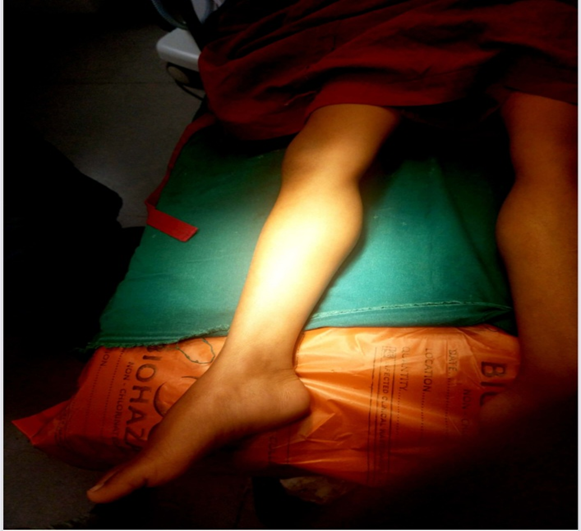
General physical examination: B/L calf muscle hypertrophy
Preoperative evaluation showed:
Airway: Mallampati II
FVC: 65% predicted
Room-air SpO₂: 96%
ECG: Sinus rhythm with nonspecific ST-T changes
Echocardiography: Mild dilated cardiomyopathy, LVEF 45%
CK: 9,800 IU/L
Electrolytes: Normal
A difficult airway cart, defibrillator and medications for management of hyperkalaemia were kept ready(5). The anaesthesia workstation was prepared as a trigger-free machine by removing vaporizers, replacing the breathing circuit and CO₂ absorbent, and flushing the machine with high fresh gas flow(6).
Intraoperative management: Patient positioned on operation table. Standard ASA monitors were connected and preoperative vitals were stable. 24G cannula was secured on the dorsum of the right hand. Patient was preoxygenated and premedicated with Inj.Glycopyrolate 0.2mg + Inj.Fentanyl 30mcg. Patient was induced with Inj.propofol 40mg IV and igel was inserted. And then chest rise and B/L equal air entry was confirmed. Patient was maintained on O2 + N2O + graded doses of Inj.propofol (5mg+5mg) and spontaneous ventilation (7).
An ultrasound guided supraclavicular block was given using Inj.Ropivacaine 0.2% 12ml with Inj.Dexamethasone 4mg for intra and postoperative analgesia.
Intraoperative vitals were stable. Duration of procedure was 60 mins. Post surgery proper efforts noted and igel was removed, recovery was smooth and vitals stable. Temperature, end-tidal carbon dioxide, urine output and serum potassium remained within normal limits. No evidence of rhabdomyolysis or arrhythmia was observed. Patient was shifted to post operative room for monitoring. Post op VAS score was 1. After 24hrs patient was shifted back to wards and discharged after 2 days.
DISCUSSION:
DMD presents several anaesthetic challenges because of respiratory muscle weakness, cardiomyopathy, and susceptibility to anaesthesia-induced rhabdomyolysis. Succinylcholine is contraindicated because it may precipitate severe hyperkalaemia and cardiac arrest(8). Although patients with DMD are not inherently susceptible to malignant hyperthermia, volatile anaesthetic agents have been associated with rhabdomyolysis and are therefore generally avoided.
A trigger-free TIVA technique is recommended(7) by many experts and avoids exposure to volatile agents. Regional anaesthesia complements TIVA by reducing opioid consumption and preserving respiratory function(9). Careful postoperative monitoring remains essential because respiratory deterioration may occur despite an initially satisfactory recovery.
CONCLUSION:
Patients with Duchenne muscular dystrophy require meticulous perioperative planning. Trigger-free anaesthesia using TIVA, avoidance of succinylcholine & volatile agents and multimodal analgesia with regional anaesthesia contributed to a favourable perioperative outcome in this high-risk patient.
REFERENCES:
1. Hoffman EP, Brown RH, Jr, Kunkel LM. Dystrophin: The protein product of the Duchenne muscular dystrophy locus. Cell. 1987;51:919–28. doi: 10.1016/0092-8674(87)90579-4.
2. Birnkrant DJ, Panitch HB, Benditt JO, Boitano LJ, Carter ER, Cwik VA, et al. American College of Chest Physicians consensus statement on the respiratory and related management of patients with Duchenne muscular dystrophy undergoing anesthesia or sedation. Chest. 2007;132:1977–86. doi: 10.1378/chest.07-0458.
3. Hayes J, Veyckemans F, Bissonnette B. Duchenne muscular dystrophy: An old anesthesia problem revisited. Paediatr Anaesth. 2008;18:100–6. doi: 10.1111/j.1460-9592.2007.02302.x.
4. Heyer A, Schevchenko Y, Parekh J. A unique approach to resolving a difficult intubation in a patient with Duchene muscular atrophy. J Anaesth Clin Pharmacol. 2010;26:257–8.
5. Wang, J.M., Stanley, T.H. Duchenne muscular dystrophy and malignant hyperthermia -two case reports. Can Anaesth Soc J 33, 492–497 (1986)
6. Bhutia MP, Pandia MP, Rai A. Anaesthetic management of a case of Duchenne muscle dystrophy with Moyamoya disease. Indian J Anaesth. 2014 Mar;58(2):219-21.
7. Saldanha RM, Gasparini JR, Silva LS, de Carli RR, de Castilhos VU, das Neves MM, Araújo FP, Sales PC, das Neves JF. Anesthesia for Duchenne muscular dystrophy patients: case reports. Rev Bras Anestesiol. 2005 Aug;55(4):445-9.
8. 6.Muenster T, Mueller C, Forst J, Huber H, Schmitt HJ. Anaesthetic management in patients with Duchenne muscular dystrophy undergoing orthopaedic surgery: A review of 232 cases. Eur J Anaesthesiol. 2012;29:489–94.
9. Deshpande J, Chavan P, Jacob M. Anaesthetic Management in Duchenne Muscular Dystrophy Patient with TIVA Using Combination of Propofol and Dexmedetomidine Complimented with USG Guided ESPB Block- A Case Report. Arch Anesth & Crit Care. 2022;8(3):252-256.