A Study to Correlate Stromal CD 10 Expression With tumour Grade And Nodal Status In Infiltrating Ductal Carcinoma
- Vanitha R Swamy , Assistant Professor, Department Of Pathology, Bgs Medical College And Hospital Bengaluru
- Priyadarshini , Assistant Professor Department Of Pathology, Farookh Academy Of Medical Education Hospital And Research Institute Mysuru
- Indira Rath , Assistant Professor, Department Of Pathology Graphic Era Institute Of Medical Sciences, Dehradun.
Article Information:
Abstract:
Background: Breast cancer is one of the most common malignancies among women worldwide. Increasing evidence suggests that the tumour stromal microenvironment plays an important role in tumour progression, invasion, and metastasis. CD10 is a cell-surface zinc-dependent metalloproteinase whose stromal expression has been associated with aggressive biological behaviour in several epithelial malignancies. The present study evaluated stromal CD10 expression in infiltrating ductal carcinoma and its relationship with tumour grade and lymph-node status. Materials and Methods: This retrospective study was conducted in the Department of Pathology, Bangalore Medical College and Research Institute, Bangalore, over a period of one year from January to December 2017. A total of 32 female patients with histologically diagnosed invasive breast carcinoma of no special type were included. Immunohistochemical staining for CD10 was performed on selected paraffin-embedded tumour tissue sections using a mouse monoclonal anti-human CD10 antibody. Stromal CD10 immunoreactivity was categorized as negative, weakly positive, or strongly positive according to staining intensity and percentage of positive stromal cells. CD10 expression was correlated with histological tumour grade and lymph-node status. Statistical analysis was performed using Pearson's chi-square test, with p<0.05 considered statistically significant. Results: The mean age of the patients was 52.2 ± 9.65 years, with an age range of 29–72 years. Stromal CD10 expression was negative in 6 (18.8%) cases, weakly positive in 13 (40.6%), and strongly positive in 13 (40.6%) cases. Stromal CD10 expression showed a statistically significant association with increasing tumour grade (p<0.001). Grade I tumours were predominantly CD10-negative, whereas Grade II tumours more frequently demonstrated weak positivity and Grade III tumours showed strong CD10 positivity. A significant relationship was also observed between stromal CD10 expression and lymph-node involvement, with stronger CD10 expression associated with more advanced nodal status. Conclusion: Increased stromal CD10 expression is significantly associated with higher tumour grade and greater lymph-node involvement in invasive ductal carcinoma of the breast. These findings indicate that stromal CD10 expression may serve as a useful prognostic marker reflecting aggressive tumour behaviour and metastatic potential. Further large-scale studies are required to establish its utility as a routine prognostic biomarker and potential therapeutic target.
Keywords:
Article :
INTRODUCTION:
Breast cancer, a major health burden both in the developed and developing countries, is the foremost cause of death in women worldwide with more than one million cases occurring annually.(4) Breast cancer stands as the most frequently diagnosed cancer in women and represents the primary cause of cancer-related mortality on a global scale.(2) In 2022, it ranked as the second most diagnosed cancer among women worldwide, second only to lung cancer.(2) In India, breast cancer accounts for 18.5% of all newly diagnosed cancers. (1) Furthermore, it held the position as the fourth highest cause of cancer-related deaths globally.[2]
The stroma plays a key role in modulating tumor invasion and metastasis. (5) CD10 is a cell surface metalloproteinase which inactivates various biologically active peptides.(6) A better understanding of stromal contribution to cancer progression will identify specific signals that promote growth, dedifferentiation, invasion, and ectopic survival of tumor cells and may eventually result in the identification of new therapeutic targets for future treatment. (5)
CD10 is a remarkable member of the major class of widely expressed cell surface proteins, endopeptidases.(7) First identified in leukemia as a tumor-specific antigen (common acute lymphoblasticleukemia antigen), CD10 has become largely used in cancer diagnosis. (7)
CD10 or common acute lymphoblastic antigen, a zinc dependent metalloproteinase, is commonly expressed in bone marrow lymphoid stem cells, pro B lymphoblasts, mature neutrophils, various lymphoma subtypes, renal cell carcinoma, and endometrial stromal sarcoma. (4) However, its function in oncogenesis remains unclear.
Various studies in the literature have demonstrated that the presence of CD10 in stromal cells is correlated with heightened biological aggressiveness in epithelial malignancies, such as gastric carcinoma, colon carcinoma, and hepatocellular carcinoma. (2) Stromal CD10 expression is known to be associated with biological aggressiveness in various epithelial malignancies.[4] Stromal markers are now emerging as novel markers in assessing the prognosis of invasive breast cancer. (5) The current study is to correlate stromal CD10 expression with tumour grade and lymph node status of the patient.
MATERIALS AND METHODS:
This is a retrospective study, conducted in the Department of Pathology at Bangalore Medical College and Research Institute, Bangalore, over a one-year period from January 2017 to December 2017. The study included 32 female patients, each diagnosed histologically with Invasive breast carcinoma of no special type. All patients had undergone either a lumpectomy or a modified radical mastectomy with axillary lymph node dissection. Tumor grade and lymph node status were obtained from the histopathological records for each case. Post- chemotherapy cases and other histological subtypes of breast carcinoma were excluded from the study. The most suitable paraffin-embedded tissue blocks containing tumor were selected for the study. Antigen retrieval was carried out using the Citrate Buffer Antigen Retrieval Protocol, with a pressure cooker serving as the heat source. Immunohistochemistry for CD10 was performed manually using a mouse monoclonal antibody against human CD10 (Dako Anti-Human CD10, clone 56C6, RTU). Negative controls were processed by omitting the primary antibody. Myoepithelial cells of normal breast tissue were used as positive controls for CD10 expression. The staining pattern, percentage of stained cells, and intensity of CD10 stains were evaluated. CD10 expression was scored as negative, weakly positive, or strongly positive (as shown in Table 1). The results were then compared with the corresponding tumor grade and lymph node status of each patient.
Statistical Methods: Statistical analysis was performed using the SPSS 20.0 statistical package for the social sciences.
Pearson's chi-square test, or the chi-square test of association, assessed the relationship between CD10 and tumor grade in breast carcinoma. A p-value of less than 0.05 was deemed to indicate statistical significance.
RESULTS:
Table 1: CD 10 IHC scoring criteria(1)
|
Immunoreactivity |
Score |
Interpretation |
|
No staining |
0 |
Negative |
|
Diffuse light brown or strong dark brown staining in less than 30% of the stromal cells |
1 |
Weakly positive |
|
Strong staining in more than 30% of the stromal cells |
2 |
Strong positive |
In this study we analysed 32 patients of infiltrating ductal carcinoma. The mean age of patients included in this study was 52.2 years (SD=9.65 years). The age of patients ranged from 29 years to 72 years. 25 put of 32 patients (75%) belonged to Tumour Grade 2. 5 (15.6%) patients had Grade 3 tumor and 3 (9.4%) had grade 1 tumour . The mean number of Nodes examined among patients is 14.3(SD=3.51) and the mean nodes positive were 3.91(SD=2.75). Regarding the nodal status 50% belonged to N1 followed by N2(37.5%). N0 and N3 was present among 6.3% patients each. CD10 expression was negative among 18.8% of patients. CD10 expression was weekly positive and strongly positive among equal number of patients (13, 40.6%).
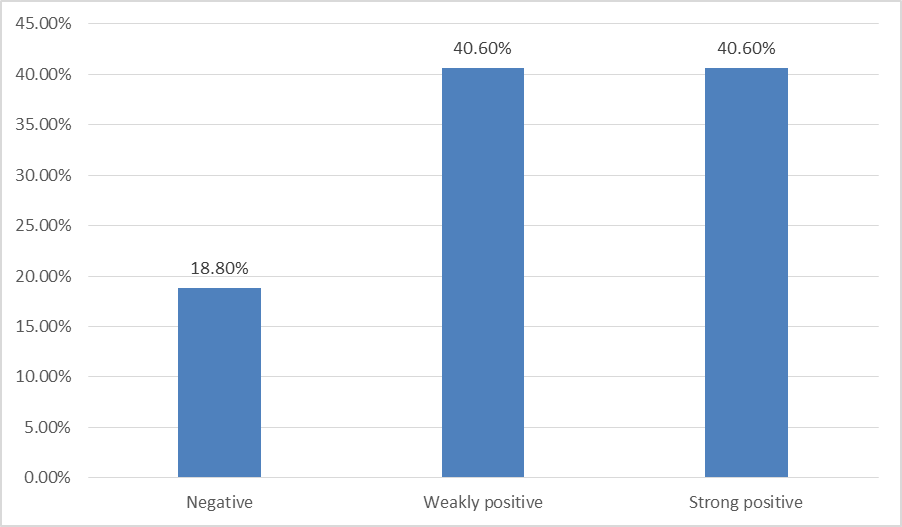
Figure 1: The expression pattern of stromal CD10 in histologically diagnosed cases of infiltrating ductal carcinoma
Table No. 2: Association between the expression patterns of stromal CD10 expression with tumour grade
The association between tumour grade and CD 10 expression is statistically significant with p value <0.001 with higher proportion of grade 1 tumour to be CD 10 negative. Similarly more garde 2 tumors were showing weakly positive CD 10 expression and Grade 3 showed higher proportion of strongly positive CD 10 expression.
|
CD10 Expression |
|||||||||||
|
Tumour grade |
|
Negative |
Weakly positive |
Strongly Positive |
Total |
||||||
|
1 |
Observed |
3 |
0 |
0 |
3 |
||||||
|
|
% within row |
100.0 % |
0.0 % |
0.0 % |
100.0 % |
||||||
|
2 |
Observed |
3 |
13 |
8 |
24 |
||||||
|
|
% within row |
12.5 % |
54.2 % |
33.3 % |
100.0 % |
||||||
|
3 |
Observed |
0 |
0 |
5 |
5 |
||||||
|
|
% within row |
0.0 % |
0.0 % |
100.0 % |
100.0 % |
||||||
|
Total |
Observed |
6 |
13 |
13 |
32 |
||||||
|
|
% within row |
18.8 % |
40.6 % |
40.6 % |
100.0 % |
||||||
Table No. 3 : Association between the expression patterns of stromal CD10 expression with lymph node status
The association between tumour grade and CD 10 expression is statistically significant with p value <0.001 with higher proportion of N0 to be CD 10 negative. Similarly more N1 were showing weakly positive CD 10 expression and N3 and N4 showed higher proportion of strongly positive CD 10 expression
|
||||||||||||||||||||||||||||||||||||||||||||||||||||||||||||||||||||||||||||||||||||||||||||||||||||||||||||||||||||||||||||||||||||||||||||||||||||||||||||||||||||||||
DISCUSSION:
Although breast cancer is an epithelial malignancy arising in the epithelial cells of the terminal ductal lobular unit, stromal microenvironment plays an important role in breast cancer evolution and metastasis. (4) However, it is important to recognize the significant role of the stromal microenvironment in the evolution and metastasis of breast cancer. (2) The concept of the microenvironment is continually evolving and elucidates that the behaviour of cancer stems not only from the genetics of the tumor cells alone (cell-autonomous), but also from the surrounding stimuli that tumor cells utilize for their survival, growth, proliferation, and metastasis. (2) The interaction between normal epithelial cells and stromal cells is modified by several factors secreted by the tumor cells themselves or by stromal cells under the influence of tumor cells. (4) One such important factor is the matrix metalloproteinase (MMP). MMP plays an important role in tumor progression and in defining the role of stromal microenvironment in tumor invasion and metastasis. (5)
The stroma mirrors the epithelial gene expression signature of tumor grade, and high-grade tumors exhibit increased stromal expression of immune response-related genes.(9)
Correlation of CD10 with Tumor Grade
In present study we found a statistically significant correlation between stromal CD10 positivity with increasing tumor grade. (p=0.000).
Howerever similar results were seen in NidhaGaffoor, Jayashree krishnamurthy et al(1), Praveena, K. P.; Glaxon, Jinu Abraham et al(2), Ashish Nitin Dhande, Siddhi Gaurish Sinai Khandeparkar et al(3). Sayantan H. Jana, Bharti M. Jha et al(4). In comparison to Nidha Gaffoor, Jayashree krishnamurthy et al(1) CD10 overexpression was seen in 76% of Grade II tumors and 91.4% of Grade III tumors. High-intensity expression was noted in 65.7% of Grade III tumors and 28% of Grade II tumors.
In contrast, Puri et al(24) and Iwaya et al(25) reported no significant correlation between CD10 positivity and tumor grade.
Correlation of CD10 with Lymph Node Status.
Stromal CD10 positivity was significantly correlated with higher metastatic lymph node count (p = 0.001). Nodal status was more frequently seen in N2/N3 nodal tumors compared to N0/N1 tumors.
Howerever similar results were seen in NidhaGaffoor, Jayashree krishnamurthy et al(1), Praveena, K. P.; Glaxon, Jinu Abraham et al(2), Ashish Nitin Dhande, Siddhi Gaurish Sinai Khandeparkar et al(3). Sayantan H. Jana, Bharti M. Jha et al(4).
Contrary to our findings, Makretsov et al (26) observed no significant correlation between stromal CD10 immunoreactivity and lymph node status.
CONCLUSION:
Stromal CD10 expression in invasive ductal carcinoma, NOS was closely associated with invasion and metastasis, suggesting a potential role in IDC pathogenesis. CD10 is an independent prognostic marker that should be incorporated into routine histopathology reports and may be a potential target for novel therapies.
REFERENCES:
1. Gaffoor N, Krishnamurthy J. Stromal expression of CD10 in breast carcinoma and its association with known prognostic factors—A tissue microarray-based study. J Lab Physicians. 2023 Feb 24. doi:10.1055/s-0043-1761925.
2. Kumar R, Chadha S, Ruhela S, Agarwal S, Singhal S. Expression of CD10 in invasive breast carcinoma and its correlation with other clinicopathological parameters. J Adv Med Pharm. 2024;6(6). doi:10.47009/jamp.2024.6.6.17.
3. Praveena KP, Glaxon JA, Chandramohan A, Vivek G. A study on stromal expression of CD10 marker in breast carcinoma and its role as a prognostic marker in a tertiary care center in South Kerala.
4. Dhande AN, Khandeparkar SGS, Joshi AR, Kulkarni MM, Pandya N, Mohanapure N, et al. Stromal expression of CD10 in breast carcinoma and its correlation with clinicopathological parameters. South Asian J Cancer. doi:10.4103/sajc.sajc_56_18.
5. Jana SH, Jha BM, Patel C, Jana D, Agarwal A. CD10—a new prognostic stromal marker in breast carcinoma, its utility, limitations and role in breast cancer pathogenesis. Indian J Pathol Microbiol. doi:10.4103/0377-4929.142639.
6. Mohammadizadeh F, Salavati M, Afshar Moghaddam N. CD10 expression in stromal component of invasive breast carcinoma: a potential prognostic determinant. J Res Med Sci. 2012;17.
7. Maguer-Satta V, Besançon R, Bachelard-Cascales E. Concise review: neutral endopeptidase (CD10): a multifaceted environmental actor in stem cells, physiological mechanisms, and cancer. Stem Cells. doi:10.1002/stem.592.
8. Gattazzo F, Urciuolo A, Bonaldo P. Extracellular matrix: a dynamic microenvironment for stem cell niche. Biochim Biophys Acta Gen Subj. 2014. doi:10.1016/j.bbagen.2014.01.010.
9. Ma XJ, Dahiya S, Richardson E, Erlander M, Sgroi DC. Gene expression profiling of the tumor microenvironment during breast cancer progression. Breast Cancer Res. 2009. doi:10.1186/bcr2222.
10. Thomas S, Babu RJ, Agarwal K, Puri V, Jain M, Andley M, et al. Effect of neoadjuvant chemotherapy on stromal CD10 antigens in breast cancer: a preliminary study. Indian J Cancer. doi:10.4103/0019-509X.112299.
11. Goldhirsch A, Winer EP, Coates AS, Gelber RD, Piccart-Gebhart M, Thürlimann B, et al. Personalizing the treatment of women with early breast cancer: highlights of the St Gallen International Expert Consensus on the primary therapy of early breast cancer 2013. Ann Oncol. 2013;24(9):2206-2223. doi:10.1093/annonc/mdt303.
12. Hilton HN, Santucci N, Silvestri A, Kantimm S, Huschtscha LI, Graham JD, et al. Progesterone stimulates progenitor cells in normal human breast and breast cancer cells. Breast Cancer Res Treat. 2014;143(2):245-257. doi:10.1007/s10549-013-2817-2.
13. Vo TND, Mekata E, Umeda T, Abe H, Kawai Y, Mori T, et al. Prognostic impact of CD10 expression in clinical outcome of invasive breast carcinoma. Breast Cancer. 2014;21(3):305-312. doi:10.1007/s12282-013-0459-1.
14. Mishra D, Singh S, Narayan G. Role of B cell development marker CD10 in cancer progression and prognosis. Biomed Res Int. 2016;2016:4328697. doi:10.1155/2016/4328697.
15. Louhichi T, Saad H, Ben Dhiab M, Ziadi S, Trimeche M. Stromal CD10 expression in breast cancer correlates with tumor invasion and cancer stem cell phenotype. BMC Cancer. 2017;17:545. doi:10.1186/s12885-017-3951-8.
16. Kim HS, Kim GY, Kim YW, Park YK, Song JY, Lim SJ. Stromal CD10 expression and relationship to the E-cadherin/beta-catenin complex in breast carcinoma. J Pathol. 2010;222(2):174-182. doi:10.1111/j.1365-2559.2010.03534.x.
17. Tse GMK, Tsang AKH, Putti TC, Scolyer RA, Lui PCW, Law BKB, et al. Stromal CD10 expression in mammary fibroadenomas and phyllodes tumours. J Clin Pathol. 2005;58(2):172-175. doi:10.1136/jcp.2004.020917.
18. Mao Y, Keller ET, Garfield DH, Shen K, Wang J. Stromal cells in tumor microenvironment and breast cancer. Cancer Metastasis Rev. 2013;32(1-2):303-315. doi:10.1007/s10555-012-9415-3.
19. Puri V, Jain M, Thomas S. Stromal expression of CD10 in invasive breast carcinoma and its correlation with ER, PR, HER2-neu, and Ki67. ISRN Pathol. 2011;2011:437957. doi:10.4061/2011/437957.
20. Iwaya K, Ogawa H, Izumi M, Kuroda M, Mukai K. Stromal expression of CD10 in invasive breast carcinoma: a new predictor of clinical outcome. Virchows Arch. 2002;440(6):593-598. doi:10.1007/s00428-002-0639-4.
21. Fidler IJ. The pathogenesis of cancer metastasis: the "seed and soil" hypothesis revisited. Nat Rev Cancer. 2003;3(6):453-458. doi:10.1038/nrc1098.
22. Taghizadeh-Kermani A, Jafarian AH, Ashabyamin R, Seilanian-Toosi M, Pourali L, Asadi M, et al. The stromal overexpression of CD10 in invasive breast cancer and its association with clinicopathologic factors.
23. Kamath R, Mahajan KS, Ashok L, Sanal TS. A study on risk factors of breast cancer among patients attending the tertiary care hospital in Udupi district. Indian J Community Med. 2013;38(2):95-99. doi:10.4103/0970-0218.112440.
24. Makretsov NA, Hayes M, Carter BA, Dabiri S, Gilks CB, Huntsman DG. Stromal CD10 expression in invasive breast carcinoma correlates with poor prognosis, estrogen receptor negativity, and high grade. Mod Pathol. 2007;20(1):84-91.