Association of Serum Retinol Binding Protein-4 Levels with HbA1 C and Anthropometric Parameters in Patients with Type 2 Diabetes.
- B. Umamaheswari , Assistant Professor, Department of Biochemistry, Government Medical College, Ariyalur, Tamil Nadu, India.
- S. Kiruba , Assistant Professor, Department of Biochemistry, Government Medical College, Namakkal, Tamil Nadu, India.
- S. Siva , Professor, Department of Biochemistry, ICH&HC, Madras Medical College, Chennai, Tamil Nadu, India.
- V. R. Prakash , Professor, Department of Biochemistry, PSP Medical College Hospital and Research Institute, Oragadam, Chennai, Tamil Nadu, India.
Article Information:
Abstract:
Background: Adipokine and retinol transport protein RBP4 (Retinol-Binding Protein-4) is linked to obesity, insulin resistance, and the development of T2DM (Type 2 Diabetes Mellitus). However, there is still variation in the association between anthropometric factors, long-term glycaemic management, and serum RBP4. This study examined the relationship between blood RBP4 levels and anthropometric parameters and glycated HbA1c (Haemoglobin) in patients with type 2 diabetes. Methodology: This analytical case–control study was conducted over 18 months among adults aged 18 years or older. Forty patients with T2DM were enrolled as cases and 40 individuals without diabetes served as controls. Participants with renal failure, malignancy, pregnancy, liver disease, thyroid disorders, or current lipid-lowering therapy were excluded. Height, weight, BMI (Body Mass Index), family history of diabetes, smoking and alcohol history, and demographic information were all noted. Venous blood was drawn after an 8–12-hour overnight fast in order to measure serum RBP4, HbA1c, and fasting serum glucose. Results: The mean age of participants was comparable between cases and controls: 55.48 ± 12.60 years and 54.80 ± 13.31 years, respectively (p = 0.816). Serum RBP4 levels were significantly higher in cases than controls, at 75.75 ± 13.80 ng/mL and 27.31 ± 8.09 ng/mL, respectively (p < 0.001). Among patients with T2DM, serum RBP4 demonstrated a significant positive correlation with HbA1c (r = 0.520, p < 0.001) and BMI (r = 0.360, p = 0.028). No significant correlation was observed between RBP4 and serum glucose (r = 0.074, p = 0.652), weight (r = −0.137, p = 0.398), or height (r = 0.050, p = 0.758). Other anthropometric parameters did not demonstrate a statistically significant association with serum RBP4. Conclusion: Serum RBP4 levels were significantly elevated in patients with T2DM compared with non-diabetic controls. In this study, RBP4 showed a moderate positive correlation with HbA1c and a weaker positive correlation with BMI, suggesting a possible association with poor glycaemic control and adiposity.
Keywords:
Article :
INTRODUCTION:
One new marker in the pathophysiology of type 2 diabetes mellitus is RBP4 (Retinol Binding Protein-4). Serum Retinol Binding Protein-4 is a carrier protein that is a member of the calycin superfamily, lipocalin family, and kernel type. The protein contains 201 amino acids and weighs 23 kDa. It is a protein involved in extracellular transport. A key factor in the modulation of insulin sensitivity in type 2 diabetes mellitus is the retinol transporter RBP4. RBP4 is thought to be a "signal" derived by adipocytes that has a role in the pathophysiology of type 2 diabetes. Reducing RBP4 levels may be a novel approach to treating type 2 diabetes. Numerous studies have demonstrated a substantial correlation between insulin resistance and RBP4.
Therefore, the purpose of this study is to evaluate the amount of serum retinol binding protein-4 in people with type 2 diabetes mellitus and its correlation with anthropometric parameters and HbA1c.
MATERIALS AND METHODS:
This was an analytical study carried out over a period of one and half years among patients with type 2 diabetes mellitus of age 18 years and above of both sexes. Patients with renal failure, malignancy pregnancy, patients with liver and thyroid disorders and patients taking lipid lowering drugs were excluded from the study.
The study population comprised 40 patients with diabetes as cases and 40 individuals without diabetes as controls. Cases and controls were enrolled by convenient sampling. The questionnaire was used to gather the required information on sociodemographic factors and anthropometric measurements, such as height, weight, waist circumference, and waist hip ratio, after the study participants gave their verbal and written consent.
5ml of venous blood samples were collected from the patients after 8-12-h overnight fasting in clot activator tube. For the biochemical examination of blood glucose and lipid profile (total cholesterol, triglycerides, high density lipoprotein, low density lipoprotein), serum was isolated. The Cobas e411 and Mindray BS 420 were used to process the samples. The sandwich ELISA method was used to process serum RBP4.
The data thus collected were entered in Excel and analysed using SPSS version.23 software. Data are expressed as mean ± SD/median. Frequencies and percentages were used to depict categorical variables, whereas mean ± SD (standard deviation) was used to portray continuous variables. The student t test was used to compare continuous variables between the study groups, including height, weight, BMI, FBS, HbA1c, and RBP4. The subjects' age, height, weight, body mass index, blood glucose, insulin, and RBP4 were all described using descriptive statistics. Using SPSS software, correlation analysis was performed using Pearson's and Spearman's correlations. P values below 0.05 were regarded as significant.
RESULTS:
The mean age in years among cases and controls was 55.48 ± 12.6 and 54.8 ± 13.31, respectively, and it was not statistically significant (p = 0.816). In contrast to the control group, which included 25% males and 75% females, the cases had 35% males and 65% females; this difference was not statistically significant (p=0.33).
The mean weight (kg) of the cases was 61.3 (± 5.36), which was 0.65 kg less than the controls' 61.95 (± 5.47) (p = 0.593), but it was not statistically significant. In comparison to the Controls, who had a mean height of 1.55 (± 0.03) (p = 0.484), the cases had a mean height of 1.54 (± 0.04), which is 0.01 lower but not statistically significant.
In contrast to the controls group, which had a normal BMI of 37.5% and an overweight BMI of 62.5%, 40% of the cases group had a normal BMI, and 60% were overweight. This difference was not statistically significant (p > 0.05).
Table 1. Distribution based on BMI
|
BMI |
Group |
Total |
Chi sq. p value |
|
|
Cases |
Controls |
|||
|
Normal |
16 (40%) |
15 (37.5%) |
31 (38.75%) |
0.819 |
|
Overweight |
24 (60%) |
25 (62.5%) |
49 (61.25%) |
|
|
Total |
40 (100%) |
40 (100%) |
80 (100%) |
|
In contrast to the controls group, which had 15% of H/o smokers, the cases group had 17.5% of H/o smokers, which was higher but not statistically significant (p > 0.05). In contrast to the controls group, which had 17.5% H/o alcohol consumption, the cases group had 22.5% H/o alcohol consumption, which was greater but not statistically significant (p > 0.05). In contrast to the controls group, which had a family history of diabetes of 47.5%, the cases group had a family history of diabetes of 57.5%, which was greater but not statistically significant (p > 0.05).
Table 2. Distribution of Social Factors
|
Variables |
Group |
Total |
Chi sq. p value |
|
|
Cases |
Controls |
|||
|
Smokers |
7 (17.5%) |
6 (15%) |
13 (16.25%) |
0.762 |
|
Non smokers |
33 (82.5%) |
34 (85%) |
67 (83.75%) |
|
|
Alcohol consumption |
9 (22.5%) |
7 (17.5%) |
16 (20%) |
|
|
Non-Alcoholics’ |
31 (77.5%) |
33 (82.5%) |
64 (80%) |
0.577 |
|
Mixed diet |
33 (82.5%) |
35 (87.5%) |
68 (85%) |
0.532 |
|
Vegetarian diet |
7 (17.5%) |
5 (12.5%) |
12 (15%) |
|
|
Family History of Diabetes Yes |
23 (57.5%) |
19 (47.5%) |
42 (52.5%) |
0.371 |
|
No |
17 (42.5%) |
21 (52.5%) |
38 (47.5%) |
|
The mean serum glucose (mg/dl) among cases was 117.35 (± 37.93) which was higher by 23.63 and statistically significant compared to 93.73 (± 18.93) in controls. The mean HbA1C among cases was 6.31 (± 0.94) which was higher by 0.95 and statistically significant compared to 5.36 (± 0.44) in controls.
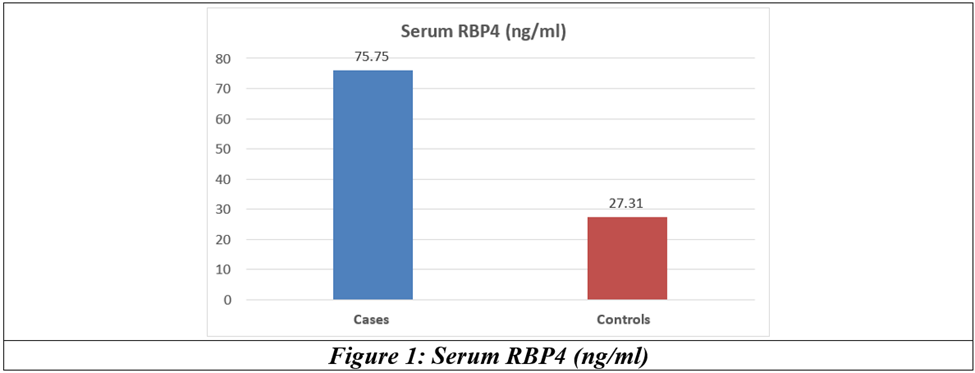
The mean serum RBP4 (ng/ml) among cases was 75.75 (± 13.8) which was higher by 48.44 and statistically significant compared to 27.31 (± 8.09) in controls.
Table 3. Serum RBP4 (ng/ml)
|
|
|
Group |
N |
Mean |
Std. dev. |
Mean diff. |
p value by 't' test |
|
Serum (ng/ml) |
RBP4 |
Cases |
40 |
75.75 |
13.80 |
48.444 |
0.001 |
|
Controls |
40 |
27.31 |
8.09 |
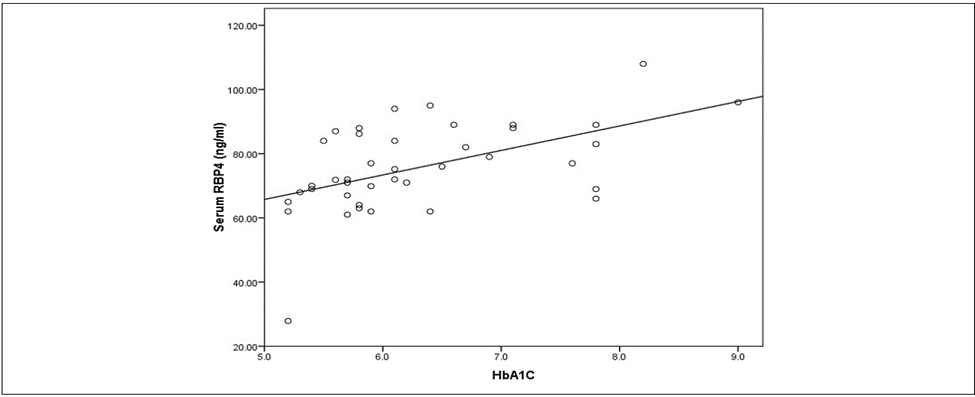
The serum RBP4 and HbA1C had a good significant positive correlation with r = 0.52. HbA1C had a positive correlation with serum RBP4 (ng/ml) with a correlation coefficient of 0.52. Serum RBP4 (ng/ml) increased by 7.63 times for each unit increase in HbA1c. The correlation between serum RBP4 (ng/ml) and HbA1c was statistically significant. There was a significant correlation of serum RBP4 with BMI (r-0.360, p- 0.028). However, other anthropometric parameters did not show a significant correlation with serum RBP4.
Table 4. Correlation between HbA1C and Serum RBP4 (ng/ml) among Diabetics
|
Predictor for Serum RBP4 (ng /ml) |
Correlation coefficient "r" |
B (95% C.I.) |
p value |
|
HbA1C |
0.520 |
7.633 (3.52 - 11.75) |
0.001 |
DISCUSSION:
RBP4 is often elevated in T2DM and correlates with insulin resistance, visceral adiposity, and some lipid abnormalities. Several well‑known studies found no significant correlation between serum RBP4 and HbA1c or fasting glucose in T2DM, despite clear links with insulin resistance and obesity measures. Anthropometric parameters (especially BMI, waist circumference, and sometimes waist‑to‑hip ratio) more consistently correlate with RBP4 than HbA1c does.[1,2]
The purpose of this case-control study is to measure serum retinol binding protein-4 (RBP4) levels and link them with anthropometric profile and HbA1c in patients with type 2 diabetes. The average age of controls is 54.8 years, while the average age of cases is 55.48 years. In contrast to the control group, which consisted of 25% males and 75% females, 35% of the males and 65% of the females were cases. When compared to controls (48.44 ± 8.09), T2DM patients had mean blood RBP4 levels of 75.75 ± 13.8, which was greater and statistically significant. We also looked into the relationship between BMI and serum RBP4 levels in teenagers who were obese and those who weren't. RBP4 levels were considerably greater in men than in women.
According to our study report, the mean serum RBP4 (ng/ml) for cases was 75.75 ± 13.8, which was greater and statistically significant than the control group's 27.31 ± 8.09. RBP4 is elevated in the early phases of T2DM development, according to a study by Kotniket al.[3] Tan et al.'s similar study[4] revealed that patients with diabetes had far higher levels of free RBP4 in their blood plasma than people without the disease. Our study report is in line with earlier studies, like those conducted by Ying and Cho et al.[5] According to research by Jia-Ying Li et al.[6] patients with issues related to diabetes had much higher plasma levels of RBP4. Similar to our work, Yeli Wang et al.'s analysis of 507 type 2 diabetes cases[7] revealed a favourable RBP4-diabetes connection in the general population. Previous research has demonstrated that RBP4 may be involved in a number of causal processes that result in the development of type 2 diabetes, including inflammation, dysregulation of insulin resistance, and failure of the intracellular lipid homeostasis mechanism.[8,9]
RBP4 may affect beta-cell insulin production in addition to causing insulin resistance. Elevated serum RBP4 levels cause the gluconeogenic enzyme phosphoenolpyruvate carboxykinase to be expressed in the liver and impair muscle insulin signalling. RBP4 is a factor generated from adipocytes that influences insulin sensitivity by acting on the liver and/or muscles. One of the primary causes of insulin resistance, serum RBP4 is increased in both type 2 diabetes and obesity. According to studies, adipocytes and primarily hepatocytes produce and secrete free RBP4 in the plasma. Participants with type 2 diabetes have high levels of RBP4 in their blood plasma, which is directly related to their metabolic regulation.[10,11] In circumstances like obesity, RBP4 levels are increased due to an increase in adipocyte size. Serum RBP4 has been shown to have a substantial pathophysiological association with insulin resistance and obesity.[12] The function of RBP4 in lipid metabolism and metabolic syndrome has also been clarified by a number of research.[13,14] Similar to our study findings, Pandey et al.[15] similarly observed that T2DM sufferers had higher circulating levels of RBP4 and that there was a significant correlation between T2DM and RBP4 (OR = 1.11, 95% CI: 1.01–1.21) among the study participants.
Several well‑designed cross‑sectional studies in T2DM and related populations report that there is no significant correlation between serum RBP4 and HbA1c or fasting plasma glucose, despite clear associations with insulin resistance (HOMA‑IR) and obesity indices. In first‑degree relatives of T2DM patients, RBP4 correlated with metabolic syndrome components but not with HbA1c. In a JCEM study of T2DM patients, RBP4 was associated with variables related to insulin resistance and complications, but not with FPG or HbA1c.[16] In a large prospective cohort of individuals with prediabetes, RBP4 showed a U‑shaped relationship with incident T2DM risk, but no strong linear association with baseline HbA1c after adjustment.[17]
Other studies, particularly in mixed metabolic cohorts (e.g., essential hypertension, metabolic syndrome), sometimes report weak positive correlations between RBP4 and HbA1c (r ≈ 0.18–0.22), but these associations are modest and often attenuate after controlling for BMI, waist circumference, and renal function.[18]
In contrast to HbA1c, the association between RBP4 and anthropometric measures is more consistent and biologically coherent. In our study, BMI had a positive correlation with serum RBP4 with an r value of 0.360. This result is consistent with the study conducted by Lee JW et al[19] in which serum RBP4 concentrations were weakly but positively correlated to BMI. In the studies of Friebe D et al.[20] The substantial correlation between RBP4 and BMI z-score was validated by multiple regression analysis.
Multiple studies report a positive correlation between serum RBP4 and BMI in T2DM and related populations. RBP4 correlates with visceral fat area on imaging and with waist circumference in several cohorts. Some studies suggest RBP4 tracks more closely with central/visceral adiposity than total fat mass. Higher RBP4 in obese versus lean individuals, independent of diabetes status has been observed in some studies. Weight loss interventions (diet, exercise, bariatric surgery) often reduce RBP4 in parallel with BMI and insulin resistance. However, RBP4 is not simply a marker of total fat mass. Some lean, insulin‑resistant individuals exhibit elevated RBP4, suggesting that fat distribution and adipose function matter more than total adiposity. Serum RBP4 correlates with WC (Waist Circumference) and waist‑to‑hip ratio (WHR) in several T2DM and metabolic syndrome cohorts. Imaging studies show RBP4 correlates with VAT (Visceral Adipose Tissue) area more strongly than with subcutaneous fat. In weight‑loss trials, reductions in visceral fat correlate more closely with RBP4 decline than total fat loss. These findings support the concept that RBP4 is a biomarker of adipose tissue dysfunction, particularly visceral/central fat, rather than simple obesity.[21]
The above findings indicate that given its role in insulin resistance and cardiometabolic disease, RBP4 is an attractive therapeutic target. Whether directly lowering RBP4 improves hard outcomes (HbA1c, DKD progression, CVD events) in humans remains an open question and a promising area for clinical trials. The following are the limitations of this study. First, it is a single cantered study. Multi-centric studies are needed to determine the association of RBP4 levels with T2DM and lipid profile. Second, the study subjects were limited to T2DM those who visited to our hospital, thus, the conclusions may not be applicable to community patients with diabetes.
CONCLUSION:
Patients with type 2 diabetes have elevated serum levels of RBP4. The serum RBP4 and glycated HbA1c as well as BMI, show a good significant positive correlation. Higher levels of RBP4 in type 2 diabetes patients may therefore be considered as an early marker in diagnosing complications and can be implemented in screening and prevention of the disease, especially among overweight or obese patients.
REFERENCES:
1. Tabesh M, Noroozi A, Amini M, et al. Association of retinol-binding protein 4 with metabolic syndrome in first-degree relatives of type 2 diabetic patients. J Res Med Sci 2017;22:28.
2. Graham TE, Yang Q, Blüher M, et al. Retinol-binding protein 4 and insulin resistance in lean, obese, and diabetic subjects. N Engl J Med 2006;354(24):2552-63.
3. Kotnik P, Fischer-Posovszky P, Wabitsch M. RBP4: a controversial adipokine. Eur J Endocrinol 2011;165(5):703-11.
4. Tan MI, Hisana AN, Ridwan A, et al. A. Diabetes and retinol-binding protein (RBP4): the study of free and exosomal RBP4 in blood plasma and urine of patients. Biomed Pharmacol J 2020;13(2).
5. Cho YM, Youn BS, Lee H, et al. Plasma retinol-binding protein-4 concentrations are elevated in human subjects with impaired glucose tolerance and type 2 diabetes. Diabetes Care 2006;29(11):2457-61.
6. Li JY, Chen XX, Lu XH, et al. Elevated RBP4 plasma levels were associated with diabetic retinopathy in type 2 diabetes. Biosci Rep 2018;38(5):BSR20181100.
7. Wang Y, Sun L, Lin X, et al. Retinol binding protein 4 and risk of type 2 diabetes in Singapore Chinese men and women: a nested case-control study. Nutr Metab (Lond) 2019;16:3.
8. Yang Q, Graham TE, Mody N, et al. Serum retinol binding protein 4 contributes to insulin resistance in obesity and type 2 diabetes. Nature 2005;436:356-62.
9. Erikstrup C, Mortensen OH, Pedersen BK. Retinol-binding protein 4 and insulin resistance. N Engl J Med 2006;355:1393-4.
10. Flores-Cortez YA, Barragán-Bonilla MI, Mendoza-Bello JM, et al. Interplay of retinol binding protein 4 with obesity and associated chronic alterations (Review). Mol Med Rep 2022;26(1):244.
11. Chen Y, Lv P, Du M, et al. Increased retinol-free RBP4 contributes to insulin resistance in gestational diabetes mellitus. Arch Gynecol Obstet 2017;296(1):53-61.
12. Krzyzanowska K, Zemany L, Krugluger W, et al. Serum concentrations of retinol-binding protein 4 in women with and without gestational diabetes. Diabetologia 2008;51(7):1115-22.
13. Lu J, Wang D, Ma B, et al. Blood retinol and retinol-binding protein concentrations are associated with diabetes: a systematic review and meta-analysis of observational studies. Eur J Nutr 2022;61(7):3315-26.
14. Shajarian M, Rafiee L, Naji-Esfahani H, et al. Association of RBP4 gene variants with adverse lipid profile and obesity. Gene 2015;561(1):1-5.
15. Pandey GK, Balasubramanyam J, Balakumar M, et al. Altered circulating levels of retinol binding protein 4 and transthyretin in relation to insulin resistance, obesity, and glucose intolerance in Asian Indians. Endocr Pract 2015;21(8):861-9.
16. Takebayashi K, Suetsugu M, Wakabayashi S, et al. Retinol binding protein‑4 levels and clinical features of type 2 diabetes patients. J Clin Endocrinol Metab 2007;92(7):2712-9.
17. Fan J, Yan S, Li D, et al. Association of serum retinol‑binding protein 4 levels and the risk of incident type 2 diabetes in subjects with prediabetes. Diabetes Care 2019;42(8):1574-81.
18. Park H, Green MH, Shaffer ML. Association between serum retinol‑binding protein 4 concentrations and clinical indices in subjects with type 2 diabetes: a meta‑analysis. J Hum Nutr Diet 2012;25:300-10.
19. Lee DC, Lee JW, Im JA. Association of serum retinol binding protein 4 and insulin resistance in apparently healthy adolescents. Metabolism 2007;56(3):327-31.
20. Friebe D, Neef M, Erbs S, et al. Retinol binding protein 4 (RBP4) is primarily associated with adipose tissue mass in children. Int J Pediatr Obes 2011;6(2-2):e345-52.
21. Fan J, Hu J. Retinol binding protein 4 and type 2 diabetes: from insulin resistance to pancreatic β-cell function. Endocrine 2024;85(3):1020-34.