Association of Serum Retinol Binding Protein-4 Level with Serum Lipids in Patients with Type 2 Diabetes.
- B. Umamaheswari , Assistant Professor, Department of Biochemistry, Government Medical College, Ariyalur, Tamil Nadu, India.
- S. Kiruba , Assistant Professor, Department of Biochemistry, Government Medical College, Namakkal, Tamil Nadu, India.
- S. Siva , Professor, Department of Biochemistry, ICH&HC, Madras Medical College, Chennai, Tamil Nadu, India.
- V. R. Prakash , Professor, Department of Biochemistry, PSP Medical College Hospital and Research Institute, Oragadam, Chennai, Tamil Nadu, India.
Article Information:
Abstract:
Background: Retinol-binding protein 4, an adipocyte-derived protein associated with insulin resistance, may contribute to the dyslipidemia observed in T2DM (Type 2 Diabetes Mellitus). This study evaluated serum RBP4 levels and their association with lipid parameters among patients with T2DM. Methods: An analytical case–control study was conducted over 18 months among adults with T2DM. Forty patients with T2DM and 40 age- and sex-comparable non-diabetic controls were recruited by convenient sampling. Participants with renal failure, malignancy, pregnancy, hepatic or thyroid disorders, or use of lipid-lowering medication were excluded. RBP4, glucose, HbA1c, and lipid profiles were measured in fasting blood samples. The sandwich enzyme-linked immunosorbent assay was used to quantify serum RBP4. SPSS version 23 was used for the statistical analysis, and p<0.05 was deemed statistically significant. Results: The mean age of cases and controls was 55.48 ± 12.60 and 54.80 ± 13.31 years, respectively. Mean serum RBP4 levels were significantly higher in patients with T2DM than in controls (75.75 ± 13.80 vs. 27.31 ± 8.09 ng/mL). Among patients with T2DM, RBP4 showed significant positive correlations with triglycerides (r=0.509, p=0.001) and LDL cholesterol (r=0.435, p=0.005), and a significant inverse correlation with HDL cholesterol (r=-0.379, p=0.016). Conclusion: Elevated serum RBP4 is associated with an atherogenic lipid profile in T2DM. RBP4 may serve as a useful biomarker of metabolic dysfunction and dyslipidemia in patients with diabetes.
Keywords:
Article :
INTRODUCTION:
The potential burden of diabetes mellitus, a chronic non-communicable disease, is increasing globally. India is known as the "Diabetic Capital of the World" due to the rising prevalence of diabetes. One new marker in the pathophysiology of type 2 diabetes mellitus is RBP4 (Retinol Binding Protein-4). Serum Retinol Binding Protein-4 is a carrier protein that is a member of the calycin superfamily, lipocalin family, and kernel type. Increased free fatty acid flow as a result of insulin resistance is linked to the lipid alterations linked to type 2 diabetes. One all-trans-retinol molecule is bound by it. Retinol saturates apolipoprotein A, causing it to be secreted into the plasma. RBP shields bound retinol from oxidation while facilitating the movement of insoluble retinol from the storage site to the peripheral tissues. Target tissue specific uptake is mediated by RBP.
RBP4 is thought to be a "signal" derived by adipocytes that has a role in the pathophysiology of type 2 diabetes. Reducing RBP4 levels may be a novel approach to treating type 2 diabetes. Numerous studies have demonstrated a substantial correlation between insulin resistance and RBP4. Therefore, the purpose of this study is to evaluate the level of serum retinol binding protein-4 in people with type 2 diabetes mellitus and how it relates to their lipid profile.
MATERIALS AND METHODS:
This was an analytical study carried out over a period of one and a half years among patients with type 2 diabetes mellitus of age 18 years and above of both sexes. Patients with renal failure, malignancy pregnancy, patients with liver and thyroid disorders and patients taking lipid lowering drugs were excluded from the study.
The study population comprised of 40 patients with diabetes as cases and 40 individuals without diabetes as controls. Cases and controls were enrolled by convenient sampling. Following verbal and written agreement from study participants, anthropometric measurements such as height, weight, waist circumference, and waist hip ratio were measured, and a questionnaire was used to gather the required data on sociodemographic characteristics.
Following an 8–12-hour overnight fast, 5 millilitres of venous blood were drawn from the patients and placed in a clot activator tube. For the biochemical examination of blood glucose and lipid profile (total cholesterol, triglycerides, high density lipoprotein, low density lipoprotein), serum was isolated. The Cobas e411 and Mindray BS 420 were used to process the samples. The sandwich ELISA method was used to process serum RBP4.
SPSS version 23 software was used to analyse the data that was so gathered after it was imported into Excel. The data are presented as mean ± SD/median. Frequencies and percentages were used to depict categorical variables, whereas mean ± SD (standard deviation) was used to portray continuous variables. Height, weight, BMI, FBS, HbA1c, RBP4, and T are examples of continuous variables. Using the student t test, the study groups' levels of cholesterol, triglycerides, HDL, and LDL were compared. The subjects' age, height, weight, body mass index, blood glucose, insulin, and RBP4 were all described using descriptive statistics. Using SPSS software, correlation analysis was performed using Pearson's and Spearman's correlations. P values below 0.05 were regarded as significant.
RESULTS:
The mean age in years among cases and controls was 55.48 ± 12.6 and 54.8 ± 13.31, respectively, and it was not statistically significant (p = 0.816). 35% of the cases were males, and 65% were females, compared to the control group, of whom 25% had males and 75% had females, and the difference was not statistically significant (p=0.33).
The mean weight (kg) among cases was 61.3 (± 5.36), which was lower by 0.65 but not statistically significant compared to 61.95 (± 5.47) in controls (p = 0.593). The mean height among cases was 1.54 (± 0.04), which is lower by 0.01 but not statistically significant compared to 1.55 (± 0.03) in controls (p = 0.484).
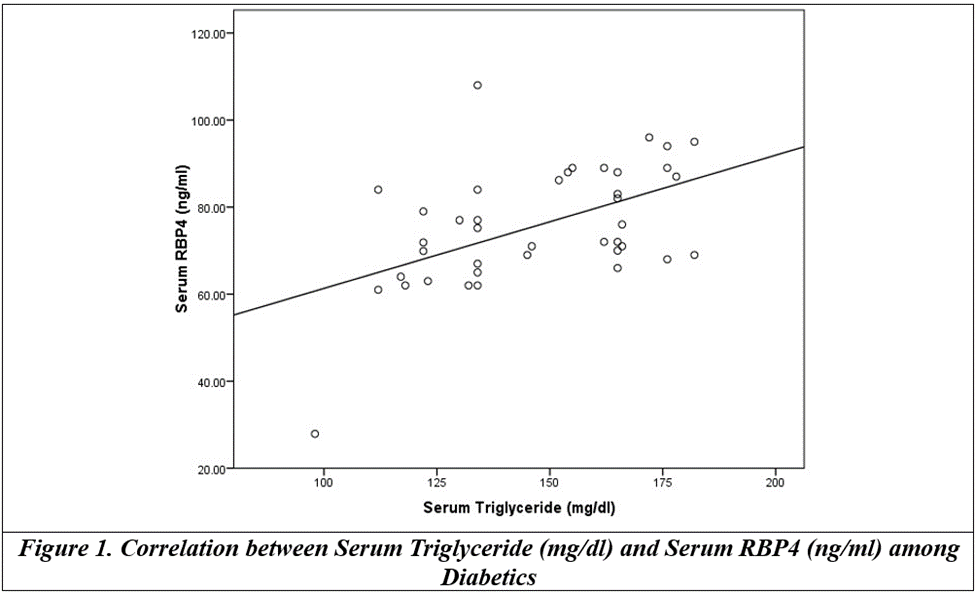
Serum triglyceride (mg/dl) had a positive correlation with serum RBP4 (ng/ml) with a correlation coefficient of 0.51. Serum RBP4 (ng/ml) increases by 0.31 times for each unit increase in serum triglyceride (mg/dl). The correlation between serum RBP4 (ng/ml) and serum triglyceride (mg/dl) was statistically significant.
Table 1. Correlation between Serum Triglyceride (mg/dl) and Serum RBP4 (ng/ml) among Diabetics
|
Predictor for Serum RBP4 (ng/ml) |
Correlation coefficient "r" |
B (95% C.I.) |
p value |
|
Serum Triglyceride (mg/dl) |
0.509 |
0.306 (0.14 - 0.48) |
0.001 |
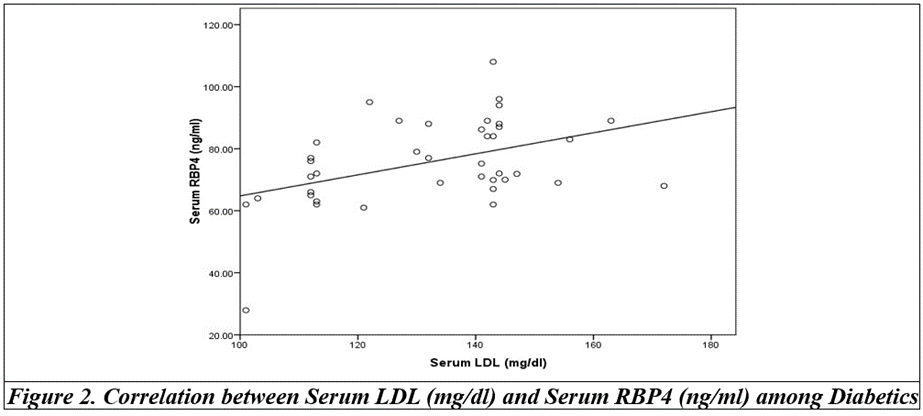
Serum LDL (mg/dl) showed a positive correlation with serum RBP4 (ng/ml) with a correlation coefficient of 0.44. Serum RBP4 (ng/ml) increases by 0.34 times for each unit increase in serum LDL (mg/dl). The correlation between serum RBP4 (ng/ml) and serum LDL (mg/dl) was statistically significant.
Table 2. Correlation between Serum LDL (mg/dl) and Serum RBP4 (ng/ml) among Diabetics
|
Predictor for Serum RBP4 (ng/ml) |
Correlation coefficient "r" |
B (95% C.I.) |
p value |
|
Serum LDL (mg/dl) |
0.435 |
0.339 (0.11 - 0.57) |
0.005 |
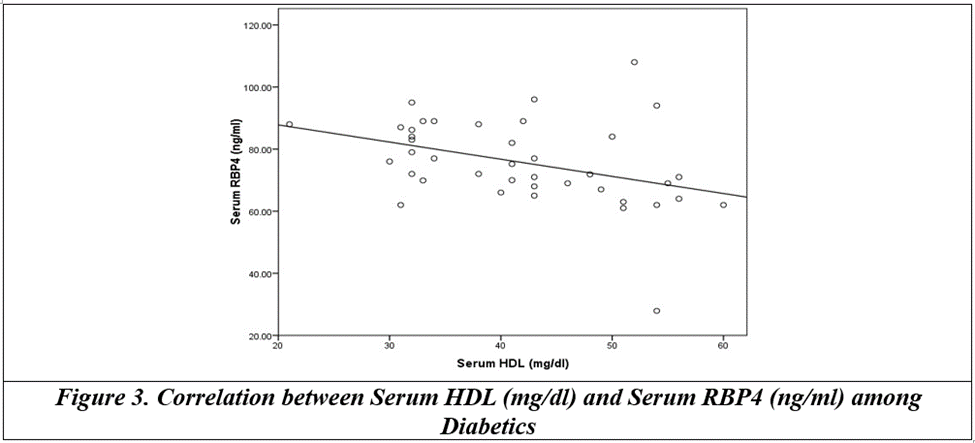
Serum HDL (mg/dl) had a negative correlation with serum RBP4 (ng/ml) with a correlation coefficient of -0.38. Serum RBP4 (ng/ml) decreases by -0.55 times for each unit increase in serum HDL (mg/dl). The correlation between serum RBP4 (ng/ml) and serum HDL (mg/dl) was statistically significant.
Table 3. Correlation between Serum HDL (mg/dl) and Serum RBP4 (ng/ml) among Diabetics
|
Predictor for Serum RBP4 (ng/ml) |
Correlation coefficient "r" |
B (95% C.I.) |
p value |
|
Serum HDL (mg/dl) |
-0.379 |
-0.553 (-0.99 to -0.11) |
0.016 |
DISCUSSION:
The purpose of this case control study was to measure Serum retinol binding protein-4 levels and connect them with lipid profiles in T2DM patients. The average age of controls was 54.8 years, while the average age of cases was 55.48 years. In contrast to the control group, which consisted of 25% males and 75% females, 35% of the males and 65% of the females were cases. The mean serum RBP4 levels among T2DM were 75.75 ± 13.8 which was higher and statistically significant when compared to controls 48.44 ± 8.09. Serum triglyceride, serum LDL, BMI had a significant positive correlation with serum RBP4. Serum HDL had a significant positive correlation with Serum RBP4. Males had significantly higher RBP4 levels than females. Our study report shows that the mean serum RBP4 (ng/ml) among Cases was 75.75 ± 13.8) which was higher and statistically significant compared to 27.31 ± 8.09 in Controls.
Serum triglyceride (mg/dl) showed a positive correlation with serum RBP4 (ng/ml). Mehta et al.,[1] stated that the most common type of dyslipidemia among type 2 diabetic patients was high LDL and triglycerides which is similar to our study report. Studies have shown positive correlations between elevated triglycerides and plasma RBP4 in both adult and paediatric populations. Hyperinsulinemia can raise triglyceride levels, which in turn stimulates the synthesis and secretion of RBP4 from the liver or ectopic adipose tissue. Kim et al.[2] discovered that even after controlling for confounding variables including age and BMI, the favourable correlation between RBP4 and triglyceride levels persisted. According to Kwanbunjan et al., 167 adult participants with elevated triglyceride levels had significantly higher RBP4 levels, and the relationships between RBP4 and insulin resistance and hypertriglyceridemia may have major effects on the risk of heart disease and stroke.[3,4]
The serum LDL among cases and controls was 132.35 and 113.50 respectively, as shown. Serum LDL (mg/dl) has a positive correlation with serum RBP4 (ng/ml) with a correlation coefficient of 0.44. RBP4 levels were associated with LDL particles as studied in Wessel H et al.[5] Another cross-sectional investigation by Okataria et al.[6] revealed a statistically significant (p<0.05) moderately positive connection between RBP4 and triglycerides in central obesity (r = 0.478).
There was a statistically significant difference in the mean HDL concentration between the patients and the control. Similar to our research, Wessel H et al.[5] also noted an independent and inverse connection between RBP4 and big HDL particles. Large VLDL is known to be adversely correlated with HDL cholesterol due to the mechanism of cholesteryl ester transfer. Large VLDL particles have been demonstrated to promote cholesteryl ester transfer in type 2 diabetes; however, it is unknown if RBP4 could impede this process. Retinol was not linked to large VLDL without RBP4, but RBP4 was linked to large VLDL without retinol. This implies that big VLDL particles are more closely associated with circulating RBP4 than retinol. Large VLDL and tiny LDL particle concentrations were also predicted to be higher in T2DM, which is in line with the idea that these particles are metabolically connected. Similar to our investigation, a study by Ali et al.[7] also showed that patients with diabetes had significantly higher levels of TC, TG, LDL, and VLDL than patients without the disease. Similar to our study findings, another study by Khan et al.[8] found that patients with diabetes and low HDL had higher levels of LDL, TG, and total cholesterol. This is comparable to the research done by Von Eynatten et al.[9] who discovered a strong association between RBP4 and VLDL triglycerides and LDL cholesterol in his study of people with type 2 diabetes.
Sterol regulatory element binding protein 1 (SREBP-1) gene expression in the fatty acid/triglyceride (TG) production pathway is stimulated by RBP4. According to certain research, there is a connection between increased RBP4 circulation and obesity, demonstrating that metabolic syndrome is associated with elevated RBP4 levels. According to a study by Aref et al.[10] the RBP4 gene produces a binding protein to retinol, or vitamin-A alcohol, which helps transport vitamin-A from the liver reserves to the peripheral tissues and minimise vitamin-A loss during glomerular filtration. RBP4 is thought to control lipid homeostasis by activating nuclear receptors via the metabolism of retinol. This control has been scrutinised so much that current research has tried to use RBP4 as an early indicator of metabolic disorders, such as dyslipidaemia, and it shows a negative correlation with RBP4, which validates our hypothesis. In essence, insulin offers a comprehensive set of signals that enable the equilibrium between the supply and demand of nutrients. Hyperglycemia is caused by insulin resistance and hyperlipidaemia, both of which are exacerbated by poor diet.
Our work is supported by a lipid trio involving an atherogenic dyslipidaemia[11,12] that is characterised by elevated triglycerides (TG), low HDL-C, and moderate/high LDL-C in several clinical contexts linked to high cardiovascular risk. It is now well acknowledged that dysfunctional adipose tissue in obesity results in an imbalanced synthesis of adipokines that have a variety of negative effects and raise cholesterol.
CONCLUSION:
Increased levels of RBP4 level correlate with serum lipid profile with elevated total cholesterol, triglyceride levels, high LDL and low HDL levels. Serum RBP4 can thence be considered as an important tool for determining insulin resistance and metabolic functions in diabetes patients. These results give a justification for selecting anti-diabetic treatments meant to reduce serum RBP4 levels.
REFERENCES:
1. Sharma N, Marguerat S, Mehta S, et al. The fission yeast Rpb4 subunit of RNA polymerase II plays a specialized role in cell separation. Mol Genet Genomics 2006;276(6):545-54.
2. Kang S, Woo JH, Shin KO, et al. Circuit resistance exercise improves glycemic control and adipokines in females with type 2 diabetes mellitus. J Sports Sci Med 2009;8(4):682-8.
3. Kwanbunjan K, Panprathip P, Phosat C, et al. Association of retinol binding protein 4 and transthyretin with triglyceride levels and insulin resistance in rural thais with high type 2 diabetes risk. BMC Endocr Disord 2018;18(1):26.
4. Friebe D, Neef M, Erbs S, et al. Retinol binding protein 4 (RBP4) is primarily associated with adipose tissue mass in children. Int J Pediatr Obes 2011;6(2-2):e345.
5. Wessel H, Saeed A, Heegsma J, et al. Plasma levels of retinol binding protein 4 relate to large VLDL and small LDL particles in subjects with and without type 2 diabetes. J Clin Med 2019;8(11):1792.
6. Lu J, Wang D, Ma B, et al. Blood retinol and retinol-binding protein concentrations are associated with diabetes: a systematic review and meta-analysis of observational studies. Eur J Nutr 2022;61(7):3315-26.
7. Li F, Xia K, Sheikh MSA, et al. Involvement of RBP4 in hyperinsulinism-induced vascular smooth muscle cell proliferation. Endocrine 2015;48:472-82.
8. Huang G, Wang D, Khan UI, et al. Associations between retinol-binding protein 4 and cardiometabolic risk factors and subclinical atherosclerosis in recently postmenopausal women: cross-sectional analyses from the KEEPS study. Cardiovasc Diabetol 2012;11:52.
9. von Eynatten M, Lepper PM, Liu D, et al. Retinol-binding protein 4 is associated with components of the metabolic syndrome, but not with insulin resistance, in men with type 2 diabetes or coronary artery disease. Diabetologia 2007;50(9):1930-7.
10. Aref-Eshghi E, Hurley O, Sun G, et al. Genetic associations in community context: a mixed model approach identifies a functional variant in the RBP4 gene associated with HDL-C dyslipidemia. BMC Med Genet 2018;19(1):205.
11. Nesto RW. Beyond low-density lipoprotein: addressing the atherogenic lipid triad in type 2 diabetes mellitus and the metabolic syndrome. Am J Cardiovasc Drugs 2005;5(6):379-87.
12. Chapman MJ, Redfern JS, McGovern ME, et al. Optimal pharmacotherapy to combat the atherogenic lipid triad. Curr Opin Cardiol 2011;26(5):403-11.