Prevalence of Vitamin D Deficiency and Its Association with Musculoskeletal Pain in School-Aged Children: A Cross-Sectional Study
- Chirag Sethi , Associate Professor, Department of Orthopedics, Alfalah School of Medical Sciences and Research Centre, Faridabad, Haryana, India
- Swati Agrawal , Associate Professor, Department of Pediatrics, Alfalah School of Medical Sciences and Research Centre, Faridabad, Haryana, India
Article Information:
Abstract:
Background: Vitamin D is essential for skeletal growth, bone mineralization, calcium homeostasis, and normal musculoskeletal function during childhood. Despite widespread sunlight exposure in many regions, vitamin D deficiency remains common among children. Musculoskeletal pain is also frequently reported during school age and may have nutritional, mechanical, developmental, and other causes. Objective: To determine the prevalence of vitamin D deficiency among school-aged children and assess its association with musculoskeletal pain. Methods: A cross-sectional study was conducted among 200 school-aged children aged 6–12 years. Serum 25-hydroxyvitamin D [25(OH)D] levels were estimated, and participants were categorized according to vitamin D status. Musculoskeletal pain was assessed using a structured questionnaire and numerical pain-rating scale. Results: Vitamin D deficiency was present in 46 (23.0%) children, insufficiency in 62 (31.0%), and sufficiency in 92 (46.0%). Musculoskeletal pain was reported by 70 (35.0%) participants. Musculoskeletal pain was more frequent among vitamin-D-deficient children than among vitamin-D-sufficient children (54.3% vs. 22.8%, p=0.001). Conclusion: Vitamin D deficiency was relatively common among the studied school-aged children and was significantly associated with musculoskeletal pain. Musculoskeletal pain was more frequently reported among vitamin-D-deficient children than among those with sufficient vitamin D levels. Further prospective studies are needed to clarify the role of vitamin D deficiency in pediatric musculoskeletal pain.
Keywords:
Article :
INTRODUCTION:
Vitamin D is essential for skeletal growth, mineralization, calcium metabolism, and maintenance of normal musculoskeletal function during childhood. Although sunlight is an important source of vitamin D, deficiency remains common among children and adolescents. Age, season, geographic location, dietary intake, physical activity, and lifestyle can all influence vitamin D status [1,2].
Indian children are similarly affected by a substantial burden of vitamin D deficiency. A nationally representative Indian survey demonstrated considerable vitamin D deficiency among children and adolescents, while a multicentre study reported that more than half of Indian children and adolescents had vitamin D deficiency or insufficiency [3,4]. These findings indicate that vitamin D deficiency remains an important pediatric nutritional concern.
Musculoskeletal pain is another common complaint during childhood. Extremity pain and low back pain may result from mechanical stress, physical activity, developmental factors, or other clinical conditions [5,6]. Vitamin D deficiency has also been investigated as a possible contributor to musculoskeletal symptoms. Studies in children with leg pain have reported a high frequency of hypovitaminosis D, although musculoskeletal pain is recognized as a multifactorial condition [7].
Therefore, the present study was undertaken to determine the prevalence of vitamin D deficiency among school-aged children and to assess its association with musculoskeletal pain.
MATERIALS AND METHODS:
A cross-sectional observational study was conducted among school-aged children attending selected schools during the study period. A total of 200 children aged 6–12 years were included.
Inclusion Criteria
Children were included if they:
· Were aged 6–12 years.
· Were enrolled in the selected schools during the study period.
· Had parental consent and child assent.
· Were willing to undergo clinical and laboratory assessment.
· Had complete demographic, clinical, and laboratory data.
Exclusion Criteria
Children were excluded if they had:
· Chronic renal, hepatic, endocrine, metabolic, or skeletal disease.
· Previously diagnosed rickets or metabolic bone disease.
· Current vitamin D or calcium supplementation.
· Long-term use of drugs affecting vitamin D metabolism.
· Incomplete clinical or laboratory information.
Assessment of Vitamin D Status
Venous blood samples were collected for estimation of serum 25-hydroxyvitamin D [25(OH)D]. Vitamin D status was classified according to the Indian Academy of Pediatrics revised guidelines as deficient (<12 ng/mL), insufficient (12–20 ng/mL), and sufficient (>20 ng/mL) [8].
Assessment of Musculoskeletal Pain
Musculoskeletal pain was assessed using a structured questionnaire. Information regarding the presence, duration, anatomical site, and severity of pain was recorded. Pain severity was assessed using a 0–10 numerical rating scale, with higher scores indicating greater pain intensity.
Statistical Analysis
Continuous variables were expressed as mean ± SD and categorical variables as frequency and percentage. The chi-square test and independent-samples t-test were used as appropriate. A p-value <0.05 was considered statistically significant.
RESULTS:
A total of 200 school-aged children were included. The mean age was 9.2±1.9 years, with 108 (54.0%) boys and 92 (46.0%) girls. Musculoskeletal pain was reported by 70 (35.0%) children.
Table 1: Demographic and Clinical Characteristics of Study Participants
|
Variable |
Total (n=200) |
|
Age, years, mean ± SD |
9.2 ± 1.9 |
|
Boys, n (%) |
108 (54.0) |
|
Girls, n (%) |
92 (46.0) |
|
Height, cm, mean ± SD |
132.8 ± 11.4 |
|
Weight, kg, mean ± SD |
31.4 ± 8.2 |
|
BMI, kg/m², mean ± SD |
17.6 ± 2.4 |
|
Musculoskeletal pain present, n (%) |
70 (35.0) |
|
Musculoskeletal pain absent, n (%) |
130 (65.0) |
The study population consisted of 200 school-aged children with a relatively balanced distribution by sex. Approximately one-third of the participants reported musculoskeletal pain.
Table 2: Distribution of Participants According to Vitamin D Status
|
Vitamin D status |
Serum 25(OH)D |
n (%) |
|
Deficient |
<12 ng/mL |
46 (23.0) |
|
Insufficient |
12–20 ng/mL |
62 (31.0) |
|
Sufficient |
>20 ng/mL |
92 (46.0) |
Vitamin D deficiency was identified in 23.0% of children, while 31.0% had insufficiency. Overall, 54.0% of participants had vitamin D concentrations below the sufficient range.
Table 3: Anatomical Distribution of Musculoskeletal Pain
|
Pain site |
n (%) among children with pain (n=70) |
|
Lower limbs |
31 (44.3) |
|
Back |
16 (22.9) |
|
Knees |
12 (17.1) |
|
Generalized/multiple sites |
7 (10.0) |
|
Upper limbs |
4 (5.7) |
Lower-limb pain was the most frequent complaint, accounting for 44.3% of children with musculoskeletal pain. Back and knee pain were the next most commonly reported locations.
Table 4: Association Between Vitamin D Status and Musculoskeletal Pain
|
Vitamin D status |
Pain present n (%) |
Pain absent n (%) |
p-value |
|
Deficient |
25 (54.3) |
21 (45.7) |
0.001 |
|
Insufficient |
24 (38.7) |
38 (61.3) |
|
|
Sufficient |
21 (22.8) |
71 (77.2) |
Musculoskeletal pain was most frequent among vitamin-D-deficient children and least frequent among vitamin-D-sufficient children. The difference across vitamin D categories was statistically significant (p=0.001), suggesting an association between lower vitamin D status and musculoskeletal pain.
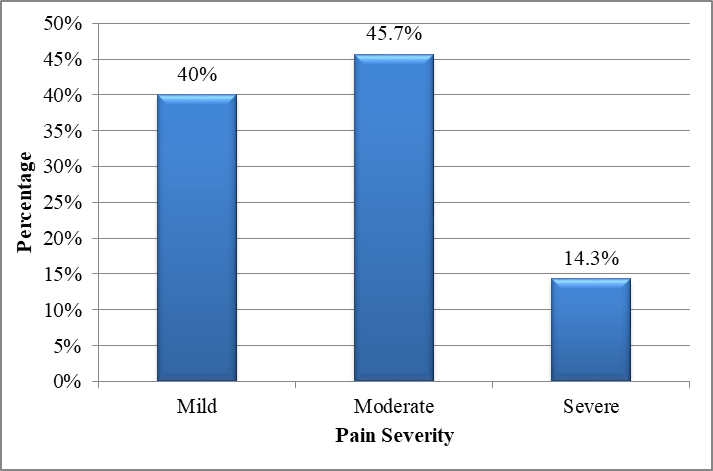
Figure 1: Distribution of Musculoskeletal Pain According to Severity Among the 70 children who reported musculoskeletal pain, moderate pain was the most frequently reported severity (32, 45.7%), followed by mild pain (28, 40.0%) and severe pain (10, 14.3%).
DISCUSSION:
The present study found vitamin D deficiency in 23.0% of school-aged children, while 31.0% had vitamin D insufficiency. Musculoskeletal pain was reported by 35.0% of participants and was significantly more common among vitamin-D-deficient children. The observed association between lower vitamin D status and musculoskeletal pain suggests that vitamin D status may be relevant in children presenting with musculoskeletal complaints.
The prevalence observed in this study is comparable with data from Indian population-based research. A nationally representative Indian survey reported vitamin D deficiency among a substantial proportion of children and adolescents, demonstrating that low vitamin D status remains an important public health concern [3]. A multicentre study involving 2500 Indian children and adolescents also found that only 36.8% had sufficient vitamin D concentrations using its predefined threshold, while younger age, female sex, overweight status, and urban residence were associated with lower vitamin D levels [4].
The association between vitamin D status and musculoskeletal symptoms has biological plausibility because vitamin D contributes to calcium and phosphate homeostasis, skeletal mineralization, and normal muscle function. A review of vitamin D in pediatric orthopedics highlighted its importance for normal skeletal development and pediatric musculoskeletal health [7].
Musculoskeletal pain in children, however, is not attributable to vitamin D status alone. A population-based study found that musculoskeletal pain was relatively common even among young children and was associated with several physical and psychosocial factors [9]. Similarly, pediatric low back pain is often related to mechanical overuse or trauma, although the differential diagnosis is broad [10].
The present findings are also consistent with earlier pediatric observations linking hypovitaminosis D with leg pain. A case-control study of children with leg pain in India reported a high frequency of hypovitaminosis D, although biomechanical factors such as joint mobility and ankle strength were also associated with pain [11]. This supports the view that vitamin D deficiency may be one component of a multifactorial process rather than the sole cause of musculoskeletal symptoms.
Evidence concerning whether vitamin D supplementation directly improves musculoskeletal outcomes is less consistent. A systematic review and meta-analysis of randomized controlled trials found no clear beneficial effect of vitamin D supplementation on overall muscle health [12]. Similarly, broader evidence regarding vitamin D supplementation and musculoskeletal health has not established a uniform clinical benefit across populations [13].
The cross-sectional design of the present study prevents assessment of temporal or causal relationships. Other factors, including physical activity, body composition, posture, mechanical stress, dietary intake, and seasonal variation, may influence both vitamin D status and musculoskeletal symptoms. Nevertheless, the observed association supports consideration of vitamin D assessment in children with persistent or recurrent musculoskeletal complaints.
CONCLUSION:
Vitamin D deficiency was relatively common among the school-aged children studied and was significantly associated with musculoskeletal pain. Musculoskeletal pain was more frequently reported among children with vitamin D deficiency than among those with sufficient vitamin D levels. These findings suggest that vitamin D status may be considered during the evaluation of children presenting with persistent or recurrent musculoskeletal pain. However, the cross-sectional nature of the study does not establish a causal relationship, and prospective studies are needed to further clarify the role of vitamin D deficiency in pediatric musculoskeletal pain.
REFERENCES:
1. Cashman KD. Vitamin D Deficiency: Defining, Prevalence, Causes, and Strategies of Addressing. Calcif Tissue Int. 2020 Jan;106(1):14-29. doi: 10.1007/s00223-019-00559-4.
2. Cui A, Zhang T, Xiao P, Fan Z, Wang H, Zhuang Y. Global and regional prevalence of vitamin D deficiency in population-based studies from 2000 to 2022: A pooled analysis of 7.9 million participants. Front Nutr. 2023 Mar 17;10:1070808. doi: 10.3389/fnut.2023.1070808.
3. Rana G, Abraham RA, Sachdev HS, Nair KM, Kumar GT, Agarwal PK, Johnston R, Wagt A, Sarna A, Acharya R, Porwal A, Khan N, Ramesh S, Bharti R, Kalaivani M, Ramakrishnan L. Prevalence and Correlates of Vitamin D Deficiency Among Children and Adolescents From a Nationally Representative Survey in India. Indian Pediatr. 2023 Mar 15;60(3):202-206.
4. Khadilkar A, Kajale N, Oza C, Oke R, Gondhalekar K, Patwardhan V, Khadilkar V, Mughal Z, Padidela R. Vitamin D status and determinants in Indian children and adolescents: a multicentre study. Sci Rep. 2022 Oct 6;12(1):16790. doi: 10.1038/s41598-022-21279-0.
5. Fuglkjær S, Dissing KB, Hestbæk L. Prevalence and incidence of musculoskeletal extremity complaints in children and adolescents. A systematic review. BMC Musculoskelet Disord. 2017 Oct 18;18(1):418. doi: 10.1186/s12891-017-1771-2.
6. MacDonald J, Stuart E, Rodenberg R. Musculoskeletal Low Back Pain in School-aged Children: A Review. JAMA Pediatr. 2017 Mar 1;171(3):280-287. doi: 10.1001/jamapediatrics.2016.3334.
7. Horan MP, Williams K, Hughes D. The Role of Vitamin D in Pediatric Orthopedics. Orthop Clin North Am. 2019 Apr;50(2):181-191. doi: 10.1016/j.ocl.2018.10.002.
8. Gupta P, Dabas A, Seth A, Bhatia VL, Khadgawat R, Kumar P, Balasubramanian S, Khadilkar V, Mallikarjuna HB, Godbole T, Krishnamurthy S, Goyal JP, Bhakhri BK, Ahmad A, Angadi K, Basavaraj GV, Parekh BJ, Kurpad A, Marwaha RK, Shah D, Munns C, Sachdev HPS. Indian Academy of Pediatrics Revised (2021) Guidelines on Prevention and Treatment of Vitamin D Deficiency and Rickets. Indian Pediatr. 2022 Feb 15;59(2):142-158.
9. van den Heuvel MM, Jansen PW, Bindels PJE, Bierma-Zeinstra SMA, van Middelkoop M. Musculoskeletal pain in 6-year-old children: the Generation R Study. Pain. 2020 Jun;161(6):1278-1285. doi: 10.1097/j.pain.0000000000001797.
10. Calvo-Muñoz I, Kovacs FM, Roqué M, Gago Fernández I, Seco Calvo J. Risk Factors for Low Back Pain in Childhood and Adolescence: A Systematic Review. Clin J Pain. 2018 May;34(5):468-484. doi: 10.1097/AJP.0000000000000558.
11. Evans AM, Berde T, Karimi L, Ranade P, Shah N, Khubchandani R. Correlates and predictors of paediatric leg pain: a case-control study. Rheumatol Int. 2018 Jul;38(7):1251-1258. doi: 10.1007/s00296-018-4056-7.
12. Bislev LS, Grove-Laugesen D, Rejnmark L. Vitamin D and Muscle Health: A Systematic Review and Meta-analysis of Randomized Placebo-Controlled Trials. J Bone Miner Res. 2021 Sep;36(9):1651-1660. doi: 10.1002/jbmr.4412.
13. Bolland MJ, Grey A, Avenell A. Effects of vitamin D supplementation on musculoskeletal health: a systematic review, meta-analysis, and trial sequential analysis. Lancet Diabetes Endocrinol. 2018 Nov;6(11):847-858. doi: 10.1016/S2213-8587(18)30265-1.