Medicine in the Machine Age: Examining Medical Students' Views on AI's Impact on Healthcare.
- Shivali Rai , Professor Department of Pharmacology, Madha medical College and Research Institute
- Shameemunisha , Assistant Professor, Department of Pharmacology, Madha medical College and Research Institute
- Saranya R , Associate Professor, Department of Pharmacology, Madha medical College and Research Institute
- S T Balamurali , HOD Professor, Department of Pharmacology Madha medical College and Research Institute,
Article Information:
Abstract:
Background: Artificial Intelligence (AI) is transforming healthcare by enhancing diagnostic accuracy and the efficiency of healthcare. As future healthcare professionals, medical students must be prepared to work with AI technologies. Understanding their knowledge, attitudes, practices, and perceptions regarding AI is essential for developing educational strategies and for integrating AI into medical education. Objectives: To assess the knowledge, attitudes, practices, and perceptions of undergraduate medical students regarding the use and future integration of Artificial Intelligence in healthcare. Methods: A cross-sectional descriptive study was conducted among 271 MBBS students at Madha Medical College and Research Institute, Chennai. Data were collected using a pre-validated, structured questionnaire administered through Google Forms. Perceptions of AI across eight clinical applications were measured using a five-point Likert scale. Descriptive statistics were used to summarise the data, while Pearson's Chi-square test, Fisher's Exact test, Mann–Whitney U test, and Kruskal–Wallis test were used to determine associations. Internal consistency of the perception scale was evaluated using Cronbach's alpha. Results: The mean age of participants was 20.12 ± 1.33 years, with females comprising 59.8% of the study population. Most participants (84.9%) were familiar with AI, and 91.9% agreed that AI has useful applications in medicine. Nearly four-fifths (79.3%) believed AI would assist healthcare providers in diagnosis and decision-making, while 68.6% expressed willingness to use AI-based software in future clinical practice. However, only 14.8% believed AI could outperform experienced physicians in diagnosis, and 63.5% preferred their own clinical judgment over AI recommendations during disagreement. AI was perceived most favourably for patient documentation (3.63 ± 0.88), diagnostic imaging (3.46 ± 0.88), and preventive health recommendations (3.43 ± 0.97), whereas emotional support (2.48 ± 1.29) and surgery (2.84 ± 1.13) received the lowest ratings. Male students were significantly more likely than female students to rely on their own clinical judgment when AI recommendations conflicted with theirs (p = 0.004). Conclusion: Medical students are aware and have positive attitude toward AI in healthcare while they recognise its limitations in replacing human judgment and being empathetic patient care. The findings support incorporating structured AI education into the undergraduate medical curriculum to equip future physicians with the knowledge and competencies needed for the effective and ethical use of AI in healthcare.
Keywords:
Article :
INTRODUCTION:
Medical practice is going through a fast transformation with the rapid advancement of Artificial Intelligence (AI). Although AI was once considered a futuristic concept, it has increasingly become a reality in healthcare. AI has also started influencing how doctors diagnose various diseases ,monitor the disease progression , decide treatment and also in disease prevention. Machine learning, deep learning and natural language processing are some of the newer technologies through which, AI systems can process large volumes of healthcare data. AI systems can help in identifying complex patterns, and also generate insights for supporting decision-making.¹˒² . As digital technology keeps becoming a bigger part of healthcare, future clinical practice will definitely be refined by Artificial intelligence systems.
There are many applications of AI that have proved to be helpful in medicine. AI technology is useful for predicting how various diseases would progress and helps personalize treatments. For example, AI could be helpful for radiologists during the analysis of the results of imaging tests. AI will be very helpful in healthcare due to its precision and speed as the number of digital health technologies grows. .³˒⁴ The widespread adoption of electronic health records, telemedicine platforms, and digital health technologies has further accelerated the integration of AI into routine clinical care.⁴˒⁵ Artificial intelligence can offer real solutions to some of the growing challenges faced by healthcare systems worldwide.
There is much potential for the use of AI in healthcare, but there are also certain issues to consider. Issues include privacy, ethical use of patient data, discrimination through algorithms, lack of transparency when making decisions using AI, and accountability for any mistakes made by artificial intelligence programs.¹˒⁵. Another issue that arises with the growing use of technology is the effect of technology on clinical judgement, autonomy of physicians, and the emotional aspect of the treatment process, including the physician-patient relationship.
Medical students make up the next generation of workforce who will operate in healthcare facilities where there is a growing trend towards technology use. Unlike the previous generation of doctors, modern medical students have to face AI tools during their entire career, which makes their perception of such technologies especially important. .⁶˒⁷ Their perception of AI could influence how readily these advances are adopted and used in clinical practice in the future. Consequently, it becomes relevant to explore their attitudes towards AI.
Many students believe that AI can improve diagnostic accuracy, enhance healthcare efficiency, and support clinicians in managing complex clinical information.⁶⁻⁸ At the same time, concerns persist regarding the reliability of AI systems, ethical implications, patient confidentiality, and the possibility that AI could reduce opportunities for clinical learning or diminish the importance of human interaction in patient care.⁶˒⁷ Interestingly, despite recognizing the growing importance of AI, many students report limited formal education or training on the subject during their undergraduate medical studies .⁸˒⁹
Existing studies have shown that medical students generally hold positive attitudes toward the potential applications of AI in medicine. Most students believe that AI will increase diagnostic precision, speed up healthcare processes, and facilitate clinicians to manage large sets of clinical data ⁶⁻⁸. Nevertheless, there is still a fear related to the reliability of the AI system, ethics, privacy of patients, and potential decrease in learning opportunities for clinicians or value of personal interaction because of the implementation of the technology.⁶˒⁷. In particular, despite the growing importance of AI acknowledged by the majority of students, they receive little education regarding the issue in medical colleges .
This has led to calls for increased incorporation of skills related to AI in the curriculum of medical schools. It has been recognized that it is crucial for future physicians to gain knowledge concerning concepts of AI, applications, limitations, and ethical considerations.⁸˒⁹ Future physicians who will work in an AI-driven healthcare environment must be educated using methodologies that instill technological understanding and analysis.
The significance of AI technology is particularly apparent in developing countries such as India, which face problems such as high number of patients, inadequate accessibility to health services, insufficient health care workers, and inadequate resources.¹⁰ AI technology has the potential of improving the provision of health services in such an environment through improved efficiency, access to expert knowledge, and decision making based on data. Nonetheless, the proper implementation of the technology depends on the readiness and willingness of future health care professionals.
An understanding of the way that medical students perceive the impact of AI on medicine is extremely important. It will help us to identify the gaps in their knowledge, correct their misconceptions and plan the curriculum in such a way that doctors of tomorrow would be ready for the developments in the field of medicine.
AIM AND OBJECTIVES
Aim
To assess the knowledge, attitudes, practices, and perceptions of medical students regarding the use and future integration of Artificial Intelligence (AI) in healthcare.
Objectives
1. To assess the level of knowledge and awareness of Artificial Intelligence among undergraduate medical students.
2. To evaluate the attitudes of medical students toward the application of Artificial Intelligence in healthcare and clinical practice.
3. To explore medical students' perceptions regarding the potential role of Artificial Intelligence in various healthcare tasks, including diagnosis, treatment planning, documentation, imaging interpretation, and patient care.
MATERIALS AND METHODS:
Study Design
A cross-sectional descriptive questionnaire-based study was conducted among undergraduate medical students.
Study Setting and Study Population
The study was conducted among MBBS students enrolled at Madha Medical College and Research Institute, Chennai.
Sampling Technique and Sample Size
A convenience sampling technique was employed. All eligible MBBS students who consented to participate during the study period were included.
A total of 271 medical students participated in the study.
Inclusion Criteria
• MBBS students studying in Madha Medical College and Research Institute.
• Students willing to participate and provide informed consent.
• Both male and female students
Exclusion Criteria
• Students unwilling to participate in the study.
• Incomplete questionnaire responses.
Data Collection Tool and Procedure
Data were collected using a pre-validated structured questionnaire administered through Google Forms.
Participation was voluntary and anonymity of responses was maintained throughout the study.
Data Analysis Plan
The collected data were entered into Microsoft Excel and analyzed using Statistical Package for Social Sciences (SPSS) software
Descriptive statistics were used to summarize the data. Inferential statistical tests were applied to assess associations between study variables. Pearson's Chi-square test and Fisher's Exact test were used for categorical variables. Mann–Whitney U test and Kruskal–Wallis test were used for comparison of non-parametric continuous variables. Internal consistency of the perception scale was assessed using Cronbach's alpha coefficient. A p-value of <0.05 was considered statistically significant.
RESULTS:
Sociodemographic profile of the participants
The mean age of the participants was 20.12 ± 1.33 years (median 20; range 17–29 years). Females accounted for 162 (59.8%) of the respondents, males for 106 (39.1%), and three participants (1.1%) preferred not to disclose their sex. Most respondents were in their third year of MBBS (167; 61.6%), followed by final-year students (76; 28.0%), interns (19; 7.0%), and second-year students (8; 3.0%); a single respondent (0.4%) had completed MBBS. The detailed sociodemographic distribution is presented in Table 1 and visualized in Figure 1.
Table 1: Sociodemographic characteristics of the study participants (N = 271)
|
Variable |
Category |
n (%) |
|
Age (years) |
|
|
|
|
≤19 |
86 (31.7) |
|
|
20–21 |
155 (57.2) |
|
|
≥22 |
28 (10.3) |
|
|
Not recorded |
2 (0.8) |
|
Sex |
|
|
|
|
Female |
162 (59.8) |
|
|
Male |
106 (39.1) |
|
|
Prefer not to say |
3 (1.1) |
|
Academic year |
|
|
|
|
2nd year |
8 (3.0) |
|
|
3rd year |
167 (61.6) |
|
|
Final year |
76 (28.0) |
|
|
Internship |
19 (7.0) |
|
|
Graduate / Post-MBBS |
1 (0.4) |
Mean age 20.12 ± 1.33 years; median 20 (range 17–29).
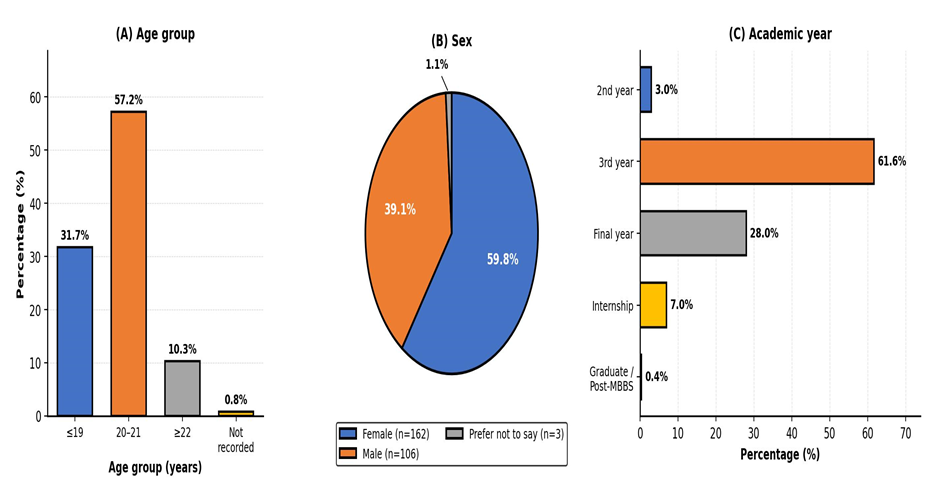
Figure 1. Sociodemographic profile of the 271 medical students included in the study. (A) Distribution by age group; (B) distribution by sex; (C) distribution by current academic year of MBBS.
Knowledge, attitude, and practice regarding artificial intelligence
A majority of students (230; 84.9%) reported being familiar with the concept of artificial intelligence, and 171 (63.1%) reported having an idea of how AI could be incorporated into clinical practice. Almost all respondents (249; 91.9%) agreed that AI has useful applications in medicine, with the most commonly perceived advantage being that AI speeds up healthcare processes and reduces medical errors (176; 64.9%), followed by the delivery of vast amounts of clinically relevant high-quality data (64; 23.6%) and freedom from emotional exhaustion or physical limitations (31; 11.4%).
Despite this favorable attitude, only 40 students (14.8%) agreed that AI's diagnostic ability would surpass the clinical experience of a human doctor; in the event of a conflict between their own clinical opinion and the AI's, 172 (63.5%) reported that they would rely on their own opinion, while 91 (33.6%) were uncertain and only 8 (3.0%) would defer to the AI. A total of 215 students (79.3%) believed that AI would help healthcare providers in diagnosis and decision-making, with diagnosis (145; 53.5%) being marginally preferred over treatment decisions (126; 46.5%) as the field most amenable to AI utility.
Translating this into intended practice, 186 students (68.6%) expressed willingness to use an AI-based software for diagnosis and treatment, 168 (62.0%) intended to use AI for diagnosis in their future practice, and 171 (63.1%) for treatment planning. However, the willingness to recommend AI to fellow practitioners was almost equally divided (139; 51.3% versus 132; 48.7%). Knowledge, attitude, and practice item frequencies are summarized in Table 2.
Table 2: Knowledge, attitude, and practice of medical students regarding artificial intelligence in healthcare (N = 271)
|
Domain |
Item |
Response |
n (%) |
|
Knowledge |
|
|
|
|
|
Familiar with the concept of AI |
Yes / No |
230 (84.9) / 41 (15.1) |
|
|
Has an idea of how AI can be incorporated into medical practice |
Yes / No |
171 (63.1) / 100 (36.9) |
|
Attitude |
|
|
|
|
|
Agrees that AI has useful applications in medicine |
Agree / Disagree |
249 (91.9) / 22 (8.1) |
|
|
Most important perceived advantage of AI |
Speed / fewer errors |
176 (64.9) |
|
|
|
Vast clinical data |
64 (23.6) |
|
|
|
No emotional / physical limit |
31 (11.4) |
|
|
Agrees that AI's diagnostic ability surpasses human experience |
Agree / Disagree |
40 (14.8) / 231 (85.2) |
|
|
Preferred judgment in case of own opinion versus AI |
My own opinion |
172 (63.5) |
|
|
|
Not sure |
91 (33.6) |
|
|
|
AI's opinion |
8 (3.0) |
|
|
Believes AI will help healthcare providers in diagnosis and decision making |
Yes / No |
215 (79.3) / 56 (20.7) |
|
|
Field most amenable to AI utility |
Diagnosis / Treatment |
145 (53.5) / 126 (46.5) |
|
Practice |
|
|
|
|
|
Willing to use an AI software for diagnosis and treatment |
Yes / No |
186 (68.6) / 85 (31.4) |
|
|
Will recommend AI to fellow practitioners |
Yes / No |
139 (51.3) / 132 (48.7) |
|
|
Will use AI for diagnosis in future practice |
Yes / No |
168 (62.0) / 103 (38.0) |
|
|
Will use AI for treatment planning in future practice |
Yes / No |
171 (63.1) / 100 (36.9) |
Perceptions of AI across eight clinical applications
Participants rated the perceived likelihood of AI performing eight specific healthcare tasks on a five-point Likert scale (1 = Extremely unlikely to 5 = Extremely likely). The eight-item scale demonstrated acceptable internal consistency, with a Cronbach's α of 0.709. AI was most positively perceived for data-centric and documentation tasks: providing patient documentation (mean 3.63 ± 0.88), interpreting diagnostic imaging (3.46 ± 0.88), and providing preventive well-being recommendations (3.43 ± 0.97). The least favorable ratings were given for human-centric tasks, namely providing emotional support to patients (2.48 ± 1.29) and performing surgery, including robotic surgery (2.84 ± 1.13). The mean composite score across the eight items was 3.25 ± 0.57. The full distribution of responses across the eight domains is shown in Table 3 and visualized in Figure 2.
Table 3: Perceived likelihood of artificial intelligence performing specific healthcare tasks (N = 271)
|
AI application |
Extremely unlikely n (%) |
Unlikely n (%) |
Neutral n (%) |
Likely n (%) |
Extremely likely n (%) |
Mean ± SD |
|
Provides patient documentation |
4 (1.5) |
17 (6.3) |
98 (36.2) |
108 (39.9) |
44 (16.2) |
3.63 ± 0.88 |
|
Interprets diagnostic imaging |
9 (3.3) |
20 (7.4) |
105 (38.7) |
112 (41.3) |
25 (9.2) |
3.46 ± 0.88 |
|
Provides preventive well-being recommendations |
11 (4.1) |
28 (10.3) |
97 (35.8) |
103 (38.0) |
32 (11.8) |
3.43 ± 0.97 |
|
Establishes prognosis from patient information |
8 (3.0) |
23 (8.5) |
104 (38.4) |
123 (45.4) |
13 (4.8) |
3.41 ± 0.83 |
|
Creates personalized treatment plans |
5 (1.8) |
38 (14.0) |
100 (36.9) |
104 (38.4) |
24 (8.9) |
3.38 ± 0.90 |
|
Reaches a diagnosis from patient information |
16 (5.9) |
23 (8.5) |
103 (38.0) |
104 (38.4) |
25 (9.2) |
3.37 ± 0.97 |
|
Performs surgery (e.g., robotic surgery) |
42 (15.5) |
52 (19.2) |
105 (38.7) |
52 (19.2) |
20 (7.4) |
2.84 ± 1.13 |
|
Provides emotional support to patients |
85 (31.4) |
53 (19.6) |
74 (27.3) |
35 (12.9) |
24 (8.9) |
2.48 ± 1.29 |
|
Composite eight-item score |
— |
— |
— |
— |
— |
3.25 ± 0.57 |
Cronbach's α for the eight-item scale = 0.709.
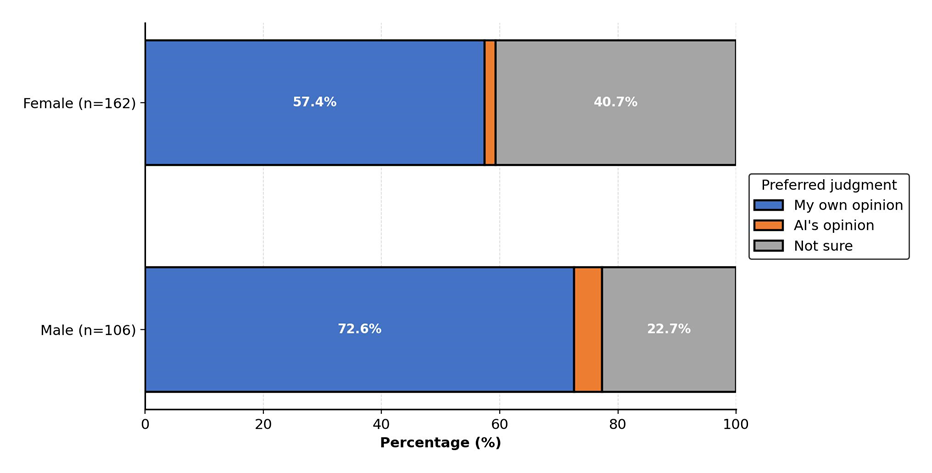
Figure 2. Mean Likert scores (± 1 SD) for the perceived likelihood of artificial intelligence performing eight specific healthcare tasks among 271 medical students. Items are ordered from highest to lowest mean rating; data-centric tasks (documentation, imaging) received the most favorable ratings, while human-centric tasks (emotional support, surgery) received the least favorable ratings.
Bivariate associations of KAP variables with sociodemographic characteristics
Associations of selected KAP variables with sex and academic year are presented in Table 4. After excluding the three respondents who preferred not to disclose their sex (n = 268 for sex-stratified analyses), a statistically significant association was observed between sex and the preferred source of judgment in case of conflict with AI (Fisher's exact p = 0.004). A higher proportion of male students (72.6%) than female students (57.4%) preferred to follow their own clinical opinion, whereas females were considerably more likely to be uncertain (40.7% versus 22.7%); this finding is illustrated in Figure 3. The association between sex and the belief that AI will help healthcare providers (χ² = 3.659, p = 0.056) and between sex and intention to use AI for treatment planning (χ² = 3.440, p = 0.064) showed borderline trends in favor of female students but did not reach statistical significance. No significant sex differences were observed for familiarity with AI (p = 0.197), agreement that AI is useful (p = 0.138), willingness to use AI software (p = 0.845), or willingness to recommend AI to peers (p = 0.712).
A statistically significant association was also observed between academic year and the field perceived as most amenable to AI utility (Fisher's exact p = 0.002): preference for diagnosis was strongest among second-year students (100.0%) and interns (78.9%), whereas final-year students slightly favored treatment decisions (52.6%). Familiarity with AI and willingness to use AI software did not differ significantly across academic-year groups (p = 0.483 and p = 0.536, respectively).
The composite eight-item Likert perception score did not differ significantly between male and female students (median 3.12 versus 3.25; Mann-Whitney U = 8784, p = 0.749), across academic-year groups (Kruskal-Wallis H = 3.693, df = 3, p = 0.297), or across age-group categories (Kruskal-Wallis H = 3.074, df = 2, p = 0.215).
Table 4: Associations of selected knowledge, attitude, and practice variables with sex and academic year
|
Association tested |
Test |
Test statistic |
p-value |
|
Sex (Female vs Male; n = 268) |
|
|
|
|
Sex × Familiarity with AI |
Pearson's χ² |
1.664 (df = 1) |
0.197 |
|
Sex × Agreement that AI is useful |
Pearson's χ² |
2.205 (df = 1) |
0.138 |
|
Sex × Willingness to use AI software |
Pearson's χ² |
0.038 (df = 1) |
0.845 |
|
Sex × Recommend AI to peers |
Pearson's χ² |
0.136 (df = 1) |
0.712 |
|
Sex × Preferred judgment in conflict with AI |
Fisher's exact (MC, B = 10 000) |
— |
0.004 * |
|
Sex × Belief that AI helps healthcare providers |
Pearson's χ² |
3.659 (df = 1) |
0.056 |
|
Sex × Intention to use AI for treatment planning |
Pearson's χ² |
3.440 (df = 1) |
0.064 |
|
Sex × Composite Likert score |
Mann-Whitney U |
W = 8784 |
0.749 |
|
Academic year (n = 270) |
|
|
|
|
Academic year × Familiarity with AI |
Fisher's exact (MC, B = 10 000) |
— |
0.483 |
|
Academic year × Willingness to use AI software |
Fisher's exact (MC, B = 10 000) |
— |
0.536 |
|
Academic year × Field most amenable to AI utility |
Fisher's exact (MC, B = 10 000) |
— |
0.002 * |
|
Academic year × Composite Likert score |
Kruskal-Wallis H |
3.693 (df = 3) |
0.297 |
|
Age group (n = 269) |
|
|
|
|
Age group × Composite Likert score |
Kruskal-Wallis H |
3.074 (df = 2) |
0.215 |
* Statistically significant at p < 0.05.
MC = Monte-Carlo simulation.
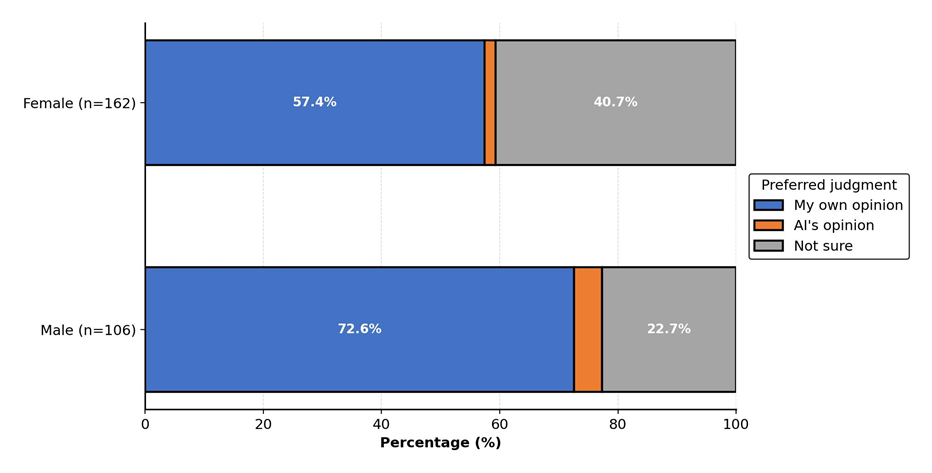
Figure 3. Sex-wise distribution of the preferred source of judgment when one's own clinical opinion conflicts with that of an artificial intelligence system (n = 268; 'Prefer not to say' excluded). Male students (72.6%) more often preferred to follow their own opinion than female students (57.4%), while female students were more likely to be uncertain (40.7% versus 22.7%); Fisher's exact p = 0.004.
DISCUSSION:
This study examines the knowledge, attitudes, practices and perceptions of medical students regarding artificial intelligence (AI) in healthcare settings. The proportion of participants familiar with AI was 84.9%, and the proportion reporting that they understood how to incorporate AI into clinical practice was 63.1%. These results are consistent with those obtained by Bisdas et al., authors who reported on a multinational study of medical and dental students and found the majority had knowledge of AI and the impending changes it would bring to healthcare (11). Likewise, Gillissen et al. reported that medical students in Germany had a positive perception of AI, but many felt they had limited knowledge of the applications of AI in the field of medicine (12). The relatively high awareness reported in the present study could be attributed to increasing levels of AI on digital channels, social media, and healthcare technologies.
One positive finding is that 91.9% of respondents identified useful applications of AI in medicine. This percent is greater than the positive response range of 60%-80% found in many international studies (11,12). In line with the literature, the participants of this study viewed AI, at least in part, as a means of improving the efficiency of the healthcare system, and as a way of minimizing errors and addressing the challenges associated with large volumes of clinical data (11,13). These views address the growing understanding that AI, in addition to improving the healthcare system, is a means of optimizing healthcare delivery without the intention of substituting healthcare professionals.
Though the response to AI in medicine is generally positive, only 14.8% of respondents believed that AI would one day have the capability to outperform experienced physicians in making clinical diagnoses. Additionally, 63% of respondents would choose to make their own clinical decision in the face of a contradiction between their clinical decision and an AI recommendation. These outcomes are in line with those of Mehta et al., who reported that medical students, while generally optimistic about the potential of AI, were skeptical about the total integration of AI in clinical practice (14). This attitude is likely to be the outcome of concerns about responsibility and the need for clinical reasoning that is contextually explainable and is beyond the current capability of AI. The outcomes of this study demonstrate that responders viewed AI as a tool to be used along with physician expertise.
Most participants thought AI would assist healthcare workers in making diagnoses and decisions (79.3%). Participants preferred AI assistance in making diagnoses versus treatment decisions. This preference reflects where most successful AI applications have been in healthcare—image interpretation, disease identification, and AI-powered clinical decision making (4). Bisdas et al. described similar trends and found that students were more positive about AI in diagnostic specialties—specifically radiology and pathology (11). Media and literature focus on diagnostic AI applications more than treatment AI applications. This emphasis leads to greater confidence in diagnostic AI than treatment AI.
The sentiment toward AI has been good, but the sentiment to use and/or endorse AI has been more conservative. Of respondents, 68.6% were willing to use AI in diagnosis and treatment; however, just 51.3% indicated that they would endorse AI to fellow health practitioners. This may reflect concerns surrounding AI, including the safety of the AI, the reliance on AI in the medico-legal space, and the day-to-day practical use of AI. The concerns and reported sentiments were similar in a variety of national contexts where participants reported the benefits of AI in healthcare, but hesitated to endorse AI in clinical practice (11,15).
One clear takeaway from this study is how people view AI so differently depending on the job. For technical data in healthcare—like patient notes, reading X-rays, or giving preventative health tips—medical students had a lot of faith in AI. But their confidence dropped when it came to things like offering emotional support or performing surgery. It matches what other research found: students trust AI for number-crunching and paperwork, but they're not buying that it can understand emotions or talk to people like a real doctor can. Mehta and his team noticed the same pattern—students were fine with AI doing analysis, but not with it giving personal advice or showing empathy. At the end of the day, even with all the tech advances, it’s obvious that people still value the human side of medicine.
The way medical students think about Artificial Intelligence does not really change with age, sex or what year they are in school which means that a lot of students have a positive view of Artificial Intelligence.. There are some big differences between male and female students when it comes to what they do when their own medical opinion does not match what Artificial Intelligence says. Male students tend to trust their opinions more while female students are more likely to say they are not sure. This is similar to what Gillissen and others found, which is that male students usually feel more confident and have an attitude towards Artificial Intelligence than female students. These differences might be because of how comfortable people're with technology how confident they are or how familiar they are with new digital tools but we need to do more research to understand this better.
This study also shows that we need to think about how we're teaching medical students about Artificial Intelligence. Even though a lot of students know about Artificial Intelligence and think it is an idea many of them do not feel confident about using it in real life or making decisions with it. This is a problem that has been reported in other places with students saying they want to learn more about Artificial Intelligence in school. As Artificial Intelligence becomes a part of healthcare medical schools need to start teaching students about how to use it including the ethics of Artificial Intelligence how to manage data, what the limits of Artificial Intelligence are and how to understand what Artificial Intelligence is telling us. This will help students feel more confident about using Artificial Intelligence in a way.
Overall medical students think Artificial Intelligence is a tool that can help make healthcare better and they know that doctors are still very important, for making decisions and taking care of patients. This supports the idea that Artificial Intelligence and humans can work together with Artificial Intelligence helping to make things better but not replacing doctors. Medical students see Artificial Intelligence as a way to enhance what they do not replace them.
CONCLUSION:
The study we did shows that medical students know a lot about intelligence in healthcare and they think it is a good thing. Most of the students we talked to think that artificial intelligence can help doctors make diagnoses work more efficiently and make good decisions.. At the same time these students still believe that doctors are important and artificial intelligence is not a substitute for them especially when it comes to caring for patients and understanding their feelings. This tells us that we need to teach students, about artificial intelligence so they can use it well when they become doctors. We want to make sure that doctors know how to use intelligence in a way that is fair and responsible. The medical students need to learn about intelligence so they can use it to help their patients.
REFERENCES:
1. World Health Organization. Ethics and governance of artificial intelligence for health. Geneva: WHO; 2021.
2. Topol EJ. High-performance medicine: the convergence of human and artificial intelligence. Nat Med. 2020;26(1):44-56.
3. Jiang F, Jiang Y, Zhi H, Dong Y, Li H, Ma S, et al. Artificial intelligence in healthcare: past, present and future. Stroke Vasc Neurol. 2020;5(4):230-243.
4. Rajpurkar P, Chen E, Banerjee O, Topol EJ. AI in health and medicine. Nat Med. 2022;28(1):31-38.
5. Meskó B, Görög M. A short guide for medical professionals in the era of artificial intelligence. NPJ Digit Med. 2020;3:126.
6. Pinto dos Santos D, Giese D, Brodehl S, Chon SH, Staab W, Kleinert R, et al. Medical students' attitude towards artificial intelligence in radiology and medicine: a multicenter survey. Eur Radiol. 2021;31(6):3945-3954.
7. Sit C, Srinivasan R, Amlani A, Muthuswamy K, Azam A, Monzon L, et al. Attitudes and perceptions of UK medical students towards artificial intelligence and radiology: a multicentre survey. Insights Imaging. 2020;11(1):14.
8. Paranjape K, Schinkel M, Panday RN, Car J, Nanayakkara P. Introducing artificial intelligence training in medical education. JMIR Med Educ. 2021;7(3):e31057.
9. Chan KS, Zary N. Applications and challenges of implementing artificial intelligence in medical education: integrative review. JMIR Med Educ. 2022;8(1):e13930.
10. IndiaAI. Artificial Intelligence for Healthcare in India: Opportunities and Challenges. Ministry of Electronics and Information Technology, Government of India; 2023.
11. Bisdas S, Topriceanu CC, Zakrzewska Z, et al. Artificial Intelligence in Medicine: A Multinational Multi-Center Survey on the Medical and Dental Students' Perception. Front Public Health. 2021;9:795284. (Frontiers)
12. Gillissen A, Kochanek T, Zupanic M, Ehlers J. Medical Students' Perceptions towards Digitization and Artificial Intelligence: A Mixed-Methods Study. Healthcare (Basel). 2022;10(4):723. (MDPI)
13. Li X, Jiang MY, Jong MSY, Zhang X, Chai CS. Understanding Medical Students' Perceptions of and Behavioral Intentions toward Learning Artificial Intelligence: A Survey Study. Int J Environ Res Public Health. 2022;19(14):8733. (MDPI)
14. Mehta N, Harish V, Bilimoria K, et al. Knowledge and Attitudes on Artificial Intelligence in Healthcare: A Provincial Survey Study of Medical Students. MedEdPublish. 2021. (MedRxiv)
15. Sassis L, Kefala-Karli P, Sassi M, et al. Exploring Medical Students' and Faculty's Perception on Artificial Intelligence and Robotics: A Questionnaire Survey. J Artif Intell Med Sci. 2021;2:76-84. (Springer Link)
16. Bisdas S, et al. Multinational survey on medical and dental students' perceptions of AI in medicine. Front Public Health. 2021;9:795284. (PMC)
17. International multicenter study of medical students' perceptions towards AI in education and practice. 2023. (MedRxiv)